
On this page
Start here
Quick answer
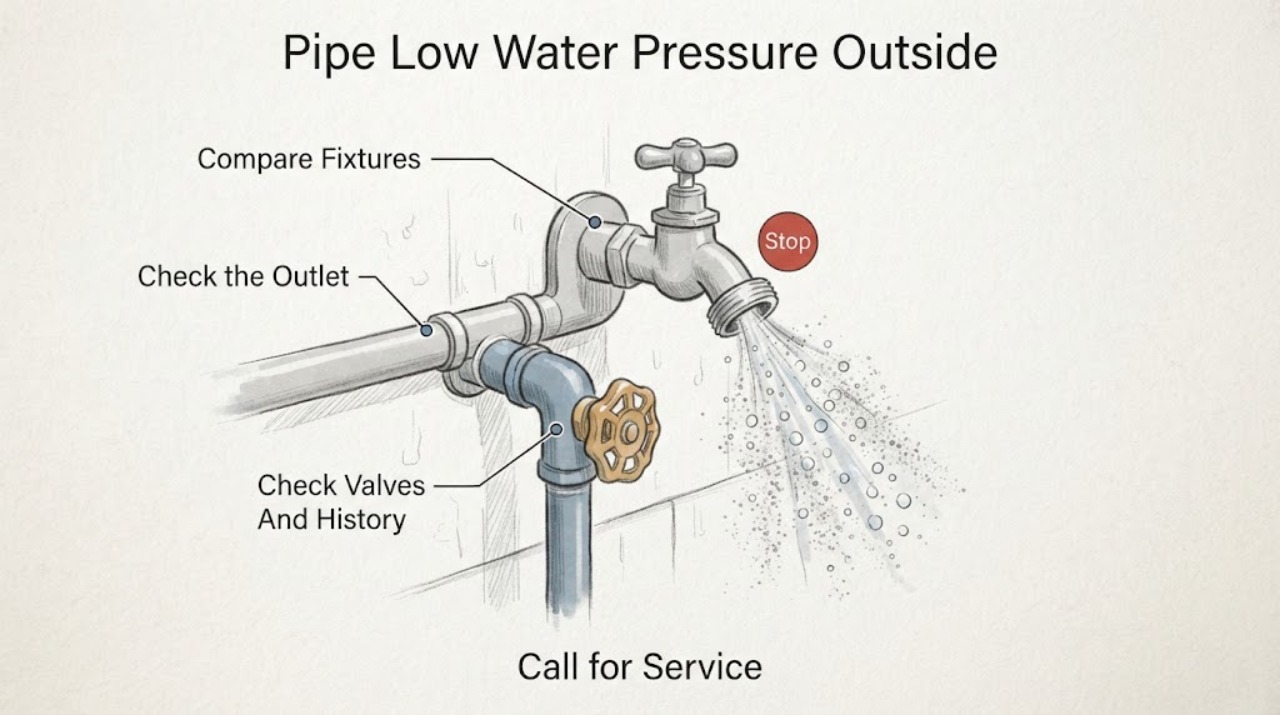
An outside spigot that sputters and has weak flow can be restricted at the outlet, hose, valve, or branch pipe, or it can reflect air entering a leaking or interrupted supply line. First remove any hose or nozzle only if the connection is cool, dry, and safe to handle, then compare the spigot with indoor and other outdoor fixtures. Observe whether the sputtering happens only at this spigot, when the spigot is fully opened, after a shutoff or repair, during irrigation use, or across the whole property. Check for visible leaks, unusual meter movement, and recent freezing or landscape work without digging. If water is near electrical equipment, the ground is collapsing, a service pipe is actively leaking, or pressure is absent throughout the property, stop and call a plumber or water utility. Do not force a valve, open a pressurized connection, or excavate an unknown line.
Before you begin
Safety first
- A plumber or water utility can separate an outlet restriction, branch pipe, service leak, pressure-control issue, and public supply event without the user opening pressurized piping or digging blindly.
Work through in order
Diagnostic checks
Use only checks that match the exact appliance or system and its official guide.
-
Check 1
Open the affected outside spigot fully once from a stable dry position and observe the stream and sound. Then compare another outside spigot and one indoor cold faucet without running several high-use fixtures at once. Do not run the test if there is visible damage or water near electricity.
Expected result: Only the target spigot may sputter, all outside spigots may be weak, or indoor and outdoor fixtures may all show weak or fluctuating flow.
Next step: Use the matching branch. If the flow is absent, rapidly falling, contaminated, or paired with a leak or electrical hazard, stop and call plumbing or utility support.
Why this matters
Why: One-spigot weakness favors a local outlet, valve, hose, or branch restriction. Several outside points suggest a shared outdoor branch. Whole-property weakness suggests service pressure, a leak, a partly closed valve, or a utility event.
-
Check 2
If the spigot is cool, dry, and undamaged, turn it off, release pressure at the outlet, and remove only a loose hose, spray nozzle, or quick-connect accessory that can be handled without tools. Look at the exposed outlet for a screen, visible scale, dirt, crushed washer, or a damaged thread; do not pry into the valve or disassemble the spigot.
Expected result: The stream may become steady with the accessory removed, or it may still sputter and remain weak directly from the spigot.
Next step: Clean or replace only the removable accessory according to its instructions. If the bare spigot still sputters or leaks around the stem or wall connection, stop and arrange plumber service.
Why this matters
Why: Improvement after removing an accessory points to a blocked nozzle, hose, washer, or connector rather than the buried pipe. Continued weakness at the bare outlet points toward the spigot valve, local branch, supply restriction, or pressure problem.
-
Check 3
Look at the visible spigot, branch shutoff, irrigation control, and nearby exposed pipe without forcing any handle or fitting. Note whether a valve is partly closed, the pipe is bulged or cracked, the area recently froze, or plumbing, irrigation, digging, or utility work occurred.
Expected result: A valve may be partly closed, an exposed section may show frost or impact damage, or the visible installation may look normal.
Next step: Operate only a clearly labeled, freely moving valve from a dry safe position and only as far as normal operation permits. Do not force it or loosen the pipe; arrange service for damage, a seized valve, or an unclear branch.
Why this matters
Why: A partly closed valve or freeze-damaged section can restrict flow and introduce air or leakage. A normal visible section does not clear buried pipe, internal corrosion, or a utility-side problem.
-
Check 4
Stop all water use inside and outside, including irrigation, appliances, and toilets, then observe the water meter or leak indicator only if the meter can be reached without standing in water or opening an unsafe enclosure. Record whether it moves and whether the outdoor patch remains wet.
Expected result: The indicator may be still, moving slowly, moving continuously, or inaccessible; the wet area may shrink, remain, or expand.
Next step: If flow is active and a known property shutoff is safely reachable from dry ground, isolate it once and call a plumber or water utility. Do not excavate or keep opening the spigot to test.
Why this matters
Why: A moving meter while use is stopped supports an active property-system leak. A still meter with persistent wet ground favors a drain, irrigation discharge, rain, groundwater, or a source outside the metered line. The meter does not prove the exact location.
-
Check 5
If the spigot is sound, dry, and easy to reach, use a properly rated pressure gauge only as directed by its instructions and only when no water hazard is present. Record the reading with all other fixtures off, then compare it with local utility guidance or a plumber's assessment; do not remove a gauge from a pressurized or damaged fitting.
Expected result: The reading may be low, within the local expected range, high, unstable, or impossible to obtain safely.
Next step: Remove the gauge only under safe, dry conditions and close the spigot normally. If the reading is abnormal, the gauge connection leaks, or the spigot continues to sputter, call a plumber or water utility.
Why this matters
Why: A low reading supports a service-pressure, supply, leak, or restriction investigation. A normal reading with weak flow at one spigot favors a local restriction. A high or unstable reading needs professional interpretation rather than a valve adjustment by guesswork.
-
Check 6
Note whether the sputter starts when another fixture, irrigation zone, sprinkler, or neighbor's shared service is active. Compare the symptom at a quiet time without repeatedly opening and closing the spigot.
Expected result: The stream may weaken only during concurrent use, fluctuate by time of day, or remain weak regardless of other use.
Next step: Reduce simultaneous use while arranging assessment. If multiple properties or fixtures are affected, contact the water utility or property manager rather than changing a private valve.
Why this matters
Why: Concurrent-use or time-of-day changes can reflect limited supply, demand peaks, shared plumbing, or a utility pressure event. A constant one-point fault remains more consistent with a local outlet or branch issue.
-
Check 7
Prepare a handoff with the spigot location, whether a hose or nozzle was attached, flow comparisons, timing, meter behavior, pressure reading if safely obtained, weather, freeze history, visible leaks, and recent work. If buried work is proposed, request utility locating before excavation.
Expected result: A plumber or utility may identify a local outlet restriction, a branch leak, a buried service issue, a shared supply event, or no pipe fault at all.
Next step: Keep the spigot or branch isolated if it leaks or the ground is unstable. Do not dig, clamp, glue, pressure-test, or replace buried pipe without a professional plan.
Why this matters
Why: The pattern distinguishes a local flow restriction from a whole-property or utility problem and prevents an unsupported repair at the wrong boundary.
Use your observations
Decision map
Find the observation that best matches what you see, then follow the next safe action.
-
PATH 01Next step
What you see
Flow becomes steady after a loose hose, nozzle, or connector is removed.
Do this next
Keep the accessory off and inspect or replace only that removable item according to its instructions.
-
PATH 02Next step
What you see
Only one bare outside spigot remains weak or sputtering while other fixtures have normal flow.
Do this next
Treat it as a local spigot, valve, branch, or exposed connection issue; do not force the handle or open the wall.
-
PATH 03Next step
What you see
Outside and indoor fixtures are weak, or flow changes at several fixtures.
Do this next
Compare hot and cold flow, stop unnecessary use, and check for visible leaks or a utility service notice from a safe position.
-
PATH 04Next step
What you see
The meter moves while all water use is off, or the outdoor ground stays wet without a fixture or rain explanation.
Do this next
Treat it as a possible active supply leak and use a known property shutoff only if it is safely reachable from dry ground.
-
PATH 05Next step
What you see
The sputter appears during irrigation, concurrent fixture use, or certain times, and several points are affected.
Do this next
Limit simultaneous demand and record when the pressure changes.
-
PATH 06Next step
What you see
There is frost damage, an unexplained wet strip, soft ground, sinkhole risk, recent digging, or no safe exposed source.
Do this next
Keep the ground intact and the area clear. Do not excavate or operate powered equipment.
-
PATH 07Next step
What you see
Water is rapid, contaminated, near electrical equipment, undermining a structure, or the source cannot be isolated safely.
Do this next
Keep people and pets away and isolate water or electricity only from a safe dry location when possible.
Helpful context
Understand the symptom
Sputtering is a clue, not a diagnosis
A spigot can sputter because air is leaving a short hose or branch after a supply interruption, because a nozzle or screen is restricted, or because flow is being starved by a valve, pipe, leak, or utility event. The first useful split is local versus whole-property: compare fixtures before buying a valve or cutting into a pipe.
Compare flow, pressure, and timing
A weak stream from one outlet is not the same as low service pressure everywhere. Note whether the stream becomes steadier after a brief burst, whether the spigot sputters only when fully opened, and whether the symptom changes when another fixture or irrigation zone runs. A recent shutoff, freeze, plumbing work, or landscaping project changes the likely path.
Keep the outdoor check safe
Stay on stable, dry ground and inspect only exposed parts. Do not use a ladder in wet weather, enter a flooded meter box, loosen a pressurized fitting, dig for a buried pipe, or touch electrical equipment near water. If the ground is soft, sinking, or contaminated, keep people away and arrange professional help.
What the first wet point can tell you
A wet spigot connection or irrigation box points toward a local branch. A wet strip between the meter and house, a continuously moving meter, or a sudden wet landscape patch raises concern for an underground supply leak. Rain, irrigation discharge, and groundwater can create a wet area without a supply-line break, so timing and meter behavior matter.
Safety boundary
Stop conditions
- Stop immediately for rapid flow, a spreading wet area, soft or sinking ground, a sinkhole, frost-split pipe, or water entering a building. Keep people away and call urgent plumbing or utility support.
- Stop immediately if water is near outlets, pumps, lighting, service equipment, or damaged electrical wiring. Do not enter standing water or touch wet electrical equipment.
- Stop for sewage, foul odor, cloudy or contaminated water, or an overflow. Keep people and pets away and arrange prompt plumbing or utility assessment.
- Do not force a spigot or shutoff, loosen a pressurized fitting, remove a buried cover, or open a meter box filled with water.
- Do not dig, probe, stake, clamp, glue, or pressure-test an unknown buried pipe before utility locating and a professional plan.
- Stop if the pressure gauge connection leaks, the reading is unstable, the pipe is damaged, or the source remains unclear after safe external checks.
Only after diagnosis
Potential parts
- hose bibb outlet screen or washer
Consider only if a removable screen, washer, or connector is visibly restricted or damaged and the spigot itself is confirmed sound.
Confirm the fitting type, size, material, freeze protection, and local requirements before selecting a replacement. - outdoor spigot valve assembly
Consider only after a plumber confirms that the local spigot valve or stem is restricting flow or leaking.
Connection, wall depth, anti-siphon or freeze-resistant design, and pipe material are installation-specific. - water pressure regulating valve
Consider only when professional testing confirms a pressure-control problem affecting the property rather than a local restriction or supply leak.
Sizing, pressure range, code, and installation location require qualified plumbing assessment.
When checks do not resolve it
Need a professional?
Arrange professional assessment when the bare spigot remains weak, flow is low across the property, a meter indicates an active leak, a buried line is suspected, or safe checks cannot identify the cause.
Safety scope: A plumber or water utility can separate an outlet restriction, branch pipe, service leak, pressure-control issue, and public supply event without the user opening pressurized piping or digging blindly.
Have this ready
- Provide the exact spigot location, attached hose or nozzle status, indoor and outdoor flow comparisons, timing, meter behavior, safe pressure reading if available, weather or freeze history, visible leaks, recent digging or plumbing work, and whether neighbors are affected.
Common questions
FAQ
Why does my outside spigot sputter when I open it fully?
Air, a restricted nozzle or hose, a partly closed valve, a local pipe restriction, a supply leak, or a utility pressure event can all produce sputtering. Compare other fixtures and remove only a safe, loose accessory before assuming the buried pipe has failed.
How do I know whether the problem is only the spigot?
Compare the bare spigot with another outside point and an indoor cold faucet. Normal flow elsewhere favors a local spigot, hose, valve, or branch issue; weak flow at several points needs a property or utility assessment.
Can a water leak cause low pressure at an outside tap?
Yes. A supply leak can reduce pressure or flow, and a moving meter while all water use is stopped supports an active leak somewhere in the property system. The meter does not locate the leak, so do not dig without professional tracing.
Should I use a pressure gauge on the outside spigot?
A properly rated gauge can provide a clue when the spigot and connection are cool, dry, and sound and the instructions are followed. Do not attach or remove one from a damaged or leaking fitting, and have abnormal readings interpreted by a plumber or utility.
When should I stop using the outside spigot?
Stop for rapid leakage, contaminated water, a cracked pipe, soft or sinking ground, water near electricity, or a source you cannot isolate safely. Keep people away and call the appropriate plumber, water utility, electrical, or emergency support.
Read the exact guide
Official sources
- Home MaintenanceU.S. Environmental Protection Agency WaterSense · Home leak checks, water-meter clues, service pressure, and hose-bibb pressure observation
- How to check for leaksCity of Portland Water Bureau · Official meter, shutoff, outdoor leak, and underground leak observation guidance
- Troubleshooting water pressure and flowCity of Portland Water Bureau · Official water-pressure and flow comparison guidance for indoor and outdoor fixtures
- Leak Detection and Flow Monitoring DevicesU.S. Environmental Protection Agency WaterSense · Official leak causes including old piping, corrosion, cold temperatures, pressure, equipment, and installation
Community feedback
Share a repair observation
Share a plain-text repair observation. Accepted observations are published automatically; this page may take a moment to update.