
On this page
Start here
Quick answer
No water from a pipe or fixture does not identify one failed part. First compare several fixtures and separate a whole-home outage from one branch, one faucet, or hot water only. Check for a local fixture shutoff and the visible main shutoff near where the water pipe enters the home; do not force a stiff or leaking valve. Look for a utility outage, meter or service-line issue, unexplained water sounds, wet walls or ceilings, and cold-weather frost or pipe damage. If a hose bibb is safe and dry, EPA describes checking service pressure with all water use stopped; a gauge result can distinguish a supply or regulator concern from a local restriction but cannot prove which pipe failed. For a burst, active leak, frozen or bulging pipe, sudden whole-home loss, water near electrical equipment, or any need to open a wall, meter, PRV, or pressurized pipe, stop using the affected line and call a qualified plumber or water utility. Do not cut pipe, thaw with an open flame, adjust a pressure regulator by guesswork, or keep operating a leaking system.
Before you begin
Safety first
- This article covers symptom mapping, ordinary-access valve and leak observation, and a safely connected static pressure check. Service-line, PRV, well, water-heater, frozen-pipe, concealed-pipe, and pressurized plumbing work requires qualified service.
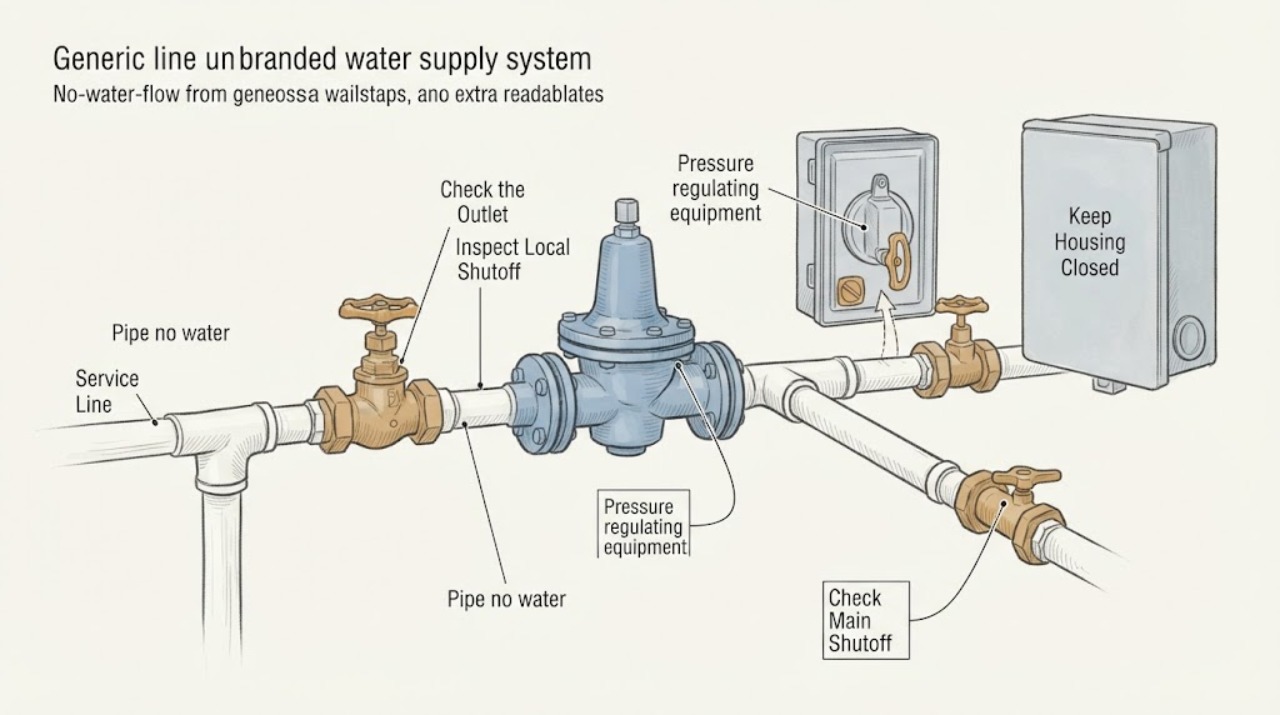
Work through in order
Diagnostic checks
Use only checks that match the exact appliance or system and its official guide.
-
Check 1
Open several fixtures one at a time, including a nearby cold outlet and a hot outlet if applicable, and compare them with the affected point without removing wall or pipe coverings.
Expected result: Record no water everywhere, no water on one floor or branch, one faucet only, hot water only, cold water only, or water that sputters briefly and then stops.
Next step: Use the matching whole-home, local, hot-water, leak, or frozen-pipe branch; do not order a replacement pipe before the scope is established.
Stop if: Stop for sudden loss accompanied by a leak, flooding, wet wall or ceiling, frost or bulging, water near electricity, or an unsafe access area.
Why this matters
Why: A whole-home pattern points upstream to the main shutoff, supply, service line, well or pressure equipment, utility interruption, or major leak. A single-outlet pattern supports a local valve, screen, faucet, or branch restriction; hot-only loss supports the water-heater branch.
-
Check 2
When only one outlet is dry, inspect that fixture's visible stop valve, connection, and accessible aerator or inlet screen; remove a screen only if the fixture instructions permit it and it turns without force.
Expected result: Record a closed or partly closed valve, scale or debris at the screen, a kinked visible supply tube, a leak, a normal local assembly, or a component that cannot be accessed safely.
Next step: Restore only a plainly closed valve or clean an accessible screen according to its instructions, then make one retest. Call a plumber if the valve is stiff, leaks, or the branch needs wall or floor access.
Stop if: Do not force corroded fittings, remove concealed valves, cut tubing, or continue with water escaping at the wall or connection.
Why this matters
Why: A local restriction can stop one outlet while the house supply remains normal. A normal local assembly moves the check toward the branch pipe or upstream supply; a leak can both reduce flow and cause damage.
-
Check 3
Locate the visible main shutoff near the meter or the point where the water pipe enters the home, and observe whether it is fully open and dry without forcing the handle.
Expected result: Record a normal open position, a partly closed position, a handle that turns without stopping, a seized handle, or dripping from the valve stem or body.
Next step: If the valve is plainly open and dry, continue with utility, leak, and pressure checks. If it is damaged, stuck, or leaking, leave it stable and call a licensed plumber or water utility.
Stop if: Do not force a gate or ball valve, remove the meter, dismantle the valve, or keep operating a stem that begins to leak heavily.
Why this matters
Why: A partly closed main valve can stop or severely restrict water to the home. A spinning, seized, or dripping valve may be defective and can turn an inspection into a leak; it does not justify force or disassembly.
-
Check 4
Check the water utility's outage information or ask whether nearby properties are also without water, then observe the meter and visible service line when every intended water use is stopped.
Expected result: Record a confirmed area outage, a still meter and dry service line, meter movement with no fixture open, running-water sounds, a wet or soft ground area, or no safe way to inspect the service line.
Next step: Contact the utility for an outage or meter-side concern. For an in-home leak, keep water use off and arrange a plumber; do not excavate or open walls to locate the pipe yourself.
Stop if: Stop for flooding, a burst line, electrical contact, a service-line leak, unstable ground, or any need to access a buried or pressurized connection.
Why this matters
Why: A neighborhood outage or utility-side issue is not repaired by opening household piping. Meter movement, running sounds, or wet ground supports an in-home or service-line leak; a still meter with no area outage keeps a shutoff, branch restriction, or concealed failure in play.
-
Check 5
If a hose bibb is safe, dry, and accessible, turn off all water-using fixtures and systems, attach a suitable pressure gauge as EPA describes, open the bibb fully, and record the static reading without changing a pressure regulator.
Expected result: Record pressure in or near EPA WaterSense's 45–60 psi range, much lower than 45 psi, much higher than 60 psi, a reading that changes unexpectedly, or a connection that leaks or will not seal.
Next step: Record the reading and outlet pattern for a plumber or utility. Arrange professional assessment when the reading is outside the range, unstable, or inconsistent with the fixtures.
Stop if: Do not use a leaking or damaged bibb, adjust a PRV by guesswork, connect to an unknown fitting, or continue if the gauge sprays or the pressure behaves erratically.
Why this matters
Why: A low static reading supports a supply, leak, shutoff, well, or regulator issue; a high reading supports professional regulator and code review; a normal static reading with no water at one outlet points back toward a local or branch restriction. A gauge cannot identify a concealed pipe fault by itself.
-
Check 6
If the outage began during freezing weather, inspect only safely visible pipes in a basement, crawlspace, garage, cabinet, or exterior-wall area for frost, bulging, split seams, wet insulation, or a developing leak; do not remove wall material or apply direct heat.
Expected result: Record a dry intact pipe, frost or a solid-feeling section, bulging or cracked pipe, wet insulation or dripping water, or no safe visibility.
Next step: For suspected freezing or damage, shut off the water before thawing or repair and arrange qualified plumbing service. If there is no damage and only an exposed line is cold, follow the property and pipe manufacturer's safe winter guidance rather than improvising heat.
Stop if: Never use an open flame, torch, kerosene heater, or improvised electrical heater to thaw a pipe; stop for a burst, active leak, wet wall, or concealed access requirement.
Why this matters
Why: Frost can indicate a frozen line and a bulge or split can release water as it thaws. A dry visible pipe does not clear a concealed freeze or service-line problem; direct heat can damage the pipe or ignite nearby material.
Use your observations
Decision map
Find the observation that best matches what you see, then follow the next safe action.
-
PATH 01Safety boundary
What you see
Every fixture is dry or only a brief sputter occurs throughout the home.
Do this next
Check the utility status, observe the main shutoff and meter safely, and arrange utility or plumbing service based on the result.
Why this path and its safety boundary
Why it matters: The problem is upstream of a single fixture and may involve a closed or failed main shutoff, utility outage, service line, well or pressure equipment, or a major leak.
Safety stop: Do not open the service line, remove the meter, or continue if flooding, a burst, or unstable ground is present.
-
PATH 02Safety boundary
What you see
Nearby fixtures work normally but one faucet, shower, or branch has no water.
Do this next
Inspect only the accessible local valve, screen, connection, and visible tubing; call a plumber if the restriction remains or hidden access is required.
Why this path and its safety boundary
Why it matters: A local shutoff, inlet screen, faucet, branch valve, or localized pipe restriction is more likely than a whole-home supply failure.
Safety stop: Do not force a corroded valve or cut or open the branch pipe.
-
PATH 03Safety boundary
What you see
Cold water works but hot water is absent at multiple fixtures.
Do this next
Check only the visible hot-water shutoff and water-heater area for a clear valve position or leak; arrange qualified water-heater or plumbing service for a persistent outage.
Why this path and its safety boundary
Why it matters: The fault is likely in the water-heater supply, hot-water branch, shutoff, or heater equipment rather than the general cold-water service pipe.
Safety stop: Do not open the water heater, adjust gas or electrical controls, or continue when there is a leak, scalding risk, gas odor, or electrical hazard.
-
PATH 04Safety boundary
What you see
The main valve is partly closed, spins, will not move, or drips when touched.
Do this next
Leave the valve in the safest stable position and call a licensed plumber or water utility to confirm ownership and repair the shutoff.
Why this path and its safety boundary
Why it matters: The valve can be stopping flow or may be failing, but forcing it can create a larger leak.
Safety stop: Do not force, dismantle, remove, or repeatedly operate a stiff or leaking main valve.
-
PATH 05Safety boundary
What you see
Water sounds continue, the meter moves with all intended use stopped, or a visible leak or wet ground is found.
Do this next
Stop water use, use the main shutoff only if it operates safely, protect the area, and contact a plumber or utility for the appropriate side of the meter.
Why this path and its safety boundary
Why it matters: An active or hidden leak can consume available flow and damage the building or service line.
Safety stop: Do not open walls, excavate, tighten buried connections, or leave the leak running while testing pressure.
-
PATH 06Safety boundary
What you see
A safe gauge connection shows service pressure much lower than EPA WaterSense's described 45–60 psi range.
Do this next
Confirm the gauge and fixture pattern, then contact the utility or plumber for supply, leak, shutoff, and regulator diagnosis.
Why this path and its safety boundary
Why it matters: A supply interruption, leak, regulator, well or pressure-tank issue, or restricted service valve may be limiting incoming water.
Safety stop: Do not adjust the PRV, remove the meter, or replace a pipe based on the gauge reading alone.
-
PATH 07Safety boundary
What you see
The no-water symptom began in freezing weather or a visible pipe is frosted, bulging, cracked, wet, or leaking.
Do this next
Shut off water before thawing or repair, keep the affected area clear, and arrange qualified plumbing service or local emergency guidance.
Why this path and its safety boundary
Why it matters: The line may be frozen or damaged and can release a larger leak when thawed; direct heating is unsafe.
Safety stop: Never use an open flame, torch, kerosene heater, or improvised electrical heater; do not cut into a wall or pipe.
-
PATH 08Safety boundary
What you see
Static pressure is present and reasonable, but one branch remains dry or water disappears only when that branch is opened.
Do this next
Arrange a plumber's branch and flow diagnosis; provide the scope, pressure reading, valve observations, and any recent work or freeze exposure.
Why this path and its safety boundary
Why it matters: A local valve, screen, branch blockage, collapsed or damaged pipe, or flow-dependent restriction remains possible.
Safety stop: Do not cut walls, drill pipe, or increase regulator pressure to force a blocked branch open.
Helpful context
Understand the symptom
Start by mapping the loss of water
If every cold and hot outlet is dry, the cause is upstream of a single fixture: a closed or failed main shutoff, utility interruption, service-line problem, well or pressure equipment, or a major leak. If one faucet is dry while nearby outlets work, check only that fixture's accessible stop valve and screen. If only hot water is missing, keep the check on the water-heater branch rather than replacing a general supply pipe. This scope decision prevents a local restriction from being mistaken for a whole-home outage.
Use the main valve and meter as observations, not parts to force
The main shutoff is commonly near the meter or where the supply pipe enters the home, but layouts vary. Observe whether its handle is in the expected open position and whether it turns easily; a valve that spins, sticks, or drips needs service. When no fixture should be using water, meter movement and running-water sounds support a leak investigation. A water meter can also help distinguish an in-home leak from a supply interruption, but it does not reveal a concealed pipe's exact location.
Treat pressure readings, frozen pipes, and hidden piping carefully
A static pressure gauge at a safe hose bibb can show whether incoming service pressure is present, but it cannot prove that a branch pipe is open while water is flowing. EPA WaterSense describes 45–60 psi as a useful incoming range and recommends professional pressure-regulator work for unusually high pressure. Cold weather, frost, bulging, wet insulation, or a split pipe requires a shutoff and qualified response; American Water specifically warns against open-flame thawing.
Safety boundary
Stop conditions
- Stop for a burst, active leak, bulging or split pipe, wet wall or ceiling, sudden whole-home loss, unexplained meter movement, water near electrical equipment, or unstable ground; use the main shutoff only if it operates safely and arrange qualified service.
- Do not force or dismantle a seized or dripping main valve, remove a meter, excavate a service line, cut or solder a pressurized pipe, or open a wall or ceiling to locate a restriction.
- Do not adjust a pressure-regulating valve by guesswork, use a leaking or unverified gauge, or replace a pipe based only on one static pressure reading.
- Never thaw a pipe with an open flame, torch, kerosene heater, or improvised electrical heater; shut off water before thawing suspected frozen piping and arrange service for damage or concealed access.
- If no water affects the whole home, persists after accessible checks, or involves a utility, well, water heater, PRV, buried line, pressurized connection, or hidden branch, stop troubleshooting and call the water utility or a qualified plumber.
Only after diagnosis
Potential parts
- water pressure test gauge
Consider this only when a safe hose bibb is available and a static pressure observation is needed to distinguish a whole-home supply issue from a local no-water branch.
Confirm the gauge and hose-bibb connection are suitable for the installation and stop for a leaking, damaged, or unstable connection. - main water shutoff valve
Consider this only when a qualified plumber confirms that the main valve is damaged, seized, leaking, or unable to open fully and is the cause of the no-water condition.
Confirm pipe material, connection, meter arrangement, service ownership, and local plumbing requirements before replacement. - pressure-regulating valve
Consider this only after professional diagnosis confirms a failed, incorrectly set, or unsuitable regulator is limiting the incoming supply.
Confirm system pressure, flow demand, connection, thermal-expansion requirements, and applicable code; do not select or adjust a regulator from a no-water symptom alone. - local faucet inlet screen or stop valve
Consider this only when no water is isolated to one outlet and inspection confirms a damaged or restricted accessible screen or valve.
Confirm the exact fixture, thread or connection, valve type, and manufacturer fit information; a local part will not repair a whole-home supply failure.
When checks do not resolve it
Need a professional?
Contact the water utility or arrange qualified plumbing service when the whole home is dry, nearby properties are also without water, the main shutoff is stuck or leaking, the meter shows unexplained flow, a service line or buried pipe may leak, a static pressure reading is unexpectedly low or unstable, one branch remains dry after local checks, hot water is absent throughout the home, or diagnosis requires a PRV, well or pressure equipment, water heater, wall, ceiling, meter, buried line, or pressurized pipe. A burst, active leak, frozen or bulging pipe, sudden loss of water, or water near electrical equipment requires immediate attention.
Safety scope: This article covers symptom mapping, ordinary-access valve and leak observation, and a safely connected static pressure check. Service-line, PRV, well, water-heater, frozen-pipe, concealed-pipe, and pressurized plumbing work requires qualified service.
Common questions
FAQ
What should I check first when no water comes from a pipe?
Compare several fixtures and hot versus cold water, then check for a utility outage, the visible main shutoff, leaks, and meter movement with intended water use stopped. One dry outlet suggests a local valve or screen; an entire dry home points upstream.
Where is the main water shutoff usually located?
It is often near the water meter or where the main water pipe enters the home, such as a basement or ground-level entry, but layouts vary. If the valve is stiff, spinning, or leaking, do not force it; call a plumber or utility.
Can a pressure gauge tell me why there is no water?
It can show whether static service pressure is present at a safe hose bibb, but it cannot identify a concealed branch blockage or failed pipe by itself. EPA describes turning off water use before measuring and treats roughly 45–60 psi as a useful incoming range.
What if only hot water is missing?
If cold water works at several fixtures, keep the diagnosis on the water-heater supply, hot-water shutoff, or hot branch rather than the general cold-water pipe. Do not open the heater or adjust gas or electrical controls; arrange qualified service if the problem persists.
What should I do if a pipe may be frozen?
Shut off the water before thawing, especially if the pipe is bulging, cracked, or leaking, and arrange qualified service for concealed or damaged piping. Never use an open flame, torch, kerosene heater, or improvised electrical heater to thaw it.
Read the exact guide
Official sources
- Cold Weather ProtectionAmerican Water · American Water cold-weather customer guidance; local utility boundaries and the pipe manufacturer's installation conditions may differ.
- Leak Detection TipsAmerican Water · American Water customer education material; property layouts and responsibility for a service line vary by utility and location.
- WaterSense Labeled Homes Technical Sheet: Service Water PressureU.S. Environmental Protection Agency WaterSense · EPA WaterSense technical reference for homes; it is not a substitute for the installed system's engineering, local code, or a plumber's diagnosis.
- Some common water service issues can be caused by in-home plumbing and resolved by the home ownerIllinois American Water · Illinois American Water customer guidance; valve layouts, utility responsibility, local requirements, and property conditions vary.
- Home MaintenanceU.S. Environmental Protection Agency WaterSense · EPA WaterSense homeowner guidance; local plumbing requirements, utility responsibility, and the installed system control a particular property.
Community feedback
Share a repair observation
Share a plain-text repair observation. Accepted observations are published automatically; this page may take a moment to update.