
On this page
Start here
Quick answer
If a pipe still supplies no water after heat was applied, the ice may not have cleared, the heat may not have reached the frozen section, a valve may be closed, or the pipe may have split while frozen and is now leaking as it thaws. Stop applying heat and check the nearest faucet, visible pipe, joints, walls, ceiling, and floor from a dry, safe position. If a break or leak appears, close the water supply before more thawing and call a licensed plumber. Never use a torch, open flame, fuel heater, or improvised electrical heating on a pipe. Do not use an electric heater or hair dryer near standing water. If water reaches outlets, wiring, a water heater, or a furnace, keep clear and use urgent electrical or fire support.
Before you begin
Safety first
- A plumber or utility can locate the remaining freeze, assess thaw damage, isolate the correct section, and repair the line without the user using flame, opening walls, or handling pressurized piping.
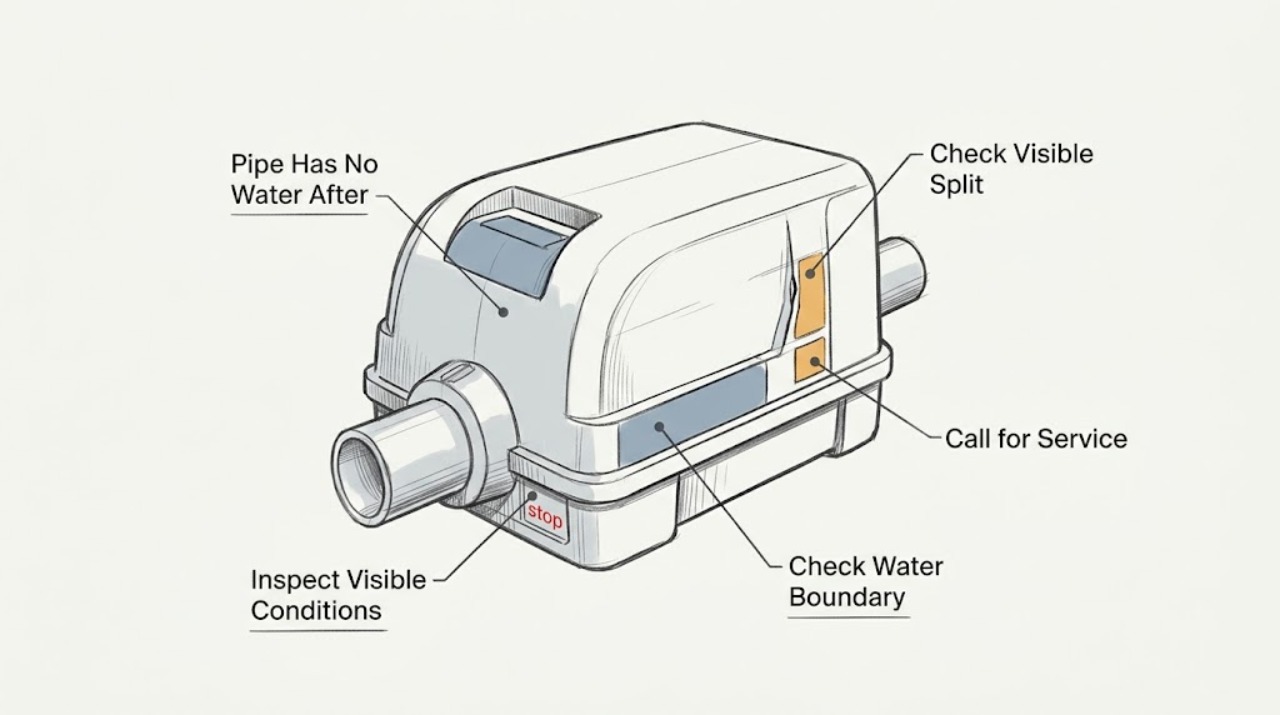
Work through in order
Diagnostic checks
Use only checks that match the exact appliance or system and its official guide.
-
Check 1
Turn off the heat source and observe the nearest faucet, the warmed section, and the surrounding wall, ceiling, floor, cabinet, crawl space, or utility area from a dry, stable position. Do not touch a hot pipe, wet electrical equipment, or a heater that is near water.
Expected result: The faucet may remain dry, begin to drip, or flow while a joint, wall, ceiling, or floor becomes wet; the pipe may also show frost, bulging, a split, or no visible change.
Next step: If any leak, bulging, rapid flow, structural moisture, or electrical contact appears, use the urgent branch. Otherwise continue with the supply and branch check without applying more heat yet.
Why this matters
Why: No flow without a leak suggests remaining ice, an unheated section, or a closed valve. New moisture as thawing begins can reveal a freeze split. A hidden or inaccessible section cannot be cleared safely by adding more heat.
-
Check 2
Identify whether the no-water symptom affects one faucet, one room, the hot side, the cold side, outdoor fixtures, or the entire property. From a dry location, look for a clearly labeled main or branch shutoff and note whether recent work, a utility event, or a cold-exposed area could have closed or frozen the supply.
Expected result: Only one branch may be dry, several fixtures may be dry, or all cold water may be absent; a valve may be closed, or no safe valve may be identifiable.
Next step: Do not force or remove a valve. Contact the water utility or plumber if the main, meter, shared building supply, or service line is involved or the boundary is unclear.
Why this matters
Why: A single-branch problem favors a local freeze, valve, or pipe break. Whole-property loss raises a main, meter, service-line, utility, or building-supply concern. No flow after warming is not proof that the pipe itself is the only fault.
-
Check 3
Inspect only exposed pipe, joints, valves, and nearby surfaces for a split, bulge, wet insulation, dripping, staining, frost line, or expanding puddle. Do not open a wall, remove insulation that is wet or contaminated, pull the appliance or water heater, or enter a flooded crawl space.
Expected result: The exposed pipe may be intact and dry, wet at a joint, visibly split, or hidden behind a wall, ceiling, floor, meter box, or inaccessible service space.
Next step: If a break is visible and the shutoff is safely reachable, close the water supply and call a plumber. If the shutoff or pipe is inaccessible, keep clear and request urgent professional help.
Why this matters
Why: A visible split or growing wet area means the pipe may fail as it thaws and needs water isolation and professional repair. An intact exposed section does not clear hidden portions of the branch.
-
Check 4
Open the faucet nearest the suspected frozen section only if the area is dry and there is no visible split or uncontrolled leak. Observe whether it stays dry, drips, sputters, or returns to a normal stream; do not leave an unattended faucet open while the line may thaw.
Expected result: A dry outlet can mean the freeze remains; a drip or sputter can show that ice is moving or air is leaving; a sudden stream can expose a downstream break.
Next step: Stop and isolate water for any leak or uncontrolled flow. If flow remains absent after a safe observation and the section is inaccessible, call a plumber rather than extending heat.
Why this matters
Why: Flow returning is not a guarantee of a sound pipe. A change in flow while nearby surfaces become wet points toward thaw damage and requires immediate isolation rather than continued testing.
-
Check 5
Record what heat was used and where it was applied. If professional guidance or the exact local instructions allow further controlled warming, use only a suitable low-risk method in a dry, attended area with combustible materials clear; never use flame, fuel heat, a welder, or improvised current through the pipe.
Expected result: The method may have been controlled warm air or a heating pad, or it may have involved a flame, fuel appliance, direct high heat, or an electrical device near water.
Next step: Stop unsafe heating immediately, move people away, and use fire or electrical support if there is smoke, flame, odor, or exposed damage. For a safe method that did not restore flow, use plumbing service.
Why this matters
Why: Controlled warming can be appropriate for an accessible pipe under safe conditions. Flame, fuel heat, concentrated high heat, or electrical heat near water can cause fire, shock, pipe damage, or a steam event and is a stop condition.
-
Check 6
If the pipe is leaking or water may return suddenly, close the known water shutoff from a dry, stable position only if it operates normally. Do not force a seized valve, open a wet meter enclosure, disconnect a pressurized fitting, or turn power off by entering standing water.
Expected result: Water may slow or stop, continue because the valve is wrong or failed, or remain impossible to isolate safely.
Next step: Keep clear and call a licensed plumber or water utility. If water is near energized equipment, a furnace, or a water heater, use urgent electrical or fire support as appropriate.
Why this matters
Why: A safe shutoff limits thaw-related flooding. Continued flow can indicate the wrong valve, a failed valve, or a different source and needs professional handling.
-
Check 7
Prepare a service handoff with the affected fixtures, exact no-flow timing, weather, heat method and location, faucet response, visible pipe or surface changes, valve and meter location, any leak, and whether other occupants or properties are affected. Do not open walls or dig for a service line.
Expected result: A plumber or utility may identify a remaining freeze, split pipe, closed or failed valve, frozen meter or service line, or a broader water-supply event.
Next step: Leave the affected water isolated when safe and follow the professional's plan. If excavation is proposed, use the required local utility-locate process before any digging.
Why this matters
Why: The sequence after heating helps distinguish an unreleased freeze from thaw damage and prevents a dangerous repeat of the same heat application.
Use your observations
Decision map
Find the observation that best matches what you see, then follow the next safe action.
-
PATH 01Next step
What you see
Water returns and no leak, heat damage, odor, or structural moisture is visible.
Do this next
Stop the heat and watch the exposed pipe and nearby surfaces during a short, attended period.
-
PATH 02Next step
What you see
The faucet remains dry, the suspected section is accessible, and there is no leak, moisture, or electrical hazard.
Do this next
Do not add flame or concentrated heat. Check for another frozen section or a closed valve from a safe position.
-
PATH 03Next step
What you see
A drip, spray, wet joint, stain, bulge, or expanding puddle appears as heat is stopped or flow returns.
Do this next
Close the water supply from a dry safe location if possible and stop using the affected fixture.
-
PATH 04Next step
What you see
No water affects many fixtures or the whole property after warming one area.
Do this next
Check for a utility notice or building-supply issue from a safe location and do not assume the warmed pipe was the only freeze.
-
PATH 05Next step
What you see
A torch, flame, fuel heater, improvised electrical heating, or a heater near water was used or is still present.
Do this next
Stop the method, keep clear, and do not touch hot, wet, damaged, or energized equipment.
-
PATH 06Next step
What you see
The suspected freeze is behind a wall, below a floor, in a crawl space, at a meter, or in a service line that cannot be safely reached.
Do this next
Leave the structure and meter area intact and stop trying to extend heat.
-
PATH 07Next step
What you see
Water reaches an outlet, panel, cord, water heater, furnace, or fuel appliance, or the area is flooding, unstable, or contaminated.
Do this next
Keep everyone away and isolate water or power only from a dry safe location when that can be done without contact with the hazard.
Helpful context
Understand the symptom
Heat does not prove the pipe is intact
When a frozen line warms, the remaining ice may still block flow, or a split may open as pressure and water return. A pipe can also be frozen somewhere farther along the branch than the section that was warmed. Treat the first return of water as a controlled observation, not as permission to turn the whole supply on quickly.
Stop the heat before checking the area
If heat was applied with a hair dryer, heater, heat lamp, heating pad, hot cloth, or another method, turn it off and let the area remain accessible. Never switch to a torch, propane heater, kerosene heater, charcoal appliance, or other flame. Keep heaters away from combustible material and water, and never use an electrical appliance in standing water.
A dry faucet and a wet pipe mean different things
No flow at the nearest faucet with no visible leak can mean the freeze remains or a valve is closed. A drip followed by water at a joint, wall, ceiling, crawl space, or floor can indicate a split that was hidden by ice. Check other fixtures to learn whether the problem is one branch or the whole supply, but do not open multiple fixtures in an unsafe area.
Know when this is a service call
An inaccessible frozen section, a meter or service-line freeze, a pipe inside a wall, no return of flow after safe warming, a recurring freeze, or any visible split belongs with a licensed plumber or the water utility. If water is near electrical equipment, a water heater, furnace, or fuel appliance, treat that as an urgent safety issue first.
Safety boundary
Stop conditions
- Stop immediately for a split, spray, expanding puddle, wet wall or ceiling, structural staining, uncontrolled flow, or a valve that cannot isolate the water safely.
- Stop immediately if water reaches an outlet, panel, cord, water heater, furnace, pump, or other electrical or fuel equipment. Do not enter standing water or touch wet equipment.
- Never use a torch, blowtorch, open flame, propane or kerosene heater, charcoal appliance, welder, or improvised electrical current to thaw a pipe.
- Do not continue applying heat to one point when water remains absent, the pipe is inaccessible, or the surrounding material is hot, wet, scorched, or combustible.
- Do not force a shutoff, disconnect a pressurized fitting, open a wet meter box, remove a wall or floor, or enter a flooded crawl space.
- Do not leave a faucet or heater unattended while a line may thaw; if the source or safe method is uncertain, call a licensed plumber.
Only after diagnosis
Potential parts
- exposed water pipe insulation
Consider only after the pipe is confirmed sound and a professional or local guidance identifies an accessible cold-exposed section that needs protection.
Select insulation for the pipe material, location, moisture, fire, and local requirements; it does not repair a split. - freeze-resistant outdoor faucet assembly
Consider only when a plumber confirms the outdoor faucet or its arrangement contributed to the freeze and replacement is appropriate.
Wall depth, pipe material, shutoff arrangement, drainage, and local code must be confirmed before selection. - replacement water pipe section
Consider only after a plumber confirms a split or structurally damaged section caused by freezing.
Material, diameter, connection method, access, permits, and pressure requirements are installation-specific.
When checks do not resolve it
Need a professional?
Arrange professional assessment when flow does not return after safe warming, when a pipe may have split, or when the section is hidden, shared, at the meter, or part of the service line.
Safety scope: A plumber or utility can locate the remaining freeze, assess thaw damage, isolate the correct section, and repair the line without the user using flame, opening walls, or handling pressurized piping.
Have this ready
- Provide the affected faucets, hot or cold side, no-flow timing, weather, heat method and location, faucet response, visible leaks or surface changes, shutoff and meter location, and whether other fixtures or properties are affected.
Common questions
FAQ
Why is there still no water after I warmed the pipe?
The freeze may remain farther along the line, a valve may be closed, or the pipe may have split while frozen. Stop adding heat, inspect safely for moisture, and call a plumber if flow does not return or the section is hidden.
Can a frozen pipe be broken even if I do not see a leak?
Yes. A split may not show until ice starts to thaw and water pressure returns. Watch exposed joints and nearby walls, ceilings, and floors, and isolate the water if a leak appears.
Is a torch safe for thawing a frozen pipe?
No. Open flame and fuel heaters can start a fire, damage the pipe, or create a steam hazard. Use only controlled methods allowed by local guidance and suitable for a dry, accessible area, or call a plumber.
Should I keep a faucet open while thawing?
Some official guidance recommends opening a nearby faucet to show when flow returns, but do not leave it unattended when a hidden break or flooding risk exists. Stop and isolate water if a leak appears.
When is frozen-pipe no water an emergency?
Treat rapid leakage, flooding, structural damage, water near electrical or fuel equipment, smoke, flame, or an inaccessible service-line break as urgent. Keep clear and use the appropriate plumber, utility, electrical, fire, or emergency support.
Read the exact guide
Official sources
- Frozen Water PipesFairfax County Fire and Rescue Department · Fire and rescue guidance on thaw-related breaks, safe shutoff, no torch, and electrical or heating-equipment hazards
- Preventing & Thawing Frozen PipesAmerican Red Cross · Emergency-preparedness guidance on frozen pipe locations, controlled heat, and licensed plumber escalation
- Essential Tasks After it Warms UpNational Weather Service · Government cold-weather guidance on frozen pipe expansion, safe warming, and plumber escalation
- Protect Your Pipes from FreezingNew York City Department of Environmental Protection · Government guidance on frozen pipes, controlled warming, shutoff, and licensed plumber escalation
Community feedback
Share a repair observation
Share a plain-text repair observation. Accepted observations are published automatically; this page may take a moment to update.