
On this page
Start here
Quick answer
If a pipe or the house has no water when the main is turned back on, first confirm that the correct house valve is actually open and that the water company or building has restored service. Open one safe faucet slowly and listen for rushing air, but do not force the main valve, operate a meter or curb-stop valve, or repeatedly cycle the supply. Compare cold and hot water at several fixtures, check neighbors or the building manager, and look for an active leak without entering wet or electrically unsafe areas. Air can delay flow, and sediment released during shutoff or repair can block a faucet screen or filter. If service is restored and a utility-authorized cold-water flush does not restore flow, or if water appears at a private pipe, valve, heater, floor, or wall, stop and call a qualified plumber; use the water utility for a shared or meter-side outage.
Before you begin
Safety first
- This article supports official-status checks, safe fixture comparison, slow normal operation of a clearly homeowner-controlled valve, utility-authorized cold-water flushing, and ordinary-access screen inspection only. It does not authorize meter or curb-stop work, forced valve movement, pressurized disassembly, excavation, water-heater service, or work around water and electricity.
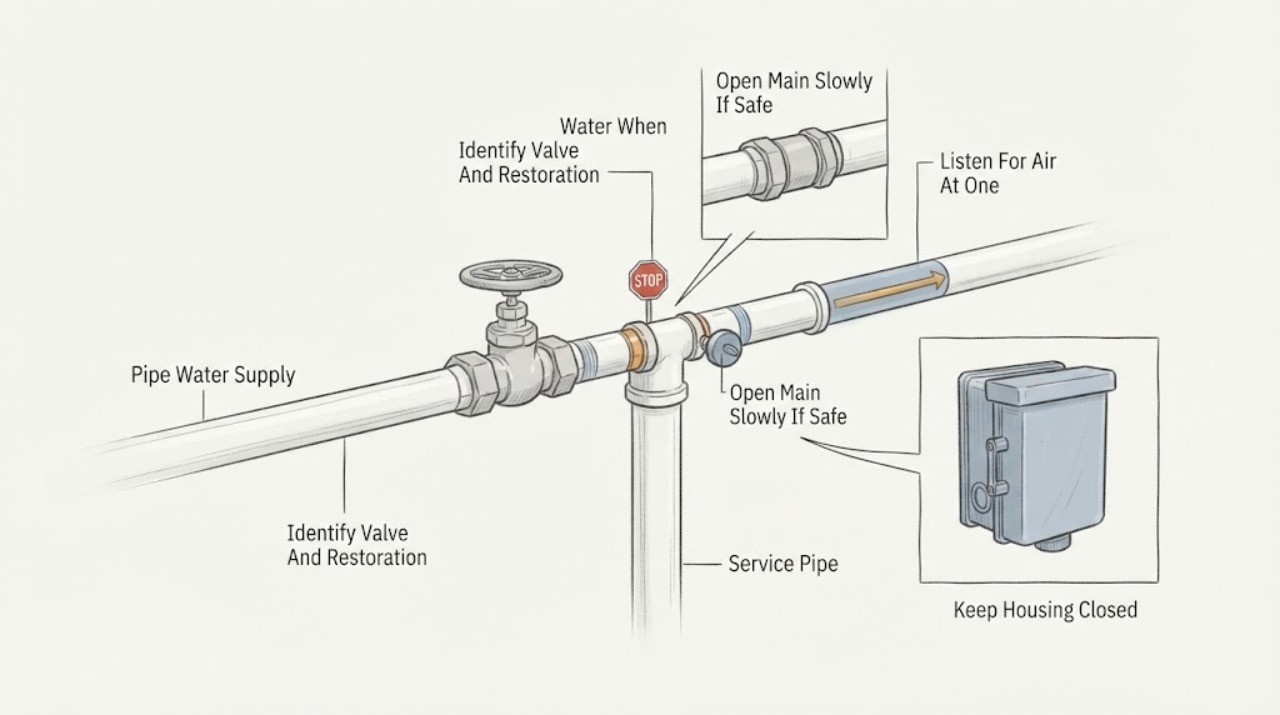
Work through in order
Diagnostic checks
Use only checks that match the exact appliance or system and its official guide.
-
Check 1
From a dry, safe position, identify whether the control turned back on is the house main valve, a building valve, a meter-side customer valve, or an irrigation valve, and check the water company's or building's restoration notice.
Expected result: Record the valve identity as confirmed, unknown, utility-controlled, partly open, closed, leaking, stiff, or damaged; record service restored, still delayed, or advisory active.
Next step: Follow the utility or building instruction and confirm the correct house valve only by safe visual observation; contact the utility or manager for service-side uncertainty before touching another valve.
Stop if: Do not open a meter or curb-stop box, operate a utility valve, force a handle, use tools, enter a work zone, or continue around a leak or standing water.
Why this matters
Why: The wrong valve or a still-closed utility/building valve can leave the home dry. A stiff, leaking, damaged, buried, or meter-side control is not a target for force or DIY repair.
-
Check 2
If the valve is clearly the homeowner's, dry, intact, and normally operable, follow its normal open position and bring it on slowly while watching accessible joints and listening for abnormal flow; do not rotate past resistance or repeatedly cycle it.
Expected result: Record water returning steadily, rushing air, sputtering, no flow, a spray or leak at a joint, pipe movement, or a valve that will not move normally.
Next step: If safe, leave one suitable faucet slightly open to observe air as instructed by the utility; if there is no flow, leakage, or abnormal movement, stop and contact the utility or plumber.
Stop if: Stop for a leak, spray, pipe movement, uncontrolled flow, pressure surge, flooding, or a stiff/broken valve; do not use pliers, a wrench, heat, or force.
Why this matters
Why: Slow reopening can limit a pressure shock and allow air to leave the line. Air or sputter may be temporary; no flow with a confirmed open valve or any leak suggests a restoration, blockage, damaged valve, or service-line problem.
-
Check 3
With the area dry and safe, open one accessible faucet slowly and briefly, preferably one the utility identifies for restoration, and listen for rushing, hissing, or sputtering air without opening multiple fixtures at once.
Expected result: Record no sound and no water, air followed by water, continuing sputter, discolored water, or a leak at the fixture or nearby pipe.
Next step: Follow the responsible utility's instruction for leaving the faucet open or flushing; if flow does not begin within its stated restoration window, report the address and valve status rather than adding more open taps.
Stop if: Do not leave water running unattended, use a hot tap to purge air, drink discolored or advisory-affected water, or continue if water escapes or reaches electricity.
Why this matters
Why: Rushing air can explain a delay while the line repressurizes. Persistent no water with no air points toward an unopened or blocked supply, while discoloration can indicate disturbed sediment and requires the utility's water-use guidance.
-
Check 4
Compare cold and hot flow at several indoor fixtures and, only when dry and safe, an outdoor hose connection; do not rapidly cycle valves or operate appliances to create demand.
Expected result: Classify the result as no water everywhere, no cold water only, no hot water only, one fixture dry, some fixtures dry, or flow returning unevenly.
Next step: Use this pattern to contact the utility, building manager, plumber, or heater professional as appropriate; preserve the main-valve and restoration sequence.
Stop if: Stop for scalding water, gas odor, heater smoke, a leak, pressure surge, flooding, or water near electrical equipment.
Why this matters
Why: No water everywhere suggests restoration, main valve, service line, or whole-house restriction. One dry fixture suggests a screen or local valve. Cold-normal/hot-dry shifts attention to the hot-water branch or heater, while uneven return may reflect air or sediment.
-
Check 5
Only when the utility has authorized post-restoration flushing, use a suitable cold-water outlet without an attached filter and follow its sequence; monitor the discharge and surrounding area while air and sediment clear.
Expected result: Record whether air stops, water becomes clear, flow improves, sediment remains, or no water appears despite the main being confirmed open.
Next step: Stop at the utility's specified endpoint, replace accessible screens correctly, follow its drinking-water advisory, and report unresolved flow or water quality.
Stop if: Do not flush through a refrigerator filter, use the hot-water tap or heater tank for an improvised flush, use water under an active advisory contrary to instructions, or continue during flooding or a leak.
Why this matters
Why: Air or repair sediment can temporarily block or restrict household plumbing. Improvement supports a restoration effect; persistent no water, recurring debris, or non-clearing discoloration requires utility or plumber assessment.
-
Check 6
If only one faucet remains dry or weak after authorized restoration, inspect its accessible aerator or screen and visible local stop valve from a dry position; remove the screen only if ordinary fixture access permits it and keep all pieces together.
Expected result: Record sediment, a blocked screen, a partly closed local valve, a clean screen, a damaged fitting, or access that would require force or pipe disassembly.
Next step: Clean or restore only the accessible screen or valve according to fixture guidance and compare flow once; arrange a plumber if it remains dry, leaks, or repeatedly blocks.
Stop if: Do not probe the pipe, remove a cartridge, loosen a pressurized connection, use chemical cleaners, or work where water can reach electrical equipment.
Why this matters
Why: Sediment released during a shutoff can block one fixture without proving that the main pipe has failed. A clean screen, damaged fitting, or forced-access requirement points to the fixture branch and needs plumbing diagnosis.
-
Check 7
After water begins to return, observe accessible floors, ceilings, wall entry points, exposed service pipe joints, toilets, and the water-heater area from a dry position for new water, running-water sound, or equipment distress; do not open or relight equipment.
Expected result: Record dry and stable, a private leak, a toilet or fixture leak after pressure changed, hot-water-only failure, water near electricity, gas odor, smoke, steam, or a ruptured/bulging pipe.
Next step: If safe, isolate a reachable private supply to contain a leak and call a plumber; contact the utility for a meter-side leak or shared outage and emergency services for fire, gas, flooding, or electrical danger.
Stop if: Do not enter standing water, touch wet electrical equipment, relight a gas appliance, open a heater, repair a pressurized pipe, or remain near smoke, flame, gas odor, or arcing.
Why this matters
Why: Repressurization can expose a damaged private connection or disturb a fixture. A leak requires containment and plumbing service; heater gas, flame, steam, or electrical signs require the appropriate specialist and immediate stop.
Use your observations
Decision map
Find the observation that best matches what you see, then follow the next safe action.
-
PATH 01Safety boundary
What you see
The water company or building has not declared service restored, neighbors are also dry, or the main break/outage remains active.
Do this next
Follow the official restoration and water-quality notices and contact the utility or building manager; stay clear of crews and work zones.
Why this path and its safety boundary
Why it matters: No water is likely a distribution, building, or meter-side restoration issue, not a private pipe that can be fixed by opening more taps.
Safety stop: Do not operate a street or meter valve, enter excavation, or use water contrary to an active advisory.
-
PATH 02Safety boundary
What you see
The correct house valve is open normally, a safe faucet produces rushing air or sputtering, and water begins to return.
Do this next
Follow the utility's instruction for one faucet or suitable outlet to release air, then stop when flow is steady and clear; protect filters and hot-water equipment.
Why this path and its safety boundary
Why it matters: Air remains in the line after the supply was restored and may be delaying steady flow.
Safety stop: Stop for leaks, pressure surge, flooding, persistent no flow, or water near electricity.
-
PATH 03Safety boundary
What you see
Several fixtures have water but one remains dry or weak and its accessible screen contains sediment after the shutoff.
Do this next
Clean and replace the accessible screen according to fixture guidance and arrange plumbing service if flow remains low or sediment returns.
Why this path and its safety boundary
Why it matters: A localized post-restoration blockage is plausible; the main pipe is not established as the failed part.
Safety stop: Do not probe pipework, force a fitting, use chemical cleaners, or continue if the fixture leaks.
-
PATH 04Safety boundary
What you see
The utility reports normal service, neighbors have water, the correct house valve is open, and every fixture remains dry.
Do this next
Leave the supply and pressurized equipment undisturbed and arrange qualified plumber diagnosis; ask the utility to confirm the meter-side service if ownership is unclear.
Why this path and its safety boundary
Why it matters: A private service-line blockage, damaged valve, frozen or damaged pipe, PRV/filter restriction, or leak remains possible.
Safety stop: Do not force the valve, open a filter, adjust a regulator, excavate, or dismantle pipework.
-
PATH 05Safety boundary
What you see
Cold water returns but hot water does not, or the water-heater area shows leaking, gas odor, smoke, steam, flame abnormality, or electrical damage.
Do this next
Stop using the affected heater and arrange qualified plumbing, gas, or electrical service as appropriate, following any utility water-quality instruction.
Why this path and its safety boundary
Why it matters: The hot-water branch or heater may be involved; this is not a reason to open or relight the heater after restoration.
Safety stop: Do not relight, drain, open, adjust, or bypass the heater when gas, smoke, heat, leakage, steam, or electrical risk is present.
-
PATH 06Safety boundary
What you see
Water appears at a private pipe, joint, floor, ceiling, wall entry, toilet, or fixture after the main is turned back on.
Do this next
From a safe dry position isolate the reachable private supply if necessary, keep people away from the wet area, and call a plumber; use emergency help for flooding or water contacting electricity.
Why this path and its safety boundary
Why it matters: The pressure change may have exposed a damaged or loose connection; continued supply can increase property damage.
Safety stop: Do not enter standing water, tighten pressurized connections, open walls, or touch wet electrical equipment.
Helpful context
Understand the symptom
No water after opening the main is a sequence problem first
Separate the main water valve from the pipe, the utility's service valve, and the faucet where no water is observed. A closed or partly open house valve, delayed utility restoration, trapped air, sediment, a frozen or damaged service line, or a local fixture blockage can all look like the same complaint. Do not keep turning a valve to search for a stop, and do not infer that no water at one faucet means the whole property is dry. Preserve the timing and the exact valve identity for the utility or plumber.
Bring water back gradually and keep sediment out of sensitive equipment
A water district advises opening a house or meter valve slowly and clearing air through a nearby hose bib or suitable outlet. After a service interruption, air can sputter from a tap and sediment can collect in screens. Flush only as directed by the responsible utility, starting with a suitable cold-water outlet; do not use a filtered refrigerator tap or hot-water outlet for an improvised flush, and do not use discolored water for drinking or cooking until the utility's guidance says it is suitable.
The fixture pattern decides who should respond
If neighbors or every fixture are dry, the utility, building, meter-side service, or main valve remains in focus. If one faucet is dry while others work, sediment at its screen or a local valve may be the restriction. If water returns and then appears at a wall, ceiling, floor, heater, or service pipe, contain the leak only from a safe reachable control and call a plumber. Normal cold flow with no hot water is a hot-water branch or heater issue, not a reason to open a heater while it is hot, leaking, gas-affected, or near electricity.
Safety boundary
Stop conditions
- Stop for flooding, a ruptured or bulging pipe, uncontrolled flow, a pressure surge, or water near electrical equipment; isolate water only from a safe reachable control and arrange emergency plumbing help.
- Do not force the main valve, use pliers or a wrench, open a meter or curb-stop box, operate a utility valve, enter a work zone, or dig for a service pipe.
- Do not repeatedly cycle the supply, open many taps to provoke flow, flush through a refrigerator filter, or use a hot-water outlet to purge post-restoration air or sediment.
- Do not drink or cook with discolored or advisory-affected water, and do not ignore the responsible utility's boil-water, flushing, or restoration instructions.
- Stop around a water heater for gas odor, abnormal flame, smoke, steam, scalding water, leakage, or electrical damage; do not relight or service it in that condition.
- Do not enter standing water or touch wet outlets, appliances, panels, pumps, or wiring; leave persistent whole-house no-water or unresolved restoration for the utility or a qualified plumber.
When checks do not resolve it
Need a professional?
Contact the water utility or building manager when service is not declared restored, neighbors are also dry, a main break or shutoff notice is active, restoration is delayed, a meter-side valve may be closed, or a water-quality advisory applies. Arrange qualified plumbing service for no water after official restoration and a normally open private valve, a damaged or leaking valve, a blocked service line, a persistent single-fixture blockage, or a leak after repressurization. Use emergency help for flooding, a ruptured pipe, gas odor, smoke, fire, or water contacting electricity.
Safety scope: This article supports official-status checks, safe fixture comparison, slow normal operation of a clearly homeowner-controlled valve, utility-authorized cold-water flushing, and ordinary-access screen inspection only. It does not authorize meter or curb-stop work, forced valve movement, pressurized disassembly, excavation, water-heater service, or work around water and electricity.
Common questions
FAQ
Why is there no water after I turn the main valve back on?
The wrong valve may be open, the utility or building may not have restored service, air may remain in the lines, or a leak, blockage, or damaged private valve may be present. Confirm restoration, listen for air at one safe faucet, compare neighbors and fixtures, and avoid forcing or repeatedly cycling the main.
How should I turn the main water valve back on?
Only operate a clearly identified, homeowner-controlled valve that is dry, intact, and normally movable, and follow its normal open position slowly. Do not use tools on resistance or operate a meter-side or utility-controlled valve; call the utility or a plumber when ownership or condition is uncertain.
What does rushing air from a faucet mean after water is restored?
Air may have entered the service or household lines during the shutoff. Follow the utility's instruction for one suitable faucet or cold-water outlet, watch for leaks, and stop if water does not return or the area becomes unsafe.
When should I call a plumber instead of the water utility?
Use the utility or building manager when service is delayed, neighbors are dry, a main break remains active, or a meter-side valve may be involved. Use a qualified plumber when the utility reports normal service but your property remains dry, a private valve is damaged, a screen or branch remains blocked, or water leaks after the main is reopened.
Read the exact guide
Official sources
- Locating a Water Meter & Emergency Service ValveCity of Columbus Department of Public Utilities · Municipal customer guidance; do not generalize the location or ownership of valves at another property.
- How to Turn Off Your WaterWestern Municipal Water District · Municipal water-district guidance; local valve design and utility control take precedence.
- Water Shut OffsNew York City Department of Environmental Protection · Municipal shutoff guidance; local utility notices and health instructions control elsewhere.
- Troubleshooting water pressure and flowCity of Portland Water Bureau · Municipal residential pressure-and-flow guidance; local conditions and qualified plumbing practice control.
- Discolored Water/Flushing GuideGreen Area Water & Sanitary Authority · Water-authority post-break guidance; follow the responsible local utility's procedure elsewhere.
Community feedback
Share a repair observation
Share a plain-text repair observation. Accepted observations are published automatically; this page may take a moment to update.