
On this page
Start here
Quick answer
A Rinnai water heater that takes too long to restore hot water may be meeting a demand larger than the system's storage or heating capacity, operating on a delayed schedule, receiving too little water flow, or running with a power, gas, inlet-filter, control, or heating fault. First identify whether the unit is a tankless continuous-flow, storage-tank, heat-pump, or solar/boosted system. Then compare the symptom with household demand, check only accessible power and controller settings, and observe one hot-water call for flow, ignition, display, or error behavior. Do not open the burner or electrical compartment, handle hot relief-valve water, clean a gas appliance internally, or change a gas or electrical setting. If recovery remains slow after the model's normal cycle, an error persists, a breaker trips, or the water is unsafe or intermittently hot, arrange qualified Rinnai or plumbing service.
Before you begin
Safety first
- The homeowner-safe checks are identifying the system type, observing demand and one fixture, checking accessible controller and isolator status, and noting visible leaks or codes. Gas, electrical, heating-element, thermostat, heat-pump, internal water-filter, relief-valve, sealed-system, and control work belongs to qualified personnel.
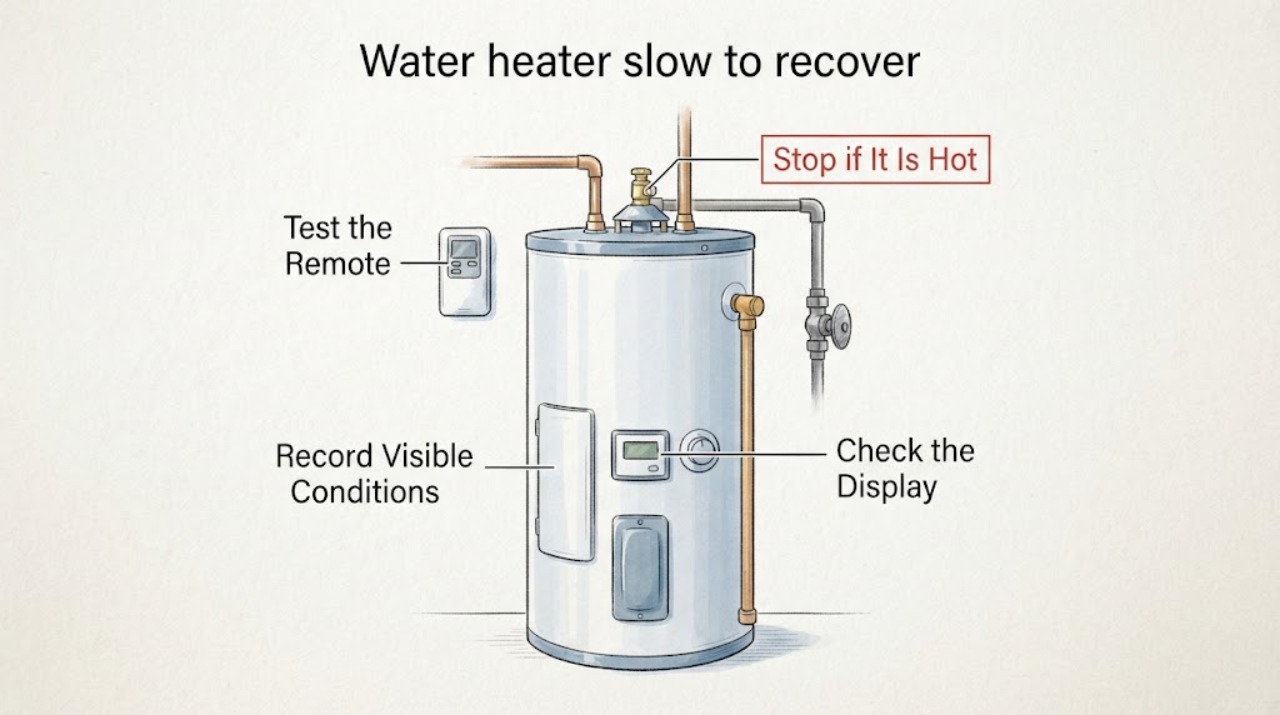
Work through in order
Diagnostic checks
Use only checks that match the exact appliance or system and its official guide.
-
Check 1
Read the Rinnai rating label or controller and identify whether the system is a continuous-flow tankless unit, storage tank, heat pump, or solar/boosted arrangement; note the model and whether a timer or remote controller is present.
Expected result: The unit has no storage tank, has a tank and recovery cycle, uses a heat-pump display, or is paired with solar and a gas or electric booster.
Next step: Use only the branch and manual guidance for the identified system. If the type or model cannot be confirmed, stop at external observations and arrange qualified Rinnai or plumbing help.
Why this matters
Why: Tankless systems respond to water flow, while storage and heat-pump systems need time to restore stored heat. Solar or boosted systems add weather, schedule, and booster paths. Applying the wrong procedure can hide the actual cause or create a safety risk.
-
Check 2
Record when the shortage occurs, how many people or fixtures used hot water, and whether one tap or the whole home is affected; test one hot tap briefly with other hot-water appliances off.
Expected result: The delay follows a large shower or several fixtures, happens at a predictable scheduled time, affects one distant fixture only, or affects every hot-water outlet.
Next step: Reduce simultaneous demand and allow the documented recovery period once. If the same shortage occurs with light demand or outside the schedule, continue with supply and controller checks and arrange service if it persists.
Why this matters
Why: A shortage after heavy use can be normal capacity or recovery behavior for a storage system. A single distant fixture may mainly reflect water remaining in the pipe. Whole-home loss or a worsening delay makes supply, heating, flow, or control trouble more likely.
-
Check 3
From a dry, safe location, verify that the water-heater isolator, labeled breaker, and accessible controller are on and that no vacation, off, boost, or timer setting is postponing heating; do not open the electrical enclosure.
Expected result: The isolator or breaker is off, a breaker trips again, the controller is off or scheduled, the display shows an alert, or power and normal settings appear correct.
Next step: Restore only a clearly switched-off normal control when the area is safe and the manual allows it. Leave a repeatedly tripping breaker off, record the alert, and arrange qualified electrical or Rinnai service.
Why this matters
Why: No power or a schedule can delay recovery without proving an appliance failure. A repeated trip, persistent alert, or correct power with no heating response points toward an electrical, control, heating, or system fault.
-
Check 4
For a continuous-flow Rinnai only, open one hot tap sufficiently and observe whether the unit activates, whether its flame or operating indicator appears, and whether flow is weak; do not remove an inlet strainer or work on a gas valve unless the exact manual expressly assigns it to a qualified technician.
Expected result: The unit activates and produces hot water after a short pipe delay, does not activate at a weak flow, starts then turns cold, or shows an ignition or other error.
Next step: Test a different hot fixture only to compare the symptom, keep the flow steady, and record the display code. Do not bypass flow or gas protections; arrange qualified service for repeated shutdown, an error, or suspected inlet-filter or gas work.
Why this matters
Why: A normal activation with delayed arrival can be pipe travel. Weak flow can fail to reach the model's activation threshold; Rinnai's continuous-flow guidance gives a model-family minimum of 2.5 L/min. Starting then going cold or showing an error keeps water, gas, ignition, and maintenance faults in consideration.
-
Check 5
For a storage or heat-pump Rinnai, compare the shortage with recent hot-water volume, the documented heating schedule, and the displayed tank or operating mode; keep fixtures closed while the unit completes one normal recovery cycle.
Expected result: The shortage follows heavy use, occurs before the next off-peak or scheduled cycle, the unit displays heating or heat-pump operation, or the tank remains slow despite light demand and a completed cycle.
Next step: Use only the documented mode or boost control, if available, and do not change service parameters. If recovery remains abnormal, an alert appears, or hot water is unsafe, arrange qualified Rinnai service.
Why this matters
Why: Demand and schedule can explain predictable depletion. Heat-pump recovery can also vary with ambient conditions. Failure to recover with light demand and an available heating cycle makes a heating element, thermostat, heat-pump, sensor, or control problem more likely.
-
Check 6
Check accessible hot-water fixtures for a dripping tap, weak flow, cross-connection symptoms, or a visible leak around the unit without opening the casing or touching relief-valve discharge water.
Expected result: A tap drips, flow is restricted at one fixture, water is leaking from pipework or the casing, hot and cold behavior suggests mixing, or no visible water issue is present.
Next step: Close the affected fixture if safe and arrange a plumber for leaks, cross-connections, or persistent flow problems. Do not operate a relief valve as a diagnostic test or attempt internal repairs.
Why this matters
Why: Continuous water loss or a fixture problem can consume or dilute hot water and make recovery appear slow. A leak at the casing or persistent cross-connection may involve plumbing or safety components that require professional diagnosis.
-
Check 7
After one model-appropriate setting, demand, and supply check, record any error code, alarm, unusual sound, gas or water symptom, and whether hot water returns normally; do not repeatedly power-cycle the unit.
Expected result: The unit recovers normally, recovers only temporarily, shows an error or protection state, has repeated ignition or flow interruption, or never restores hot water.
Next step: Keep the unit in its safe normal state and arrange qualified Rinnai or plumbing service. Provide the model, system type, demand pattern, controller status, flow behavior, error code, and recovery timing.
Why this matters
Why: Stable recovery supports a demand, schedule, fixture, or temporary supply explanation. A recurring or persistent fault points toward a component, maintenance, gas, water, electrical, or control issue that cannot be selected safely from symptoms alone.
Use your observations
Decision map
Find the observation that best matches what you see, then follow the next safe action.
-
PATH 01Next step
What you see
Only one distant tap is slow, the Rinnai activates normally, and hot water arrives after the pipe clears.
Do this next
Avoid wasting water while waiting and compare another fixture. If the delay grows, the unit fails to activate, or several fixtures are affected, arrange service.
Why this path and its safety boundary
Why it matters: Delivery distance and cold water in the hot-water line are more likely than slow heater recovery.
-
PATH 02Next step
What you see
A storage or heat-pump unit runs out after long showers or several simultaneous fixtures, then recovers on its normal schedule.
Do this next
Spread demand where practical and verify the documented schedule or mode. If the same delay occurs with light use or after a full cycle, arrange qualified service and capacity review.
Why this path and its safety boundary
Why it matters: Demand may be exceeding available storage or the heating cycle's recovery rate rather than indicating an immediate component failure.
-
PATH 03Next step
What you see
A continuous-flow unit has weak flow, does not activate, starts then turns cold, or shows a flow or ignition error.
Do this next
Compare one other fixture without opening the heater. Record the code and arrange qualified Rinnai or gas service for inlet-filter, gas, ignition, or internal diagnosis.
Why this path and its safety boundary
Why it matters: Insufficient flow, an inlet restriction, gas or power supply issue, ignition fault, or protective shutdown is more likely than normal pipe delay.
-
PATH 04Next step
What you see
Power or a schedule is off, a breaker trips, or a storage or heat-pump display remains in an off, vacation, protection, or error state.
Do this next
Restore only a clearly disabled normal setting if safe. Leave a recurring trip or error unresolved and arrange qualified electrical or Rinnai service.
Why this path and its safety boundary
Why it matters: Heating may be postponed or disabled, while repeat trips or persistent protection states indicate a fault requiring professional evaluation.
-
PATH 05Next step
What you see
There is gas odor, smoke, sparking, flooding, water on electrical equipment, dangerously hot water, or a relief-valve or casing leak.
Do this next
Stay clear, use emergency or gas-utility assistance from a safe location for immediate danger, and arrange qualified plumbing or Rinnai service. Do not restart, open, or manipulate the heater until it is cleared.
Why this path and its safety boundary
Why it matters: A gas, fire, electrical, scalding, pressure, or water-damage hazard overrides recovery troubleshooting.
Helpful context
Understand the symptom
Slow recovery means different things on different Rinnai systems
A tankless Rinnai normally heats water during flow, so a delay may be the cold water already sitting in the pipe, insufficient flow to activate the unit, or an ignition or water-supply fault. A storage or heat-pump unit must reheat water after a large draw, and its recovery can depend on the heating schedule, inlet or ambient temperature, and household demand. Identify the equipment before changing a setting or inspecting a component.
Separate a delivery delay from a true recovery problem
If hot water eventually arrives at one distant tap but the heater fires normally, the wait may be pipe travel rather than slow heating. If several fixtures lose hot water, the unit does not activate, the controller shows a fault, or the tank remains depleted after its normal cycle, the issue is at the appliance, its supply, or the demand pattern. Test one fixture at a time and note the timing without wasting hot water.
Demand and schedules can be normal limits
Long showers, multiple hot taps, laundry, and dishwashing can consume stored hot water faster than a storage system can recover. An off-peak or timer schedule may postpone reheating until its next permitted period. Reducing simultaneous demand and checking the documented schedule can explain a predictable morning or evening shortage, but a new or worsening delay still deserves service review.
Keep gas, electricity, and scalding hazards outside the home check
The user-safe boundary is the model label, controller status, accessible isolator or breaker, one controlled hot-water observation, and visible leaks or error messages. Do not remove covers, test heating elements, reset a thermal cut-off, adjust gas controls, open a relief valve, or service a sealed heat-pump circuit. Stop immediately for gas odor, smoke, sparking, flooding, or dangerously hot water.
Safety boundary
Stop conditions
- Do not remove the heater cover, adjust gas controls, test electrical elements or thermostats, reset an internal thermal cut-off, service refrigerant, open a relief valve, or remove an inlet strainer unless the exact model manual and a qualified professional permit the work.
- Arrange qualified Rinnai, plumbing, gas, or electrical service when the unit remains slow after the documented recovery cycle, an error or protection state persists, ignition repeatedly fails, flow is restricted, or a breaker trips again.
- Protect the household from scalding and water damage: stop using the unit and obtain service for dangerously hot water, a casing leak, continuous relief discharge, flooding, or water near electrical equipment.
- For gas odor, smoke, fire, sparking, or another immediate hazard, leave the area and use emergency or gas-utility assistance from a safe location.
When checks do not resolve it
Need a professional?
Safety scope: The homeowner-safe checks are identifying the system type, observing demand and one fixture, checking accessible controller and isolator status, and noting visible leaks or codes. Gas, electrical, heating-element, thermostat, heat-pump, internal water-filter, relief-valve, sealed-system, and control work belongs to qualified personnel.
Common questions
FAQ
Why does my Rinnai water heater take a long time to recover?
The answer depends on the system. A storage or heat-pump unit may be recovering from heavy demand or waiting for a scheduled heating cycle; a tankless unit may have a flow, water, gas, or ignition issue. Identify the system, record the demand pattern and controller state, and arrange service if the delay is new, worsening, or present with light use.
Can high hot-water use make a Rinnai storage heater recover slowly?
Yes. Rinnai notes that long showers, multiple outlets, and other appliances can use stored hot water faster than the system recovers. A predictable shortage after heavy use may be a capacity or schedule issue, but slow recovery with light demand or after a complete cycle needs professional evaluation.
Why does a Rinnai tankless heater start and then go cold?
Rinnai's troubleshooting guidance points to possible flow, water-filter, gas-supply, ignition, or protective-shutdown paths, depending on the model. Compare one other fixture and record any display code, but do not open the unit or adjust gas equipment; arrange qualified service if the symptom repeats.
Could a timer or off-peak setting delay hot-water recovery?
Yes. Some storage systems heat only during scheduled or off-peak periods, so a tank depleted during the day may not reheat until the next permitted cycle. Check the documented controller setting without changing service parameters. A delay outside the schedule or a persistent fault should be assessed by a qualified technician.
When should I call for Rinnai water-heater service?
Arrange service when recovery stays slow with light demand, hot water cuts out repeatedly, an error or protection code remains, a breaker trips, flow or ignition is abnormal, or there is a leak, scalding water, gas odor, smoke, or sparking. Internal gas, electrical, heating, heat-pump, relief, and sealed-system work is not a homeowner repair.
Read the exact guide
Official sources
- Troubleshooting - Hot WaterRinnai Australia · Rinnai Australia product families and terminology; exact controls, schedules, flow thresholds, and procedures vary by model and installation
- Rinnai Electric Heat Pump Water Heater ManualRinnai · Rinnai electric heat-pump water heaters covered by the manual; other Rinnai system types require their own model documentation
Community feedback
Share a repair observation
Share a plain-text repair observation. Accepted observations are published automatically; this page may take a moment to update.