
On this page
Start here
Quick answer
When a shower drains slowly but the supply pipes, valve, and showerhead are not leaking, the likely problem is a restriction at the drain opening or farther down the shower branch. Stop adding water while the basin is rising, remove and clean the drain cover or strainer if it is safely accessible, and pull out visible hair and soap buildup without pushing it deeper. A plunger may help a minor blockage when no chemical drain cleaner is present. If the shower is the only slow fixture and the water clears after the opening is cleaned, the restriction was likely local. If several fixtures are slow, water backs up in another fixture, the drain gurgles, sewage appears, or the slowdown returns after surface cleaning, stop using the affected fixtures and arrange plumber service to locate the deeper branch or main-line obstruction. A supply leak is a separate issue: any new water around the valve, wall, ceiling, or floor needs prompt leak evaluation.
Before you begin
Safety first
- This article supports tracing visible water, cleaning an accessible drain cover, removing visible hair, and attempting a controlled plunger check when no chemical cleaner is present. It does not authorize chemical drain treatment, concealed-pipe access, trap removal, high-pressure equipment, or leak repairs inside walls or near electrical areas.
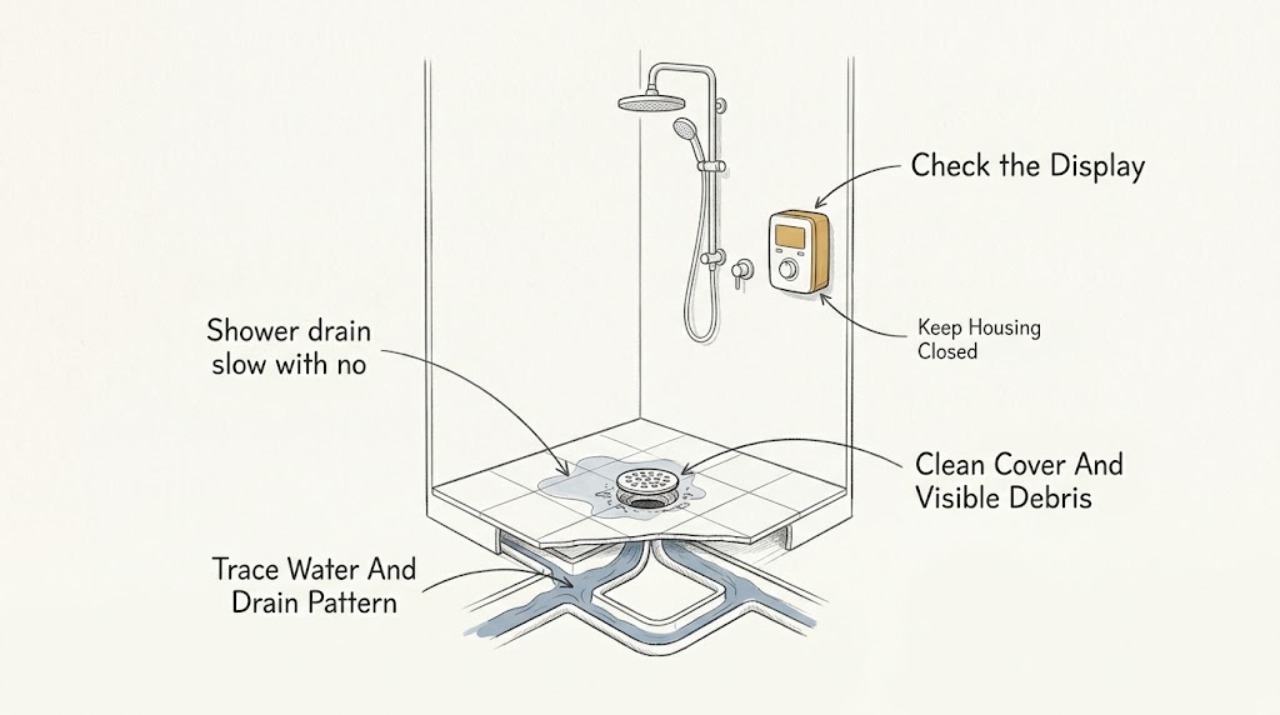
Work through in order
Diagnostic checks
Use only checks that match the exact appliance or system and its official guide.
-
Check 1
With the shower off, dry the floor and visible trim. Run only a small amount of water while watching the drain opening and the exposed valve, shower arm, trim, nearby floor, ceiling below if accessible, and wall edges. Do not remove wall panels or open the plumbing cavity.
Expected result: Record whether water rises only in the shower base and then falls, whether it remains after the water stops, and whether new water appears around the supply trim, wall, floor, or ceiling independently of drainage.
Next step: If the supply path is wet or water is inaccessible, stop using the shower and arrange leak service. If the water is confined to a slow-draining basin, continue with the drain-opening check.
Stop if: Do not run more water to reproduce a leak, remove tile or wall coverings, or continue if water is reaching electrical fixtures or causing ceiling damage.
Why this matters
Why: Water that rises in the basin while the supply area stays dry supports a drain restriction. Water that appears around the valve, behind trim, below the shower, or when the shower is not running is a separate supply or enclosure leak and should not be treated as a clog.
-
Check 2
Remove the shower drain cover or strainer only by its intended accessible fastener or lift point, then clean hair, soap scum, and debris from the cover and the drain opening. Use gloves and a suitable blunt retrieval tool if needed, keeping a firm grip so debris is lifted out rather than pushed downward.
Expected result: Note whether the cover is packed with hair or soap, whether debris is visible just below the opening, and whether the basin drains faster after the opening is cleaned and the cover is replaced.
Next step: If flow improves, rinse the area with ordinary water and monitor it. If it remains slow, stop adding water and use the plunger or professional-service branch.
Stop if: Do not force a stuck cover, push debris into the pipe, probe with a sharp object, or use chemical drain opener before any mechanical check.
Why this matters
Why: A dirty cover or visible hair mass can explain a local slow drain. No improvement after the opening is clean makes a deeper restriction, trap buildup, vent issue, or shared-line problem more likely.
-
Check 3
If the drain opening is clear and no chemical product is in the drain or standing water, add enough clean water to cover the plunger cup, center a drain-appropriate plunger over the opening, and use controlled push-and-pull strokes without splashing. Stop if the fixture, seal, or drain assembly moves.
Expected result: Observe whether the water level drops quickly, changes only briefly, remains unchanged, or backs up elsewhere when the plunger is used.
Next step: Rinse and monitor after a successful local improvement. Arrange plumber service when the drain stays slow, the improvement is temporary, another fixture backs up, or the plunger causes movement or leakage.
Stop if: Do not plunge after chemical drain cleaner has been used, use compressed-air or high-pressure devices on an uncertain drain, or keep plunging against a blocked or leaking assembly.
Why this matters
Why: A quick improvement supports a minor blockage near the fixture. Little or temporary improvement points to a deeper restriction or a material the plunger cannot move. Backup or movement elsewhere indicates that continued force could spread water or damage the assembly.
-
Check 4
Without adding unnecessary water, observe whether a nearby sink, tub, toilet, or floor drain also empties slowly, gurgles, smells like sewage, or receives water when the shower drains. Note any recent overflow or water-use restriction.
Expected result: Classify the symptom as one shower only, several fixtures on the same level, fixtures throughout the home, or a backup that changes when another fixture is used.
Next step: For a single shower, arrange a plumber if cleaning and a controlled plunger check do not restore flow. For multiple fixtures or backup, minimize water use and arrange plumber service to locate the shared blockage before using the plumbing normally.
Stop if: Do not flush toilets, run a washer, or keep showering when wastewater is backing up or several fixtures are slow.
Why this matters
Why: One shower alone makes a local drain or branch restriction more likely. Several affected fixtures or cross-fixture backup makes a shared branch, vent, cleanout, or main sewer-line problem more likely than a shower strainer alone.
-
Check 5
Arrange plumber service when the shower remains slow after the cover and visible debris are cleaned, the improvement is temporary, the plunger has no effect, the drain is inaccessible, or any supply or enclosure leak appears. Provide the water location, affected fixtures, drain-cover condition, and what changed after each safe check.
Expected result: The plumber should determine whether the restriction is in the fixture drain, trap, branch line, vent, or main sewer path and should check for concealed water damage when the supply path is wet.
Next step: Keep water use limited until the plumber confirms the path is open and any leak source is repaired. Add a hair-catching drain cover after service to reduce repeat buildup.
Stop if: Do not remove traps or access concealed piping, use caustic chemicals, snake through a damaged or unknown assembly, or ignore wastewater, ceiling staining, or a new supply leak.
Why this matters
Why: A persistent or shared-line symptom cannot be safely localized by the shower opening alone. A no-supply-leak assumption remains valid only while the valve, wall, floor, and ceiling stay dry during and after use.
Use your observations
Decision map
Find the observation that best matches what you see, then follow the next safe action.
-
PATH 01Safety boundary
What you see
Only the shower is slow, the supply area remains dry, hair or soap is packed at the cover or opening, and flow improves after visible debris is removed.
Do this next
Rinse normally, monitor the drain, and use a hair-catching cover; arrange service if the slowdown returns quickly or no longer responds to surface cleaning.
Why this path and its safety boundary
Why it matters: A local restriction near the shower drain is more likely than a supply leak or shared sewer blockage.
Safety stop: Do not push debris deeper or add chemical cleaner to chase a small remaining slowdown.
-
PATH 02Safety boundary
What you see
The shower is the only affected fixture, the visible opening is clean, and a controlled plunger check gives no improvement or only short-lived improvement.
Do this next
Limit water use and arrange a plumber to locate and clear the deeper obstruction without damaging the drain assembly.
Why this path and its safety boundary
Why it matters: A restriction farther down the shower branch or trap is more likely and cannot be confirmed from the strainer alone.
Safety stop: Do not keep plunging, force a snake through an uncertain drain, or pour chemicals into standing water.
-
PATH 03Safety boundary
What you see
Several fixtures are slow, a toilet or other drain backs up when the shower runs, there is gurgling, or water is visible in a cleanout or another fixture.
Do this next
Stop or sharply reduce water use and arrange plumber service to locate the shared blockage before normal use resumes.
Why this path and its safety boundary
Why it matters: A shared branch, vent, cleanout, or main sewer-line obstruction is more likely than a shower-only cover clog.
Safety stop: Do not flush, run laundry, or continue showering while wastewater is backing up; avoid opening an uncertain cleanout if it may release sewage.
-
PATH 04Safety boundary
What you see
Water appears around the valve trim, shower arm, wall, floor, ceiling below, or another concealed area independently of the shower basin's drainage, even though the drain is slow.
Do this next
Stop using the shower, dry and document the area, and arrange prompt plumbing or leak service. Keep access to affected electrical areas clear.
Why this path and its safety boundary
Why it matters: A supply, enclosure, or concealed piping leak may coexist with the drain restriction; the no-supply-leak condition no longer holds.
Safety stop: Do not open the wall, remove tile, keep running water to find the source, or ignore staining, soft materials, or active leakage.
Helpful context
Understand the symptom
Confirm that the symptom is drainage, not a new supply leak
A slow shower drain leaves water standing in the base while the shower runs. A supply leak wets the valve trim, wall, ceiling below, or nearby floor even when the drain is not being used. Since this topic has no known supply leak, keep the two paths separate: trace any unexpected water without opening the wall, and diagnose the drain by how the water level changes during and after a shower.
Start at the drain opening
Hair and soap buildup commonly collect in the strainer and the first section of the drain. Clean what is visible and remove it rather than pushing it down the pipe. Use a drain cover or hair trap afterward. Do not combine chemical products, pour chemicals into standing water, or use a tool that could damage a liner or trap.
The number of affected fixtures changes the next step
A single slow shower with no backup elsewhere usually points to a local restriction. Several slow fixtures, gurgling, or water rising in another fixture suggests a shared branch, vent, or main-line issue. Reduce water use until the path is clear; continued use can turn a partial blockage into an overflow.
Safety boundary
Stop conditions
- Do not add water when the shower basin is rising, wastewater is backing up, or several fixtures are slow; overflow can damage the room and concealed materials.
- Do not mix drain chemicals, plunge after chemical cleaner has been used, or pour chemicals into standing water.
- Do not force a stuck cover, push hair farther down, probe with sharp tools, or use high-pressure equipment on an uncertain drain assembly.
- Do not open walls, remove tile or traps, access concealed piping, or continue when a supply, enclosure, floor, ceiling, or electrical-area leak is present.
- Arrange plumber service for a persistent or recurring slow drain, no improvement after safe surface cleaning, multi-fixture backup, sewage odor or wastewater, or any newly discovered supply leak.
Only after diagnosis
Potential parts
- shower drain cover or hair-catching strainer
Consider this only if the existing cover is damaged, missing, or allows hair to pass through after the local restriction is cleared.
Confirm the drain opening, cover retention method, and finished surface before sourcing a replacement; do not force a cover into an unknown drain assembly. - shower drain trap or branch-line component
Consider this category only when a plumber confirms that the deeper restriction or damaged component is in the trap or shower branch rather than at the cover.
The plumbing layout, access, pipe material, and local requirements must be confirmed by the plumber before a component is selected or opened.
When checks do not resolve it
Need a professional?
Arrange plumber service when the shower remains slow after the drain cover and visible debris are cleaned, a controlled plunger check gives no lasting improvement, the drain is inaccessible, or the problem returns quickly. Call promptly if several fixtures are slow, wastewater backs up, a cleanout is full, sewage odor appears, or water is found around the supply trim, wall, floor, ceiling, or electrical area. Keep water use limited until the blockage or leak is located.
Safety scope: This article supports tracing visible water, cleaning an accessible drain cover, removing visible hair, and attempting a controlled plunger check when no chemical cleaner is present. It does not authorize chemical drain treatment, concealed-pipe access, trap removal, high-pressure equipment, or leak repairs inside walls or near electrical areas.
Common questions
FAQ
Why is my shower drain slow if there is no supply leak?
A restriction at the drain cover or nearby pipe is commonly caused by hair, soap, or cleaning-product buildup. If cleaning the opening does not help, the restriction may be farther down the shower branch or in a shared line. A supply leak is separate and would wet the valve, wall, floor, or ceiling independently of the basin draining.
What should I clean first on a slow shower drain?
Start with the accessible drain cover or strainer and remove hair and soap buildup from the cover and opening. Lift debris out rather than pushing it deeper. If the drain stays slow after the opening is clean, stop adding water and use a controlled plunger check or arrange plumber service.
Can I plunge a slow shower drain?
A plunger may clear a minor near-fixture blockage when no chemical drain cleaner is present. Use controlled strokes over a clear opening and stop if water backs up elsewhere, the drain assembly moves, or no improvement occurs. Do not plunge after chemicals have been used.
When does a slow shower drain indicate a main-line problem?
Several slow fixtures, gurgling, water backing up in another fixture, or water visible in a cleanout makes a shared branch or main-line problem more likely than a shower cover clog. Limit water use and arrange plumber service to locate it.
How do I prevent the shower drain from slowing again?
Use a drain cover or hair trap and remove hair before it enters the drain. Do not flush inappropriate solids or push debris down the opening. If the drain repeatedly slows despite that prevention, have a plumber check the deeper branch or shared line.
Read the exact guide
Official sources
- Clog, Be Gone!Delta Faucet · Delta Faucet home-improvement guidance for a typical shower drain; drain covers and assemblies vary, so do not force model-specific parts or access.
- Prevent Blocked DrainsCity of Tampa · City of Tampa wastewater guidance for household drains; local cleanout ownership and response rules vary by jurisdiction.
- Sewer System Do's & Don'tsNewport News Public Works · Newport News wastewater guidance for preventing blockages; local sewer service boundaries and emergency procedures vary.
Community feedback
Share a repair observation
Share a plain-text repair observation. Accepted observations are published automatically; this page may take a moment to update.