
On this page
Start here
Quick answer
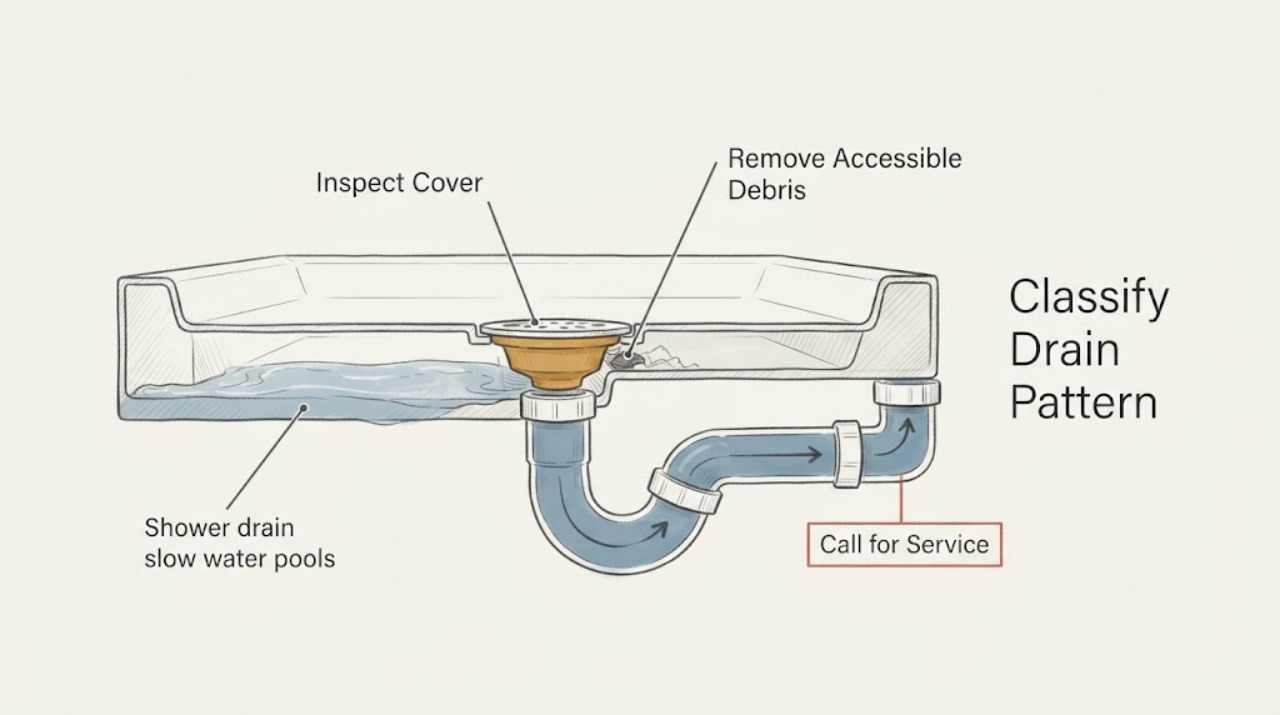
Water pooling around your feet while a shower runs is usually a partial restriction from hair, soap scum, skin cells, bath-product residue, or mineral deposits at the cover or nearby drain opening. First determine whether only this shower is slow, then clean the removable cover and accessible debris without pushing it deeper or mixing chemicals. If the cover is clear but flow stays slow, several fixtures are affected, water backs up elsewhere, or you notice sewage odor, discolored water, a leak, or repeated recurrence, stop using the affected drain and arrange qualified plumbing service; those patterns can indicate a deeper branch, vent, or main-line problem rather than a surface clog.
Before you begin
Safety first
- This article supports ordinary-access observation and removal of plainly accessible debris only. A professional should handle deeper drain clearing, concealed plumbing, contaminated water, damaged drain assemblies, and any chemical exposure.
Work through in order
Diagnostic checks
Use only checks that match the exact appliance or system and its official guide.
-
Check 1
With the shower off and the floor safe to stand on, observe how quickly the pooled water falls and compare a nearby sink or tub drain during ordinary use; do not add water if another fixture is already backing up.
Expected result: Record whether the symptom is limited to this shower, whether water remains after the shower stops, whether another fixture makes the shower rise or gurgle, and whether multiple fixtures are slow.
Next step: If the problem is shared, stop testing with more water and arrange plumbing assessment; if it is isolated, continue only with ordinary-access drain inspection.
Stop if: Stop using the affected fixtures for a sewage-smelling or discolored backup, water rising elsewhere, an active leak, or any condition that could spread contaminated water.
Why this matters
Why: A symptom isolated to one shower supports a local cover, strainer, trap, or branch check. Cross-fixture backup, gurgling, or several slow fixtures makes a shared downstream, vent, or main-line restriction more likely.
-
Check 2
Put on gloves, remove the shower drain cover or strainer only if it is intended to lift or unscrew with ordinary access, and clean the removed piece with mild soap and water; do not force a stuck fastener or dismantle the drain body.
Expected result: Look for a mat of hair, soap scum, skin residue, mineral crust, a damaged grate, or a cover that will not come out without force.
Next step: Lift out only loose, accessible debris, keep the cover and fasteners together, and continue to the opening check if the assembly remains intact.
Stop if: Stop if the cover is cracked, bonded, corroded, sharp, or stuck, or if standing water appears contaminated; ask a qualified plumber to handle the assembly.
Why this matters
Why: Debris on the cover can restrict the inlet and explain a local slow drain. A clear or damaged cover, or a cover that requires force, does not establish that the pipe below is safe to dismantle.
-
Check 3
From the open drain, remove only hair or residue that is plainly accessible using a purpose-made plastic hair-removal tool or the drain manufacturer's approved hand method; pull debris upward rather than pushing it down.
Expected result: The material may come out as a visible hair-and-soap mass, only a small amount may be reachable, or nothing may be visible; note whether the drain begins to accept water more freely after the removal.
Next step: Bag the removed material, reinstall the cover only when it is clean and undamaged, and use a small amount of clean water to observe the result without creating a backup.
Stop if: Do not force a tool, use a wire or sharp object, plunge against an unknown drain design, use compressed water or air, or continue if a chemical product is present in the standing water.
Why this matters
Why: A clear improvement after lifting a local mass supports a near-opening restriction. No visible debris or no improvement makes a deeper trap or branch obstruction more likely and is not a reason to force a tool farther.
-
Check 4
After replacing an intact cover or strainer, run a small amount of clean water while watching the drain and the floor, then stop before the water approaches the feet or any other fixture begins to back up.
Expected result: Record whether water moves away without pooling, still rises slowly, drains and then returns, or leaks around the cover or into an accessible adjacent area.
Next step: Use a hair catcher and periodically remove collected debris if the result is good; otherwise stop using the shower and provide the plumber with the before-and-after observations.
Stop if: Stop immediately for water below the shower, an active leak, foul odor, discolored water, or water rising at another fixture.
Why this matters
Why: Faster flow after safe debris removal supports a local inlet restriction. Persistent pooling, return of water, or a new leak points to a deeper blockage, damaged drain assembly, or sealing issue that needs diagnosis rather than more cleaner.
-
Check 5
Check the bathroom without opening walls, floors, traps, or ceilings for shared warning signs: another slow fixture, gurgling, sewage odor, repeated pooling after cleaning, or a leak at the drain area.
Expected result: Classify the remaining symptom as a one-time local improvement, an isolated slow drain with no improvement, a recurring drain, a cross-fixture backup, or contaminated water or leakage.
Next step: Arrange qualified plumbing service for persistent, recurring, shared, leaking, or contaminated-drain symptoms and report what was removed and any drain product used.
Stop if: Do not open concealed plumbing, run repeated drain chemicals, or keep using fixtures that back up, leak, or expose people to sewage-contaminated water.
Why this matters
Why: An isolated improvement supports routine debris prevention. Recurrence or no improvement may require a professional drain assessment; cross-fixture symptoms suggest a shared branch or main-line issue, and sewage or leakage raises the urgency and hygiene risk.
Use your observations
Decision map
Find the observation that best matches what you see, then follow the next safe action.
-
PATH 01Safety boundary
What you see
Only the shower is slow, hair or soap residue is accessible at the cover or opening, and flow improves after it is lifted out.
Do this next
Keep the intact cover seated, use a hair catcher if the drain design permits one, and remove collected debris routinely.
Why this path and its safety boundary
Why it matters: A near-opening restriction is plausible and the safe cleaning result supports a local cause.
Safety stop: Escalate if pooling returns quickly, the cover is damaged, or leakage or foul odor appears.
-
PATH 02Safety boundary
What you see
The cover and accessible opening are clear, but this shower remains slow after ordinary-access cleaning.
Do this next
Stop adding cleaners or forcing tools and arrange a plumber's drain assessment; share the cleaning result and fixture comparison.
Why this path and its safety boundary
Why it matters: A deeper trap or branch restriction, mineral buildup, or drain assembly problem is more likely than debris on the cover.
Safety stop: Do not open concealed plumbing or use aggressive pressure equipment as a homeowner test.
-
PATH 03Safety boundary
What you see
The shower backs up or gurgles when another fixture runs, or more than one bathroom fixture drains slowly.
Do this next
Limit water use in the affected area and arrange qualified plumbing diagnosis before further testing.
Why this path and its safety boundary
Why it matters: The pattern is consistent with a shared branch, vent, or main-line drainage issue rather than a shower cover alone.
Safety stop: Stop using fixtures if wastewater rises, smells foul, or threatens floors, walls, or the level below.
-
PATH 04Safety boundary
What you see
The shower drains after cleaning but begins pooling again soon or repeatedly.
Do this next
Document when recurrence occurs and request a professional assessment rather than relying on repeated chemical or improvised treatments.
Why this path and its safety boundary
Why it matters: Recurring symptoms may indicate debris continuing into the drain, a deeper restriction, a damaged or poorly seated strainer, or an unaddressed drainage condition.
Safety stop: Stop if recurrence is accompanied by backflow, sewage odor, leakage, or water damage.
-
PATH 05Safety boundary
What you see
The cover is stuck, cracked, sharp, or damaged, or water leaks around the drain after reassembly.
Do this next
Stop using the shower if water can reach the floor structure and arrange qualified plumbing service with the cover and fasteners available.
Why this path and its safety boundary
Why it matters: The drain assembly or its seal may be damaged; forcing the cover or overtightening can worsen the leak.
Safety stop: Do not pry the drain body, seal over an unknown leak, or continue operating a leaking drain.
-
PATH 06Safety boundary
What you see
Standing water is foul-smelling, black or discolored, or appears to be sewage backup.
Do this next
Keep people and pets away, limit fixture use, contain spread without contacting the water, and arrange prompt professional plumbing or remediation guidance.
Why this path and its safety boundary
Why it matters: This is a hygiene and possible shared-drain boundary, not a routine hair-clog cleanup.
Safety stop: Do not plunge, add chemicals, or handle contaminated water without appropriate protective and cleanup guidance.
Helpful context
Understand the symptom
Start by separating a local shower clog from a shared drain problem
Notice whether the water rises only while this shower is running, remains for a long time after the controls are off, or backs up when a nearby sink, tub, or toilet is used. A slow shower with normal nearby fixtures supports a local strainer or trap check. Gurgling, sewage odor, backup at another fixture, or several slow fixtures makes a deeper shared drain or vent problem more likely; do not keep adding water to test it.
Hair and residue are common, but do not force a blockage farther into the pipe
Hair and soap buildup can collect on the cover and just below the drain opening. Remove only a cover or strainer that is designed to come out with ordinary access, wear gloves, and lift accessible debris out rather than pushing it down. Use the fixture maker's care instructions for any drain assembly. Mechanical clearing is generally preferred before chemical products, and repeated or harsh chemical use can damage some plumbing or leave a hazard for the next person working on the drain.
A clean cover does not prove the downstream drain is clear
If visible debris is gone but the shower still pools, the restriction may be farther into the trap or branch, or the drain body may have a damaged or poorly seated strainer. Do not open a trap, remove a wall or ceiling, use pressurized equipment, or improvise with tools that can damage the drain. Give a plumber the symptom timing, fixture comparison, cover condition, and what changed after safe cleaning.
Keep wastewater and chemical exposure out of the decision
Treat foul-smelling, black or discolored, or sewage-contaminated standing water as a hygiene boundary, not an invitation to keep plunging or pouring products. Keep people and pets away, prevent spread to other surfaces, and arrange prompt professional help. Never mix drain products, and disclose any product already poured into the drain before service.
Safety boundary
Stop conditions
- Do not force a stuck cover, open concealed plumbing, or dismantle a trap, drain body, wall, floor, or ceiling as a routine homeowner check.
- Do not push hair farther into the pipe, use sharp or improvised tools, or use pressurized equipment when the drain design and condition are unknown.
- Do not mix drain products, pour a product into standing water without following its exact label and plumbing compatibility instructions, or conceal a chemical treatment from the technician.
- Stop using the affected fixtures for wastewater backup, sewage odor, discolored water, an active leak, water damage, or water rising at another fixture.
- Arrange qualified plumbing service when accessible cleaning does not restore flow, the problem recurs, multiple fixtures are affected, or the drain assembly is damaged or unsafe to access.
Only after diagnosis
Potential parts
- shower drain cover or strainer
Consider this category only if the installed cover is cracked, missing, damaged, or cannot be restored after the cause of the slow drain is assessed.
Match the installed drain body, opening, retention method, finish, and manufacturer's fit information; do not choose by appearance alone. - shower drain hair catcher or basket
Consider this only when the drain design accepts an added catcher and the user wants to intercept hair before it reaches the opening.
Confirm that it seats without reducing the opening, holding water, creating a trip hazard, or interfering with the installed grate. - drain cover fastener or seal
Consider this category only when inspection confirms a missing or damaged retention or sealing component and the exact drain assembly is identified.
Use the installed manufacturer's specified component; do not compensate for a mismatch by overtightening, caulking over the leak, or forcing the cover.
When checks do not resolve it
Need a professional?
Arrange qualified plumbing service when the cover and accessible debris are clear but the shower still pools, the problem returns, another fixture is slow or backs up, gurgling or sewage odor is present, water is discolored, the drain leaks, or the cover cannot be removed safely. Stop using fixtures for contaminated backup or an active leak and tell the technician about any drain product already used.
Safety scope: This article supports ordinary-access observation and removal of plainly accessible debris only. A professional should handle deeper drain clearing, concealed plumbing, contaminated water, damaged drain assemblies, and any chemical exposure.
Common questions
FAQ
Why does water pool around my feet in the shower?
The most common local cause is a partial restriction from hair, soap scum, skin cells, product residue, or mineral deposits at the cover or drain opening. If several fixtures are slow, water backs up elsewhere, or the shower remains slow after safe cover cleaning, the issue may be deeper in the shared drainage path.
Can I remove the shower drain cover myself?
Only if it is designed to lift or unscrew with ordinary access and comes out without force. Wear gloves, keep the fasteners together, clean the cover, and stop if it is stuck, corroded, cracked, sharp, or part of an assembly you cannot identify safely.
What can I do if I can see hair in the shower drain?
Remove only plainly accessible hair or residue with a purpose-made plastic hair-removal tool or the drain manufacturer's approved hand method, pulling upward instead of pushing debris down. Do not force sharp or improvised tools, and stop if the drain contains a chemical product or contaminated water.
Should I pour chemical drain cleaner into a slow shower drain?
Do not mix products or use a chemical cleaner as a first guess. Follow the exact product label and compatibility directions if a product is used, and disclose it to any technician. Persistent, recurring, shared, leaking, or contaminated symptoms need qualified diagnosis rather than repeated chemicals.
When should I call a plumber for a slow shower drain?
Call when accessible debris removal does not restore flow, pooling returns, another fixture is slow or backs up, you hear gurgling, sewage odor or discolored water is present, the drain leaks, or the cover cannot be removed safely. Stop using affected fixtures for active leaks or contaminated backup.
Read the exact guide
Official sources
- Clog, Be Gone! | Delta Faucet BlogDelta Faucet Company · Delta's general shower-drain guidance; the installed drain manufacturer's instructions control the particular cover and assembly.
- How to Unclog a Shower DrainOatey · Oatey's general residential shower-drain guidance; product labels, pipe materials, the installed drain design, and qualified local service control a particular repair.
Community feedback
Share a repair observation
Share a plain-text repair observation. Accepted observations are published automatically; this page may take a moment to update.