
On this page
Start here
Quick answer
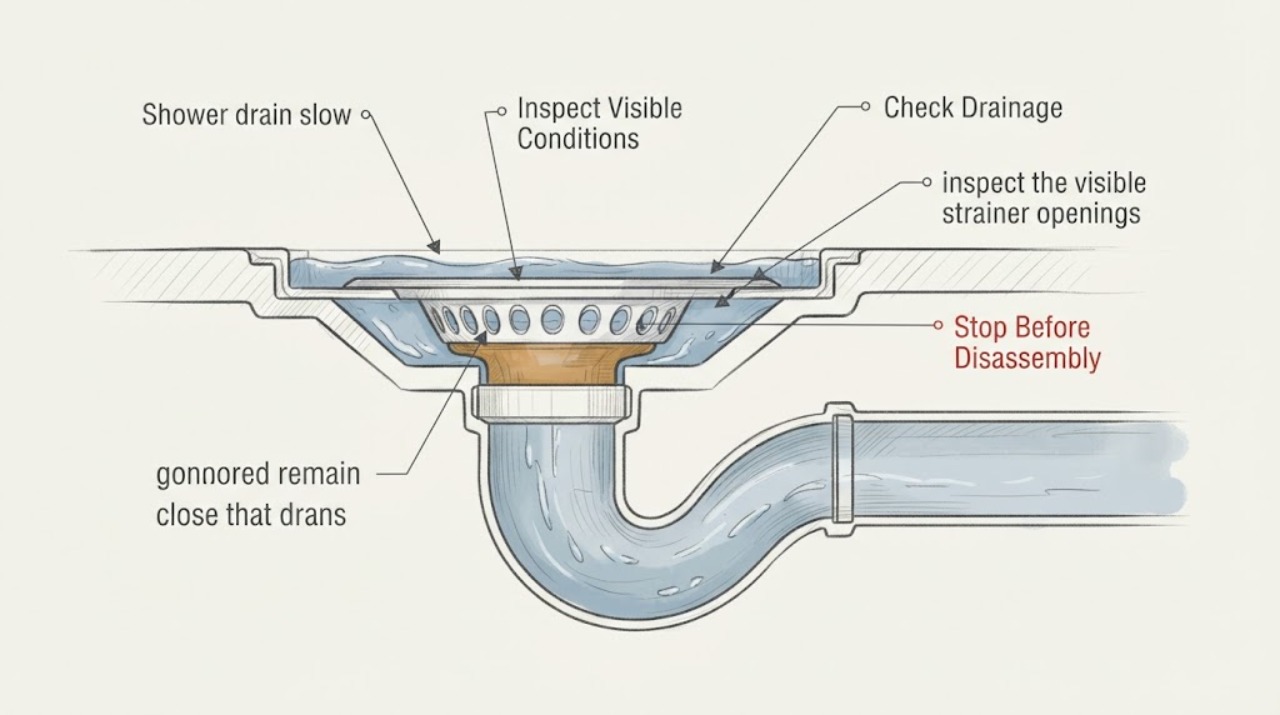
First determine whether the slow drain is limited to the shower or affects other fixtures, and when the slowdown starts during a normal shower. From a dry position, look at the visible strainer for hair or soap buildup without removing it or reaching into the drain, and note whether water pools, smells like wastewater, or rises toward the threshold. Do not pour caustic chemicals, mix cleaners, use pressurized devices, remove a trap or drain assembly, or expose yourself to sewer water. If other fixtures also drain slowly, water backs up, wastewater is present, the drain does not improve after a safe professional assessment, or the cause is below the visible strainer, call a plumber.
Before you begin
Safety first
- The reader should limit work to safe observation from above and ordinary-use timing. Do not mix or pour caustic chemicals, use pressure, remove a trap or drain assembly, force a tool, contact sewer water, or perform plumbing work that could damage the shower pan or line.
Work through in order
Diagnostic checks
Use only checks that match the exact appliance or system and its official guide.
-
Check 1
During one ordinary shower, observe from a stable position when water first begins to pool and whether the level falls between uses; do not intentionally overflow the pan or continue if the floor becomes slippery.
Expected result: Water drains normally, pools only near the end of use, pools quickly, rises toward the threshold, or remains after the shower.
Next step: Record the timing, water location, and whether the water clears between uses, then provide those observations to a plumber.
Stop if: Stop using the shower if water approaches the threshold, enters another room, creates a slip hazard, or appears contaminated.
Why this matters
Why: The timing and level show whether this is a mild flow change or an urgent backup risk. Rapid or persistent pooling needs service before more water is used.
-
Check 2
Without running a large volume of water, observe whether the nearby sink, tub, toilet, or floor drain shows the same slow drainage or bubbling during ordinary use.
Expected result: Only the shower is slow, or two or more fixtures are slow, bubbling, or backing up.
Next step: Tell the plumber which fixtures are affected and whether they changed at the same time; stop testing if water backs up or wastewater appears.
Stop if: Do not keep sending water into the system to compare fixtures once backup, bubbling, or overflow begins.
Why this matters
Why: A shower-only pattern points toward the shower fixture or branch. Multiple affected fixtures raise concern for a shared downstream restriction and make a plumber visit more urgent.
-
Check 3
From above the drain, inspect the visible strainer openings with a flashlight or camera without removing the cover, inserting a tool, or reaching into the drain.
Expected result: Hair, soap film, or debris is visibly covering openings; the openings look clear; or the strainer is damaged, displaced, or missing.
Next step: Photograph the strainer and note its shape and location; ask the plumber whether the installed cover can be safely serviced or should be replaced.
Stop if: Do not lift, unscrew, pry, hook, or push material through the strainer.
Why this matters
Why: Visible buildup can explain a local slowdown, but a clear strainer does not rule out a restriction below it. A damaged or missing strainer needs a plumbing assessment before any replacement is selected.
-
Check 4
Observe the water's appearance and odor only from a safe distance, and check the shower floor, threshold, and nearby baseboard for water escaping the intended area.
Expected result: Water is clear and contained, has an unusual wastewater odor or visible residue, or has escaped onto the floor, wall, or adjacent room.
Next step: Keep people away, stop water use, and tell the plumber exactly where the water or odor was observed; do not touch or collect the water.
Stop if: Stop immediately when wastewater, sewage-like odor, electrical exposure, or a slip hazard is present.
Why this matters
Why: Unusual odor, residue, or escaped water raises the risk of a broader drain or sanitary problem and should not be handled as a cosmetic strainer issue.
-
Check 5
Compare today's drain behavior with recent showers and note whether the slowdown began suddenly, worsened gradually, followed construction or cleaning work, or returns after a period of normal drainage.
Expected result: The change is sudden, gradual, intermittent, or consistently worsening.
Next step: Share the timeline, recent work, products already put down the drain, and whether any pressure or disassembly was attempted; do not add another product to test the theory.
Stop if: Stop further testing if any chemical product has already been used, the drain backs up, or the floor is unsafe.
Why this matters
Why: A sudden change after work or an event and a steadily worsening pattern both help a plumber distinguish a local visible issue from a deeper or shared restriction; intermittent behavior still warrants disclosure.
Use your observations
Decision map
Find the observation that best matches what you see, then follow the next safe action.
-
PATH 01Safety boundary
What you see
The shower alone is slow, the strainer visibly has buildup, and there is no backup, wastewater, or unsafe water on the floor.
Do this next
Ask a plumber or qualified service provider to confirm the installed strainer and choose an approved, non-damaging cleaning or service method.
Why this path and its safety boundary
Safety stop: Do not reach into the drain, remove the cover, use pressure, or pour a chemical cleaner.
-
PATH 02Safety boundary
What you see
The strainer looks clear or damaged, but the shower remains slow.
Do this next
Request a plumber's assessment of the drain assembly and downstream line rather than assuming the cover is the cause.
Why this path and its safety boundary
Safety stop: Do not force a tool through the strainer or disassemble the trap or drain hardware.
-
PATH 03Safety boundary
What you see
Other fixtures are slow, bubbling, or backing up as well.
Do this next
Stop adding water and arrange prompt plumbing service for a possible shared-line restriction.
Why this path and its safety boundary
Safety stop: Do not use a pressurized device or chemical product while the shared drainage condition is unknown.
-
PATH 04Safety boundary
What you see
Standing water has an unusual wastewater odor, visible residue, or has escaped the shower area.
Do this next
Keep people and pets away and contact a plumber; provide the water location and fixture pattern without handling the water.
Why this path and its safety boundary
Safety stop: No contact with sewer-like water, and no further shower use until the risk is assessed.
-
PATH 05Safety boundary
What you see
A chemical drain product has already been used, or products may have been mixed.
Do this next
Stop adding anything else, keep the area ventilated only if it is safe, and tell the plumber the exact product and timing.
Why this path and its safety boundary
Safety stop: Do not mix, neutralize, siphon, pressurize, or disassemble a drain that may contain chemical residue.
Helpful context
Understand the symptom
A shower that drains slowly may have buildup at the visible strainer, a restriction farther down the branch, or a problem shared with other fixtures. The pattern matters: a shower-only slowdown is different from water backing up in several fixtures. A normal-looking strainer also does not prove that the downstream line is open.
Keep the first check observational and low risk. Use only ordinary shower use if the floor remains safe, look from above without removing hardware, and stop before chemicals, pressure, disassembly, or contact with standing wastewater. EPA guidance treats some drain products as household hazardous waste and warns that incompatible products can react when mixed.
A shower drain is designed with a strainer, but the exact grate, trap, and line configuration varies by installation and jurisdiction. Do not assume that a cover can be lifted or a tool can be forced through it. Give the plumber the observed scope, timing, strainer condition, and water behavior so the next step matches the installation.
These checks are for deciding urgency and preparing a service call, not for exposing a drain or sewer line. Keep children and pets away from pooled water and use the shower only when the floor and drainage behavior remain safe.
Only after diagnosis
Potential parts
- shower drain hair catcher
Consider a catcher only if a plumber confirms the drain opening and installation can accept it without reducing flow or interfering with the existing strainer.
Match the opening, height, material, and cleanability to the installed drain; do not force a universal insert into an unknown assembly. - drain snake
Consider a snake only when a qualified plumber selects the method for the known drain configuration and confirms that it will not damage the pan, trap, or line.
Confirm access, length, diameter, and safe use for the installation; this article does not authorize user disassembly or pressurized clearing. - shower drain cover
Consider a replacement only if the existing strainer is damaged, missing, or incompatible after a plumber identifies the drain assembly.
Verify the drain brand or dimensions and attachment method before ordering; a cover should not be used to conceal a deeper restriction.
When checks do not resolve it
Need a professional?
Safety scope: The reader should limit work to safe observation from above and ordinary-use timing. Do not mix or pour caustic chemicals, use pressure, remove a trap or drain assembly, force a tool, contact sewer water, or perform plumbing work that could damage the shower pan or line.
Have this ready
- Share the pooling timing, fixture scope, visible strainer condition, water appearance and odor, recent work or products used, and whether any pressure, removal, or disassembly was attempted.
Common questions
FAQ
What does a slow shower drain usually tell me?
It tells you that water is leaving the shower more slowly than expected, but not where the restriction is. Compare the shower with nearby fixtures, observe the visible strainer without opening it, and note whether pooling is local, recurring, or spreading.
Should I pour drain cleaner into a slow shower drain?
Do not add a chemical product as a first observation step, and never mix products. EPA identifies some household cleaners as hazardous and warns that incompatible products can react. Tell the plumber if any product has already been used.
When is a slow shower drain an urgent plumbing call?
Call promptly when water backs up, reaches the threshold, escapes onto the floor, smells like wastewater, affects other fixtures, or follows a chemical product. Stop using the shower until the situation is assessed.
Read the exact guide
Official sources
- Household Hazardous Waste (HHW)U.S. Environmental Protection Agency · Supports the article's no-mixing and no-unplanned-chemical boundary for a slow shower drain; it does not prescribe a shower-drain clearing procedure.
- 815 KAR 20:070 Plumbing FixturesKentucky Legislative Research Commission · Used only as a jurisdiction-specific example that shower drains are designed with strainers and that fixture access and configuration are installation-dependent; local requirements and the actual drain assembly may differ.
Community feedback
Share a repair observation
Share a plain-text repair observation. Accepted observations are published automatically; this page may take a moment to update.