
On this page
Start here
Quick answer
Compare the shower's hot and cold flow separately, then compare another shower device and another fixture before changing a part. If only hot or only cold is weak, the temperature-specific path points toward a partly closed check stop, inlet screen, balancing spool, cartridge, or supply on that side. If both temperatures are weak only at one showerhead or handheld, a clogged device or transfer valve is more likely; if both are weak throughout the shower or home, look upstream to the mixing valve, pressure, or building supply. Remove and clean a showerhead only as the installed model allows, and do not drill out or remove an integral flow-control component. Sudden temperature changes, a missing pressure-compensating valve, or a pressure change when another fixture runs can create a scald risk. Stop and arrange qualified plumbing service when the valve, cartridge, check stop, concealed piping, or temperature-control function needs disassembly or when flow remains low after safe device checks.
Before you begin
Safety first
- This article covers comparing flow, ordinary-access device inspection, visible labeled stop or handle checks, and brief observation for temperature stability. It does not authorize limiter alteration, cartridge or valve disassembly, pressure adjustment, concealed access, or supply repair.
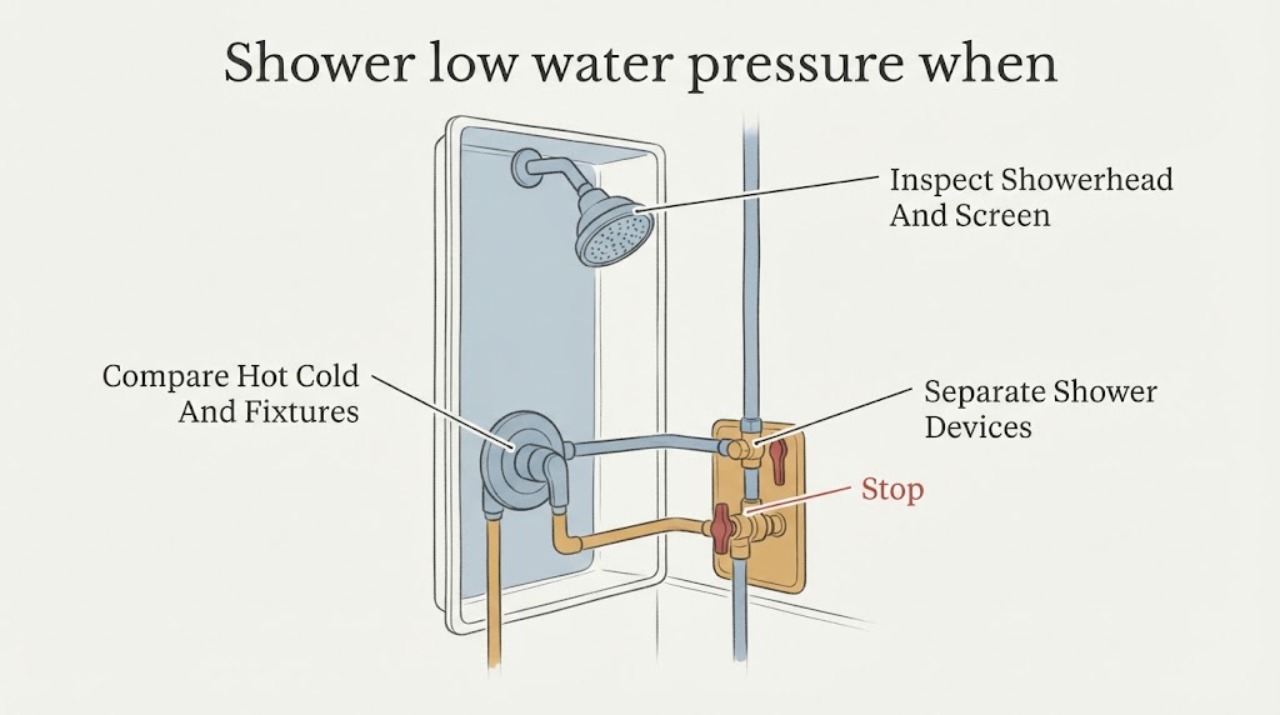
Work through in order
Diagnostic checks
Use only checks that match the exact appliance or system and its official guide.
-
Check 1
With the shower area clear, use the normal control to compare hot, mixed, and cold flow at the same shower device, then compare another shower device or nearby bathroom fixture without removing trim or opening the wall.
Expected result: Record whether only hot, only cold, both temperatures at the shower, only one device, or several fixtures are weak; note whether flow changes when another fixture runs.
Next step: Use the pattern to select the device, valve, or upstream branch below. Stop and arrange service for sudden temperature changes, an unsafe hot stream, leaks, or any need to open a concealed valve.
Stop if: Do not keep testing if the water becomes scalding, pressure changes sharply, the control sticks, or water leaks behind the wall or below the shower.
Why this matters
Why: Only one temperature suggests a temperature-specific mixing-valve or supply path. Both temperatures at one device suggest a showerhead or transfer path. Several shower devices or fixtures being weak points toward the main mixing valve, pressure, or building supply rather than a single spray outlet.
-
Check 2
If the shower has a showerhead, handheld, or body spray on a transfer control, operate only the normal selection for each device and compare their flow without running multiple devices unnecessarily.
Expected result: Note whether one device is weak or has no flow while another is normal, whether all devices are weak, and whether the problem changes with the transfer setting or temperature.
Next step: For a single-device result, continue to the manufacturer-permitted device inspection. For all-device or temperature-specific results, document the pattern and arrange valve or plumbing diagnosis rather than swapping showerheads at random.
Stop if: Do not force a transfer handle, block an outlet, remove trim, or continue operating a system that produces unstable temperature.
Why this matters
Why: A single-device reduction supports a blocked device or transfer-valve path. An all-device reduction shifts suspicion to the mixing valve or supply. A temperature-specific reduction that appears on every device points toward the hot or cold side of the mixing system.
-
Check 3
If only one device is weak and no temperature hazard is present, remove the showerhead or handheld only by the installed model's ordinary procedure; inspect the visible inlet screen, washer, spray openings, and scale or debris, then restore the original flow-control arrangement.
Expected result: Classify the device as visibly scaled or blocked, damaged, missing a washer or screen, clean but still weak, or impossible to inspect without force or deeper disassembly. If the model procedure permits a brief test without the device, compare the exposed outlet flow carefully.
Next step: Use only the manufacturer's approved cleaning or seal replacement, rinse and retest once, and arrange service for a damaged device or unchanged flow. Keep any restrictor or pressure-compensating insert in its original position.
Stop if: Do not drill, pin, scrape, enlarge, discard, or substitute an integral flow-control or pressure-compensating component, and do not force a threaded device.
Why this matters
Why: Normal flow with the device removed supports a blocked or damaged showerhead or handheld. Low flow with the device removed shifts suspicion to the transfer valve, mixing valve, check stops, or supply. Scale can restrict flow, but modifying the limiter can change performance and temperature behavior.
-
Check 4
If the shower was recently installed or serviced and its valve has clearly labeled, user-accessible hot and cold check stops, confirm from the manufacturer's instructions that each stop is in its normal open position; also verify the handle is being operated in the intended volume and temperature range.
Expected result: Record a stop that is partly closed, a handle position that limits volume, a recently changed valve or trim, or an unknown or concealed stop. Do not remove the escutcheon to reach a stop.
Next step: Correct only a clearly identified handle or stop position according to the exact instructions, then compare hot and cold once. If the stop is inaccessible, flow remains low, or temperature changes, arrange qualified plumbing service.
Stop if: Do not force a stop, turn an unlabeled valve, remove valve trim, or adjust pressure regulators or the cartridge as a homeowner experiment.
Why this matters
Why: A partly closed temperature-side stop or an incorrect handle position can create a one-sided or overall reduction after service. An unknown, inaccessible, or correctly open stop points toward screens, balancing components, cartridge, transfer valve, pressure, or supply diagnosis.
-
Check 5
During a normal, brief shower-flow observation, note temperature stability while no other fixture is started; stop the water if it becomes unexpectedly hot or cold, and do not measure or adjust internal valve pressure yourself.
Expected result: Record a stable but weak stream, a sudden hot or cold swing, a change when another fixture runs, a device that diverts water unexpectedly, or a control that cannot maintain the selected temperature.
Next step: Stop using the shower for unstable temperature and request a plumber to check the compensating valve, hot and cold supplies, showerhead flow, and transfer configuration. For stable low flow, provide the earlier device and temperature comparison to service if safe checks did not help.
Stop if: Do not remove the compensating valve, alter the limiter, adjust hidden stops, or continue testing water that swings dangerously hot or cold.
Why this matters
Why: A stable weak stream can remain a flow restriction, but sudden temperature changes raise a pressure-balancing, thermostatic, supply, or compatibility concern and create a scald or thermal-shock risk. Unexpected flow from another outlet can indicate a transfer or diverter issue.
Use your observations
Decision map
Find the observation that best matches what you see, then follow the next safe action.
-
PATH 01Safety boundary
What you see
One temperature is clearly weak at every shower device while the other temperature is normal, and nearby fixtures do not show the same difference.
Do this next
If an accessible stop was recently serviced, verify its normal position from the model instructions; otherwise arrange qualified valve and supply diagnosis with the hot-versus-cold pattern documented.
Why this path and its safety boundary
Why it matters: The temperature-specific path is more likely: a check stop, inlet screen, balancing spool, cartridge, or hot or cold supply restriction may be limiting that side.
Safety stop: Do not remove the cartridge, balancing component, or concealed stop, and stop immediately for unstable or unsafe temperature.
-
PATH 02Safety boundary
What you see
The showerhead, handheld, or one body spray is weak at both temperatures while another shower device is normal.
Do this next
Inspect the affected device's visible screen, washer, and scale only under its ordinary procedure. If its flow remains low when isolated, ask a plumber or manufacturer to evaluate the transfer path.
Why this path and its safety boundary
Why it matters: The restricted device or its transfer-valve path is more likely than the common mixing valve or building supply.
Safety stop: Do not drill the device, force the transfer handle, or substitute a flow-control insert.
-
PATH 03Safety boundary
What you see
Hot and cold flow are both weak at every shower device, including after a permitted device check, while nearby fixtures may be normal or may also be weak.
Do this next
Document whether other fixtures are affected and arrange qualified plumbing diagnosis of the valve, stops, pressure, and supply; do not keep replacing shower devices without isolating the common path.
Why this path and its safety boundary
Why it matters: A common mixing valve, overall transfer path, check stops, pressure condition, or building supply is more likely than one clogged showerhead.
Safety stop: Do not remove the mixing-valve cartridge, alter the home's pressure regulator, or open concealed plumbing.
-
PATH 04Safety boundary
What you see
The pressure difference began after the shower was installed, serviced, or its trim or device was changed, and a labeled check stop or handle position may be different.
Do this next
Use the exact installation instructions to verify only visible, labeled positions and device seating. If the result is still low or the instructions are unavailable, have the installer or plumber evaluate the assembly.
Why this path and its safety boundary
Why it matters: A partly closed stop, incorrect handle operation, displaced screen, or installation-specific valve configuration is plausible; the symptom does not identify a replacement cartridge.
Safety stop: Do not force stops, remove trim, change pipework, or change the flow-control arrangement to compensate.
-
PATH 05Safety boundary
What you see
Flow is low or changes when another fixture runs, and the shower temperature swings unexpectedly hot or cold, or water comes from an unintended outlet.
Do this next
Stop using the shower and arrange qualified plumbing service to evaluate the compensating valve, supplies, transfer arrangement, and showerhead compatibility.
Why this path and its safety boundary
Why it matters: A pressure-balancing or thermostatic valve, hot or cold supply difference, transfer or diverter path, or compatibility issue may be involved; this carries a thermal-shock or scald risk.
Safety stop: Do not continue testing, remove a limiter, adjust hidden pressure controls, or open the valve body.
-
PATH 06Safety boundary
What you see
Hot and cold flow are weak at several fixtures or the whole home, or the shower changes substantially when other fixtures use water.
Do this next
Reduce simultaneous water use and arrange qualified plumbing assessment of the home's supply and pressure. Keep the shower's flow-control and valve arrangement unchanged until the cause is known.
Why this path and its safety boundary
Why it matters: The issue is more likely upstream in the service pressure, main shutoff, supply, pressure regulator, or building plumbing than in the showerhead.
Safety stop: Stop for a leak, failed main shutoff, sudden pressure loss, water damage, or any need to adjust a regulator or access concealed piping.
Helpful context
Understand the symptom
Hot-versus-cold behavior is the first useful split
A weak hot stream and a normal cold stream do not point to the same place as two weak streams. Start with the same shower device and control position, then compare the other temperature and a nearby fixture. A temperature-specific difference makes a mixing-valve, check-stop, inlet-screen, balancing, cartridge, or supply issue more plausible; an all-device or whole-home reduction points farther upstream.
One shower device can restrict flow by itself
A showerhead, handheld, body spray, or transfer setting can have a different restriction from the rest of the shower system. If the flow becomes normal with a device removed under the manufacturer's procedure, debris or scale in that device is a focused check. If the flow remains low with the device isolated, the valve or supply path deserves attention instead.
Low pressure and temperature safety are linked
An automatic-compensating shower valve is intended to reduce the effect of hot- or cold-side pressure changes on outlet temperature. A sudden change when another fixture runs, or a shower that swings hot and cold, is not a reason to remove the showerhead limiter. Keep the control near a safe temperature, stop if the water becomes unexpectedly hot, and have the valve and showerhead compatibility checked.
Safety boundary
Stop conditions
- Stop using the shower for sudden hot or cold swings, scalding risk, a leak behind the wall, water below the shower, a stuck control, or a failed or inaccessible stop.
- Do not drill, enlarge, remove, bypass, or substitute an integral flow-control or pressure-compensating component in the showerhead or valve.
- Do not remove a cartridge, balancing spool, diverter, pressure regulator, concealed stop, or valve trim without exact model instructions and appropriate plumbing experience.
- Do not force a handle or stop, change hidden pressure settings, or open concealed piping as a response to a hot-versus-cold flow difference.
- Arrange qualified plumbing service when a device check does not restore flow, several fixtures are affected, temperature is unstable, or the valve and supply path cannot be safely identified.
Only after diagnosis
Potential parts
- showerhead inlet screen or washer
Consider this only when one shower device is weak at both temperatures and inspection confirms a damaged, missing, or blocked screen or washer under the model's permitted procedure.
Confirm the exact device, seal location, dimensions, and manufacturer's fit information; keep integral flow-control and pressure-compensating components unchanged. - shower mixing-valve cartridge or balancing component
Consider this only after a qualified diagnosis confirms temperature-specific or all-device low flow in the mixing-valve path and rules out an accessible stop, device blockage, and supply issue.
Confirm the exact valve series, cartridge or balancing design, hot and cold orientation, and installation procedure; do not substitute a visually similar part. - shower transfer or diverter cartridge
Consider this only when one showering device is weak or has no flow while another device is normal and qualified diagnosis places the restriction in the transfer path.
Match the exact valve, number of functions, outlet arrangement, and manufacturer service information; do not force the transfer control or block an outlet. - shower valve pressure-compensating assembly
Consider this only when a qualified assessment confirms that the compensating valve or its compatibility is causing unstable temperature or hot-versus-cold flow behavior.
Confirm the exact valve, showerhead flow, plumbing arrangement, and applicable requirements with a qualified plumber or manufacturer before replacement.
When checks do not resolve it
Need a professional?
Arrange qualified plumbing service for sudden hot or cold temperature changes, a scald or thermal-shock concern, water behind the wall or below the shower, low flow at several fixtures, a failed or inaccessible check stop, a clean device that still has low flow, a suspected balancing or thermostatic valve problem, or any work involving a cartridge, diverter, concealed valve, pressure regulator, or supply piping.
Safety scope: This article covers comparing flow, ordinary-access device inspection, visible labeled stop or handle checks, and brief observation for temperature stability. It does not authorize limiter alteration, cartridge or valve disassembly, pressure adjustment, concealed access, or supply repair.
Common questions
FAQ
Why is shower pressure low on hot water but normal on cold?
A temperature-specific difference points toward the hot-side check stop, inlet screen, balancing component, cartridge, or supply rather than the showerhead alone. Confirm any clearly labeled stop position after recent service, then arrange valve or supply diagnosis if the difference remains.
Why are both hot and cold sides weak at the shower?
Both weak at one device can indicate a blocked showerhead, handheld, or transfer path. Both weak at every shower device points more toward the mixing valve, check stops, pressure, or supply; compare another fixture before choosing a part.
Can a clogged showerhead cause low water pressure?
Yes. Scale or debris can restrict a showerhead or handheld. Remove and clean it only as the model permits, keep its flow-control arrangement intact, and treat normal flow with the device removed as evidence that the device—not necessarily the valve—is restricted.
Why does shower temperature change when another faucet runs?
Using another fixture can change hot or cold pressure at the shower. A properly selected compensating valve is intended to reduce significant fluctuations, but sudden hot or cold changes need plumbing assessment because they can create thermal-shock or scald risk.
Should I remove the showerhead flow restrictor to improve pressure?
No. Do not drill out, remove, or substitute an integral flow-control or pressure-compensating component. It can alter performance and temperature behavior; ask a plumber or manufacturer to identify a compatible solution if the design flow is unsuitable.
When does low shower pressure need a plumber?
Arrange service for a hot-versus-cold difference that remains after safe checks, low flow at several fixtures, unstable temperature, leaks, a failed or inaccessible stop, a clean device that is still weak, or any work involving a cartridge, balancing valve, transfer valve, pressure regulator, or concealed supply.
Read the exact guide
Official sources
- ShowerheadsU.S. Environmental Protection Agency · EPA WaterSense program information for labeled showerheads; a particular device's manufacturer instructions control its cleaning and parts.
- Shower Faucet: Flow Issues- Moentrol with Integrated Transfer ValveMoen Solutions · Moen Moentrol integrated-transfer guidance; the handle and valve arrangement is model-specific.
- WaterSense at Work Sanitary Fixtures and Equipment 3.4 Showerheads and Bath and Shower DivertersU.S. Environmental Protection Agency · EPA WaterSense technical guidance; it does not diagnose a particular shower and installed manufacturer instructions and local requirements control.
- Shower Faucet: Low Flow- Independent Transfer ValvesMoen Solutions · Moen shower-system troubleshooting guidance; other valve families, devices, and installation configurations differ.
- Rite-Temp Valve Dripping from Showerhead or SpoutKohler Assist · Kohler Rite-Temp single-control shower-valve guidance; other valves and installations differ.
Community feedback
Share a repair observation
Share a plain-text repair observation. Accepted observations are published automatically; this page may take a moment to update.