
On this page
Start here
Quick answer
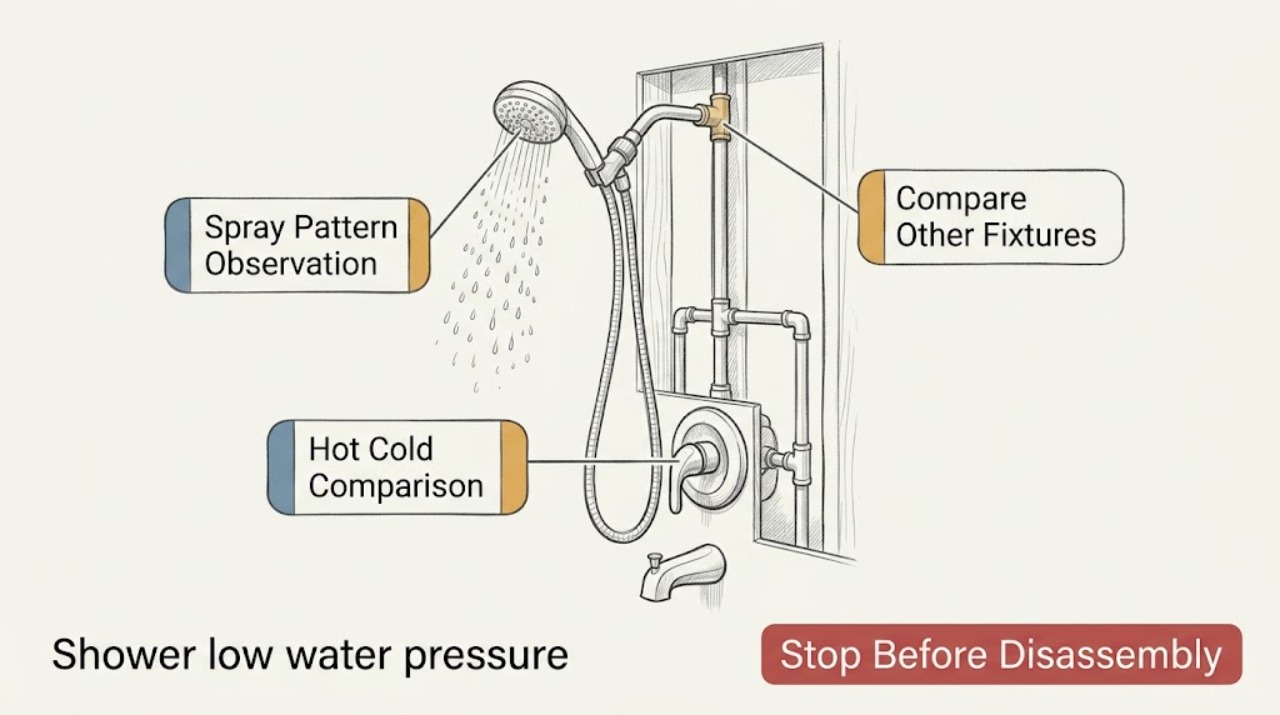
Start by deciding whether the weak flow is limited to this shower or affects other fixtures. From a safe standing position, observe the spray pattern, compare hot and cold separately, note whether a tub spout or handheld works differently, and look for a visible kink, leak, or recent change. Do not remove a concealed valve, force a handle, adjust a pressure device, use harsh chemicals, or open plumbing. A blocked or changed showerhead can create a local symptom, while a house-wide or temperature-specific loss points toward supply or valve service. Stop for a leak, scalding or unexpectedly cold water, damage, or rapidly worsening flow and call a plumber.
Work through in order
Diagnostic checks
Use only checks that match the exact appliance or system and its official guide.
-
Check 1
During a normal shower use, observe this shower's flow, then compare a nearby sink or another shower at its ordinary faucet position without running multiple fixtures unnecessarily.
Expected result: Record whether the weak flow is limited to this shower, affects several fixtures, or changes when another fixture is being used.
Next step: Keep a note of which fixtures and times show the change, then continue with the showerhead-pattern and temperature observations only if there is no leak or unsafe temperature behavior.
Stop if: Stop and call a plumber for a leak, water damage, a sudden house-wide loss, or any fixture that cannot be shut off normally.
Why this matters
Why: A single weak shower points toward the visible shower device or local control path. A broader or time-dependent drop suggests a household supply, shared plumbing, or demand-related issue.
-
Check 2
From the shower floor, observe the visible showerhead spray without removing, scraping, poking, or forcing the head or its openings.
Expected result: Note whether the spray is even, weak across the whole face, or concentrated in only a few jets; look for visible mineral scale, debris, or a kinked visible hose if present.
Next step: Record the pattern and model information. Use only the manufacturer's model-specific care guidance for any removable device; otherwise ask a plumber before removing or cleaning it.
Stop if: Stop if the head, arm, trim, or hose moves, leaks, cracks, or requires force; do not continue handling it and arrange plumbing service.
Why this matters
Why: An uneven pattern or visible buildup makes the showerhead path a plausible restriction. A uniformly weak stream with a clear face is less specific and may involve the hose, control, or supply.
-
Check 3
Use the normal shower control gently and observe the flow first toward the cooler setting and then toward the warmer setting, stopping at a comfortable temperature; do not force the handle or deliberately create a scalding condition.
Expected result: Record whether both temperature directions are similarly weak, only hot or only cold is weak, or flow changes abruptly while the handle moves normally.
Next step: Give the temperature pattern to a plumber and avoid removing the trim or cartridge; keep the shower out of use if temperature control is unreliable.
Stop if: Stop immediately for scalding, unexpectedly cold water, unstable temperature, a stuck handle, or a leak and call a plumber.
Why this matters
Why: A temperature-specific reduction can indicate one supply side or the mixing-valve path. Similar weakness on both sides is more consistent with a shared restriction, shower device, or overall supply condition.
-
Check 4
If the installation has a tub spout, handheld, or second shower device, use the normal diverter or selector once and observe each visible outlet without forcing the selector or disconnecting a hose.
Expected result: Record whether one outlet has normal flow while another is weak, whether water comes from more than one outlet, or whether every outlet is weak.
Next step: Return the selector to its normal position and report the outlet pattern and any water escaping from an unintended outlet to a plumber; do not access a concealed diverter cartridge.
Stop if: Stop for a selector that sticks, a leak behind trim, water entering a wall or ceiling, or any outlet that cannot be controlled normally.
Why this matters
Why: One weak outlet points toward that device or a transfer/diverter path. Flow from multiple outlets or uniformly weak flow can indicate a control or supply issue that needs model-specific diagnosis.
-
Check 5
Observe when the low flow occurs—every use, only at busy times, after another fixture runs, or only since a showerhead, plumbing, or water-supply change—without changing valves or pressure settings.
Expected result: Record the time, other fixtures in use, whether the condition is new or gradual, and whether the stream returns on its own.
Next step: Share the timeline with a plumber, including any visible moisture or prior service, and let the professional determine whether pressure or concealed components need testing.
Stop if: Stop using the shower and request prompt plumbing service if flow is rapidly worsening, water is escaping from a wall or ceiling, or the control cannot maintain a safe temperature.
Why this matters
Why: A demand- or time-linked change supports a supply or shared-system investigation. A gradual change isolated to this shower keeps a local restriction or device issue in consideration; a symptom immediately after service needs the installer or plumber to review the work.
Use your observations
Decision map
Find the observation that best matches what you see, then follow the next safe action.
-
PATH 01Next step
What you see
Only this shower is weak and the visible spray pattern is uneven or visibly obstructed.
Do this next
Treat the showerhead path as the first model-specific support question. Do not force removal or use chemicals; ask a plumber if the device cannot be safely serviced by its instructions.
-
PATH 02Next step
What you see
Several fixtures are weak, or the shower changes when another fixture is used.
Do this next
Request a plumber to assess the household supply and shared plumbing. Do not adjust a regulator, concealed stop, or pressure device yourself.
-
PATH 03Next step
What you see
Only hot or only cold flow is weak, or temperature changes are unstable.
Do this next
Stop using the shower until a plumber assesses the mixing and supply path; do not remove a cartridge or trim plate.
-
PATH 04Next step
What you see
One outlet is weak while another is normal, or water exits an unintended outlet.
Do this next
Provide the outlet pattern to a plumber for a device or diverter diagnosis. Do not open a concealed valve or force the selector.
-
PATH 05Next step
What you see
There is a leak, wall or ceiling moisture, scalding, unexpected cold water, visible damage, or a rapidly worsening loss of flow.
Do this next
Stop the shower and arrange prompt plumbing service; if water is actively damaging the property and the local shutoff is safely known, follow the household emergency plan without dismantling anything.
Helpful context
Understand the symptom
Separate the shower from the house
A low stream at one shower is a different starting point from low flow at several fixtures. The comparison does not prove which part failed, but it tells you whether to focus on the visible shower device or request a broader plumbing diagnosis. Make the comparison during ordinary use and do not change a pressure regulator or concealed stop.
Read the pattern, not just the sensation
Mineral or debris restriction can show up as uneven spray from the visible showerhead, while a temperature-specific change can point toward a mixing or supply path. A new showerhead can also feel weaker because its flow design differs from the previous one. Record the pattern before considering any part.
Keep the boundary observational
These checks use ordinary handles and visual observations only. Do not remove a trim plate, cartridge, filter, showerhead, hose, or concealed valve for this article, and do not scrape deposits or pour chemicals into the fixture. A plumber can isolate the water and identify a valve, cartridge, or supply fault safely.
Only after diagnosis
Potential parts
- shower head
Consider this only when the problem is isolated to the visible shower device and the spray pattern remains restricted after model-specific care guidance or a professional diagnosis.
Match connection, flow characteristics, and the exact fixture requirements; a similar-looking head is not proof of fit or performance. - shower cartridge
Consider this only when a plumber confirms a temperature-specific or overall local flow problem in the concealed mixing valve.
Identify the valve and model before ordering; cartridge access and replacement are not part of these user-level observations. - pressure-balancing valve
Consider this only after a plumber separates a valve or pressure-balancing fault from a showerhead restriction and household supply issue.
Confirm the complete valve model and approved compatibility information; do not adjust or replace a concealed valve based on symptom alone.
When checks do not resolve it
Need a professional?
Have this ready
- Provide the shower and other-fixture comparison, spray pattern, hot-versus-cold result, outlet or diverter pattern, timing, recent service or fixture changes, and any visible leak or damage.
Common questions
FAQ
Why is only one shower low pressure?
A single weak shower keeps the visible showerhead, hose, local control, or local restriction in consideration. Compare the spray pattern and other outlets, then use model-specific support or a plumber rather than opening a concealed valve.
What does low flow on only hot or only cold mean?
A temperature-specific change can point toward one supply side or the mixing-valve path. Stop if temperature is unstable or unsafe and give the pattern to a plumber; do not remove the cartridge.
Can I remove the showerhead to check the pressure?
This article keeps the check observational because forcing a connection can create a leak or damage the finish. If the head or hose does not clearly release under its model instructions, stop and ask a plumber.
Why does the shower get weaker when another fixture runs?
The timing suggests a shared supply or demand-related issue rather than proving that the showerhead is clogged. Record which fixtures and times are involved and request a plumbing assessment if the pattern persists.
Read the exact guide
Official sources
- Low flow from the shower (K-305 Rite-Temp Diverter Valve)Kohler Assist · The manufacturer identifies sediment or debris in a model-specific diverter channel as one possible cause and provides model-specific support rather than a universal diagnosis.
- Shower Faucet: Low Flow- Independent Transfer ValvesMoen Solutions · The guide distinguishes one-device low flow from overall or temperature-specific reductions and identifies the shower device, mixing valve, or transfer valve as different diagnostic paths.
- How to Fix Low Pressure in Your ShowerDelta Faucet · The manufacturer distinguishes pressure from flow, notes that debris can restrict a showerhead, and directs unresolved household or valve issues to a plumbing professional.
Community feedback
Share a repair observation
Share a plain-text repair observation. Accepted observations are published automatically; this page may take a moment to update.