
On this page
Start here
Quick answer
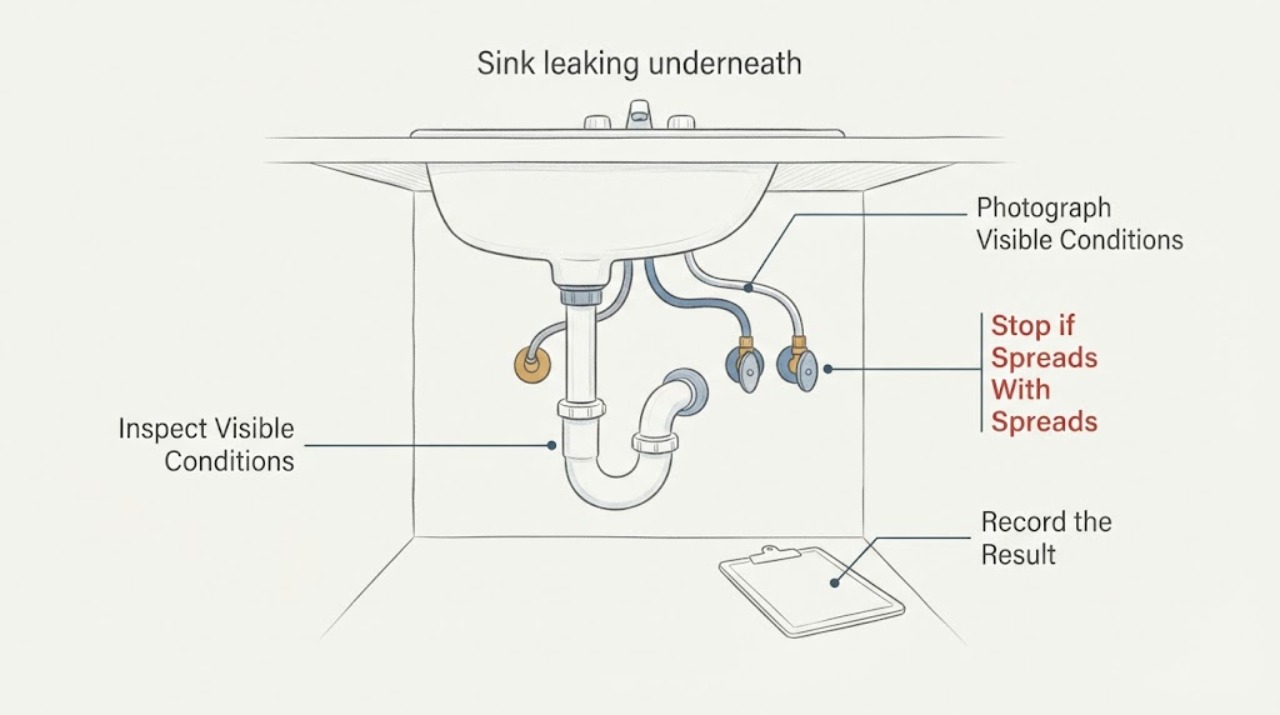
Stop using the sink if water is actively escaping underneath, then observe from a dry, safe position. If the leak is worsening and the fixture shutoff is dry, clearly accessible, and operates normally, close it gently; do not force it or dismantle any plumbing. Note whether water appears during faucet use, draining, overflow, or with no use, and whether it is at a supply connection, drain connection, basket, faucet body, or cabinet surface. Keep away from standing water or wet electrical equipment, and call a qualified plumber promptly if the source is uncertain, the shutoff fails, sewage is involved, or damage is spreading.
Work through in order
Diagnostic checks
Use only checks that match the exact appliance or system and its official guide.
-
Check 1
From a dry position, look for active dripping, a growing puddle, wet flooring, standing water, sewage-like water, or water near an outlet, appliance cord, disposal, or other electrical equipment. Stop using the sink and keep people and pets away; if water is worsening and a fixture shutoff is dry, clearly reachable, and normally operable, close it gently without force.
Expected result: The leak is active or expanding, the area contains standing or contaminated water, water is near electrical equipment, the shutoff is inaccessible or resists normal operation, or the area is dry with only an old mark.
Next step: Keep the sink out of service and call a qualified plumber; include an electrician if electrical equipment was wetted. Do not enter water, touch wet equipment, force a valve, or continue leak testing.
Stop if: Stop immediately if water reaches electrical equipment, sewage is suspected, the shutoff will not operate gently, water spreads rapidly, or the floor or cabinet becomes unstable.
Why this matters
Why: An active, contaminated, or electrically unsafe leak needs isolation and prompt professional help. A dry mark may still indicate prior damage or an intermittent leak, so it does not prove the problem is resolved.
-
Check 2
Using the existing leak history and safe visual access, note whether water appeared while the faucet was running, while the sink was draining, after an overflow or splash, or when the sink was unused. Photograph the dry visible area and do not run repeated faucet or drain tests to reproduce the leak.
Expected result: The leak is linked to faucet use, draining, an overflow, or no fixture use; the timing is inconsistent; or only staining remains.
Next step: Share the timing and photos with the plumber and leave the fixture unused while the source is uncertain or active.
Stop if: Stop if determining the timing would require prolonged water use, removing a panel, reaching into a wet cavity, or touching a fitting.
Why this matters
Why: Timing helps a plumber narrow the likely source, but water can travel and timing alone cannot confirm a supply, drain, basket, faucet, or concealed leak.
-
Check 3
From outside the cabinet and without touching plumbing, visually locate the highest visible wet point or stain among the faucet body, supply area, drain opening, trap area, cabinet floor, side walls, and underside of the counter. Look for water trails or a spot that is damp while nearby surfaces remain dry.
Expected result: A supply-side, faucet-side, drain-side, basket/underside, or cabinet-only pattern is visible; several areas are wet; or the source cannot be seen without disassembly.
Next step: Record the location and avoid tightening, loosening, or removing any connection. Ask the plumber to inspect the suspected source and the path water may have traveled.
Stop if: Stop if inspection would require moving the sink, removing the trap or supply, opening a wall or cabinet panel, or contacting wet material near electricity.
Why this matters
Why: The pattern is a useful service clue, but a cabinet surface can collect water from a higher concealed point. Multiple wet areas or an unseen source increases the need for professional diagnosis.
-
Check 4
Visually inspect the cabinet floor, toe-kick, side panels, adjacent flooring, and wall from a dry stance for swelling, dark staining, peeling finish, soft-looking material, odor, or a widening boundary. Do not press the material, pull the toe-kick, remove shelves, or clean suspected mold.
Expected result: Damage appears limited to a small dry mark; swelling, delamination, odor, or persistent dampness is visible; or damage extends beyond the cabinet.
Next step: Photograph the boundary and arrange plumbing plus cabinet or water-damage assessment after the leak is controlled. Isolate visible mold-like material and do not disturb it.
Stop if: Stop if material is sagging or unstable, mold-like growth is visible, contaminated water is involved, or the assessment would require demolition, cutting, or scraping.
Why this matters
Why: A small mark may be old, while swelling, odor, recurring dampness, or a wider boundary suggests hidden moisture or material damage that a surface repair will not solve.
-
Check 5
Record the fixture type and the information a plumber will need: kitchen or bathroom sink, single or double basin, disposal present or absent, visible shutoff location, whether the leak is intermittent, and any recent installation, drain clearing, or cabinet work. Use safe photos rather than removing parts or labels.
Expected result: The fixture identity and access are clear; a disposal or unusual configuration is present; recent work preceded the leak; or key information is unknown.
Next step: Give the plumber the fixture details, leak timing, visible location, shutoff status, damage boundary, and photos. Keep the area isolated until the source is confirmed.
Stop if: Stop if obtaining information would require touching a wet connection, opening a disposal, moving a fixed appliance, or working in a cramped or unsafe space.
Why this matters
Why: Configuration and recent work can change the likely source and the safe service plan. Unknown details are a reason to document, not a reason to disassemble.
Use your observations
Decision map
Find the observation that best matches what you see, then follow the next safe action.
-
PATH 01Next step
What you see
Water is worsening, the shutoff will not operate gently, sewage is suspected, or water is near electrical equipment.
Do this next
Stop using the sink, isolate the area from a dry safe location, and call qualified plumbing and electrical help as applicable. Do not enter water or touch wet equipment.
-
PATH 02Next step
What you see
The leak is associated with faucet use, draining, an overflow, or no fixture use.
Do this next
Give the timing and safe visual source clues to a plumber, but do not repeatedly run the fixture or loosen a connection to reproduce it.
-
PATH 03Next step
What you see
A visible supply, faucet, drain, basket, trap, or cabinet pattern is present.
Do this next
Photograph the pattern and leave the fixture unused while a qualified plumber confirms the source and repairs it.
-
PATH 04Next step
What you see
Swelling, odor, mold-like material, persistent dampness, or damage beyond the sink cabinet is visible.
Do this next
After source control, arrange cabinet or water-damage assessment. Do not scrape, clean, coat, dismantle, or demolish affected material yourself.
-
PATH 05Next step
What you see
The area is dry and only an old stain is visible, but the leak source is not confirmed.
Do this next
Keep a record and schedule a plumbing inspection; a dry surface does not rule out an intermittent or concealed leak.
Helpful context
Understand the symptom
Why water appears underneath a sink
Water under a sink can come from a supply connection, faucet body, drain or trap connection, sink basket, overflow, or a leak that travels along the underside of the counter. A wet spot is not always directly below the source. The useful first step is to record timing and location without loosening fittings or repeatedly running water.
Keep the area safe
Use only dry, readily accessible observation points. Do not reach into standing water, touch wet electrical equipment, force a shutoff, disconnect a supply or trap, cut pipe, disassemble a disposal, or continue using the sink to see whether the leak grows. If water has reached an outlet, appliance cord, or other electrical equipment, keep clear and arrange qualified electrical assessment.
The repair decision comes after source control
A plumber can confirm the source and stop the leak. Cabinet, flooring, or wall damage may need a separate assessment after the area is safe and dry. Do not cover a wet cabinet or apply a cosmetic sealant before the leak and any hidden moisture are addressed.
Only after diagnosis
Potential parts
- p-trap kit
Consider this part only if a qualified diagnosis identifies a damaged or incompatible trap as the confirmed source after the area is safe.
Confirm sink configuration, drain size, material, and local requirements before ordering; do not infer fit from the symptom. - faucet supply line
Consider this part only if a plumber confirms that the supply line or its connection is leaking and the shutoff and surrounding area are safe to service.
Verify connection type, length, material, faucet, and shutoff compatibility with the complete fixture details. - sink basket strainer
Consider this part only if a qualified inspection confirms leakage at the basket or sink-drain seal rather than at the trap, supply, or concealed structure.
Confirm basin opening, drain configuration, material, and model or fixture fit before selecting a replacement.
When checks do not resolve it
Need a professional?
Call a qualified plumber promptly for any active, worsening, recurring, concealed, or unexplained leak, and immediately isolate the area for sewage, standing water, failed shutoff, unstable damage, or wet electrical equipment.
Have this ready
- Provide sink type and configuration, leak timing, suspected location, whether the shutoff is safely accessible, photos from dry positions, recent work, water or sewage observations, and the visible damage boundary.
Common questions
FAQ
Should I shut off the water when a sink leaks underneath?
If the leak is worsening and the fixture shutoff is dry, clearly accessible, and operates normally, close it gently. Do not force a resistant valve or reach through standing water; keep the sink out of service and call a plumber.
How do I tell whether the sink supply or drain is leaking?
Use existing observations to note whether water appeared during faucet use, draining, an overflow, or while the sink was idle, and photograph the highest visible wet area. Do not loosen fittings or run repeated tests; a plumber should confirm the source.
What if water is near an outlet or disposal cord?
Keep clear and do not touch wet electrical equipment. Stop using the sink, isolate the area from a dry safe location, and arrange qualified electrical assessment in addition to plumbing service.
Can I repair the trap or supply line myself?
This page limits the first response to safe observation and a normal, accessible shutoff. Do not disconnect the trap or supply line when the leak is active, the shutoff is uncertain, water is near electricity, or the source is not confirmed; have a qualified plumber diagnose and repair it.
Read the exact guide
Official sources
- Home MaintenanceU.S. Environmental Protection Agency WaterSense · General residential water-fixture maintenance guidance used for safe observation and plumbing escalation.
- Mold Clean Up Guidelines and RecommendationsCenters for Disease Control and Prevention · General household mold-safety guidance supporting no-contact observation and professional escalation when mold-like material is present.
- Home Electrical Safety ChecklistU.S. Consumer Product Safety Commission · General home electrical-safety guidance used for the wet-equipment stop boundary under a sink.
Community feedback
Share a repair observation
Share a plain-text repair observation. Accepted observations are published automatically; this page may take a moment to update.