
On this page
Start here
Quick answer
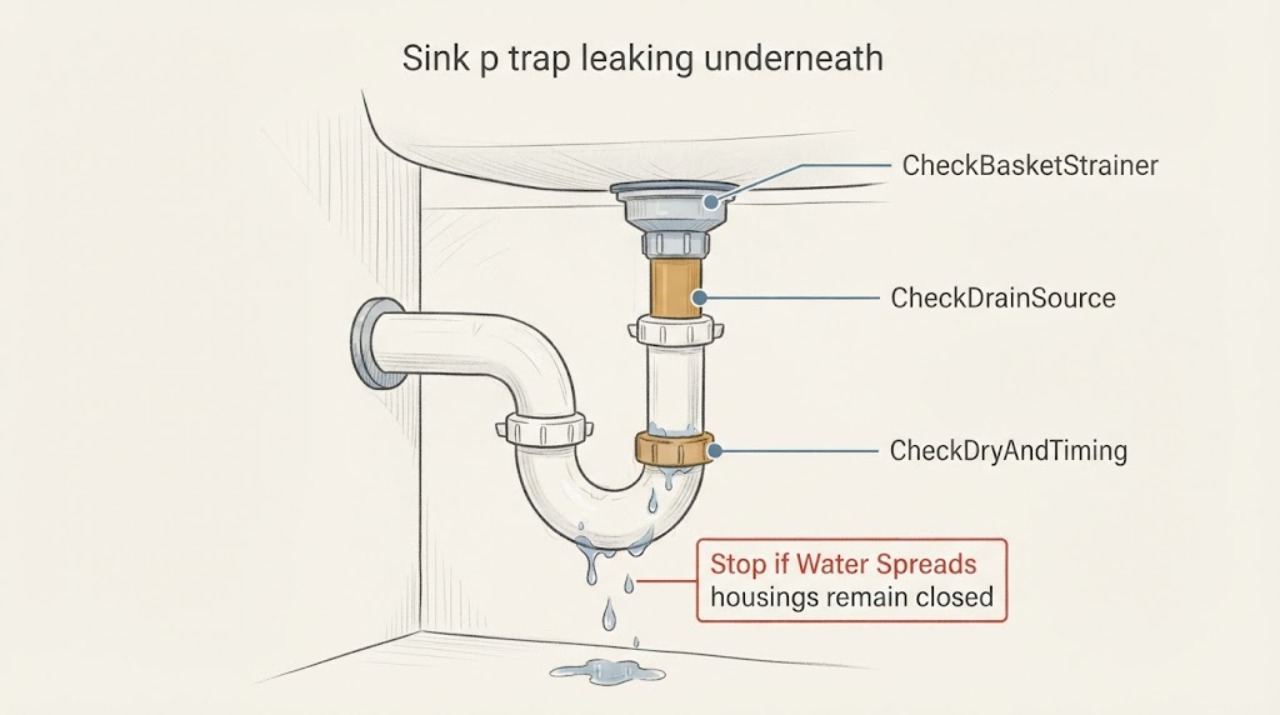
A wet P-trap does not prove that the trap itself is leaking. First dry the cabinet and identify whether water appears only when the sink drains, at a P-trap slip-joint, at the tailpiece above the trap, or around the sink basket strainer. A drip that starts at a connection under the bowl can be a washer, nut, misalignment, corrosion, or an upstream drain seal; a puddle that grows without using the sink can instead involve a faucet supply or shutoff. Use a dry towel or tissue from a safe position and, if the cabinet is stable, run only a small amount of clean water while watching the exact joint. Stop using the sink and call a plumber for a steady leak, cracked or corroded pipe, damaged cabinet, sewage odor, inaccessible or contaminated water, or any repair that would require cutting, opening a wall, or forcing plastic fittings. Do not overtighten plastic connections or use drain chemicals as a leak fix.
Work through in order
Diagnostic checks
Use only checks that match the exact appliance or system and its official guide.
-
Check 1
Remove items from under the sink, dry the visible P-trap, tailpiece, drain body, supply lines, and cabinet floor, then leave the faucet off for several minutes.
Expected result: Water returns while the faucet is off, or the area stays dry until the sink is filled and drained.
Next step: If water returns while unused, stop using the affected supply and inspect only visible supply connections before arranging plumbing service. If it stays dry, continue with one controlled drain observation.
Stop if: Stop for a steady stream, water near an outlet or appliance, sewage odor, contaminated water, a soaked cabinet base, or unsafe access.
Why this matters
Why: Moisture with no sink use makes a faucet supply, shutoff, dishwasher connection, or other pressurized line more likely than a drain-only P-trap leak. Moisture that appears only during draining keeps the drain assembly, including the P-trap and basket strainer, in focus.
-
Check 2
Place a towel or shallow container below the dry trap. From outside the cabinet, run only a small amount of clean water into the sink and watch the upper drain, tailpiece, curved P-trap, and trap arm in that order.
Expected result: The first wet point is above the trap, at the tailpiece-to-trap joint, at the curved trap, or at the wall-side trap arm.
Next step: Stop the water when the first source is visible, photograph it, and describe the exact joint to the plumber. Do not keep filling the sink or disassemble the trap merely to confirm the location.
Stop if: Stop immediately if the pipe shifts, cracks, sprays, the container overflows, or the leak reaches electrical equipment or stored chemicals.
Why this matters
Why: The first wet point is more informative than the lowest drip. Above-trap moisture points toward the basket strainer or drain-body seal; a slip-joint wetting points toward its washer, nut, alignment, or damaged threads; a wall-side wetting points toward the trap arm or wall connection.
-
Check 3
If water appears above the P-trap, look from below the sink bowl at the basket strainer or drain-body flange and the tailpiece connection. Keep the drain stopper and faucet still; do not turn the drain body or remove its retaining nut.
Expected result: Water starts at the underside of the sink around the drain flange, at the drain body or tailpiece, or only lower at the P-trap connection.
Next step: Mark the highest wet point with a photo and tell the plumber whether the leak occurs while draining or when water stands in the bowl. Keep the cabinet dry and avoid sealant or putty added from below.
Stop if: Do not loosen the drain body, pull the tailpiece, scrape old sealant, or use a wrench on a connection whose material and function are unknown.
Why this matters
Why: A wet underside of the bowl or drain flange is a basket-strainer or drain-body scope, not a P-trap replacement decision. A dry drain body with a wet slip joint keeps the P-trap washer, nut, alignment, or trap material as the more likely inspection area.
-
Check 4
Inspect the P-trap and trap arm from a normal position for a visible split, corrosion, white stress mark, missing washer edge, cross-threaded-looking nut, sag, or sideways force on the connections. Do not bend the pipe or tighten anything during this check.
Expected result: The trap and arm appear aligned and intact, or a crack, corrosion, unsupported span, visible washer displacement, or forced angle is present.
Next step: Photograph the condition and arrange a plumber when any damage, misalignment, or persistent joint leak is visible. If everything looks intact, use the timing and first-wet-point result to guide service instead of replacing the trap speculatively.
Stop if: Do not overtighten plastic, support the trap by hanging weight from it, cut the trap arm, or use tape or cement on a slip-joint connection unless the exact manufacturer procedure calls for it.
Why this matters
Why: An intact and aligned trap with a wet joint may need a model-specific washer or connection inspection. A crack, corrosion, sag, or forced angle can prevent the slip-joint washer from sealing and may require replacement or correction of the drain route rather than a simple tightening.
-
Check 5
Check the cabinet base, adjacent wall, and floor from a dry, accessible position for swelling, staining, mold-like growth, rust, or a spreading puddle. Keep the sink unused if water is reaching the cabinet structure.
Expected result: Only a small, recent wet spot is present, or the cabinet/floor is swollen, soft, stained, odorous, or repeatedly wet.
Next step: Photograph the damage, dry what can be safely dried, and request prompt plumbing service. Ask whether cabinet, flooring, or moisture remediation should be coordinated after the leak is stopped.
Stop if: Stop handling the area for sewage, mold-like contamination, unstable cabinetry, sharp corrosion, or water near electrical equipment.
Why this matters
Why: A small localized spot may be contained while the plumbing source is addressed. Swelling, odor, or repeated wetting means secondary damage may need attention as well as the P-trap or drain repair, and a hidden leak cannot be ruled out from the visible trap.
-
Check 6
Prepare a service note with sink type and location, the first wet point, whether the leak occurs only while draining, photos of the trap and drain underside, visible material or damage, and any recent faucet, disposer, dishwasher, or drain work.
Expected result: The leak began after installation or drain work, has gradually worsened, or has no identifiable trigger; the source is clear or remains uncertain.
Next step: Give the note and photos to a qualified plumber and ask them to verify the basket strainer, drain body, tailpiece, P-trap slip joints, trap arm, and any concealed or pressurized source before selecting parts.
Stop if: Do not dismantle the trap, pour chemicals into it, or leave a container as a permanent repair while the leak continues.
Why this matters
Why: Recent work makes alignment, washer placement, or a disturbed drain seal worth checking. A gradual or unexplained leak raises the value of inspecting the full drain path and cabinet damage rather than ordering a generic P-trap.
Use your observations
Decision map
Find the observation that best matches what you see, then follow the next safe action.
-
PATH 01Safety boundary
What you see
The sink stays dry when unused, and the first wet point appears at a slip-joint nut or washer on the curved P-trap while water drains.
Do this next
Keep the sink use to a minimum and have a plumber inspect the joint without assuming that overtightening or a universal trap will solve it.
Why this path and its safety boundary
Why it matters: The immediate scope is the P-trap connection, washer, alignment, threads, or trap material, but the correct fit and repair method depend on the assembly.
Safety stop: Stop if plastic is cracked, the pipe moves, the leak becomes a stream, or water reaches the cabinet structure or electrical equipment.
-
PATH 02Safety boundary
What you see
The first wet point is under the sink bowl at the drain flange or drain body, while the P-trap remains dry until water travels down from above.
Do this next
Describe the upper drain location and draining-only timing to the plumber and request a drain-body or strainer inspection.
Why this path and its safety boundary
Why it matters: A basket-strainer or drain-body seal is more likely than a leaking P-trap; replacing the visible curved trap could leave the actual leak untouched.
Safety stop: Do not rotate the drain body, remove the retaining nut, add putty or sealant from below, or keep filling the bowl.
-
PATH 03Safety boundary
What you see
Water returns while the faucet is off or appears at a supply hose, shutoff, faucet shank, or other pressurized connection rather than during draining.
Do this next
Stop using the sink and arrange plumbing service. If the flow is steady and the shutoff is safely identifiable, follow the home's normal water-isolation procedure without forcing a stuck valve.
Why this path and its safety boundary
Why it matters: The P-trap is less likely to be the source; a supply-side leak can continue without drain use and may worsen quickly.
Safety stop: Do not work on a pressurized connection, electrical appliance, or stuck shutoff when water is spreading.
-
PATH 04Safety boundary
What you see
The wall-side trap arm is wet, the trap appears forced out of alignment, water disappears into the wall, or no visible first wet point can be established.
Do this next
Keep the sink out of service and ask a qualified plumber to inspect the trap arm, wall connection, and concealed route before any cutting or replacement.
Why this path and its safety boundary
Why it matters: The drain route, wall connection, concealed pipe, or installation geometry may be involved and is outside a reliable visual-only P-trap diagnosis.
Safety stop: Do not open the wall, cut the pipe, push a snake through a leaking assembly, or force a misaligned joint.
-
PATH 05Safety boundary
What you see
The cabinet or floor is swollen or soft, there is mold-like growth, sewage odor, contaminated water, corrosion, or water near electrical equipment.
Do this next
Stop using the sink, keep people and pets away from the affected area, and arrange prompt plumbing and appropriate remediation or electrical help.
Why this path and its safety boundary
Why it matters: Secondary property or health risk may now be more important than identifying a replaceable trap part.
Safety stop: Do not handle contaminated water, wet electrical equipment, or unstable cabinetry.
-
PATH 06Safety boundary
What you see
The leak began immediately after a faucet, drain, disposer, dishwasher, or P-trap installation or service.
Do this next
Contact the installer or plumber with the first-wet-point photo and ask them to verify alignment, washer orientation, drain-body sealing, and the full connection path.
Why this path and its safety boundary
Why it matters: A disturbed washer, rotated drain body, misaligned trap arm, or connection that was overtightened is more plausible than unrelated pipe aging, but the visible symptom still needs confirmation.
Safety stop: Do not add more sealant or force a nut to compensate for an installation that is under warranty or otherwise unresolved.
Helpful context
Understand the symptom
The wet spot is a starting point, not a diagnosis
Water from a sink drain often travels along the outside of a pipe before it drips, so the lowest wet point may not be the failed seal. The P-trap is the curved section under the sink, but water can come from the drain body or basket strainer above it, the tailpiece-to-trap connection, the trap arm toward the wall, a faucet supply, or a shutoff. The timing is equally useful: a drain-side leak usually appears while water is leaving the bowl, whereas a supply-side leak can wet the cabinet even when the faucet is off.
Use a controlled, low-volume observation
Remove stored items, place an empty container or towel beneath the trap, and dry the outside of every visible connection. If the cabinet and floor are stable, pour a small amount of clean water into the sink while watching from outside the cabinet. Stop as soon as the source is clear. This is a location check, not permission to dismantle the trap, use a chemical drain opener, or keep running water over a cabinet that is already being damaged.
P-trap versus basket strainer
If the first wet point is the upper drain flange or the underside of the sink bowl, the basket strainer or drain-body seal is more likely than the P-trap. If it begins at the slip nut where the vertical tailpiece enters the curved trap, the trap connection is the immediate inspection area. If it begins at the trap arm near the wall, the wall connection or alignment may be involved. A trap that looks dry while the drain leaks above it should not be replaced simply because it is the most visible part.
Protect the cabinet and set the service boundary
Dry standing water promptly and leave the sink unused or use it only as little as needed until the source is addressed. Persistent moisture can damage the cabinet and surrounding floor. Do not force a plastic nut, support a pipe by bending it, cut a pipe, open a wall, or pour solvent or drain cleaner into the assembly. A plumber should assess a cracked trap, corrosion, a shifted wall arm, a concealed leak, sewage odor, or any connection that cannot be viewed safely.
Safety boundary
Stop conditions
- Stop for a steady stream, water near electrical equipment, sewage odor, contaminated water, a soaked or unstable cabinet, or unsafe access.
- Do not overtighten plastic, force or bend the P-trap, cut pipe or walls, use drain chemicals, or add improvised sealant to an unknown connection.
- If the first wet point is above the trap, at a wall connection, or on a pressurized line, stop treating the P-trap as the confirmed cause.
- Keep the sink unused and call a plumber for persistent, concealed, corroded, cracked, or property-damaging leakage.
Only after diagnosis
Potential parts
- P-trap kit or slip-joint washer
Consider only after inspection confirms that the P-trap, washer, or slip-joint is the source and that it is damaged or no longer seals.
Confirm sink drain size, pipe material, trap shape, washer profile, wall-arm alignment, and local plumbing requirements before ordering; do not assume a universal kit fits. - sink basket strainer or drain-body seal
Consider only when the first wet point is at the underside of the sink bowl or drain flange rather than at the P-trap.
Confirm the sink type, drain opening, overflow arrangement, material, gasket, and manufacturer instructions; a strainer part will not correct a leaking trap arm.
When checks do not resolve it
Need a professional?
Call a plumber for a persistent or steady leak, cracked or corroded pipe, wet supply connection, trap-arm or wall leak, cabinet or floor damage, sewage odor, concealed route, or any repair that requires cutting, pressurized work, or uncertain disassembly.
Have this ready
- Sink location and whether it is kitchen, bathroom, laundry, or utility
- First wet point and whether the leak appears only while draining or while unused
- Photos of the dry and wet trap, drain underside, tailpiece, wall arm, and cabinet damage
- Pipe material, visible nut or washer condition, corrosion, cracks, sag, or misalignment
- Recent faucet, drain, disposer, dishwasher, or P-trap work
- Any steady flow, sewage odor, contamination, electrical exposure, or unsafe access
Common questions
FAQ
Does water under the sink always mean the P-trap is leaking?
No. Water can start at the basket strainer, drain body, tailpiece, P-trap, trap arm, faucet supply, or shutoff and travel downward. Dry the visible assembly and identify the first wet point.
How can I tell a P-trap leak from a basket-strainer leak?
During one small, controlled drain observation, watch the underside of the sink first and then the trap. Water starting at the drain flange or bowl underside points to the basket strainer or drain body; water starting at a trap slip joint points to the P-trap connection.
Can I tighten the P-trap nut to stop the leak?
Do not blindly tighten it. Misalignment, a displaced washer, cracked plastic, corrosion, or an upstream leak can be the cause, and overtightening plastic can create damage. Have the connection identified and repaired according to the exact assembly instructions.
Why does the leak happen only when the sink drains?
A drain-only pattern keeps the basket strainer, tailpiece, P-trap, trap arm, and wall connection in scope. Watch for the first wet point and stop the test; do not assume the lowest drip is the failed joint.
What if water appears when the sink is not being used?
A supply hose, shutoff, faucet shank, dishwasher connection, or other pressurized line is more likely than a drain-only trap. Stop using the sink and arrange plumbing service, especially if the flow is steady.
Should I pour drain cleaner into a leaking P-trap?
No. Drain chemicals do not repair a leaking connection and can create a chemical hazard for anyone who later opens the trap. Keep the sink unused and have the leak diagnosed.
When is a sink leak urgent?
Seek prompt help for a steady stream, water near electrical equipment, sewage odor or contaminated water, a cracked or corroded pipe, swollen cabinetry or flooring, a concealed wall leak, or any unsafe access.
Read the exact guide
Official sources
- P-TRAP EXTENSIONDelta Faucet · Manufacturer installation guide used for aligning the P-trap arm, using slip nuts with gaskets, avoiding excessive tightening, and checking for leaks; the pictured parts are model-specific.
- Home MaintenanceU.S. Environmental Protection Agency WaterSense · Government guidance used for checking under-sink pipe connections, pooling water, rust, moisture, and when professional plumbing help is appropriate.
- Kohler Bathroom Sink Drain Installation GuideKohler · Manufacturer installation guide used to distinguish drain-body and tailpiece sealing from the P-trap connection and to support a final leak check; exact sink model instructions govern.
Community feedback
Share a repair observation
Share a plain-text repair observation. Accepted observations are published automatically; this page may take a moment to update.