
On this page
Start here
Quick answer
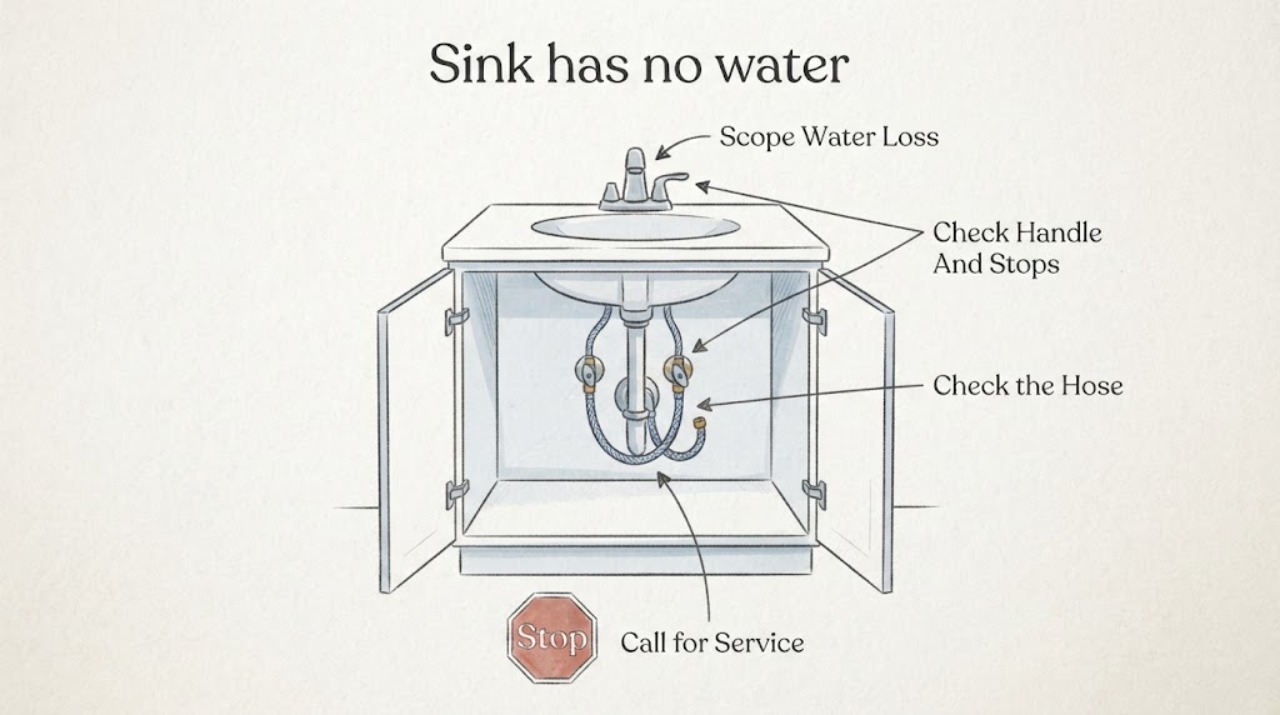
When a sink has no water, first determine whether both hot and cold sides are affected and whether other fixtures still have water. A closed or partially closed shutoff valve, kinked supply hose, blocked aerator or sprayhead, low incoming supply, sensor or power issue on a touchless faucet, or a failed cartridge can all look like a dead faucet. Check the handle position and visible valves and hoses without forcing anything; clean or remove an outlet part only when the exact faucet instructions make that safe. If other fixtures are also dry, a supply problem is likely. Stop for a leak, corroded or immovable valve, water near electrical controls, or any work requiring pressurized connection or faucet disassembly, and arrange a licensed plumber.
Work through in order
Diagnostic checks
Use only checks that match the exact appliance or system and its official guide.
-
Check 1
Open the sink handle normally and observe whether no water comes from both hot and cold positions, only one side, or the faucet outlet is restricted. Check one other nearby fixture without changing plumbing connections.
Expected result: Both sides are dry, only hot or cold is dry, flow is weak rather than absent, or other fixtures are also without water.
Next step: Record the pattern and continue with the matching safe observation. If the whole property or multiple fixtures are affected, check the building or main supply status and arrange plumbing help if it does not return.
Stop if: Stop for spraying water, flooding, sewage-like water, a leak near electricity, or a handle or valve that requires force.
Why this matters
Why: Both sides absent at one faucet keeps the faucet, outlet, supply valves, and hoses in scope. One-sided loss narrows the visible supply path, while several dry fixtures suggest an upstream supply issue. Weak flow can be a restriction rather than a complete shutoff.
-
Check 2
Confirm the handle is in the open position and look under the sink to see whether the hot and cold supply stop valves are visibly open. Do not force or remove a valve.
Expected result: A handle is closed, a supply stop is visibly closed or partly closed, both stops appear open, or a stop is corroded or stuck.
Next step: If a valve is clearly accessible and turns normally, open it gradually and check for leaks. If it will not turn, leaks, or flow remains absent, leave it alone and call a plumber.
Stop if: Stop for a seized valve, active leak, split fitting, severe corrosion, or water reaching electrical equipment.
Why this matters
Why: A closed handle or supply stop can fully interrupt flow. Open-looking stops do not prove that the valve passes water, and a corroded or stuck stop can fail when operated.
-
Check 3
Observe the visible hot and cold hoses from the cabinet opening for sharp kinks, crushing, pinching, or a wet connection. Do not pull the cabinet or disconnect a hose.
Expected result: A hose is kinked or crushed, a connection is wet, both hoses look clear, or the rear connection cannot be seen safely.
Next step: If a hose is plainly displaced and can be eased without moving the faucet or connection, correct only that obstruction and check once. For wet, damaged, or inaccessible connections, stop use and arrange a plumber.
Stop if: Stop for spraying water, a bulging or split hose, a corroded connection, an unstable sink, or any need to loosen a fitting.
Why this matters
Why: A kinked supply hose can restrict or stop water to the faucet. A wet connection is a pressurized leak and needs isolation and repair, not an outlet cleaning. A clear visible hose does not rule out an internal valve or supply problem.
-
Check 4
If the faucet has an accessible aerator or sprayhead and there is no leak or electronic hazard, observe whether the outlet screen is visibly scaled or blocked. Do not disassemble a pull-out hose or outlet unless the exact faucet instructions are available.
Expected result: The outlet screen appears obstructed, the faucet has weak flow from both sides, the faucet has no removable outlet, or flow remains absent after a safe outlet check.
Next step: Clean only the accessible outlet according to the faucet instructions, then check once. If there is still no flow, identify the model and arrange service rather than disconnecting hoses or opening the valve.
Stop if: Stop for a seized outlet, damaged threads, leaking hose, electronic sensor wiring, or any need to use force.
Why this matters
Why: Mineral or debris buildup can restrict flow at an aerator or sprayhead. If flow is absent before the outlet or does not improve after an appropriate cleaning, the cartridge, valve, supply, or control remains in scope.
-
Check 5
For a touchless or electronic faucet, observe whether the sensor indicator responds and whether the handle is open, without wetting or opening the control box or touching wiring.
Expected result: The sensor responds, the indicator is dark, the handle is closed, the supply stops are open, or water remains absent with normal sensor response.
Next step: Follow only the exact model's external sensor or battery guidance. If the sensor or control still fails, or water does not return, arrange service without opening the electronics or faucet body.
Stop if: Stop for water near powered components, damaged wiring, a wet control box, or any need to remove the faucet or electronics.
Why this matters
Why: Kohler's touchless guidance separates handle position, sensor activation, and open supply stops. A dark or unresponsive sensor adds a power, battery, or control path; normal sensor response with no water keeps the plumbing supply and valve in scope.
-
Check 6
After the sink is dry and no connection has been disturbed, observe whether water returns later and whether other fixtures have normal flow. Record recent installation, shutoff, water outage, or plumbing work.
Expected result: Water returns without a change, the whole home has low or no supply, only the sink remains dry, or the timing is unknown.
Next step: Give the timing and fixture comparison to a plumber. Do not keep cycling a dry faucet, bypass a valve, or select a cartridge without exact model and diagnostic confirmation.
Stop if: Stop for flooding, an inaccessible main valve, water damage, or any need to cut into a wall or disconnect piping.
Why this matters
Why: Property-wide loss points upstream of the faucet, while an isolated persistent loss keeps the faucet, valves, hoses, or cartridge in scope. A timing link to recent work raises the possibility of debris, a closed valve, or an installation issue.
Use your observations
Decision map
Find the observation that best matches what you see, then follow the next safe action.
-
PATH 01Next step
What you see
Several fixtures or the whole property have no water or unusually low supply.
Do this next
Check the building or main supply status without forcing a valve and arrange plumbing service if supply does not return; do not dismantle the sink faucet.
-
PATH 02Next step
What you see
A sink stop is visibly closed or a supply hose is plainly kinked, with no leak or corrosion.
Do this next
Correct only the obvious position if the valve or hose moves safely, then check once. If flow remains absent, request a plumber.
-
PATH 03Next step
What you see
Water appears at a stop valve, supply hose, or faucet connection.
Do this next
Stop using the sink, isolate the supply only if safe, and arrange prompt plumbing service. Do not loosen the wet connection.
-
PATH 04Next step
What you see
The faucet has weak flow and an accessible aerator or sprayhead is visibly scaled or blocked.
Do this next
Clean only that outlet using the exact faucet instructions. If flow remains weak or absent, have the cartridge, valve, and supply assessed.
-
PATH 05Next step
What you see
A touchless faucet has no sensor response or normal sensor response but no water.
Do this next
Follow model-specific external sensor or battery guidance. Arrange service for persistent control or supply faults; do not open electronics.
-
PATH 06Next step
What you see
Other fixtures have water, visible stops and hoses look normal, and this sink remains dry.
Do this next
Leave the faucet unused and request a plumber to diagnose the outlet, cartridge, internal valve, or hidden supply connection.
Helpful context
Understand the symptom
What no water at one sink can mean
If both hot and cold sides stop at one faucet while other fixtures work, the faucet, aerator, sprayhead, cartridge, supply hoses, or under-sink valves remain in scope. If only hot or only cold is missing, compare the two visible supply paths. If several fixtures are dry, the issue may be upstream of the sink. Touchless faucets add a sensor, battery, solenoid, or control path, so their symptoms should be checked against the exact model instructions rather than a standard handle faucet procedure.
Keep the first checks external
Do not force a handle or shutoff, loosen a pressurized hose, pull the faucet from the counter, or probe an electronic control with tools. Keep water away from powered sensor components and outlets. If a connection is corroded, leaking, wet near electricity, or inaccessible, stop and arrange plumbing service. A local shutoff may be closed only when it is clearly accessible and turns without force.
What to record for a plumber
Record whether hot, cold, or both sides are affected, whether the handle moves normally, whether water is available at other fixtures, the visible valve and hose position, faucet type, recent installation or plumbing work, and any flow change after cleaning an accessible outlet. Note leaks, corrosion, noise, or sensor indicators. A plumber can then decide whether the supply, aerator, cartridge, sensor assembly, or hose needs service.
Safety boundary
Stop conditions
- Stop for an active leak, flooding, severe corrosion, a seized valve, water near electrical equipment, damaged wiring, or a supply connection that cannot be safely isolated.
- Do not force handles or valves, loosen pressurized hoses, disconnect pull-out lines, open electronic controls, remove the faucet body, or cut into walls during these checks.
- Supply, cartridge, valve, hidden-pipe, and electronic-faucet repairs belong to a licensed plumber or qualified service technician when the source is persistent, concealed, corroded, or requires disassembly.
Only after diagnosis
Potential parts
- faucet aerator or sprayhead
Consider only if the outlet is confirmed blocked or damaged and the faucet and supply path provide normal flow before that outlet.
Match the faucet model, thread, outlet design, and flow specification; appearance alone is not enough. - faucet cartridge or valve
Consider only after supply stops, hoses, and outlet have been assessed and diagnosis points to an internal faucet valve.
Identify the exact faucet model and valve design before replacement; internal disassembly requires water isolation and appropriate service judgment. - sink supply hose or shutoff valve
Consider only when inspection confirms a damaged hose or valve and the water can be safely isolated.
Confirm connection size, valve arrangement, routing, material, and local requirements with a plumber before replacement.
When checks do not resolve it
Need a professional?
Use a licensed plumber for persistent no water, multiple dry fixtures, a supply leak, corroded or stuck valves, a hidden connection, or any cartridge or faucet-body repair. Use qualified service for a touchless control or sensor fault that model-specific external checks do not resolve.
Common questions
FAQ
Why is there no water from my sink faucet?
A closed stop, kinked hose, blocked aerator or sprayhead, failed cartridge, low supply, or touchless control issue can all stop flow. Check the handle, both visible supply paths, and other fixtures without forcing or opening anything.
What if only the hot or cold side has no water?
Compare the affected side's visible stop valve and supply hose with the working side. A partly closed valve, kink, restriction, or internal faucet path may be involved; arrange plumbing service if a safe visual check does not explain it.
Can a blocked aerator cause no water?
A blocked aerator or sprayhead can restrict flow, especially when flow was gradually getting weaker. Clean an accessible outlet only according to the faucet instructions; if both sides remain dry, the fault may be upstream or inside the faucet.
Should I replace the faucet cartridge?
Not as a first guess. Confirm that the supply valves and hoses provide water and that the outlet is not blocked, then identify the exact faucet and valve before any disassembly. A persistent or concealed fault belongs to a plumber.
When is no water at a sink urgent?
Arrange prompt help for an active leak, flooding, a corroded or seized shutoff, water near electrical equipment, multiple dry fixtures, or a hidden connection. Do not force a valve or loosen a pressurized hose.
Read the exact guide
Official sources
- Low Flow from Hot and Cold WaterKohler Assist · Manufacturer guidance for low or absent faucet flow involving supply hose kinks, debris, sprayheads, valve or cartridge, and model identification.
- Home MaintenanceU.S. Environmental Protection Agency WaterSense · Home faucet leak and visible supply-connection observations, water-meter awareness, and fixture maintenance guidance.
- No Water Flow from Touchless FaucetKohler Assist · Manufacturer no-flow guidance for handle position, sensor activation, and fully open supply stops on touchless faucets.
- Technical Reference Manual for WaterSense Labeled HomesU.S. Environmental Protection Agency WaterSense · WaterSense fixture leak-check locations including faucet outlets, hot and cold supply hoses and valves, and visible connections.
Community feedback
Share a repair observation
Share a plain-text repair observation. Accepted observations are published automatically; this page may take a moment to update.