
On this page
Start here
Quick answer
After a main shutoff is turned back on, a sink may remain dry because the main or sink branch valve is not fully open, the neighborhood supply is still off, air is moving through the lines, or sediment has reached the faucet screen. First check whether other fixtures and neighbors have water, then inspect only the clearly accessible main and under-sink valves without forcing them. If the faucet sputters, run it slowly into a safe drain until the air clears; if water is discolored, flush until clear before drinking. Stop for a burst pipe, uncontrolled leak, water near electrical equipment, a valve that will not operate safely, or no restoration throughout the property, and call a plumber or water utility.
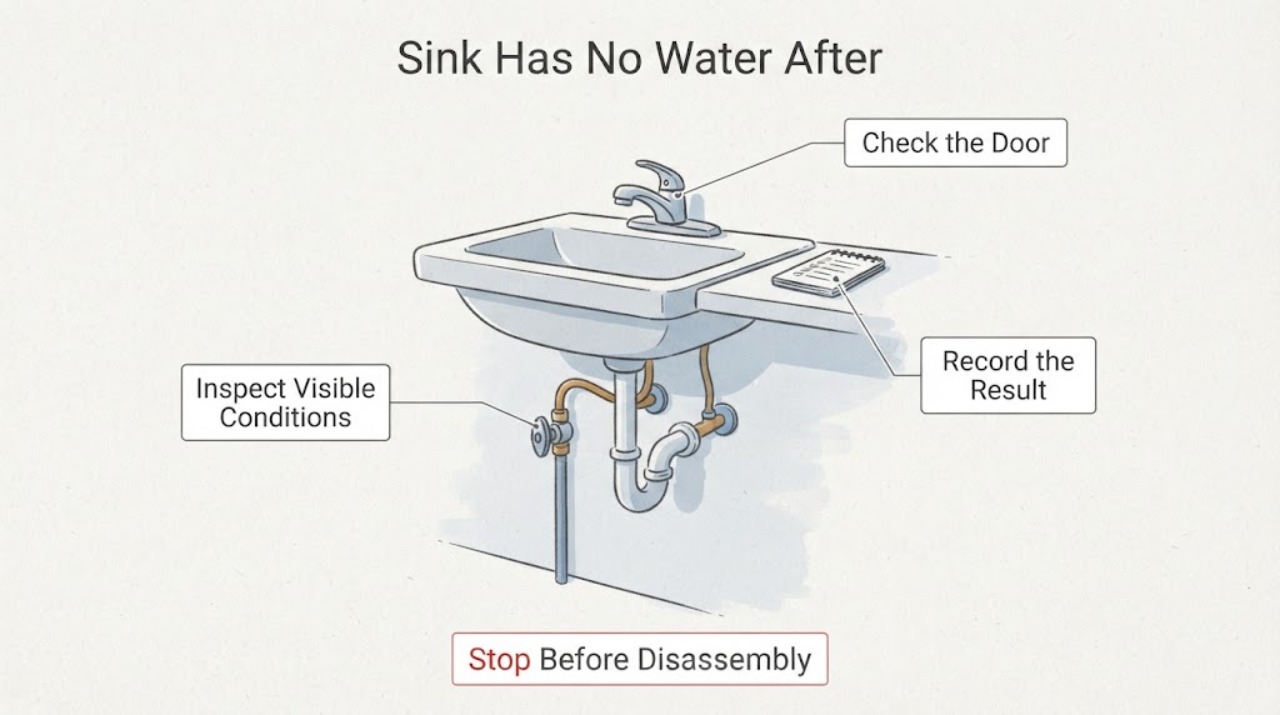
Work through in order
Diagnostic checks
Use only checks that match the exact appliance or system and its official guide.
-
Check 1
With the sink area dry, open the faucet briefly and compare it with another indoor faucet, a bathtub or utility sink, and an outside spigot if safely accessible. Ask whether neighbors or other units also have no water, and note whether the sink is completely dry, sputters, or produces a weak stream.
Expected result: Only this sink being dry points toward its branch valve, supply hose, faucet screen, or local blockage. Several fixtures being dry points toward the main valve, building supply, water utility, or a leak. Sputtering after restoration is consistent with air moving through the line; it is not by itself proof of a permanent blockage.
Next step: Follow the local branch when other fixtures have water. Follow the whole-home or utility branch when multiple fixtures or neighbors are affected.
Why this matters
Why: Scope determines whether the sink can be checked locally or whether the restoration problem is upstream.
-
Check 2
From a dry, safe position, look at the house main valve and the sink's accessible branch shutoff. Compare each handle with its known normal position, check for a visible break or drip, and operate a sound valve only gently if the valve instructions permit it; do not force a stiff or damaged control.
Expected result: A main or branch valve left partly closed can leave the sink dry or weak after restoration. A valve that is fully open but the home remains dry shifts attention to the utility or a failed valve. A drip, spray, wet wall, or valve that leaks when touched is an active leak condition, not a reason to turn harder.
Next step: Return only an obviously partly closed, freely moving valve to its documented normal position and retest once. Leave a seized, corroded, leaking, buried, or uncertain valve alone and call a plumber or water utility.
Why this matters
Why: A valve-position check can find an incomplete restoration without requiring pressurized disassembly.
-
Check 3
If water reaches the sink but sputters, spits, or looks milky after the main was restored, open the faucet slowly into the sink and observe the stream without placing hands under an unstable spray. Keep the drain clear and stop if the flow surges, the cabinet wets, or water escapes a connection.
Expected result: Air in the line may cause temporary sputtering or milky-looking water that clears as the line flushes. A steady stream that never reaches the sink, a new leak, or persistent air after safe flushing indicates that the restoration or local plumbing needs further investigation.
Next step: Let the line clear only as long as the faucet and drain remain controlled. If sputtering persists, other fixtures are affected, or water does not return, contact the utility or a plumber.
Why this matters
Why: A short-lived air symptom can follow restoration, but a dry fixture or persistent unstable flow should not be treated as a harmless air lock indefinitely.
-
Check 4
When a controlled stream reaches the sink, inspect the faucet outlet screen or aerator for visible grit without forcing a seized fitting. If the faucet instructions allow ordinary screen removal, keep the small parts together, rinse the screen with clean water, and reinstall it gently; do not open a wall or remove pressurized internal parts.
Expected result: A screen covered with grit after a shutdown can explain weak flow at this faucet while other fixtures work. A clean screen with no flow, a damaged outlet, or repeated blockage points toward the branch valve, supply hose, faucet body, or upstream sediment.
Next step: Retest once after a correctly seated screen. If it is tamper-resistant, damaged, seized, or quickly blocks again, stop and arrange plumbing service.
Why this matters
Why: Restoration can disturb sediment, so a faucet screen is a local, observable restriction—not evidence that the main supply itself is absent.
-
Check 5
Observe the water's appearance and odor after restoration, and compare it at more than one cold-water fixture. Note clear water, temporary rust or cloudiness, particles, unusual odor, or a condition that continues after a safe flush. Do not use uncertain water for drinking or cooking.
Expected result: Temporary air or sediment can clear during flushing, while persistent discoloration, particles, or unusual odor warrants utility or water-quality guidance. A problem at only one faucet points to its screen or local plumbing; the same appearance everywhere points upstream.
Next step: Follow the local utility's restoration or advisory instructions. Pause drinking-water use until the water is clear and the source is understood; call a plumber for local persistent sediment or a utility for a wider event.
Why this matters
Why: Water quality and water availability are separate decisions: a restored stream is not automatically suitable for drinking.
-
Check 6
If the sink remains dry, check only safe external clues: whether the main valve is known to be open, whether the utility's shutoff window has ended, whether neighbors or other units have water, and whether the meter or property shows signs of an uncontrolled leak. Do not open the meter, dig, loosen a buried fitting, or repeatedly cycle a questionable valve.
Expected result: No water at neighbors or multiple units suggests restoration work is incomplete. Water elsewhere but not at this sink suggests the branch valve, local pipe, or faucet. Meter movement with all fixtures closed, a wet wall or floor, or rushing water suggests a leak that needs prompt service.
Next step: Contact the water utility or property manager for a wider outage. Call a plumber for a local dry branch, suspected leak, or valve problem, and keep the water off if a safe shutoff is available for an active leak.
Why this matters
Why: A no-water condition after main restoration can be a utility event, local valve issue, or leak; the safe next step depends on the scope and visible evidence.
Use your observations
Decision map
Find the observation that best matches what you see, then follow the next safe action.
-
PATH 01Safety boundary
What you see
The sink and several fixtures, units, or neighboring properties have no water after the stated restoration time.
Do this next
Check the utility notice or building manager and contact the water utility. Keep fixtures closed except for a controlled restoration check.
Why this path and its safety boundary
Why it matters: The supply restoration may still be incomplete, or a building, main, or utility issue remains; the sink is not the first repair target.
Safety stop: Do not dismantle the main valve, meter, or buried supply.
-
PATH 02Safety boundary
What you see
Other fixtures have water, but this sink remains dry.
Do this next
Check the dry, accessible branch valve and faucet screen without force. Call a plumber if both are normal or inaccessible.
Why this path and its safety boundary
Why it matters: The sink branch shutoff, visible supply hose, faucet screen, local pipe, or faucet body is more likely than a utility-wide outage.
Safety stop: Leave a seized, leaking, or broken valve or hose untouched.
-
PATH 03Safety boundary
What you see
Water reaches the faucet but sputters, spits, or briefly looks milky after the main is turned back on.
Do this next
Run the faucet slowly into a safe drain and observe from a dry position. Stop and call a plumber if the symptom persists, surges, or wets the cabinet.
Why this path and its safety boundary
Why it matters: Air introduced during restoration may be clearing from the local line; this should improve under controlled flushing.
Safety stop: Do not cap, pressurize, or disassemble the line to force air out.
-
PATH 04Safety boundary
What you see
A weak stream returns, but the faucet screen is visibly loaded with grit after restoration.
Do this next
Clean the accessible screen only as the faucet instructions allow, reinstall it gently, and retest once. Escalate for repeated blockage or no flow.
Why this path and its safety boundary
Why it matters: Sediment may be restricting the outlet while the supply is otherwise present.
Safety stop: Do not force a seized screen or remove pressurized faucet internals.
-
PATH 05Safety boundary
What you see
Water returns but remains discolored, particle-filled, or unusual in odor after safe flushing.
Do this next
Follow the local restoration or advisory instructions and pause drinking-water use until the water clears and its source is understood.
Why this path and its safety boundary
Why it matters: The availability problem may be improving, but the water needs utility or water-quality guidance before drinking or cooking.
Safety stop: Do not use persistently abnormal water for drinking or food preparation.
-
PATH 06Safety boundary
What you see
A pipe bursts, a connection sprays or leaks uncontrollably, water reaches electrical equipment, or a valve leaks when touched.
Do this next
Leave the wet or unsafe area, close water only from a dry and clearly accessible shutoff if it can be done without force, and call a plumber or emergency service from a safe location.
Why this path and its safety boundary
Why it matters: The priority is preventing water damage, shock, or injury rather than restoring the sink through more testing.
Safety stop: Do not touch energized equipment, enter unsafe standing water, force a valve, or continue opening fixtures.
Helpful context
Understand the symptom
The timing matters: a dry sink immediately after the main is reopened may be a valve or restoration problem rather than a failed faucet. Check the scope first. If another indoor fixture works, focus on the sink branch, faucet screen, and under-sink valve. If the entire home or nearby properties are dry, keep the faucet intact and contact the utility, building manager, or plumber.
Sputtering or briefly milky water can be trapped air after water service returns, while grit or rusty sediment can block a small faucet screen. These are observations, not proof that a hidden pipe is blocked. Flush only into a drain that can handle the flow and stop if the water is uncontrolled or the plumbing becomes wet outside the fixture.
Turn a valve only when it is dry, clearly accessible, and intended for normal user operation. A stiff, corroded, leaking, or partly broken valve can worsen the loss of water if forced. Do not remove a meter cover, dig for a buried valve, open a wall, or dismantle pressurized plumbing as part of this check.
Safety boundary
Stop conditions
- Stop for a burst pipe, uncontrolled spray, active flooding, a valve that leaks when touched, water near an outlet or appliance, or a wet wall, ceiling, or electrical area.
- Do not force a seized main or branch valve, open a meter, dig for a buried fitting, dismantle pressurized plumbing, or repeatedly cycle a questionable valve.
- Pause drinking and cooking use for persistent discoloration, particles, unusual odor, or an active water advisory; follow utility or water-quality guidance instead of repeatedly flushing.
Only after diagnosis
Potential parts
- faucet aerator or screen
Consider this only when water reaches the sink but restoration sediment blocks or damages the outlet screen and the faucet instructions identify a replacement as appropriate.
Confirm the faucet model, thread type, screen style, gasket arrangement, and required flow before selecting a replacement. - sink shutoff valve
Consider this only after a plumber confirms that a local valve is seized, internally failed, or leaking and is the cause of the sink-only no-water condition.
Match the pipe, connection, water application, and local code; do not replace a pressurized valve as a first-response DIY step.
Common questions
FAQ
Why is my sink still dry after I turned the main water valve back on?
First check another fixture and, if safe, a neighbor or outside spigot. If only the sink is dry, inspect its accessible branch valve and faucet screen; if the whole property or neighborhood is dry, the restoration or utility supply is still the likely boundary.
Is sputtering after the main is restored an air lock?
It can be air in the plumbing after restoration. Run the faucet slowly into a safe drain and observe whether the sputtering clears. Persistent sputtering, no water, or any leak needs plumbing or utility investigation rather than forced pressurization.
Why did the faucet become weak after the water was turned back on?
Restoration can disturb sediment that reaches a small faucet screen or aerator. If water is present and the fitting is designed for routine removal, clean the screen according to the faucet instructions; stop for a seized fitting or repeated blockage.
Can I drink the water immediately after service returns?
Not if it is persistently discolored, contains particles, or has an unusual odor. Follow the local utility or advisory flushing guidance and wait for clear water and appropriate confirmation before drinking or cooking.
Read the exact guide
Official sources
- Flushing InstructionsCity of Wenatchee Water Resource Department · Air, sediment, sputtering, discoloration, cold-water flushing, and faucet-screen cleaning after water restoration
- Water Pressure HelpEast Valley Water District · Under-sink valves, main valves, local blockage, pressure equipment, and visible leak clues
- Water Shut OffsNew York City Department of Environmental Protection · Water restoration after planned or emergency shutoffs, low pressure, sediment, air, main valve checks, and escalation
- Troubleshooting water pressure and flowCity of Portland · Comparing fixtures, local versus whole-home flow problems, leaks, valves, and utility escalation
- Drinking Water Advisory Communication ToolboxCenters for Disease Control and Prevention · Air in lines, sputtering faucets, flushing after restoration, faucet screens, and water-advisory precautions
Community feedback
Share a repair observation
Share a plain-text repair observation. Accepted observations are published automatically; this page may take a moment to update.