
On this page
Start here
Quick answer
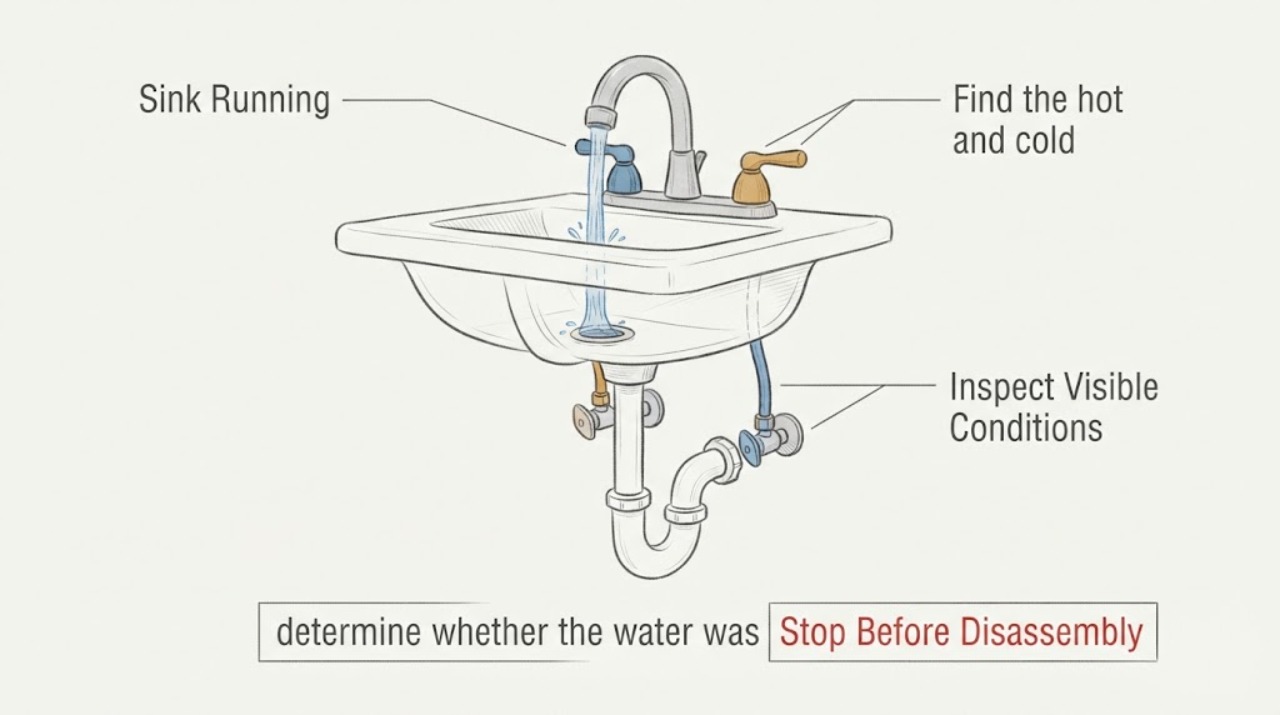
If a sink keeps running after the faucet handle is closed, first identify whether water is coming from the spout, around the handle or base, a supply connection under the sink, or a drain or overflow. Close the handle normally, then turn the accessible hot and cold shutoff valves under the sink clockwise without forcing them; if they do not stop the flow, use the home's main shutoff if you know it and can reach it safely. A spout that continues flowing points toward a worn washer, O-ring, cartridge, or valve, while a leak at a connection needs a different repair. Stop for a burst or inaccessible pipe, rapidly spreading water, electrical contact, or a shutoff that will not operate, and call a licensed plumber or emergency water service. Do not overtighten, hammer the handle, or dismantle a pressurized fitting.
Before you begin
Safety first
- Keep the local or main water supply closed when safe if flow continues or water is spreading. Do not work on pressurized or concealed plumbing, force corroded valves, or leave a repaired connection unattended while water is restored.
Work through in order
Diagnostic checks
Use only checks that match the exact appliance or system and its official guide.
-
Check 1
Close the faucet handle or handles normally and watch for several moments without forcing them. Look at the spout, handle or stem, faucet base, supply hoses and shutoff valves under the sink, and the cabinet floor. Keep hands away from wet electrical equipment and do not reach into an inaccessible opening.
Expected result: Water may continue from the spout, appear only around a handle or stem, bead at the faucet base, spray from a supply connection, or collect below the sink while the spout is dry.
Next step: If water is at a pressurized connection or spreading, isolate the supply before further inspection. If it is only a controlled faucet leak, continue to identify whether it is at the handle, stem, or spout.
Stop if: Do not keep operating a faucet with a burst hose, uncontrolled spray, damaged pipe, or water near electrical equipment.
Why this matters
Why: The leak location determines the next check. Continuous spout flow points to the faucet's closing mechanism; handle or stem moisture points to a seal or packing area; a supply connection or cabinet-floor leak may be a pressurized plumbing failure rather than a faucet repair.
-
Check 2
Find the hot and cold water shutoff valves under the sink if they are accessible and clearly identified. Turn the affected valve clockwise gently until it stops; do not force a stiff valve. If there are no usable local valves, use the home's main water shutoff only if you know its location and can operate it safely.
Expected result: The flow may stop, slow to a drip, or continue unchanged. A valve may be missing, seized, visibly corroded, or connected to a hose that moves when the valve is turned.
Next step: If the flow stops, leave the affected valve closed and proceed with a safe faucet-location diagnosis. If it does not stop or the valve is unsafe to operate, shut off the main only if safe and arrange plumbing service.
Stop if: Do not use pliers, a wrench, heat, or force on a stuck shutoff valve or pressurized fitting.
Why this matters
Why: A closed local valve that stops the flow isolates the faucet and prevents further water waste while it is repaired. Continued flow means the wrong valve may have been closed, the valve may not seal, or another supply path is involved; forcing it can cause a larger leak.
-
Check 3
With the local supply isolated and the area dry, determine whether the water was at the spout, handle, stem, or faucet body. If the leak is from the spout with the handle fully closed, note whether the faucet has one handle or separate hot and cold handles. If it is around the handle or stem, do not remove parts until the exact valve type and model are known.
Expected result: A spout may keep dripping or running, a handle may leak only while the faucet is open, or the stem and faucet body may stay wet after the flow is isolated. The leak may be on one side of a two-handle faucet or on the single control.
Next step: Use the observation to tell the plumber which faucet section is affected. Only attempt a user repair when the supply is isolated, the faucet type is known, and the manufacturer's instructions support it; otherwise keep the valve closed and arrange service.
Stop if: Do not force a handle, strike it, overtighten packing hardware, or remove a faucet stem from a pressurized line.
Why this matters
Why: EPA notes worn washers and gaskets as common faucet leak causes. Portland's guide maps handle leaks to the packing area, stem leaks to an O-ring, and outlet leaks to the lower stem washer; a single-handle cartridge or valve body can require a different model-specific procedure.
-
Check 4
Inspect the supply hoses, shutoff-valve connections, faucet mounting area, trap, drain tailpiece, and overflow area with the cabinet dry. Use a towel to identify the first place that becomes wet, but do not loosen a connection to test it. If the leak is from a drain joint rather than the faucet, do not treat it as a running faucet valve problem.
Expected result: Water may appear at a hose nut or shutoff valve, beneath the faucet mounting point, at a trap or drain connection, or only at the sink rim or overflow. The first wet point may be higher than the puddle.
Next step: Keep the relevant supply valve closed for a supply leak, avoid using the sink for a drain or overflow leak, and arrange plumbing service if the connection is corroded, inaccessible, or still wet after isolation.
Stop if: Do not use the sink when water is entering cabinetry, a wall, flooring, or electrical equipment.
Why this matters
Why: A pressurized supply leak can continue whenever the valve is open and needs a different isolation and repair path from a faucet-spout drip. A drain or overflow leak may occur only while the sink is draining or filled, so the trigger matters.
-
Check 5
Prepare a repair handoff after isolating the water. Record the faucet brand and model if visible, one or two handles, hot or cold side, whether the flow is a drip or steady stream, exact leak location, whether the local valve closes, and whether the leak returns when the valve is reopened. Do not order a washer, O-ring, cartridge, or valve by appearance alone.
Expected result: The repair may be a simple seal or washer, a cartridge or valve assembly, a supply hose or shutoff valve, a drain connection, or a hidden pipe leak. The model or valve type may be unknown.
Next step: Give the recorded details to a licensed plumber or the faucet manufacturer support channel. Keep the local or main supply closed until the leak is repaired if reopening it causes a continuing flow or unsafe leak.
Stop if: Do not dismantle hidden piping, use incompatible seals, or leave a repaired connection unattended while water is restored.
Why this matters
Why: A part name cannot be established from the symptom alone. The leak location and faucet design determine compatibility, and complicated or pressurized plumbing repairs can cause property damage if performed incorrectly.
Use your observations
Decision map
Find the observation that best matches what you see, then follow the next safe action.
-
PATH 01Next step
What you see
Water is only a small drip from the spout with the handle fully closed, and no other area is wet.
Do this next
Isolate the sink supply, identify the faucet type, and use model-specific instructions or arrange a plumber; do not choose a part from appearance alone.
Why this path and its safety boundary
Why it matters: A worn washer, O-ring, cartridge, or valve-closing surface is possible.
-
PATH 02Next step
What you see
Water appears around the handle or stem while the faucet is used, but the supply connections stay dry.
Do this next
Close the supply and follow exact faucet instructions only if the design is known; call a plumber for a seized handle, corroded hardware, or an unfamiliar valve.
Why this path and its safety boundary
Why it matters: A packing seal, O-ring, or handle/stem seal may be leaking.
-
PATH 03Next step
What you see
Water sprays or pools at a supply hose, shutoff valve, or pipe connection under the sink.
Do this next
Shut off the nearest safe upstream supply without forcing the valve, protect the area, and obtain plumbing service.
Why this path and its safety boundary
Why it matters: This is a pressurized plumbing leak, not just a faucet-spout drip.
-
PATH 04Next step
What you see
The water appears only while the sink drains or is filled, and the faucet itself is dry.
Do this next
Stop using the sink if water is entering cabinetry or flooring and arrange a plumber to inspect the drain or overflow path.
Why this path and its safety boundary
Why it matters: A drain, trap, tailpiece, rim, or overflow leak is more likely than a running faucet valve.
-
PATH 05Next step
What you see
The local shutoff valve closes the flow and operates normally.
Do this next
Leave the valve closed, identify the leak location and faucet type, and repair or schedule service before reopening it.
Why this path and its safety boundary
Why it matters: The sink is isolated and further water damage can be limited while the faucet is repaired.
-
PATH 06Next step
What you see
The shutoff valve is stuck, cannot be found, does not stop the flow, or water is rapidly spreading.
Do this next
Use the main shutoff only if safely known and accessible, keep clear of electrical hazards, and call a plumber or emergency water service.
Why this path and its safety boundary
Why it matters: The leak cannot be safely isolated at the sink.
Helpful context
Understand the symptom
A running sink is not always a faucet-spout problem
Start by watching the exact water path. A stream from the spout with the handle closed is different from water around the handle, water at a supply connection, or water that is draining normally but sounds continuous. EPA guidance recommends examining faucet gaskets and pipe fittings for surface water, while the Portland Water Bureau separates handle, stem, and faucet leaks because each follows a different repair path.
Isolate water before opening anything
If the sink is running in a steady stream or a connection is spraying, isolate the water before attempting a faucet repair. Close accessible supply valves gently and manage water with a towel or container. If a valve is stuck, the leak is behind a wall or cabinet, or water is approaching electrical equipment, stop and obtain professional help rather than forcing the plumbing.
Safety boundary
Stop conditions
- Stop for a burst hose or pipe, rapidly spreading water, water near electrical equipment, a concealed or inaccessible leak, or a shutoff valve that will not operate.
- Do not force, hammer, heat, or use tools on a stuck shutoff valve, faucet handle, corroded nut, or pressurized connection.
- Do not open a faucet stem or cartridge housing until the supply is isolated and the exact faucet procedure is known.
- Stop after an attempted seal or washer repair if the flow continues, the connection leaks, or the faucet cannot be reassembled without force; call a licensed plumber.
Only after diagnosis
Potential parts
- faucet washer or O-ring
Consider only when the leak location and faucet instructions identify a worn washer or O-ring after the water supply is isolated.
Confirm the exact faucet model and seal dimensions; a similar-looking seal may not fit or seal safely. - faucet cartridge or valve assembly
Consider only when a known single-handle or model-specific valve is confirmed to be the source of continued spout flow.
Verify the complete faucet model and valve design before selection; running water alone does not prove cartridge failure. - under-sink shutoff valve or supply hose
Consider only if a plumber confirms the supply connection or shutoff itself leaks or cannot isolate the faucet.
Confirm connection type and local plumbing requirements; do not replace a pressurized valve without proper isolation and skill.
When checks do not resolve it
Need a professional?
Water is spraying, pooling rapidly, entering a wall or cabinet, or approaching electrical equipment., The under-sink shutoff is stuck, missing, corroded, or does not stop the flow, or the main shutoff is needed., The faucet continues to run after a correct handle and supply isolation check, or the valve type and model are unknown., The suspected repair involves a supply pipe, shutoff valve, concealed plumbing, corroded pressurized connection, or repeated leak after repair.
Safety scope: Keep the local or main water supply closed when safe if flow continues or water is spreading. Do not work on pressurized or concealed plumbing, force corroded valves, or leave a repaired connection unattended while water is restored.
Common questions
FAQ
Why does my sink keep running after I close the faucet?
Watch whether water is coming from the spout, handle or stem, faucet base, supply connection, or drain area. A spout flow with the handle closed can indicate a worn washer, O-ring, cartridge, or valve, while a supply connection needs immediate isolation and a different repair path.
How do I stop a sink that will not stop running?
Close the faucet normally, then gently close the accessible hot and cold shutoff valves under the sink. If they are stuck, missing, or ineffective, use the main shutoff only if safely known and accessible, and call a plumber. Do not force a valve or continue while water is spreading.
Is a running sink always caused by a bad faucet washer?
No. Worn washers and gaskets are common faucet-leak causes, but water may instead be coming from a stem seal, cartridge, supply hose, shutoff valve, drain connection, or overflow. Locate the first wet point before choosing a repair.
When should I call a plumber for a running sink?
Call when the flow cannot be isolated, water is spraying or spreading, a valve or pipe is corroded or concealed, water is near electricity, the faucet model is unknown, or the leak continues after a model-specific repair. Keep the supply closed when reopening it causes unsafe flow.
Read the exact guide
Official sources
- Fix a Leak WeekU.S. Environmental Protection Agency WaterSense · EPA WaterSense guidance for identifying and addressing household faucet leaks and surface leaks at gaskets and pipe fittings
- How to fix a faucet leakCity of Portland Water Bureau · Official municipal guide to locating, isolating, and repairing common sink-faucet leaks
Community feedback
Share a repair observation
Share a plain-text repair observation. Accepted observations are published automatically; this page may take a moment to update.