
On this page
Start here
Quick answer
The phrase “both not running and not stopping water” describes two different states that must be separated: no water comes from the sink, or water continues to flow after the handle or control is closed. First check the upstairs bathroom and another fixture to determine whether the problem is local or affects the supply. From a dry, safe position, locate the sink's hot and cold shutoffs and close them only if they are clearly identified and operate normally; if water still flows or a valve will not close, use the home's main shutoff if safely reachable. Do not open the faucet, wall, or plumbing fittings. A continuous stream, hidden moisture, sewage backup, or water near electricity requires immediate isolation and a licensed plumber.
Before you begin
Safety first
- Do not stand in water, force or repeatedly operate a shutoff, open the faucet or wall, use chemical drain cleaner, or handle wet electrical equipment.
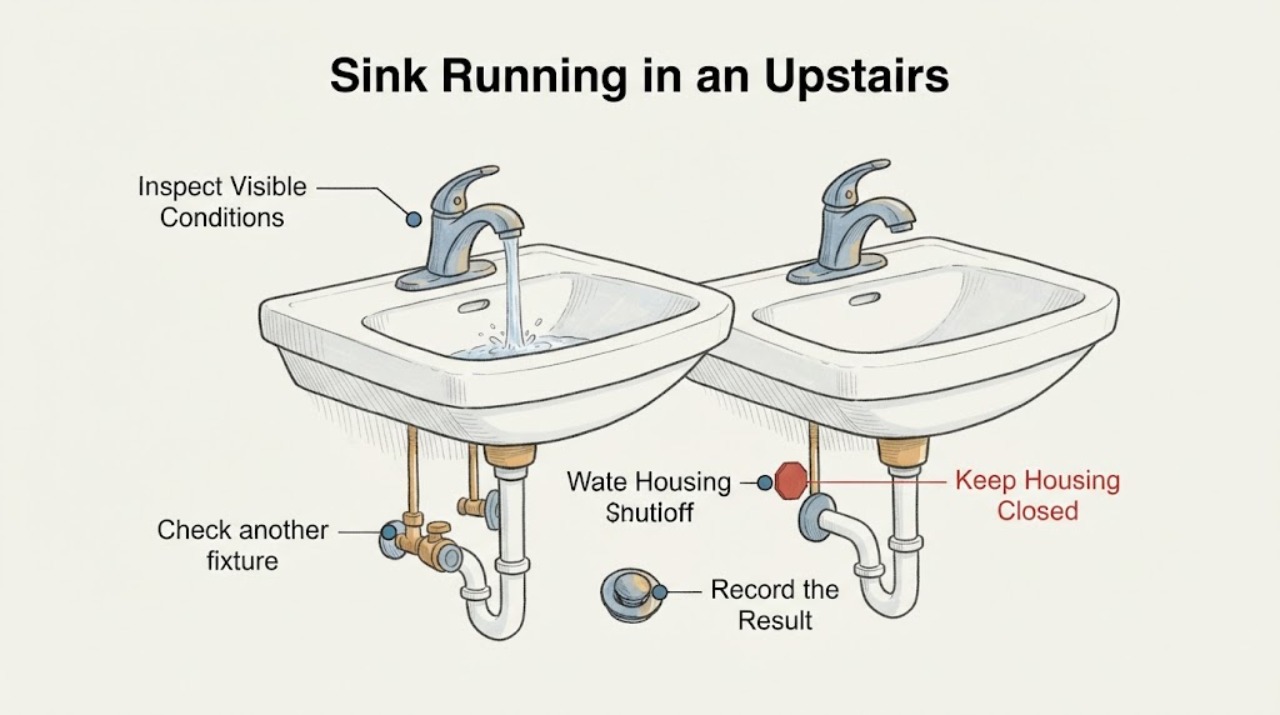
Work through in order
Diagnostic checks
Use only checks that match the exact appliance or system and its official guide.
-
Check 1
From a dry position, write down what “not running” and “not stopping” mean at this sink. Observe each hot and cold handle or control separately, and identify whether water is absent, drips, streams from the spout with the control closed, or leaks below the basin.
Expected result: Both sides have no flow, only one side has no flow, water streams with the control closed, or water is leaking below the sink while the spout is dry.
Next step: Keep the control in its normal closed position, do not leave the water running to reproduce the symptom, and continue with scope and shutoff observations.
Stop if: Stop immediately for rapid flow, water entering the wall or floor, standing water, or water near electrical equipment.
Why this matters
Why: No flow and uncontrolled flow are different paths. A missing hot or cold side favors a supply or faucet-side restriction, while a stream with the control closed favors a faucet flow-control problem or a supply that has not been isolated.
-
Check 2
Check another fixture in the upstairs bathroom and one fixture on a different floor without changing any plumbing. Note whether cold and hot water are available elsewhere and whether other drains or fixtures are also affected.
Expected result: Only this sink is dry or uncontrolled, both upstairs fixtures are affected, hot and cold are affected differently, or the whole home has weak or absent water.
Next step: Leave the affected sink unused and record the scope. Do not open fittings or repeatedly operate fixtures to chase the symptom.
Stop if: Stop for ceiling stains below, active leakage, sewage backup, or any need to enter a wet area or concealed space.
Why this matters
Why: A single-sink symptom points toward local shutoffs, hoses, faucet, or drain. Two fixtures on the same floor suggest a branch or local supply issue; a wider loss suggests the home supply, main shutoff, or utility.
-
Check 3
From outside the cabinet, locate the sink's hot and cold shutoff valves and observe whether each appears open, closed, wet, damaged, or connected to a kinked hose. Do not force a valve or use a tool on a connection.
Expected result: A valve is clearly closed, a hose is kinked, the valve or hose is leaking, both valves appear open, or the valves cannot be reached safely.
Next step: If the area is dry and the valve works normally, restore a clearly closed valve once and observe. If a valve leaks, spins, or will not operate, leave it alone and call a plumber.
Stop if: Stop for spray, a seized or spinning valve, a cracked hose, water in the cabinet, or electrical equipment in the wet area.
Why this matters
Why: A closed local supply can explain no flow; a wet or damaged valve or hose can explain uncontrolled water. Apparently open valves do not prove the faucet or branch is clear.
-
Check 4
If water continues from the spout or a supply leak after the local valves are closed, observe whether the flow decreases. From a dry, safe location, close the home's main shutoff only if the local valves do not isolate the leak and the main valve is clearly accessible.
Expected result: The flow stops at the local valves, slows but does not stop, or continues unchanged after local isolation.
Next step: Keep the isolated valve or main shutoff closed, protect the rooms below, and contact a licensed plumber. Do not dismantle the faucet or pipe while pressure or flow remains.
Stop if: Stop for uncontrolled flow, a main valve that will not close, water entering a wall or ceiling, or any electrical hazard.
Why this matters
Why: A local shutoff that works narrows the fault to the sink fixture or its local supply. Continued flow may indicate a failed valve, an upstream connection, trapped water, or a separate source.
-
Check 5
With the local supply isolated and the area dry, inspect the faucet outlet, handle or sensor area, base, underside connections, basin rim, and cabinet for the first wet point. Do not remove the handle or body.
Expected result: The first wet point is the spout or control, faucet base, supply connection, basin rim, or no visible sink point while water appears below.
Next step: Photograph the first wet point and provide the faucet model to the builder, manufacturer, or plumber. Keep the supply isolated until the correct repair is confirmed.
Stop if: Stop if finding the source requires opening the wall, lifting the basin, forcing the faucet, or handling contaminated water.
Why this matters
Why: A spout or control that drips or streams while closed can involve the faucet's internal flow-control component. A base or underside leak may be a seal or connection. Water below without a visible sink source may be traveling from a concealed pipe or nearby fixture.
-
Check 6
If the sink has a touchless, sensor, or powered control, observe its indicator and power status without reaching into the control box or moving cables. If it has an ordinary handle, use the handle position and the first wet point instead; do not apply sensor guidance to a non-sensor faucet.
Expected result: A sensor faucet shows an alert or erratic behavior, a powered control is unresponsive, an ordinary handle is fully closed but water continues, or the faucet type is unknown.
Next step: Record the exact faucet type and model, keep the water isolated, and use only the manufacturer's instructions or a plumber. Do not reset repeatedly or disconnect powered controls under the sink.
Stop if: Stop for wet electronics, a damaged cord, heat, smoke, or any need to access wiring or a control box.
Why this matters
Why: Electronic controls can create model-specific open or close behavior, while a conventional faucet that streams when closed may have an internal cartridge or valve issue. Unknown type means the model manual is needed.
-
Check 7
Observe the drain, P-trap, wall-side drain, and ceiling or wall below from outside the cabinet only. If the sink has no active supply leak and the floor is dry, run a very small amount of water once to see whether the drain path is the source; stop at the first sign of backup or leakage.
Expected result: Water appears only while draining, the basin backs up, the trap or wall connection is wet, or water is present below without an active sink supply.
Next step: Stop using the sink, keep the affected area isolated, and call a plumber. Do not pour chemical cleaner, open the wall, or continue testing upstairs water over a room below.
Stop if: Stop for dirty backup, sewage odor, ceiling damage, water near electrical equipment, or any concealed leak.
Why this matters
Why: A drain, branch, or concealed pipe can mimic a faucet that will not stop, especially when water travels inside the cabinet or floor. A drain problem does not justify changing the faucet cartridge.
-
Check 8
Prepare a service record with the exact wording of the symptom, both fixture observations, hot and cold results, valve positions, first wet point, timing, photos, and whether the local or main shutoff changed the flow. Keep the upstairs sink unused until the source is resolved.
Expected result: The issue is isolated to the faucet, local supply, branch, drain, main supply, or remains uncertain after safe external checks.
Next step: Call a licensed plumber and, if the home is new or under warranty, notify the builder or property manager with the same evidence. Do not assign responsibility or buy a part before the source is identified.
Stop if: Stop all homeowner diagnosis when the source is hidden, flow cannot be isolated, damage is spreading, or repair would require opening plumbing or a wall.
Why this matters
Why: A clear record lets a plumber separate no flow from uncontrolled flow and identify whether the two reported symptoms are connected or are two faults occurring in the same bathroom.
Use your observations
Decision map
Find the observation that best matches what you see, then follow the next safe action.
-
PATH 01Next step
What you see
Only the sink has no water, while another bathroom fixture has normal flow.
Do this next
Observe valve and hose condition without force, keep the sink isolated, and call a plumber if flow does not return safely.
Why this path and its safety boundary
Why it matters: The local hot or cold shutoff, hose, faucet, or sink-specific branch is more likely than a whole-home supply issue.
-
PATH 02Next step
What you see
Water streams or drips from the spout even though the control is closed.
Do this next
Close the local supply, record the faucet model and first wet point, and arrange faucet or plumbing service; do not open the body while pressurized.
Why this path and its safety boundary
Why it matters: The faucet's internal flow-control component may not be sealing, but the correct part and procedure are model-specific.
-
PATH 03Next step
What you see
Both upstairs fixtures have no water or the whole home has weak or absent flow.
Do this next
Check for a known service interruption from a safe location and call the water utility or plumber; do not dismantle the sink fixture.
Why this path and its safety boundary
Why it matters: The issue may be the upstairs branch, home's main shutoff, service supply, or a utility interruption rather than this sink.
-
PATH 04Next step
What you see
Water appears only when draining, backs up, or reaches the wall, ceiling, or room below.
Do this next
Stop using the sink and call a plumber; keep people away from the wet area and do not open the wall.
Why this path and its safety boundary
Why it matters: A drain or concealed pipe path is more likely than the faucet control.
-
PATH 05Next step
What you see
The local valve will not close, water is uncontrolled, or water is near electrical equipment.
Do this next
Move to a dry location, close the main supply only if safely reachable, and obtain urgent plumbing or electrical help.
Why this path and its safety boundary
Why it matters: The priority is preventing flooding, shock, and structural damage, not identifying a cartridge or handle.
Helpful context
Understand the symptom
An upstairs bathroom report that says the sink is both not running and not stopping water is internally ambiguous. It may mean there is no flow from one or both handles while a separate leak continues, or that a faucet will not shut off and another fixture has no supply. Treat those as separate observations before choosing a repair.
The first split is scope: does only this sink have the problem, do both hot and cold sides behave the same way, are other upstairs fixtures affected, or is the whole home affected? The next split is timing: water flows while the control is closed, water appears only during use, or no water flows at all. This avoids calling a cartridge a supply failure or calling a drain leak a faucet problem.
Manufacturer guidance for faucets emphasizes shutting off the local or main supply before repair because failing to isolate water can cause flooding or injury. It also notes that a faucet that continues to drip or stream after its handle is closed may have an internal flow-control problem, and that replacement parts depend on the exact faucet model.
Because this is an upstairs bathroom, protect the ceiling and rooms below. Do not leave a running test unattended, enter standing water, force a shutoff, open a wall, or remove the faucet body when the source is uncertain. Water near an outlet, light, fan, or other electrical equipment changes this to an emergency safety response.
When checks do not resolve it
Need a professional?
Safety scope: Do not stand in water, force or repeatedly operate a shutoff, open the faucet or wall, use chemical drain cleaner, or handle wet electrical equipment.
Common questions
FAQ
How can a sink have no water and water that will not stop at the same time?
Those words may describe different outlets or different paths: one hot or cold side may have no supply while a faucet or separate leak continues, or the visible water may be a drain leak. Check each control and the first wet point separately.
What should I do if the faucet will not shut off?
Close the local faucet shutoffs if they are clearly accessible and safe; if they do not isolate the flow, close the home's main supply only when safely reachable. Keep the area clear and call a plumber rather than opening the faucet body while pressurized.
Could a drain leak be mistaken for a faucet that will not stop?
Yes. Water may appear only when the basin drains or may travel to the cabinet floor or room below. Stop using the sink for backup, sewage odor, or concealed moisture and arrange plumbing service.
Read the exact guide
Official sources
- Kitchen Faucet: Leaking From The SpoutMoen Solutions · Faucet water continuing after the handle is closed, model-specific cartridge diagnosis, and non-interchangeable parts
- How To Turn Off The Water Supply To The FaucetMoen Solutions · Local and main faucet shutoff locations and isolating water before faucet repair
- Home MaintenanceU.S. Environmental Protection Agency · Household leak detection, sink faucet and under-sink observations, water meter clues, and professional leak escalation
Community feedback
Share a repair observation
Share a plain-text repair observation. Accepted observations are published automatically; this page may take a moment to update.