
On this page
Start here
Quick answer
A sink that is “running” can mean water still comes from the spout after the handle is off, a continuous sound or stream comes from the cabinet, or an under-sink filter, reverse-osmosis unit, storage tank, or hot-water device is repeatedly filling or sending water to a drain. First identify the exact source and timing without opening or disconnecting anything. If the faucet will not stop, water is spraying or pooling, a tank or hose is leaking, or water is near electricity, close a normally accessible local valve only if it moves safely, keep clear of wet equipment, and call a plumber. A tank is only one possible path; do not adjust pressure, open a vessel, disconnect tubing, or assume the tank is at fault.
Before you begin
Safety first
- Keep the sink and tank path unused for uncontrolled leaks, water near electricity, hot or contaminated water, smoke, fuel odor, electrical odor, arcing, shock, or severe damage. Do not open devices, adjust pressure, disconnect tubing, force valves, or perform unsafe work.
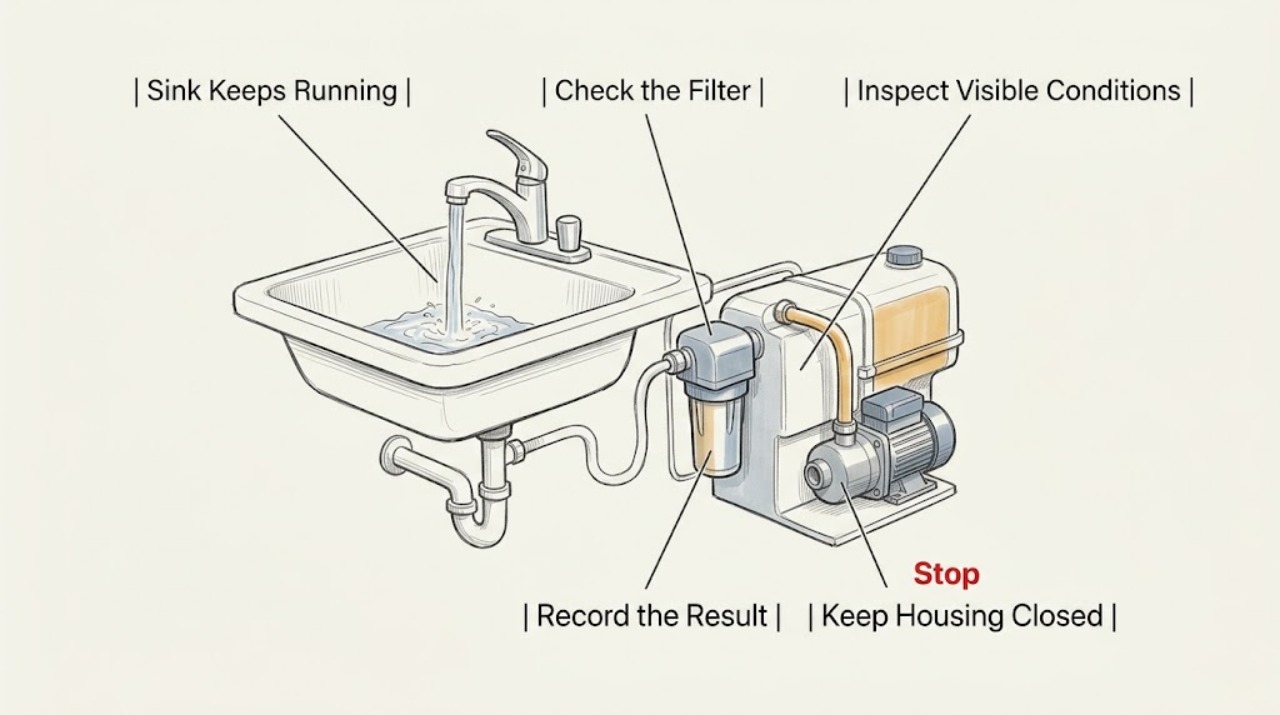
Work through in order
Diagnostic checks
Use only checks that match the exact appliance or system and its official guide.
-
Check 1
From a dry position, identify where the running sound or water is coming from: the faucet spout, handle or base, supply connection, drain, tank or filter device, a dedicated small outlet, or a wall, floor, or ceiling. Note whether it is a drip, steady stream, spray, hum, refill sound, or discharge sound.
Expected result: Water is visible at the spout, below the cabinet, at a tank or hose, in the drain, or nowhere visible while a sound continues.
Next step: Record the first wet point and sound location. Do not remove the faucet, tank, filter housing, drain trap, or tubing to find the source.
Why this matters
Why: A spout or handle symptom favors the faucet. Cabinet water favors a supply, tank, filter, or drain connection. A refill or discharge sound keeps an under-sink treatment or hot-water branch in scope. A hidden sound with no visible water can still be a concealed leak or device operation.
-
Check 2
With no force and only from a safe dry position, observe whether the faucet handle is visibly in the off position and whether water continues from the spout. For a faucet that is already off, do not keep turning or forcing the handle; note whether the water is a drip or stream and whether it changes with hot versus cold.
Expected result: The handle appears off but water continues, only hot or only cold continues, the base or handle is wet, or the spout stops normally.
Next step: If water continues, use the normally accessible local shutoff only if it moves easily and the area is safe; otherwise stop and call a plumber. Do not dismantle the faucet or select a cartridge without exact model identification.
Why this matters
Why: Continued flow with the handle off points to the faucet's internal shutoff component or a handle/control issue, not automatically to the tank. One-temperature flow points to that branch. A wet base or handle may be a separate external faucet leak.
-
Check 3
Look under the sink with the water off and the cabinet dry. Visually check the local supply valves, hoses, tank or filter housing, tubing, drain connection, and cabinet floor for droplets, a spray trail, rust, swelling, or a steady wet spot. Do not touch wet electrical equipment, hot tubing, or a pressurized vessel.
Expected result: The cabinet is dry, a supply or tank connection is wet, water appears only while the faucet runs, or water appears continuously even when the faucet is unused.
Next step: For any active or growing leak, stop using the sink and close the local water valve only if safe and easy; if it does not stop the flow, use the main shutoff from a safe location and call a plumber. Do not tighten or disconnect a wet fitting by guesswork.
Why this matters
Why: A continuous wet spot can be a pressurized supply, tank, filter, or connection leak. Water only during use favors a drain, faucet base, or connection that is stressed by flow. A dry cabinet does not rule out a concealed leak or a device discharge routed to a drain.
-
Check 4
Identify any under-sink filter, reverse-osmosis system, storage tank, or instant hot-water device by its exterior label or manual. Without opening it, observe its indicator, pump or refill sound, drain discharge, and the timing after a glass of water or hot-water request. Do not change tank pressure, open a cartridge housing, or disconnect a tube.
Expected result: There is no tank device, a device refills briefly after use, a discharge continues long after use, an indicator reports service, or a device leaks or sounds abnormal.
Next step: Follow only the exact model's visible user-level indication or manual procedure once. If the symptom persists or the procedure requires opening the system, leave the device unused and call a plumber or qualified water-system technician.
Why this matters
Why: Brief model-documented refill or discharge can be part of a treatment or hot-water system cycle. Continuous or repeated operation, a service indication, abnormal noise, or a leak shifts the issue to the feed valve, filter, drain path, tubing, tank, or device control and needs model-specific service.
-
Check 5
Stop using all fixtures and water-using appliances for a short observation, then look at the home's water meter or leak indicator from a safe, accessible location if your property provides one. Do not enter a wet utility area or alter a valve just to perform this check.
Expected result: The leak indicator or meter still moves, stops when the sink branch is isolated by a normally accessible valve, or cannot be checked safely.
Next step: Record the result and arrange plumbing service for unexplained movement, a hidden leak, or any branch that cannot be safely isolated. Do not excavate, open walls, or adjust pressure equipment.
Why this matters
Why: Continued meter movement means water is flowing somewhere in the system and can indicate a hidden indoor or outdoor leak. A local isolation result can help a plumber distinguish the sink branch from a wider supply issue, but a meter result cannot locate a tank fault by itself.
-
Check 6
Compare the symptom with another fixture and with hot versus cold water without opening or modifying the sink equipment. Record whether other fixtures have normal flow, whether only this sink runs, whether the sound follows hot-water use, and whether the issue began after plumbing work, a filter change, a power outage, or a water interruption.
Expected result: Only the sink is affected, several fixtures run or lose water together, the symptom follows hot-water use, or it began after work or a device change.
Next step: Give the timing and comparison results to a plumber or water-system technician. Do not replace the tank or faucet until the affected branch is identified.
Why this matters
Why: A single-sink pattern favors the faucet, local valve, hose, tank/filter branch, or drain connection. A wider pattern favors a shared supply or hidden leak. Hot-water timing keeps a water-heating branch in scope. A post-work change raises connection, valve, air, debris, or device-setup questions.
-
Check 7
From a safe position, check for hot water or steam, unusual color, odor or taste, a fuel odor, smoke, electrical odor, buzzing, visible arcing, water near an outlet or powered device, cabinet damage, or a hose spraying. Photograph only closed equipment from a dry position and prepare the source, timing, model, and valve observations for service.
Expected result: No hazard is visible, or there is an active leak, hot water or steam, contaminated water, moisture near electricity, smoke, fuel odor, electrical odor, arcing, shock, or structural damage.
Next step: Stop using the sink. Close water only from a safe position if the valve moves normally; keep clear of wet electrical or hot equipment. Obtain emergency help for smoke, fire, or fuel danger and qualified plumbing service for other hazards.
Why this matters
Why: A hazard overrides ordinary running-water diagnosis. Hot water can scald, uncertain water should not be consumed, and moisture or combustion/electrical warnings can create an immediate safety event.
Use your observations
Decision map
Find the observation that best matches what you see, then follow the next safe action.
-
PATH 01Next step
What you see
Water continues from the faucet spout after the handle is off.
Do this next
Use the local shutoff only if it is accessible, dry, and moves without force; otherwise call a plumber. Do not open the faucet or order a cartridge without exact model confirmation.
Why this path and its safety boundary
Why it matters: The faucet control or internal shutoff is more likely than an under-sink tank, although an upstream branch can still contribute to pressure or flow.
-
PATH 02Next step
What you see
Water is visible under the sink or at a tank, filter, hose, or connection.
Do this next
Stop using the sink and isolate water only from a safe, dry position. Call a plumber for a growing leak, failed valve, tank, filter housing, hose, or hidden connection.
Why this path and its safety boundary
Why it matters: This is a leak first, not a normal tank-running symptom. The first wet point and whether it occurs continuously or only during use determine the service path.
-
PATH 03Next step
What you see
A treatment, reverse-osmosis, storage-tank, or hot-water device makes a brief documented refill or discharge after use.
Do this next
Check only the exact model's user-level indicator or manual. If operation continues, repeats without a draw, leaks, or lacks a safe user procedure, leave it unused and call qualified water-system service.
Why this path and its safety boundary
Why it matters: The behavior may be a model-specific cycle, but a tank is not proven to be defective. The feed, filter, drain path, tubing, faucet, and device control can produce similar sounds.
-
PATH 04Next step
What you see
The meter or leak indicator moves after all water use is stopped, or several fixtures are affected.
Do this next
Arrange plumbing or building-supply assessment. Do not adjust a pressure-control device, excavate, or replace an under-sink part based only on the sound.
Why this path and its safety boundary
Why it matters: A hidden indoor, outdoor, shared-supply, main-valve, or pressure-related leak is possible; the sink tank may be unrelated.
-
PATH 05Next step
What you see
The symptom follows hot-water use, and a hot-water device or tank is present.
Do this next
Keep clear of hot equipment and steam. Follow no internal tank procedure; request qualified plumbing or water-heater service, with fuel-system service if the equipment is fuel-fired.
Why this path and its safety boundary
Why it matters: The hot-water branch, device feed, relief or drain path, faucet, or tank may be involved; model and fuel type matter.
-
PATH 06Next step
What you see
There is uncontrolled water, water near electricity, hot water or steam, contaminated water, smoke, fuel odor, electrical odor, arcing, shock, or severe damage.
Do this next
Leave the hazard area and keep others away. Use emergency help for smoke, fire, fuel danger, or shock; otherwise obtain urgent qualified plumbing and electrical service as appropriate. Do not touch, open, reset, or test the equipment.
Why this path and its safety boundary
Why it matters: This is an immediate water, scald, combustion, shock, or fire hazard and ordinary diagnosis must stop.
Helpful context
Understand the symptom
Define what “running” means before changing anything
Watch and listen from a dry position. A stream or drip from the spout with the handle off is different from water under the cabinet, a tank refill sound, a treatment system discharge, or a sound that comes from the drain. Record whether the symptom stops when the faucet is not being used, repeats after a draw, or continues with every water fixture off.
Keep the tank path conditional
Some sinks have no tank. Others are connected to a filtered-water or reverse-osmosis system, an under-sink storage vessel, or a separate hot-water device. A repeated refill or discharge sound can involve the feed valve, filter, tubing, air gap, drain connection, faucet, or tank. Use only the exact model's visible indicator or user procedure; do not open a pressurized housing or change a tank setting.
Stop first for uncontrolled water or heat
If the water cannot be controlled, a hose is spraying, a tank is leaking, a cabinet or floor is swelling, or water is near a powered device, stop using the sink. Hot water or steam can burn, and a fuel-fired water-heating system adds a separate fuel-safety boundary. Keep clear and arrange qualified service.
Safety boundary
Stop conditions
- Stop immediately for a burst or uncontrolled leak, spraying hose, water near an outlet or powered device, hot water or steam, cabinet or floor damage, contaminated water, smoke, fuel odor, electrical odor, visible arcing, shock, or repeated protective-device operation.
- Do not open a tank, pressure vessel, filter housing, hot-water device, faucet body, or drain connection; adjust tank pressure; disconnect tubing; force a shutoff; or continue consuming water with unexplained color, odor, or taste.
- Do not keep testing a faucet that will not shut off, a device that runs continuously, or a valve that does not move normally. Isolate water only from a safe, dry position and call qualified service.
- Do not infer a failed tank from a running sound. Identify the source, timing, hot/cold pattern, other-fixture pattern, and first wet point before selecting a part.
Only after diagnosis
Potential parts
- faucet cartridge or internal shutoff component
Consider only when a qualified diagnosis confirms that the faucet continues to flow with the handle off and the exact faucet model identifies the compatible internal component.
Single-handle and two-handle designs use different parts; confirm the exact faucet model and keep repair work within qualified capability. - under-sink filter cartridge or treatment valve
Consider only when the exact system indicator or professional diagnosis links continuous refill or discharge to a serviceable filter or feed component.
Treatment type, connections, pressure limits, sanitation requirements, and user procedure are model-specific; do not substitute by appearance. - under-sink storage tank
Consider only after qualified testing separates a tank fault from the feed valve, filter, tubing, faucet, drain path, and incoming supply.
Tank volume, connection style, pressure limits, and sanitation requirements must be confirmed for the exact system; installation belongs to qualified service. - sink shutoff valve or supply hose
Consider only when inspection confirms a restricted, damaged, or leaking local supply component after the running-water source is established.
Connection, temperature rating, access, and local plumbing requirements must be confirmed; do not force or replace a wet valve.
When checks do not resolve it
Need a professional?
Call after recording the source, first wet point, timing, hot/cold pattern, other-fixture comparison, meter result, device identity, and visible indicators, or immediately for uncontrolled leaks, heat, steam, water-quality changes, electrical moisture, smoke, fuel odor, or shock.
Safety scope: Keep the sink and tank path unused for uncontrolled leaks, water near electricity, hot or contaminated water, smoke, fuel odor, electrical odor, arcing, shock, or severe damage. Do not open devices, adjust pressure, disconnect tubing, force valves, or perform unsafe work.
Common questions
FAQ
What does it mean if my sink keeps running after I turn it off?
If water still comes from the spout, the faucet control or internal shutoff is a likely branch. If the sound or water is under the cabinet, inspect only from a dry position for a supply, tank, filter, or drain leak. Do not force the handle or open the faucet.
Could an under-sink tank make a running sound?
A treatment, reverse-osmosis, storage-tank, or hot-water system can have model-specific refill or discharge behavior, but continuous operation can also involve its feed valve, filter, drain path, tubing, faucet, or a leak. Identify the exact system and follow only its user-level guidance.
How can I tell whether the running water is a hidden leak?
After stopping normal water use, observe an accessible meter leak indicator if it is safe to do so. Continued movement means water is flowing somewhere, but it does not identify a failed tank. Record the result and call a plumber for unexplained flow or visible moisture.
Should I close the valve under the sink?
Only if the valve is normally accessible, the area is dry, and it moves easily without force. If it is stuck, wet, damaged, or the water is uncontrolled, keep clear and obtain qualified service; a professional may need to isolate the main supply safely.
When is a running sink an emergency?
Leave the area and obtain emergency help for smoke, fire, fuel odor, shock, or active arcing. Request urgent plumbing or electrical service for uncontrolled leaks, water near electricity, hot steam, cabinet or floor damage, or a wet powered device.
Read the exact guide
Official sources
- Publication 5098 - Tap Water ScaldsU.S. Consumer Product Safety Commission · General residential scald-safety guidance; it is not a water-heater repair manual.
- Kitchen Faucet: Leaking From The SpoutMoen · Moen-specific guidance; other faucet brands and models use different internal parts.
- Water TreatmentA. O. Smith Corp. · Manufacturer water-treatment overview; exact equipment manuals and service boundaries take precedence.
- Detect and Chase Down Leaks ChecklistU.S. Environmental Protection Agency · EPA WaterSense checklist; it is not a tank or faucet repair manual.
- How to check for leaksPortland Water Bureau · Municipal water-bureau guidance; local valve locations and procedures vary.
- How to fix a faucet leakPortland Water Bureau · Municipal faucet guidance; faucet construction and user skill vary.
Community feedback
Share a repair observation
Share a plain-text repair observation. Accepted observations are published automatically; this page may take a moment to update.