
On this page
Start here
Quick answer
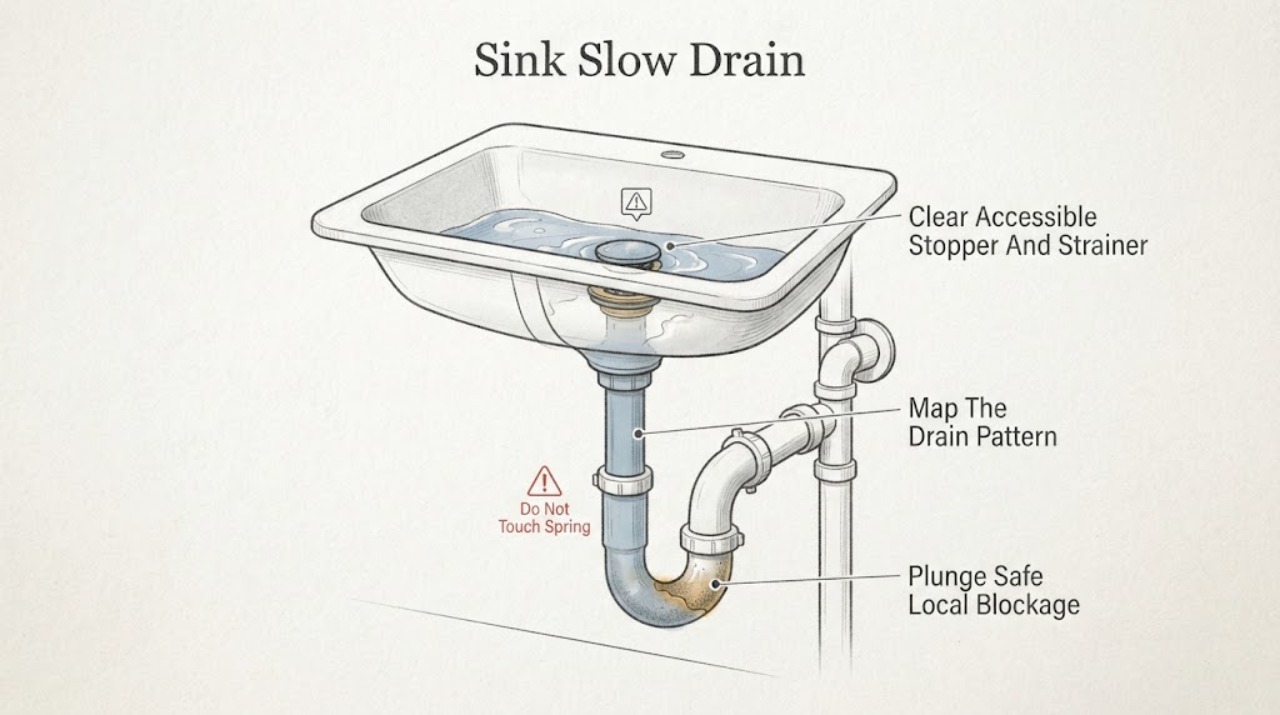
A sink that drains slowly usually needs the blockage localized before anything is removed. First note whether only this sink is slow, whether water rises or backs up, and whether the problem follows a stopper, strainer, or food-and-grease use pattern. Remove only accessible debris, then use a sink-appropriate cup plunger with the overflow opening covered when the basin and drain are free of chemical cleaner. EPA guidance identifies a plunger or plumber's snake as an alternative to drain cleaner, and public plumbing guidance warns that grease can coat pipes and gradually reduce flow. Do not mix or add chemical drain products, especially if one has already been used. If several fixtures are slow, wastewater backs up, the trap or wall connection leaks, the blockage is beyond safe access, or the slow drain returns after a permitted mechanical check, stop using the affected fixtures and call a qualified plumber.
Before you begin
Safety first
- No chemical mixing, trap or wall disassembly, pipe cutting, forced stopper removal, cable work in an unknown line, or handling of corrosive residue.
Work through in order
Diagnostic checks
Use only checks that match the exact appliance or system and its official guide.
-
Check 1
Stop adding water to the affected sink and observe it from a dry, stable position. Compare another nearby fixture without deliberately overflowing anything, and note whether the sink drains slowly all the time or only when a lot of water enters.
Expected result: Record whether only this sink is slow, more than one fixture is slow, water rises or backs up into another fixture, the drain gurgles, or the issue began after a spill or plumbing change.
Next step: Continue with above-sink checks only when the problem is localized and there is no chemical residue, sewage backup, or active leak. For multiple fixtures, cross-backup, or unknown shared-line symptoms, stop using the affected fixtures and arrange qualified plumbing service.
Stop if: Stop for wastewater backup, foul or contaminated overflow, an active leak, water near electrical equipment, or any need to enter a cabinet or wall cavity that is wet.
Why this matters
Why: An isolated, gradual slowdown supports a local stopper, outlet, trap, or branch restriction. Several slow fixtures, cross-fixture backup, or recurring gurgling points toward a shared drain or vent condition that should not be chased with repeated chemicals or force.
-
Check 2
From above the basin, remove only a stopper or strainer that lifts out or releases through its normal user control. Use gloves if desired, remove visible hair, soap film, food, or other debris without pushing it farther into the outlet, and wipe the accessible drain opening.
Expected result: Record whether the stopper is obstructed, the drain opening is clear, the stopper is damaged or misaligned, or the assembly will not release without tools or force.
Next step: Restore the stopper only if it seats normally and test with a small amount of clean water; if flow remains slow, proceed to a mechanical check or request service based on the branches below.
Stop if: Do not remove trim, pull a fixed drain fitting, use sharp objects in the pipe, or continue if chemical cleaner may be present.
Why this matters
Why: Debris at the stopper or strainer can create a local slow drain, while a clean opening with no improvement shifts suspicion toward the trap or branch line. A damaged or captive assembly is a repair or model-specific removal question, not a reason to pry it out.
-
Check 3
Only when no chemical drain product has been used and the sink is not backing up with contaminated water, place enough clean water in the basin to cover the cup of a sink plunger. Cover the overflow opening with a damp cloth if the sink has one, form a seal over the drain, and use controlled up-and-down strokes without splashing.
Expected result: After a short set of strokes, observe whether the water level drops faster, the blockage releases completely, the sink gurgles without improving, or dirty water rises elsewhere.
Next step: Rinse with a small amount of clean water only if flow improves and no leak appears. If there is no improvement, recurring slowdown, or cross-fixture backup, stop and have a plumber diagnose the trap or branch line.
Stop if: Do not plunge after chemical cleaner, with an overflowing or contaminated sink, against a loose fixture, or with force that makes the trap or connections move.
Why this matters
Why: Improved flow supports a localized partial blockage. No change can mean the obstruction is deeper, the seal is poor, or the drain layout differs; backup elsewhere suggests a shared-line issue rather than a sink-surface clog.
-
Check 4
If the sink cabinet is dry and the trap and connections are plainly visible, inspect from outside for standing water, a slow drip, a displaced joint, corrosion, or a cleanout/connection that is already loose. Place a towel under the area for observation only; do not undo a trap or wall connection unless a qualified plumber directs the work.
Expected result: Classify the visible plumbing as dry and intact, leaking, corroded or damaged, visibly blocked downstream, or inaccessible behind a sealed cabinet or wall.
Next step: Keep the sink out of service for a leak, corrosion, or damaged joint and call a plumber. If the trap is dry and intact after a successful plunger check, monitor the drainage pattern rather than dismantling it preemptively.
Stop if: Do not loosen slip nuts, cut pipe, insert a cable through an unknown opening, or continue if standing water, sewage, chemical residue, or structural damage is present.
Why this matters
Why: A leak or damaged connection can accompany or cause poor drainage and needs repair before further flow testing. A dry visible trap does not rule out an obstruction inside it or farther downstream; inaccessible plumbing cannot be safely diagnosed by appearance alone.
-
Check 5
For a kitchen sink, review whether fat, oil, grease, sauces, or food scraps have been poured or washed into the drain. Clean the sink strainer from above and keep solids and cooled grease out of the drain; do not pour a chemical opener or hot liquid into a drain whose material and condition are unknown.
Expected result: Record a likely grease/food pattern, no such history, or an ongoing slowdown despite removing surface debris and changing disposal habits.
Next step: Use a strainer and dispose of grease and solids appropriately. If slow flow persists or returns, stop escalating home remedies and arrange plumbing diagnosis.
Stop if: Do not add bleach, acid, commercial drain opener, or mixed products; stop if any chemical has already been added and tell the plumber exactly what and when.
Why this matters
Why: Pinellas County explains that FOG can cling to pipe interiors, progressively narrow the passage, and turn a slow drain into a complete clog. If the pattern is absent or the problem persists, the cause may be hair, soap, a trap restriction, or a deeper line issue.
-
Check 6
After a permitted above-sink clean or plunger check, verify recovery with a small, controlled amount of clean water while watching the drain, visible trap, cabinet floor, and any nearby fixture. Stop before the basin approaches overflow.
Expected result: Record full recovery, partial improvement, unchanged slow flow, a new leak, gurgling or backup, or water appearing at another connection.
Next step: Use the sink normally only if it drains freely and remains dry; otherwise stop using it, protect the area from overflow, and provide the plumber with the pattern, checks, and any chemical history.
Stop if: Do not run repeated tests, fill the basin to force flow, or continue when water backs up, leaks, smells of chemicals, or threatens cabinets or electrical equipment.
Why this matters
Why: Full recovery after a localized check supports a shallow obstruction, but recurring or partial improvement means the restriction may remain deeper. A new leak or cross-fixture backup changes the task to plumbing repair.
Use your observations
Decision map
Find the observation that best matches what you see, then follow the next safe action.
-
PATH 01Safety boundary
What you see
The stopper or strainer has visible hair, food, soap, or other debris and the sink has no active leak or chemical residue.
Do this next
Remove only accessible debris from above, restore the stopper normally, and perform a small controlled flow check.
Why this path and its safety boundary
Why it matters: A local obstruction is plausible.
Safety stop: Stop if the assembly is fixed, damaged, contaminated, or requires force.
-
PATH 02Safety boundary
What you see
Only this sink is slow and there is no history of chemical drain opener.
Do this next
Cover the overflow, seal the sink drain, and plunge gently as described; stop if water backs up elsewhere or the trap moves.
Why this path and its safety boundary
Why it matters: A cup plunger is a reasonable mechanical first check for a localized partial blockage.
Safety stop: Do not plunge after chemical cleaner or against a leaking/loose fixture.
-
PATH 03Safety boundary
What you see
The affected sink is a kitchen sink and fat, oil, grease, sauces, or food scraps have entered the drain.
Do this next
Keep grease and solids out of the drain, clean the strainer, and arrange service if the slow flow persists or recurs.
Why this path and its safety boundary
Why it matters: A gradual pipe-coating restriction is plausible.
Safety stop: Do not use mixed or corrosive drain chemicals, especially after any prior product.
-
PATH 04Safety boundary
What you see
Several fixtures are slow, water backs up into another fixture, or the sink repeatedly gurgles without recovering.
Do this next
Stop using affected fixtures and arrange qualified plumbing diagnosis; report the fixtures involved and when backup occurs.
Why this path and its safety boundary
Why it matters: The restriction may be in a shared branch, main drain, or vented waste system rather than at the sink opening.
Safety stop: Do not keep adding water, pour drain opener into a shared line, or open wall plumbing.
-
PATH 05Safety boundary
What you see
The trap or connection leaks, the blockage is inaccessible, or a commercial drain product has already been used.
Do this next
Stop using the sink, ventilate without touching residue, keep people and pets away, and tell a qualified plumber the product and timing if known.
Why this path and its safety boundary
Why it matters: Further DIY flow testing can spread contaminated or corrosive liquid and worsen a plumbing failure.
Safety stop: Do not plunge, mix products, open the trap, or handle a leaking chemical container.
Helpful context
Understand the symptom
Start with the pattern, not a bottle of drain opener
A single slow sink often points to a restriction at the stopper, strainer, outlet, trap, or nearby branch. If several fixtures slow together, water backs up into another fixture, or the problem returns quickly, the restriction may be farther along the shared waste system or involve drainage airflow. The sink type also matters: kitchen grease and food residue behave differently from hair and soap debris at a bathroom basin.
Mechanical checks are safer when the drain is free of chemicals
EPA recommends a plunger or plumber's snake as an alternative to drain cleaner. Do not plunge or open a trap after a chemical drain product has been poured in unless a qualified professional has made the area safe; splashing or incompatible residues can injure skin and eyes. Never mix drain products, bleach, acids, or homemade mixtures.
A trap or branch-line boundary needs plumbing service
A visible stopper or strainer can be cleaned from above, and a cup plunger can address a localized partial blockage. Opening a trap, using a cable beyond safe access, or diagnosing a shared line can release dirty water and may expose a leak or damaged connection. Stop when the obstruction is not accessible, water is contaminated or backing up, or the sink will not recover after a safe check.
Safety boundary
Stop conditions
- Stop for wastewater or sewage backup, an active trap or wall-connection leak, water near electrical equipment, or an overflow threatening cabinets or flooring.
- Do not use or mix chemical drain products, bleach, acids, or homemade mixtures; if a product was already used, stop mechanical checks and disclose it to the plumber.
- Stop before undoing a trap, cutting pipe, opening a wall, forcing a stopper, or sending a cable into an unknown or damaged line.
- Stop repeated testing when several fixtures are affected, flow does not improve after a permitted mechanical check, or the slow drain returns quickly.
When checks do not resolve it
Need a professional?
Use qualified plumbing service for a shared-line symptom, trap or wall leak, inaccessible blockage, chemical history, or failed safe mechanical checks.
Safety scope: No chemical mixing, trap or wall disassembly, pipe cutting, forced stopper removal, cable work in an unknown line, or handling of corrosive residue.
Have this ready
- Sink location and type, whether kitchen or bathroom, affected fixtures, backup/gurgling pattern, visible trap and stopper observations, what mechanical check was tried, and any drain product used.
Common questions
FAQ
What is the safest first step for a slow sink drain?
Determine whether the problem is isolated to one sink, remove only accessible stopper or strainer debris, and use a sink cup plunger only when no chemical drain product is present.
Should I use chemical drain cleaner in a slow sink?
Avoid improvising with chemical products. EPA lists mechanical options instead and warns about hazardous products in drains; never mix products. If one was already used, stop and tell the plumber.
Can grease make a kitchen sink drain slowly?
Yes. Pinellas County says fat, oil, and grease can cling to pipe interiors, narrow the passage, and progress from slow flow to a complete clog. Keep cooled grease and food solids out of the drain.
When should I stop plunging and call a plumber?
Stop for a leak, contaminated backup, multiple affected fixtures, chemical history, no improvement after a safe check, or a blockage that is beyond the sink opening or requires disassembly.
Why are several sinks or fixtures slow at once?
Several affected fixtures suggest a shared drain, branch, or vented waste-system issue rather than a stopper alone. Stop adding water and arrange qualified plumbing diagnosis.
Read the exact guide
Official sources
- Household Hazardous Waste (HHW)U.S. Environmental Protection Agency · Safe handling and non-chemical alternatives for household drain cleaning
- 4. Knows how to use a plunger to unstop a toilet or sinkState of Connecticut · General sink-plunger selection and basic sealing technique
- Your Sink’s Worst Nightmare: GreasePinellas County Government · Kitchen sink fat, oil, and grease buildup and chemical-free drain guidance
- Self-siphonage of fixture trapsU.S. Department of Commerce, National Bureau of Standards · Background for distinguishing sink outlet, trap, fixture drain, and vent/waste-system behavior
Community feedback
Share a repair observation
Share a plain-text repair observation. Accepted observations are published automatically; this page may take a moment to update.