
On this page
Start here
Quick answer
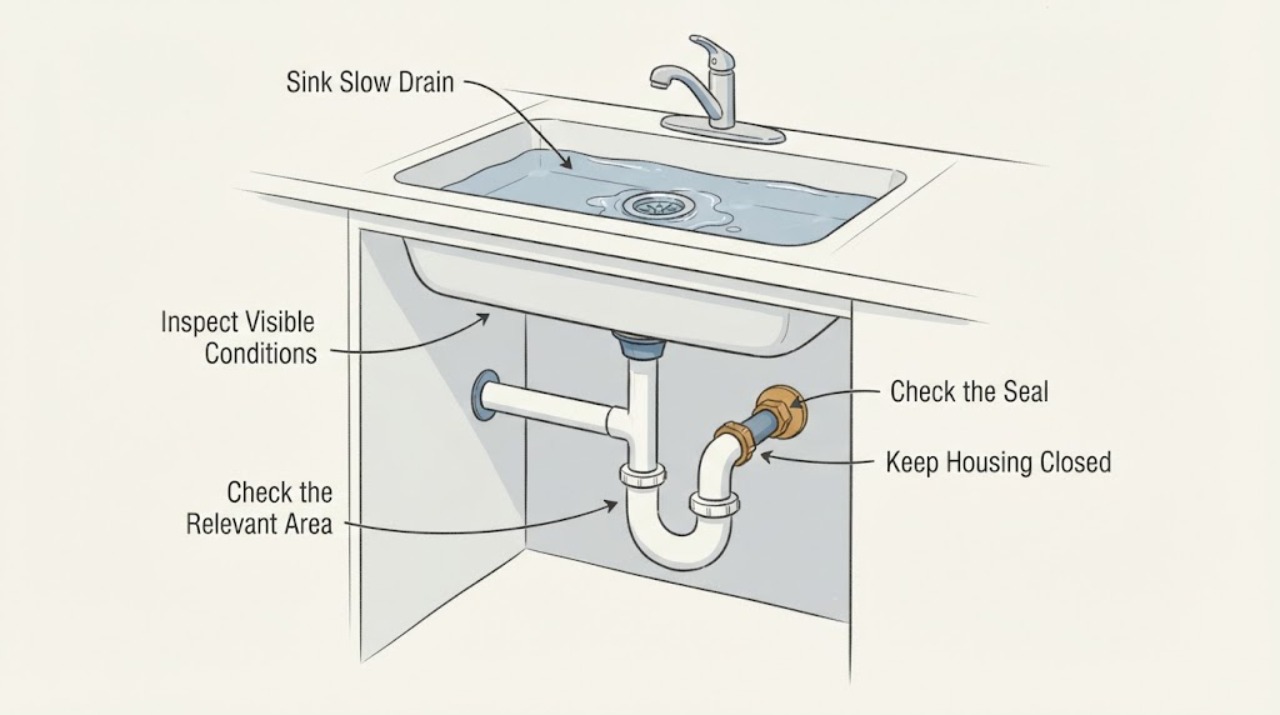
A sink that drains slowly usually has restriction near the visible strainer or stopper, in the trap below the sink, or farther along a branch drain. First note whether the water level falls slowly, stops completely, backs up into another fixture, or leaks under the sink. Compare this sink with nearby fixtures before taking anything apart. You may inspect visible debris and an accessible trap or drain connection for leaks, but do not open a hidden line, mix drain chemicals, or dismantle a pipe after chemicals have been used. A single-sink problem points toward the fixture or local trap; several fixtures, foul water, gurgling, or backup points toward a branch or building drain and needs a plumber. Stop for overflowing or contaminated water, a leak near electrical equipment, chemical residue, or a pipe that is damaged or under strain.
Before you begin
Safety first
- Keep the fixture unused for overflow, sewage, leaks, chemical history, damaged pipe, or spreading symptoms. Hidden-line work, chemical-line handling, pipe opening, and branch or building-drain clearing belong to qualified plumbing service.
Work through in order
Diagnostic checks
Use only checks that match the exact appliance or system and its official guide.
-
Check 1
Add no cleaner and do not dismantle anything; observe how the sink drains after ordinary use, noting whether the water level falls slowly, stops, rises again, or leaves residue, odor, or overflow at the rim.
Expected result: The sink is merely slow, fully blocked, intermittently slow, or overflowing and backing into the bowl.
Next step: Limit water use at the sink and record the behavior for the next check. For overflow, contaminated water, or a worsening blockage, stop and arrange plumbing service.
Stop if: Stop for sewage or contaminated water, overflow that cannot be contained, a leak, or water near electrical equipment.
Why this matters
Why: A slow isolated fall suggests a partial local restriction, while a full stop or overflow raises the chance of a substantial blockage or downstream restriction.
-
Check 2
With the sink unused, look at the visible strainer, stopper, overflow opening, and drain opening; if a loose surface item can be lifted without tools or force, remove only that visible debris and keep the trap and pipe connected.
Expected result: Hair, food, soap residue, or a visibly closed or misaligned stopper is present, or the visible opening is clear.
Next step: Clean only accessible surface debris with ordinary water and a cloth. If the opening is clear or the stopper cannot be safely identified, do not force it and continue to the under-sink inspection or call a plumber.
Stop if: Stop for a sharp or broken part, a stuck stopper, foul liquid, chemical residue, or any need to pry, drill, or remove hidden plumbing.
Why this matters
Why: A surface restriction can slow a sink without involving the trap. A clear opening shifts attention below the sink or farther along the branch; the drain design still determines what is accessible.
-
Check 3
From outside the pipework, inspect the trap and visible drain connections for drips, damp cabinet material, a displaced joint, sagging, corrosion, or strain; do not loosen a nut or open a pipe if any drain chemical may be present.
Expected result: The trap area is dry and intact, a local joint is damp, the pipe is displaced or damaged, or chemical use is known or uncertain.
Next step: Stop using the sink if it leaks or the pipe is damaged. Keep the product container or name available for the plumber, ventilate without leaning over the drain, and do not add water, another product, or pressure to the line.
Stop if: Stop for a pressurized leak, chemical residue, strong fumes, contaminated water, damaged pipe, or water near electrical equipment.
Why this matters
Why: A damp or displaced local connection can accompany poor drainage and needs leak control as well as blockage diagnosis. Chemical history makes opening the line unsafe because corrosive liquid may remain.
-
Check 4
Without disassembling or altering plumbing, observe whether another sink, tub, shower, floor drain, or toilet in the same area is also slow, gurgling, backing up, or showing foul water; record the order in which symptoms appear.
Expected result: Only this sink is slow, two fixtures share the symptom, or several fixtures or levels are affected.
Next step: For multiple affected fixtures, stop adding water and call a plumber for branch or building-drain assessment. For an isolated dry sink, continue with the drain-assembly and service handoff notes.
Stop if: Stop for sewage backup, wastewater at another fixture, bubbling or overflow, or any sign that the blockage is spreading.
Why this matters
Why: One fixture points toward its strainer, stopper, trap, or local branch. Several fixtures suggest a shared branch, vent, stack, or building drain and should not be treated as a single sink clog.
-
Check 5
Record whether the sink is a kitchen or bathroom fixture, whether it has an overflow opening, disposal or appliance connection, visible grid or stopper style, and whether the slowdown follows food, grease, hair, or recent plumbing work; do not choose a replacement part from appearance alone.
Expected result: The drain style and recent trigger are clear, the style is mixed or unknown, or recent work changed the drain path.
Next step: Give the assembly description, photos taken from a safe dry position, and recent-use history to the plumber. Follow only a manufacturer-specific procedure that matches the identified drain and does not require opening a hidden line.
Stop if: Stop for an unknown chemical history, a damaged overflow, a disposal or appliance connection that is leaking, or any need to cut or force pipework.
Why this matters
Why: Drain assemblies and trap arrangements differ, and a recent change can leave a misaligned or restricted connection. Unknown configuration is a reason to identify the model or use a plumber, not to improvise.
-
Check 6
Prepare a service note with the sink location, slow or blocked pattern, water level, odor, overflow, visible debris, trap and connection condition, other affected fixtures, drain style, recent work, and every product used in the line; keep the drain unused if the symptom is worsening.
Expected result: The slow drain persists after visible debris is addressed, the trap or branch is suspected, several fixtures are affected, or the line has chemical history or a leak.
Next step: Arrange a plumber to assess the accessible trap, branch drain, venting, and downstream path with the correct equipment and precautions. Do not use a hidden-line tool, chemical opener, or forced pressure without professional direction.
Stop if: Stop all user work if it would require removing the trap after chemical use, opening a hidden line, entering a confined space, or handling sewage or corrosive liquid.
Why this matters
Why: The remaining fault may be in the trap, local branch, vent, stack, building drain, a displaced connection, or a chemically loaded line requiring controlled plumbing work.
Use your observations
Decision map
Find the observation that best matches what you see, then follow the next safe action.
-
PATH 01Next step
What you see
Visible debris or a stopper that is not opening fully is found and the trap area is dry.
Do this next
Remove only loose surface debris without force, then observe one normal drain cycle. Call a plumber if slow flow remains or the stopper is stuck.
Why this path and its safety boundary
Why it matters: The restriction may be local to the accessible drain opening.
-
PATH 02Next step
What you see
The visible trap or drain connection is damp, displaced, corroded, or accompanied by a local leak.
Do this next
Stop using the sink, protect the cabinet, and arrange plumbing service; do not loosen the connection or force it open.
Why this path and its safety boundary
Why it matters: A local connection may be leaking or restricting flow and needs controlled plumbing attention.
-
PATH 03Next step
What you see
Several fixtures or levels are slow, gurgling, backing up, or producing foul water.
Do this next
Stop adding water to affected fixtures and request prompt plumber assessment of the shared drainage path.
Why this path and its safety boundary
Why it matters: A shared branch, vent, stack, or building drain is more likely than a single sink restriction.
-
PATH 04Next step
What you see
A drain opener or other chemical was used, or the product history is unknown.
Do this next
Do not add another product, plunge forcefully, or open the trap. Keep the container information and tell the plumber before work begins.
Why this path and its safety boundary
Why it matters: Corrosive liquid may remain in a blocked line and can injure anyone who opens or pressurizes it.
-
PATH 05Next step
What you see
The sink does not drain, water rises quickly, or wastewater returns through the bowl or another fixture.
Do this next
Stop using the connected fixtures, contain water without direct contact, and arrange plumbing service.
Why this path and its safety boundary
Why it matters: A substantial local or downstream blockage is present and overflow or contamination can spread.
-
PATH 06Next step
What you see
Flow improves briefly but becomes slow again or other fixtures later show the same symptom.
Do this next
Record the recurrence and fixture sequence and have a plumber assess the trap, branch, vent, or downstream line.
Why this path and its safety boundary
Why it matters: A partial restriction or shared drainage problem may remain rather than a fully cleared local obstruction.
Helpful context
Understand the symptom
Start with the pattern, not a bottle of cleaner
A slow sink can be a small accumulation at the strainer, a stopper that is not opening fully, a trap restriction, or a blockage in the branch line. The most useful first distinction is whether only one sink is affected. Gurgling, foul water, or backup at another fixture suggests that the problem is farther downstream. A chemical opener can leave a hazardous liquid in a blocked line and make later work more dangerous, so record what has been used and do not add another product.
Identify the drain assembly before choosing a part
Manufacturers use different grid strainers, push-button drains, lift-rod assemblies, overflow arrangements, and trap materials. A bathroom sink and kitchen sink may have different access and waste arrangements, and a disposal or dishwasher connection can change the under-sink path. Do not assume that a generic replacement or cleaning method fits the installed drain.
When the slow drain becomes a plumbing service call
A sink that is slow but isolated and dry may be a local restriction. A group of fixtures that slows together, backs up, or produces sewage odor needs a plumber to assess the branch, vent, stack, or building drain. A leaking trap or connection can damage the cabinet and floor even when the bowl eventually empties.
Safety boundary
Stop conditions
- Stop for overflowing or contaminated water, sewage odor or backup, a leak that is worsening, or water near electrical equipment.
- Stop if drain cleaner or another chemical was used, the product is unknown, fumes are present, or corrosive liquid may remain in the line.
- Do not mix chemicals, force a plunger against an unknown chemical, open a trap after chemical use, or pressurize a hidden line.
- Stop for a cracked, displaced, corroded, or pressurized pipe, a damaged overflow, or any need to cut into a wall or floor.
- Do not treat several slow or backing-up fixtures as one sink problem; stop adding water and call a plumber.
Only after diagnosis
Potential parts
- strainer or stopper assembly
- sink trap
- branch drain or vent component
When checks do not resolve it
Need a professional?
The sink is fully blocked, overflows, repeatedly slows after temporary improvement, or wastewater returns elsewhere., More than one fixture is slow, gurgling, backing up, or producing foul water., The trap or drain connection leaks, is displaced, corroded, under strain, or cannot be identified safely., Any drain chemical was used, the product history is unknown, or chemical liquid may remain in the line., Clearing the restriction would require hidden-line access, force, pipe disassembly, cutting, or handling sewage or contaminated water.
Safety scope: Keep the fixture unused for overflow, sewage, leaks, chemical history, damaged pipe, or spreading symptoms. Hidden-line work, chemical-line handling, pipe opening, and branch or building-drain clearing belong to qualified plumbing service.
Common questions
FAQ
Why is only one sink draining slowly?
An isolated sink more often points toward its visible strainer or stopper, trap, or local branch. Inspect from a safe position, avoid chemicals and hidden-line work, and call a plumber if the slow flow persists or a local leak appears.
What if several fixtures become slow?
Several slow, gurgling, or backing-up fixtures suggest a shared branch, vent, stack, or building-drain issue rather than one sink opening. Stop adding water and arrange plumbing service.
Should I pour drain cleaner into a slow sink?
Do not add chemical opener as a first response, especially when the line may be blocked. Drain cleaners can be corrosive and make later pipe work hazardous; tell the plumber exactly what was used if any product has already been added.
Can I remove the sink trap?
Only a qualified plumber should decide whether opening it is safe when the pipe is leaking, damaged, contaminated, pressurized, or has chemical history. Drain styles and under-sink arrangements vary, so do not force an unknown connection.
What information should I give the plumber?
Give the sink location and type, flow pattern, water level, overflow or odor, visible debris, trap condition, other affected fixtures, drain style, recent work, and every product used in the line. This helps separate a local restriction from a branch problem and sets the correct safety precautions.
Read the exact guide
Official sources
- Drain cleaner poisoningMedlinePlus, U.S. National Library of Medicine · U.S. government health information about drain-cleaner exposure; follow the product label and local emergency guidance for an actual exposure.
- Bathroom Faucet DrainsMoen Solutions · Moen bathroom drain guide; exact sink, faucet, drain, and under-sink configuration may differ.
- Lavatory DrainsMoen Solutions · Moen lavatory drain information; model-specific parts and procedures must be confirmed for the installed fixture.
- Approved Document H: Drainage and waste disposalUK Government · UK building guidance for domestic and small non-domestic drainage; local code and installed configuration control.
- Plumbing WorksPUB, Singapore's National Water Agency · Singapore national plumbing guidance; licensing and local work rules vary by location.
Community feedback
Share a repair observation
Share a plain-text repair observation. Accepted observations are published automatically; this page may take a moment to update.