
On this page
Start here
Quick answer
If pipes bang or vibrate at a sink, first note whether the noise starts when the faucet is turned on or turned off, and whether it affects hot water, cold water, or another fixture. Water hammer is most likely when a sudden valve closure creates a pressure surge; vibration that starts when a tap is opened can instead be air in the pipes. Check only the visible faucet, under-sink supports, accessible shutoff valves, and nearby fixtures. Stop for a leak, a pipe that moves hard, water near electrical equipment, or a noise that persists after safe external checks. Do not cut pipes, alter pressure controls, or install an arrestor without a qualified plumber and the applicable local requirements.
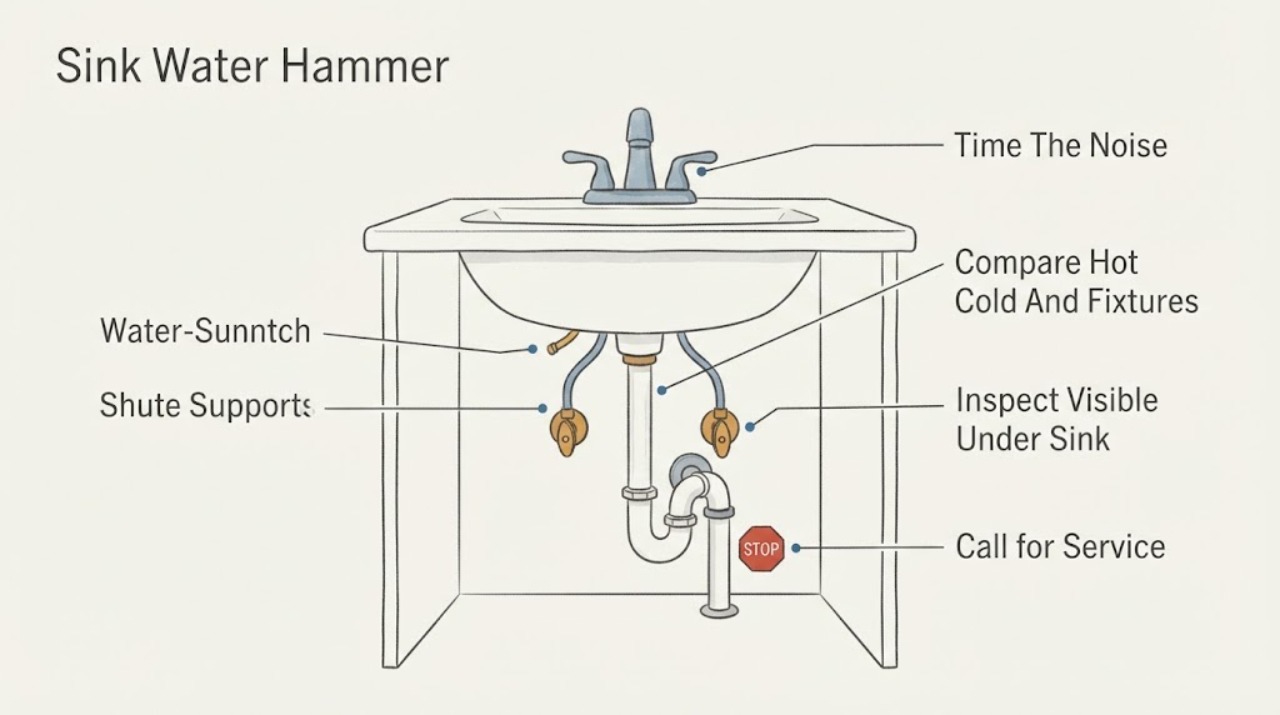
Work through in order
Diagnostic checks
Use only checks that match the exact appliance or system and its official guide.
-
Check 1
From a safe, dry position, operate the sink faucet normally once and note whether the bang or vibration begins when water starts flowing, when the faucet is shut, or a few moments later. Do not slam the handle or repeat the event to make the noise louder.
Expected result: The sound begins on opening; it begins immediately on closing; it occurs after a delay or during a separate appliance cycle; or no repeatable timing is found.
Next step: Record the timing and choose the matching branch. If the noise is accompanied by a leak, violent movement, or electrical hazard, stop immediately rather than repeating the check.
Stop if: Stop for leaking fittings, spray, violent pipe movement, or water near electrical equipment.
Why this matters
Why: The housing guidance associates vibration on opening with air in the pipes and banging on closing with water hammer. A delayed or unrelated event may come from another valve, pump, or pipe support and should not be labeled sink water hammer without more evidence.
-
Check 2
With the faucet used normally, compare the hot side and cold side one at a time, then note whether another nearby faucet causes the same bang. Do not open multiple valves rapidly or use a fixture with visible damage.
Expected result: Only hot, only cold, both sides, or several fixtures trigger the sound; or the sink is the only trigger.
Next step: Record which handles and fixtures trigger the sound. If another fixture or a fast-closing appliance is the trigger, include it in the plumbing assessment rather than focusing only on the sink.
Stop if: Stop if any fixture shows a leak, uncontrolled flow, or a pipe movement that could damage a connection.
Why this matters
Why: A single side or sink branch narrows the likely valve or branch location. Several fixtures point toward a shared supply, pressure, or pipe-support issue, so replacing the sink faucet alone would be an unsupported conclusion.
-
Check 3
Use a dry light to inspect only the visible area below the sink for a loose pipe clip, pipe touching the cabinet, unsupported flexible connector, damp fitting, or an accessible shutoff valve that is visibly damaged. Do not loosen a nut, bend a pipe, or force a valve.
Expected result: A pipe visibly touches the cabinet or moves with the noise; a support is loose; a fitting is damp; or the visible piping is dry and stable.
Next step: Remove only a loose object that is not attached to the plumbing and document the rest. Arrange a plumber for a loose support, damaged connector, damp fitting, or any concealed movement; do not improvise a clamp or repair.
Stop if: Stop for active leakage, corrosion, a bulging connector, or a pipe that moves forcefully.
Why this matters
Why: Contact or poor support can amplify a pressure event into a cabinet bang, while dampness indicates a leak that needs prompt attention. Dry, stable visible piping does not clear concealed lines or the valve itself.
-
Check 4
While the sink is quiet, note whether the noise occurs when a dishwasher, washing machine, toilet fill valve, or other nearby quick-closing valve operates. Do not dismantle or adjust the appliance valve to test the theory.
Expected result: The bang occurs only with the sink faucet; it occurs when another appliance or valve closes; or it occurs throughout the plumbing system.
Next step: Record the actual trigger and tell the plumber which valve closes immediately before the noise. Do not throttle an appliance supply valve unless the appliance manual and a qualified professional direct that action.
Stop if: Stop if an appliance hose, valve, or connection leaks, bulges, or moves sharply.
Why this matters
Why: Water hammer can be triggered by any quick-closing valve, and official housing guidance specifically calls out dishwasher and washing-machine supply lines. A different trigger changes the source branch and may make sink-faucet work irrelevant.
-
Check 5
If the vibration begins when the sink tap is opened, the plumbing is dry, and the main shutoff is clearly accessible, consider the housing authority's air-in-pipes procedure only if you are comfortable operating the known main valve and draining fixtures safely. Do not attempt it in a shared building or where the main controls another property.
Expected result: The opening-related vibration stops after the safe drain-and-refill procedure; it returns; or the procedure cannot be performed confidently.
Next step: Follow the exact published procedure only when its scope fits the property. If the noise is on closing, returns, or the main cannot be safely controlled, use the professional branch.
Stop if: Do not operate an unknown main valve, drain a shared system, or continue if a leak or water damage appears.
Why this matters
Why: The procedure is intended for air-related vibration on opening, not for a confirmed pressure surge on closing. A returning symptom or uncertain main-valve arrangement needs a plumbing assessment rather than repeated draining.
-
Check 6
Note other water-supply symptoms without changing any pressure control: unusually strong or weak flow, toilet or appliance valves that also bang, leaks after the event, or a recent change to the building supply or plumbing. Do not adjust a pressure-reducing valve or add an air chamber yourself.
Expected result: The sink is the only symptom; several fixtures bang or flow changes are widespread; or leaks appear after the event.
Next step: Arrange a qualified plumbing inspection for widespread symptoms, leaks, or recent installation changes. Keep use gentle and avoid repeatedly triggering the noise until it is assessed.
Stop if: Stop using the affected fixtures if a leak grows, a pipe shifts, or water reaches electrical equipment.
Why this matters
Why: A localized trigger can point toward a faucet branch, while widespread noise or flow change points toward shared pressure, valve, or support conditions. A leak after a pressure event raises the urgency because joints and fixtures may be under stress.
-
Check 7
After removing only a loose external object or completing a property-appropriate air check, operate the sink once normally and observe from outside the cabinet. Do not repeatedly open and shut the faucet to force a result.
Expected result: The vibration stops and no leak appears; the same bang returns; the noise is louder; or a leak or pipe movement appears.
Next step: If the noise returns or any abnormal condition appears, stop using the trigger and arrange qualified plumbing service with the timing and fixture observations. Do not install parts based on the sound alone.
Stop if: Stop immediately for a leak, pipe movement, water damage, or a noise that becomes violent or continuous.
Why this matters
Why: A quiet retest after an external correction suggests that condition contributed, but it does not prove the supply is correctly supported or the pressure is appropriate. A returning or worsening bang needs diagnosis of the valve, pressure, arrestor, and pipe supports.
Use your observations
Decision map
Find the observation that best matches what you see, then follow the next safe action.
-
PATH 01Next step
What you see
A fitting leaks, a pipe moves violently, water sprays, or water is near electrical equipment.
Do this next
Stop using the fixture, close the nearest known safe shutoff if reachable without exposure, protect the area, and arrange urgent qualified plumbing help; use emergency response for immediate danger.
-
PATH 02Next step
What you see
Vibration begins when the sink faucet is opened and no leak or damage is visible.
Do this next
Treat air in the pipes as a possibility and use the published drain-and-refill procedure only when the property's main valve and scope are clear. If it returns, arrange plumbing service.
-
PATH 03Next step
What you see
Banging or vibration starts immediately when the sink faucet is shut.
Do this next
Treat water hammer as the leading description, record the triggering handle and branch, and arrange a plumber to assess the quick-closing valve, supports, pressure, and any arrestor requirement.
-
PATH 04Next step
What you see
The noise is actually triggered by a dishwasher, washing machine, toilet valve, or another quick-closing valve.
Do this next
Document that trigger and have the relevant branch assessed; do not modify the appliance valve or install a device without professional sizing and placement.
-
PATH 05Next step
What you see
Several fixtures bang, flow changes across the property, or a leak appears after the event.
Do this next
Stop repeated testing and arrange qualified plumbing inspection for shared pressure, valve, supports, and connection conditions.
-
PATH 06Next step
What you see
Only the sink branch triggers a persistent bang after safe external checks and no visible hazard is present.
Do this next
Arrange a plumber to inspect the sink faucet, shutoff valves, branch piping, supports, and whether a correctly selected arrestor is appropriate.
Helpful context
Understand the symptom
What sink water hammer means
Water hammer is a pressure surge caused by moving water meeting a quickly closing valve, and it is heard as a bang, knock, or vibration in the supply piping. A similar vibration when a tap is opened can have a different cause, such as air in the pipes. A sink faucet can be the trigger even when the movement is heard in a nearby wall or cabinet, so timing and location matter more than the loudest point in the pipe.
Keep the checks visible
Do not cut into a supply line, loosen a concealed fitting, alter a pressure-reducing valve, or add an arrestor based only on a noise description. Do not force a stuck shutoff valve. If water is spraying, a pipe is moving violently, a fitting is leaking, or water is near electrical equipment, close the nearest safe shutoff only if you know it and can reach it without exposure, then obtain professional help.
What to record for a plumber
Record whether the sound starts on opening or closing, which faucet handle or side triggers it, whether other fixtures trigger the same vibration, how long it lasts, where the pipe moves, and whether there is a leak, pressure change, or recent plumbing work. A short recording from a safe position and a photo of visible under-sink piping can help, but do not remove panels or concealments to reach the source.
Safety boundary
Stop conditions
- Do not cut, drill, loosen, or reroute supply piping; do not alter a pressure-reducing valve or concealed shutoff; and do not force a stuck valve.
- Do not install or size a water-hammer arrestor from sound alone. Location, valve behavior, pipe conditions, local requirements, and manufacturer instructions must be assessed by a qualified professional.
- Stop immediately for active leakage, spraying water, violent movement, water near electrical equipment, or visible pipe or fitting damage.
Only after diagnosis
Potential parts
- water-hammer arrestor
Consider this only after a qualified plumber confirms that a quick-closing sink or branch valve is the trigger and that an arrestor is the correct remedy for the measured or observed plumbing conditions.
The plumber must select location, connection method, size, and approval for the local plumbing requirements and the actual pipe and valve arrangement.
When checks do not resolve it
Need a professional?
Use qualified plumbing service when the sink bang persists after safe external checks, starts on faucet closure, involves another quick-closing valve, affects multiple fixtures, causes leaks or movement, or requires piping, pressure, valve, support, or arrestor work.
Have this ready
- Provide the opening-versus-closing timing, hot or cold side, triggering fixture, noise location, duration, visible pipe movement, under-sink condition, leaks, recent plumbing changes, and whether an air check was attempted. Do not dismantle the plumbing to gather more information.
Common questions
FAQ
Is a bang when I turn off the sink faucet water hammer?
It is consistent with water hammer, which is a pressure surge associated with a quickly closing valve. Confirm the timing, check for leaks or pipe movement, and have a plumber assess the faucet branch if the sound persists; do not cut pipes or fit an arrestor based only on the noise.
Why does my sink pipe vibrate when I turn the faucet on?
The housing troubleshooting guide associates vibration that begins when a tap is opened with air in the pipes, which differs from the closing event typical of water hammer. If the sound returns after a property-appropriate air check or occurs with leaks, arrange plumbing service.
Could a washing machine cause banging at the sink?
Yes. A quick-closing valve elsewhere, such as a washing-machine or dishwasher supply, can create a pressure event that is heard through nearby piping. Identify the actual trigger and tell the plumber rather than assuming the sink faucet is faulty.
Can I install a water-hammer arrestor under the sink?
Do not choose or install one from the sound alone. The device must be appropriate for the triggering valve, location, pipe arrangement, and applicable plumbing requirements, so have a qualified plumber assess and install it if needed.
Read the exact guide
Official sources
- Troubleshooting guidesDefence Housing Australia · Official housing guidance distinguishing tap-opening air vibration from tap-closing water hammer and identifying other appliance valves as possible triggers
- Water HammerWashington State University · University reference explaining pressure surge from sudden valve closure and the variables that affect it; not a residential installation manual
- Title 815 Chapter 20 Regulation 120Kentucky Legislative Research Commission · Regulatory example showing that a protective device may be required near a quick-acting valve and must follow manufacturer specifications; local code controls elsewhere
Community feedback
Share a repair observation
Share a plain-text repair observation. Accepted observations are published automatically; this page may take a moment to update.