
On this page
Start here
Quick answer
A bang, knock, or vibration at the sink when water is turned on or off is usually a pressure surge caused by a rapid valve change, but loose or poorly supported piping, a worn faucet valve or washer, trapped air, excessive pressure, or a nearby device can make it worse. Record whether the noise occurs on hot, cold, opening, closing, or both, and whether it is only at this sink or throughout the home. Open and close the faucet gently for one brief observation only if there is no leak or other hazard; do not slam the handle, adjust the main pressure, open hidden piping, or install an arrestor without a qualified plumbing assessment. Stop for leaking joints, pipe movement, ceiling or wall damage, or a sudden severe bang and call a plumber.
Before you begin
Safety first
- Keep use gentle or stop it for severe impacts, leaks, flooding, damage, or contaminated water. Do not adjust pressure, open hidden piping, force valves, disconnect devices, install an arrestor, or enter a wet or damaged area.
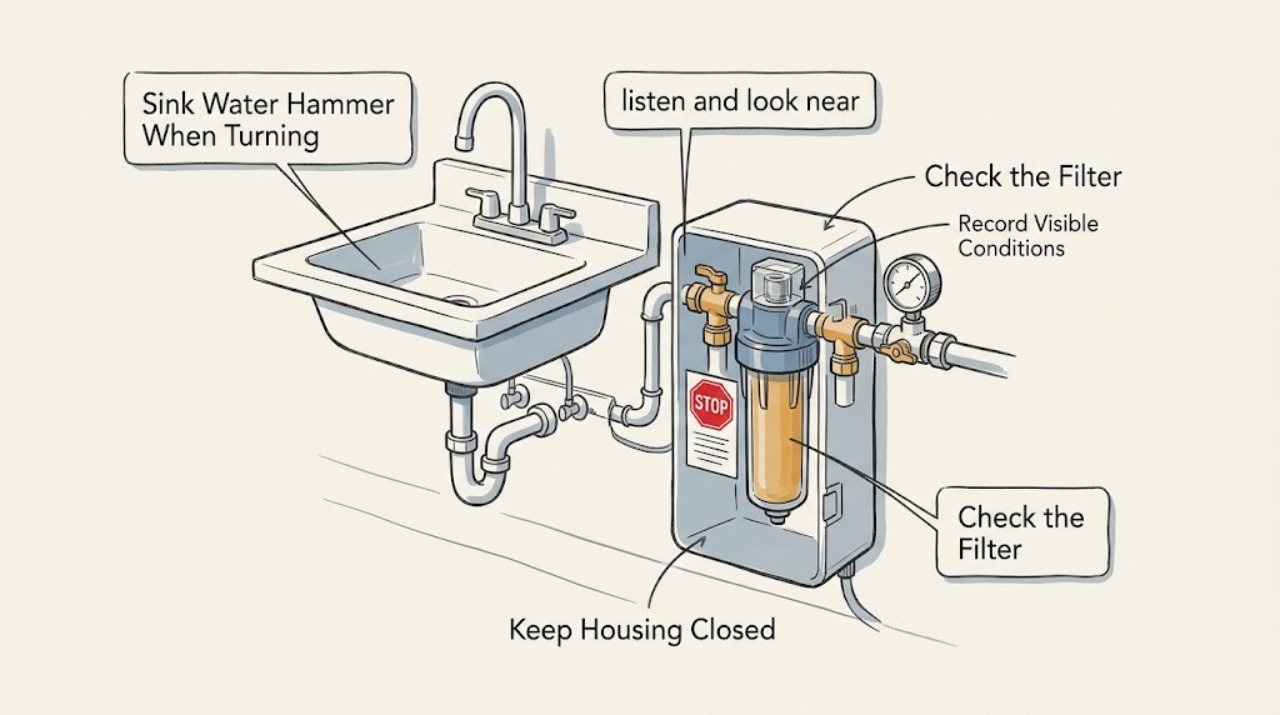
Work through in order
Diagnostic checks
Use only checks that match the exact appliance or system and its official guide.
-
Check 1
Write down the exact trigger: opening or closing, hot or cold, slow or quick handle movement, fully open or partly open, and whether the noise is one bang, a series of knocks, humming, vibration, or a burst of air. If the area is dry and intact, make one gentle normal-use observation rather than repeatedly slamming the handle.
Expected result: The hammer occurs only when closing, only when opening, on one temperature side, at a partial-flow position, or with both sides and both directions.
Next step: Record the pattern and stop recreating it if the impact is severe. Continue with non-invasive location and comparison observations; do not alter the pressure or hidden piping.
Why this matters
Why: A closing-only response fits a sudden stop in flow; an opening response can involve a pressure change, trapped air, or a restriction. One-side or one-handle behavior narrows the branch. Partial-flow chatter can keep a worn valve or washer in scope. Both sides and directions suggest shared piping, supports, pressure, or another valve.
-
Check 2
From a dry position, listen and look near the faucet, cabinet, exposed supply tubes, and the wall or floor behind the sink while the sound occurs during ordinary use. Do not put a hand on a moving pipe, reach behind a wall, remove trim, or loosen a connection.
Expected result: The sound is at the faucet, an exposed pipe visibly shifts, the cabinet vibrates, the impact comes from inside a wall or floor, or no movement is visible.
Next step: Photograph or note only what is visible. Call a plumber for pipe movement, a concealed impact, persistent vibration, or any sign of a stressed connection; do not clamp or brace piping yourself.
Why this matters
Why: A faucet-local sound can involve a valve or washer. Visible pipe movement suggests support or connection issues. A wall or floor sound requires concealed-pipe assessment. No visible movement does not rule out pressure shock or a hidden support problem.
-
Check 3
Repeat the same brief observation at another nearby faucet, then note whether toilets, a washer, dishwasher, refrigerator water valve, filter, or other quick-closing device makes a similar noise during normal use. Do not disconnect or cycle an appliance just to reproduce the sound.
Expected result: Only the sink is affected, several fixtures share the noise, or another device triggers a bang that travels toward the sink.
Next step: Give the plumber the fixture-by-fixture pattern and the triggering device. Do not replace the sink faucet or add an arrestor until the source branch is identified.
Why this matters
Why: A single-sink pattern favors the faucet, local branch, valve, or support. A multi-fixture pattern points toward shared pressure, main or branch piping, supports, or another valve. A nearby device can transmit a pressure shock through shared piping.
-
Check 4
Look for visible context from a safe position: recent plumbing work, a new faucet or appliance, a water-main interruption, a pressure-control change, a filter or tank installation, or air and sputtering after service. Do not adjust a pressure regulator or open a tank or concealed pipe.
Expected result: The hammer began after plumbing work, a device change, a water interruption, or a pressure change, or there is no known change.
Next step: Record dates and the affected fixtures and request the original plumber or a qualified plumber to inspect the changed branch. Do not reopen finished work or make a pressure adjustment to chase the sound.
Why this matters
Why: Recent work can leave air, a changed valve condition, an unsupported section, or a connection issue. A new device can introduce a quick-closing valve. No recent change keeps normal wear, supports, pressure, and hidden defects in scope.
-
Check 5
From a safe accessible location, observe for a drip, spray, damp cabinet, rust, joint movement, pipe rubbing, water stain, ceiling mark, floor swelling, or an unexplained meter change after normal water use stops. Do not touch wet fittings or enter a damaged area.
Expected result: No leak or damage is visible, or there is active water, a wet connection, structural damage, or continued water movement.
Next step: Stop using the sink and close a normally accessible local valve only if it is safe and moves easily. If the valve does not control the water, use the main shutoff from a safe location and call a plumber; do not force a valve or repair a wet connection.
Why this matters
Why: A water hammer can stress fittings and piping, but a visible or suspected leak becomes the priority regardless of the noise cause. Hidden moisture or meter movement can indicate a separate leak that needs prompt investigation.
-
Check 6
If there is no leak or hazard, note whether the hammer is getting louder, lasts longer, causes visible vibration, or is accompanied by pressure fluctuation, sputtering, discolored water, or an unusual odor. Do not use chemical treatments, open hidden piping, or change the main pressure.
Expected result: The noise is occasional and unchanged, is worsening or severe, or is paired with pressure, air, water-quality, or structural symptoms.
Next step: Arrange plumbing service and provide the full observation log. Stop using the sink for severe impacts, leaks, contaminated water, or damage rather than performing more tests.
Why this matters
Why: A stable mild sound can still need a branch inspection, while worsening or multi-symptom behavior raises concern for supports, valves, pressure, trapped air, a leak, or a water-supply problem. Water-quality changes are not explained away as ordinary hammer.
-
Check 7
Prepare a service note with the sink location, hot/cold and open/close trigger, handle speed and position, sound type and location, other-fixture results, nearby devices, recent work or water interruption, visible pipe movement or supports, pressure changes, leaks, and water-quality observations.
Expected result: The source remains uncertain, the noise is severe or persistent, or a repair would require access to a valve, pressure device, support, arrestor, faucet body, or concealed pipe.
Next step: Request qualified plumbing service and ask for the source diagnosis before approving a faucet, valve, arrestor, regulator, or hidden-pipe repair.
Why this matters
Why: The remaining work may require controlled pressure and flow checks, inspection of supports and valves, and selection or placement of a model- and code-appropriate mitigation device. These are professional plumbing tasks when the source is not exposed and safe.
Use your observations
Decision map
Find the observation that best matches what you see, then follow the next safe action.
-
PATH 01Next step
What you see
The bang occurs only as this sink's cold or hot faucet closes.
Do this next
Keep use gentle and arrange a plumber if the sound persists. Do not replace an internal faucet part without exact model diagnosis or open the wall to inspect the branch.
Why this path and its safety boundary
Why it matters: A local faucet valve, washer, cartridge, shutoff, branch support, or local pressure response is more likely than a whole-home problem.
-
PATH 02Next step
What you see
The bang occurs when the faucet opens, sputters air, or follows recent water-main or plumbing work.
Do this next
Record the work and timing and request plumbing inspection. Do not rapidly cycle the tap, adjust pressure, or reopen finished plumbing.
Why this path and its safety boundary
Why it matters: A pressure change, trapped air, changed valve condition, debris, or an unsupported connection may be involved.
-
PATH 03Next step
What you see
Several fixtures or a nearby quick-closing appliance produce the same hammer.
Do this next
Call a plumber to trace the branch and consider professionally selected shock control or support work. Do not disconnect the appliance or fit a device by guesswork.
Why this path and its safety boundary
Why it matters: Shared piping, supports, pressure conditions, or the other device's valve may be transmitting the shock to the sink branch.
-
PATH 04Next step
What you see
The pipe visibly moves, rubs against a structure, or the sound comes from a wall, floor, ceiling, or concealed space.
Do this next
Stop severe or worsening use and request a plumber. Do not brace, clamp, cut, or expose hidden pipe yourself.
Why this path and its safety boundary
Why it matters: Loose support, a concealed connection, or a pressure wave being amplified by the structure is possible.
-
PATH 05Next step
What you see
There is active leakage, water damage, a stressed joint, pressure fluctuation, discolored water, or an unexplained meter change.
Do this next
Stop using the sink, isolate water only from a safe position if possible, and call urgent plumbing service. Keep clear of damaged areas and do not force valves.
Why this path and its safety boundary
Why it matters: The issue is a possible plumbing or water-supply fault, not just an annoying noise.
-
PATH 06Next step
What you see
The impact is sudden and severe, rapidly worsening, or accompanied by a burst, spray, ceiling or wall damage, flooding, or inability to control water.
Do this next
Leave the affected area if unsafe, close the main water supply only if safely accessible, and obtain emergency plumbing help. Do not enter a flooded or damaged space or attempt a hidden-pipe repair.
Why this path and its safety boundary
Why it matters: There may be an imminent water-damage or structural risk.
Helpful context
Understand the symptom
Use the trigger to locate the decision point
A single knock as a tap closes is different from vibration during flow, a bang when the tap opens, or a repeated series of impacts after the water stops. Note the exact handle, hot or cold side, opening or closing direction, and whether the sound is at the sink, in the wall, or elsewhere. A controlled observation is useful; repeatedly recreating a severe impact is not.
Why the same sink symptom has several causes
A rapid valve change can create a pressure wave. The wave may be amplified when a pipe is loose, a connection is poorly supported, a faucet washer or valve is worn, or pressure and trapped air make the branch more responsive. A nearby appliance or quick-closing valve can also transmit noise to the sink branch.
Keep pressure and hidden-pipe work professional
A water hammer arrestor, pipe support, pressure regulator, valve, or concealed connection may be relevant only after the branch is identified. Do not change the main pressure, open a wall or ceiling, loosen a pipe, or fit a device by guesswork. A plumber can check pressure, supports, valves, and the correct arrestor location safely.
Safety boundary
Stop conditions
- Stop immediately for a burst or spraying pipe, uncontrolled water, active leak, water near electricity, ceiling or wall damage, floor swelling, flooding, or a sudden severe impact. Isolate water only from a safe position if possible and obtain urgent or emergency plumbing help.
- Do not adjust the main pressure or pressure regulator, open a wall or ceiling, loosen hidden piping, install an arrestor, brace a pipe, disconnect an appliance, or open a tank based only on the noise.
- Do not force a stuck shutoff valve, repeatedly slam or cycle the faucet, use chemical treatments, or continue using the sink when water is discolored, odorous, contaminated, or accompanied by sputtering and structural symptoms.
- Do not assume the faucet is the cause when several fixtures are affected. Record the opening/closing and hot/cold pattern and have the branch, supports, valves, and pressure conditions assessed by a qualified plumber.
Only after diagnosis
Potential parts
- water-hammer arrestor
Consider only when professional tracing confirms a pressure-shock problem and identifies an accessible, correctly sized installation point on the affected branch.
Type, connection, pressure rating, location, access, certification, and local plumbing requirements must be confirmed; do not install from the sound alone. - faucet washer, cartridge, or valve component
Consider only when the hammer is isolated to one faucet and professional or exact-model guidance identifies a worn or defective control component.
Single-handle and two-handle designs use different internal parts; confirm the exact faucet model and safe repair method. - pipe support or isolation material
Consider only when inspection finds visible movement, rubbing, loose support, or structural transmission on the affected branch.
Support type, material compatibility, access, movement allowance, and local requirements are installation-specific; do not brace concealed pipe by guesswork. - pressure-regulating valve
Consider only after controlled pressure testing shows a pressure-control problem affecting the sink or wider supply; a hammer alone does not prove regulator failure.
Pressure range, flow capacity, connection, location, expansion control, and code requirements must be confirmed by a qualified plumber.
When checks do not resolve it
Need a professional?
Call after recording the hot/cold and opening/closing pattern, fixture comparison, sound location, recent work, visible movement, and leak signs, or immediately for severe impact, active leakage, flooding, damage, or inability to control water.
Safety scope: Keep use gentle or stop it for severe impacts, leaks, flooding, damage, or contaminated water. Do not adjust pressure, open hidden piping, force valves, disconnect devices, install an arrestor, or enter a wet or damaged area.
Common questions
FAQ
Why does my sink bang when I turn the water off?
A quick stop in flow can create a water-pressure shock. Loose supports, a worn faucet valve or washer, pressure conditions, trapped air, or a nearby quick-closing valve can amplify it. Record the hot/cold and opening/closing pattern before calling a plumber.
Is water hammer worse when I turn the faucet on or off?
Closing often produces the familiar bang because moving water stops suddenly, but opening can also trigger a pressure change, trapped-air response, or restriction. The direction, handle speed, and temperature side are useful observations, not proof of a failed component.
Can I install a water-hammer arrestor under the sink?
Do not install one based only on the noise. Arrestor placement, size, working pressure, access, certification, and manufacturer direction depend on the branch. Have a qualified plumber identify the source and select any shock-control device.
What if the hammer started after plumbing work?
Record when it started and which fixtures are affected. Air, a changed valve condition, an unsupported section, or a connection issue may follow work. Use only gentle normal flow and request the original plumber or another qualified plumber to inspect; do not reopen finished piping.
When is sink water hammer urgent?
Stop and obtain urgent service for a severe or worsening impact, visible pipe movement, active leak, spray, water damage, flooding, water that cannot be controlled, or a sound from a damaged wall, floor, or ceiling. Keep clear and do not force valves or enter a wet damaged area.
Read the exact guide
Official sources
- Detect and Chase Down Leaks ChecklistU.S. Environmental Protection Agency · EPA WaterSense checklist; it is not a water-hammer repair manual.
- CIR828/AE066: Water Hammer In Irrigation SystemsUniversity of Florida IFAS Extension · University extension guidance for irrigation systems; residential plumbing details and installation requirements vary.
- Quieting in the HomeU.S. Environmental Protection Agency · EPA technical guidance; it is not a site-specific repair instruction.
- Hammering noise in pipesUnitywater · Water-utility guidance; local plumbing configuration and service conditions vary.
- PLUMBING DETAILSNational Institute of Standards and Technology · Reference building-plumbing drawings, not a homeowner installation guide; manufacturer and local requirements apply.
- How to fix a faucet leakPortland Water Bureau · Municipal faucet guidance; faucet construction and safe repair capability vary.
Community feedback
Share a repair observation
Share a plain-text repair observation. Accepted observations are published automatically; this page may take a moment to update.