
On this page
Start here
Quick answer
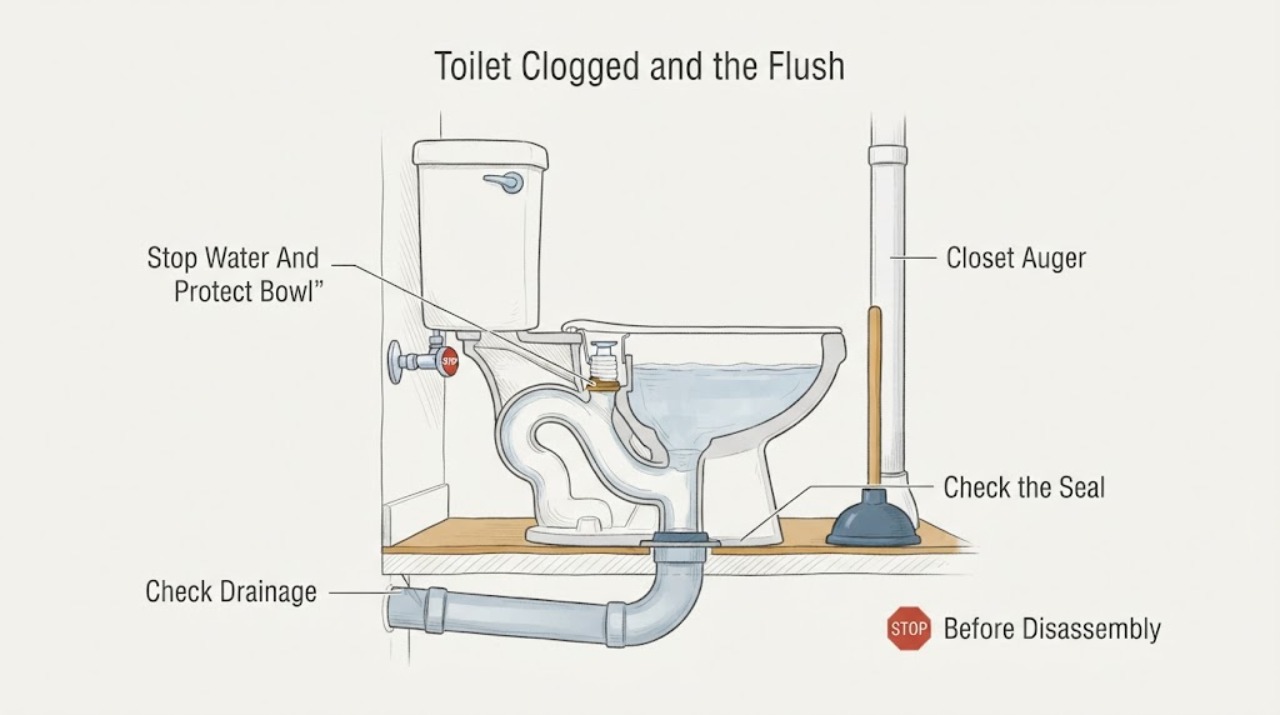
If a toilet is clogged and the flush does not clear it, stop adding water first so the bowl cannot overflow. Close the toilet’s supply valve, or hold the flapper closed if water is still entering the bowl, then use a toilet flange plunger with enough water to seal the trap opening. A falling bowl level and a normal test flush suggest that a nearby soft clog moved; a bowl that rises, a solid object, repeated clogging, gurgling in other fixtures, or several slow drains points to a deeper trap, branch, vent, or sewer problem. Do not keep flushing a slow toilet, pour chemical drain cleaner into it, use an improvised metal tool that can crack or scratch porcelain, or remove the toilet unless a qualified plumber directs it. If plunging does not restore normal drainage, use a closet auger only if the tool and toilet manual support it, then stop and call a plumber for a persistent, recurring, deep, shared-line, overflow, sewage, or unknown-object blockage.
Work through in order
Diagnostic checks
Use only checks that match the exact appliance or system and its official guide.
-
Check 1
Stop flushing immediately; close the toilet supply valve, and if the tank is still sending water into the bowl, hold the flapper closed or stop the fill mechanism from above the tank without reaching into contaminated water.
Expected result: The bowl level stops rising, the tank continues filling, the bowl is already near the rim, or water is leaking onto the floor.
Next step: Keep the toilet out of service, remove only enough standing water to work safely if needed, and proceed to a controlled plunger check only when the bowl is stable. Call a plumber for overflow, sewage, or an unknown leak.
Stop if: Do not flush again, pour a bucket into the bowl, use chemical cleaner, or continue if contaminated water is spreading or the toilet, floor, or supply connection is damaged.
Why this matters
Why: Stopping incoming water prevents an avoidable overflow. A bowl near the rim or water outside the bowl is an escalation condition, not a reason to add more water or continue flushing.
-
Check 2
With the toilet unused, watch whether the bowl level falls on its own, stays high, or rises when another nearby drain or fixture is used; note whether the tank has a normal water supply and whether this is the only affected fixture.
Expected result: The bowl slowly drains, remains full, rises with another fixture, or other toilets, sinks, tubs, or floor drains are also slow or gurgling.
Next step: Use a flange plunger only for a stable, local-looking clog. If several fixtures are affected or water backs up elsewhere, stop using water and arrange prompt plumbing service.
Stop if: Do not run another fixture to provoke a backup, open a cleanout that is under pressure, or continue if wastewater is entering the home.
Why this matters
Why: A bowl that slowly drains can fit a partial local clog. A high bowl that does not drain points to a stronger obstruction. A response in other fixtures or several slow drains makes a shared branch, vent, or sewer-line blockage more likely than a simple toilet-trap clog.
-
Check 3
Place a toilet flange plunger over the bowl’s drain opening, keep a seal, and use controlled push-and-pull strokes without splashing or forcing the handle; stop if the bowl rises toward the rim.
Expected result: The water level drops, the clog moves but drainage remains slow, the seal cannot be maintained, or the bowl rises instead of draining.
Next step: If drainage returns, wait for the bowl to settle and perform one cautious normal flush while ready to stop the water. If it remains slow or rises, stop plunging and move to an auger or plumber decision.
Stop if: Do not use a flat sink cup as a substitute if it cannot seal, strike the bowl, plunge against a solid object, or continue when water is near the rim.
Why this matters
Why: A drop in level suggests the obstruction is moving or the seal is working. A partial improvement keeps a local trap blockage in focus. A failed seal or rising bowl means the method is not clearing the obstruction and continued plunging risks an overflow.
-
Check 4
If plunging does not restore drainage and the blockage appears limited to this toilet, read the toilet and closet-auger instructions and use the auger only with controlled force and a clear path; otherwise stop and arrange a plumber.
Expected result: The auger reaches a soft obstruction and drainage returns, it stops against a hard object, the cable will not pass, the toilet is scratched or damaged, or the clog remains after the permitted attempt.
Next step: Test only once after a successful controlled clearing. Call a plumber for a hard object, repeated clog, deep obstruction, auger failure, or any toilet that must be removed.
Stop if: Do not force the cable, use a bare metal rod, remove the toilet, disconnect the waste connection, or use chemical drain cleaner as a substitute for an auger or plumber.
Why this matters
Why: A local soft blockage that clears can support a trap obstruction. A hard stop, unknown object, damaged porcelain, or failed auger attempt requires professional assessment because the obstruction may be deeper or unsuitable for further force.
-
Check 5
Without adding more water to the blocked toilet, note whether another toilet, sink, tub, or floor drain gurgles, drains slowly, backs up, or changes level; if there is a safe, accessible cleanout, observe whether it is visibly holding water without opening a pressurized cap.
Expected result: Only this toilet is affected, several fixtures are slow or gurgling, water is visible at an accessible cleanout, or no cleanout can be checked safely.
Next step: Stop using water and call a plumber for shared symptoms or a full cleanout. If only this toilet is affected, arrange service when controlled plunging or an auger does not restore normal flushing.
Stop if: Do not open a capped cleanout under pressure, enter a sewage area, flush other fixtures to test the line, or handle wastewater without appropriate protection.
Why this matters
Why: A single affected toilet keeps a local trap or branch blockage more likely. Multiple affected fixtures or standing water in a cleanout points farther downstream toward a house drain, property sewer, or public-line issue; a cleanout observation cannot identify the exact location by itself.
-
Check 6
Record what was flushed before the clog, the bowl level, whether the water was stopped, plunger and auger results, affected fixtures, gurgling, cleanout observations, leaks, and whether the clog returned after a cautious test flush.
Expected result: A wipe, paper towel, hygiene product, hard object, excessive paper, or unknown item may have been flushed, or the cause is not known and the clog is recurring.
Next step: Keep the toilet out of service for a persistent or recurring clog and provide the record to a plumber. Dispose of non-flushable items in the trash and flush only human waste and toilet paper.
Stop if: Do not keep flushing an unresolved clog, use chemicals to dissolve an unknown object, or conceal a sewage backup until it spreads to another fixture or room.
Why this matters
Why: Non-toilet-paper items can persist in the trap or sewer and recurring or unknown blockages need more than repeated plunging. The cause record helps a plumber choose a trap, branch, vent, or sewer-line inspection without guessing.
Use your observations
Decision map
Find the observation that best matches what you see, then follow the next safe action.
-
PATH 01Next step
What you see
The bowl is stable, only this toilet is affected, and a flange plunger or carefully used closet auger restores normal drainage without damage.
Do this next
Perform one cautious flush with the supply shutoff within reach, then monitor. Stop flushing and call a plumber if the clog returns or drainage remains slow.
Why this path and its safety boundary
Why it matters: A local trapway blockage is more likely than a shared sewer-line blockage, although recurrence would change the diagnosis.
-
PATH 02Next step
What you see
The bowl rises toward the rim or remains full despite a properly sealed plunger attempt.
Do this next
Stop adding water and arrange a plumber. Use a closet auger only if the instructions and toilet design support it and the bowl is stable; stop immediately at a hard obstruction.
Why this path and its safety boundary
Why it matters: The blockage is not clearing with the available pressure and an overflow risk is increasing; a stronger trap or downstream obstruction is possible.
-
PATH 03Next step
What you see
The auger stops at a hard object, an unknown item may have been flushed, or the porcelain or trap appears damaged.
Do this next
Stop using the toilet and call a plumber to assess the trap and removal method. Do not remove the toilet or push a rod through it as a home experiment.
Why this path and its safety boundary
Why it matters: A solid obstruction or fixture damage is more likely than a soft paper clog, and force can worsen the damage or push the item deeper.
-
PATH 04Next step
What you see
Other fixtures gurgle or drain slowly, wastewater backs up elsewhere, or a safe accessible cleanout is visibly holding water.
Do this next
Stop using all water and call a plumber; contact the responsible wastewater utility when the blockage appears to be in the public line under local procedures.
Why this path and its safety boundary
Why it matters: A branch drain, building sewer, or downstream line blockage is more likely than an isolated toilet clog.
-
PATH 05Next step
What you see
The toilet clears temporarily but clogs again, has a consistently weak flush, or gurgles even when the bowl appears clear.
Do this next
Arrange a plumber to inspect the toilet and drainage path. Do not keep treating a recurring blockage with repeated plunging or chemicals.
Why this path and its safety boundary
Why it matters: A recurring trapway, vent, flush mechanism, branch-line, or object-related issue is more likely than a one-time soft clog.
Helpful context
Understand the symptom
Prevent an overflow before trying to clear the clog
Do not test the flush again while the bowl is high or draining slowly. Close the supply valve near the toilet; if water is still entering, hold the tank flapper closed or remove the tank lid and stop the fill path. Keep towels and gloves available, protect nearby flooring, and treat any sewage backup as a contamination and plumbing-service issue rather than a routine flush test.
A flange plunger and a closet auger do different jobs
A toilet flange plunger is designed to seal the bowl opening and move water through the trap. If controlled plunging does not restore drainage, a closet auger can reach into the toilet trap more directly, but a hard object, deep line obstruction, or uncertain path needs professional equipment. Avoid forcing tools because porcelain can be scratched or cracked.
One toilet versus several fixtures changes the next step
A single toilet that became slow after a flushable-looking item or excess paper is more consistent with a local trap blockage. Gurgling, water rising in more than one fixture, or several slow drains makes a branch, vent, or sewer-line issue more likely. Stop water use and call a plumber when the pattern is shared or the blockage returns.
Safety boundary
Stop conditions
- Stop flushing as soon as the bowl drains slowly or rises. Close the supply valve and arrange a plumber for an overflow, sewage backup, water around the base, a hard or unknown object, a failed plunger or auger attempt, a recurring clog, several affected fixtures, gurgling, a full cleanout, a damaged toilet, or a blockage whose location is unclear. Seek urgent help for contaminated water spreading, structural damage, or an unsafe electrical condition nearby. Do not use chemical drain cleaner, open a pressurized cleanout, force an auger or rod, remove the toilet, or continue adding water to an unresolved blockage.
Only after diagnosis
Potential parts
- toilet flange plunger
Consider this only when the existing plunger cannot seal the toilet trap opening and the blockage appears local and safe for a controlled plunger attempt.
Use a toilet-specific flange design that fits the bowl opening; a tool choice does not establish that the clog is safe to clear at home. - closet auger
Consider this only for a stable, single-toilet blockage after plunging fails and the toilet and tool instructions support a controlled trapway attempt.
Use the tool only as directed for the toilet design and stop at a hard object, damage, or resistance; a plumber may need different equipment. - toilet flush valve or flapper assembly
Consider this only if professional or manual-guided inspection finds that a weak flush mechanism, rather than a drain blockage, is causing the recurring incomplete flush.
Confirm the toilet model and tank mechanism before selecting a component; a weak flush symptom does not establish compatibility.
When checks do not resolve it
Need a professional?
Call a plumber when controlled plunging does not restore normal drainage, the bowl rises or remains full, the clog returns, an auger meets a hard stop, the cause is an unknown object, another fixture is affected, or sewage backs up. A single stable soft clog that clears without damage can be monitored after one cautious test flush, but recurrence requires service.
Have this ready
- Provide the toilet location, bowl behavior, what may have been flushed, whether the water was stopped, plunger and auger results, other fixture symptoms, cleanout observations, leaks, and photos of visible damage without exposing people to sewage.
Common questions
FAQ
What should I do first when a toilet is clogged and will not flush clear?
Stop flushing and stop incoming water by closing the toilet supply valve or holding the tank flapper closed. Once the bowl is stable, use a toilet flange plunger with a seal. If the bowl rises, the clog persists, or another fixture is affected, call a plumber.
Why does my toilet fill but not clear when I flush?
A partial or complete trapway blockage can let the bowl fill while preventing water from passing through. A weak flush mechanism, vent issue, downstream drain blockage, or an object in the trap can produce a similar symptom, so the result of a controlled plunger attempt matters more than the bowl fill alone.
Should I use a plunger or a toilet auger?
Start with a toilet flange plunger for a stable, local-looking clog. If that does not restore drainage, a closet auger may be appropriate when the tool and toilet instructions support it. Stop at a hard object, damage, or strong resistance and call a plumber.
Can I use chemical drain cleaner in a clogged toilet?
Do not use chemical drain cleaner as a substitute for controlled mechanical clearing or professional service. It can leave hazardous liquid in the bowl and complicate later work. Stop adding water and call a plumber when plunging or an appropriate auger does not clear the blockage.
What does it mean if other drains gurgle when the toilet is clogged?
Gurgling or slow drainage in other fixtures makes a shared branch, vent, or sewer-line blockage more likely than an isolated toilet trap clog. Stop using water and arrange plumbing service rather than repeatedly flushing the toilet.
What items commonly cause a toilet to clog?
Toilets should receive human waste and toilet paper only. Wipes, paper towels, hygiene products, diapers, dental floss, cat litter, and other non-flushable items can persist in household or public sewer pipes and contribute to backups.
When should I call a plumber for a toilet clog?
Call when the bowl rises or overflows, plunging does not restore drainage, an auger meets a hard stop, an unknown object may be present, the clog recurs, water appears at the base, several fixtures are affected, or wastewater backs up into the home. Do not keep flushing an unresolved blockage.
Read the exact guide
Official sources
- Prevent Blocked DrainsCity of Tampa · Public wastewater guidance distinguishing local drain clogs from downstream line blockages and advising against repeated flushing of a slow toilet.
- TroubleshootingKohler · Manufacturer troubleshooting flow for checking a toilet blockage, using a plunger, and escalating to a plumber with a snake when the blockage remains.
- Home ManagementConnecticut Department of Mental Health and Addiction Services · Public household-skills guidance distinguishing a flange plunger for toilets and the seal-and-stroke principle.
- What you can (and can't) flushCity of Portland Bureau of Environmental Services · Public wastewater guidance identifying human waste and toilet paper as the only appropriate flush materials and explaining backup risks from wipes and other items.
- 3 Quick Fixes for Common Toilet ProblemsDelta Faucet · Manufacturer guidance on stopping incoming water, using a plunger, using a toilet auger when plunging fails, and calling a plumber for vent or base-leak symptoms.
Community feedback
Share a repair observation
Share a plain-text repair observation. Accepted observations are published automatically; this page may take a moment to update.