
On this page
Start here
Quick answer
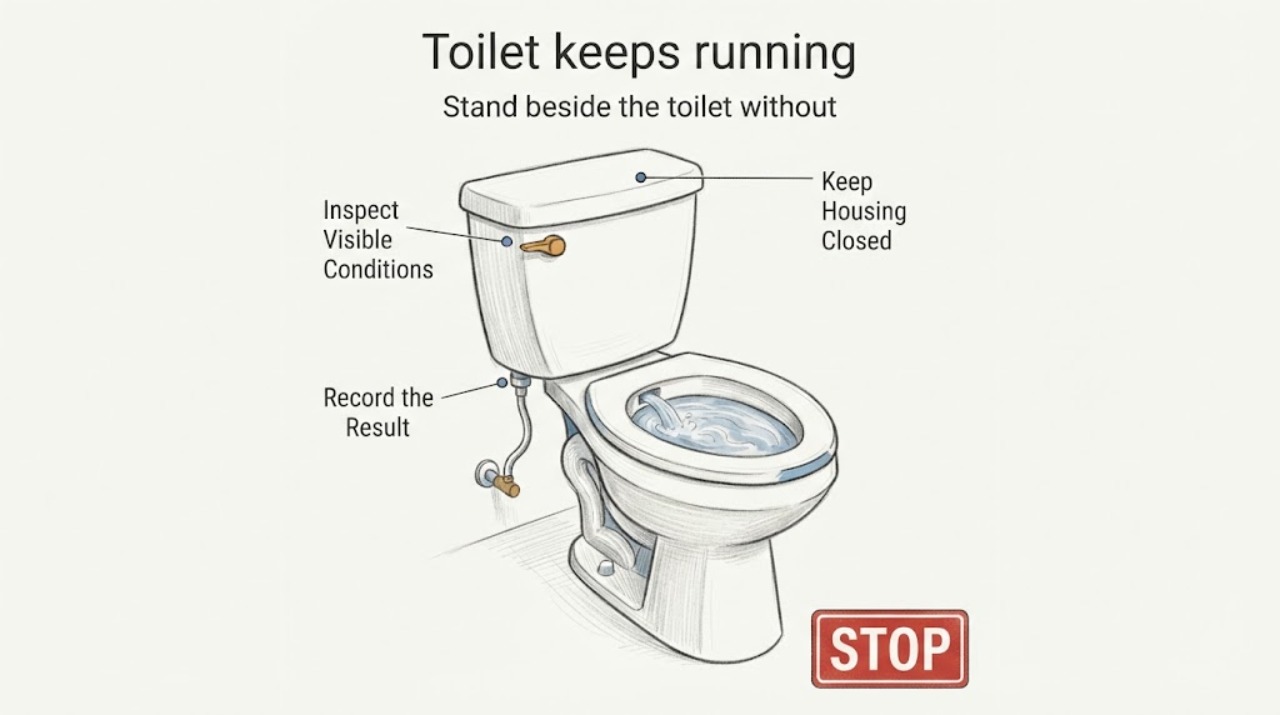
A toilet that keeps refilling or makes a steady hiss usually has water passing from the tank into the bowl, a flush handle or chain that is not returning, or a fill control that is not stopping at the normal level. Start with external sound, water-surface, handle, tank, and nearby-fixture observations. If the supply valve is dry, clearly reachable, and turns easily, you may gently close it to contain a persistent run; do not force it or remove tank, toilet, or pipe parts. An overflow, wastewater leak, a supply valve that will not close, or water spreading beyond the toilet is a reason to stop and call a plumber.
Work through in order
Diagnostic checks
Use only checks that match the exact appliance or system and its official guide.
-
Check 1
Stand beside the toilet without touching the tank or plumbing and listen for a hiss, trickle, refill cycle, or intermittent sound when no one has just flushed.
Expected result: Note whether the sound is continuous, starts and stops, or is absent while the bowl surface remains still.
Next step: Continue with the visible bowl and handle checks, record when the sound occurs, and avoid repeated flushes intended to reproduce it.
Stop if: Stop if you hear rushing water with an overflowing bowl, see water outside the toilet, or cannot safely remain in the area; contain access and call a plumber.
Why this matters
Why: A continuing sound when the toilet is idle supports water loss or an incomplete refill, while an intermittent cycle can point to water slowly moving from the tank into the bowl. A quiet toilet does not rule out a silent leak.
-
Check 2
Look at the bowl water from a stable position without touching it or adding anything.
Expected result: Check for a thin stream entering the bowl, ripples, or a visible water streak when the toilet has not been flushed recently.
Next step: Photograph the visible pattern if useful, then arrange a plumbing inspection or use a manufacturer-approved leak test only if the bowl is stable and there is no overflow risk.
Stop if: Stop immediately if the bowl level is rising toward the rim, wastewater is present, or water is escaping at the base; do not flush again and seek prompt plumbing help.
Why this matters
Why: A stream, ripple, or streak indicates water is entering the bowl and supports a tank-to-bowl leak or incomplete seal; it does not identify which internal part is responsible.
-
Check 3
Use the handle once in its normal direction and release it normally; observe the handle, any visible external lever movement, and the return of the bowl and refill sound without jiggling or forcing the control.
Expected result: Note whether the handle returns freely, feels stuck or loose, or leaves the toilet running after the flush cycle should have ended.
Next step: Record the handle behavior and tell the plumber whether the running changes when the handle is released; leave the control alone if it is stiff, loose, or damaged.
Stop if: Stop using the handle if it binds, breaks, causes a leak, or requires force; isolate the toilet and request professional service.
Why this matters
Why: A handle that sticks or fails to return can keep the flush mechanism open, while a normally returning handle with continued running suggests a different internal leak or fill-control issue. This observation does not justify opening or adjusting the tank mechanism.
-
Check 4
From outside the tank, inspect only normal visible conditions; if the lid is already safely open or can be lifted straight up with dry hands without force, observe the water level and overflow area without touching or removing any parts.
Expected result: Note whether water is visibly above the normal level, entering the overflow tube, or stopping below it, and whether the tank contains an obvious displaced or stuck external control.
Next step: Replace the lid gently if it was moved, document the visible level, and provide the result to a plumber; do not bend, cut, remove, or force tank components.
Stop if: Stop if the lid is stuck, the tank or porcelain is cracked, water is spraying, the level is rising rapidly, or any part needs force; close access and call a plumber.
Why this matters
Why: Water entering the overflow area suggests the fill control is not stopping at the expected level; water below the overflow with a bowl stream is more consistent with a tank-to-bowl seal or flush-control path. The observation is not a license to adjust or dismantle the mechanism.
-
Check 5
With all other fixtures visibly off, listen and look for water use elsewhere in the home and check whether the toilet is the only fixture continuing to run; do not open a meter box or manipulate other valves.
Expected result: Note whether only this toilet has sound or bowl movement, whether another faucet or appliance is using water, and whether a home water-use alert or unusual usage is already present.
Next step: Document the timing and other visible fixture status, then request a plumber if water use remains unexplained or the toilet continues to run.
Stop if: Stop the inspection if you find water outside the toilet, a wet wall or floor, wastewater, or a rapidly increasing leak; keep people away and obtain urgent plumbing help.
Why this matters
Why: A toilet-only symptom supports a localized toilet inspection, while simultaneous water use or a broader continuous-use indication may point to another fixture or a wider plumbing leak. Neither result identifies a repair part by itself.
Use your observations
Decision map
Find the observation that best matches what you see, then follow the next safe action.
-
PATH 01Safety boundary
What you see
The bowl is rising, overflowing, contains wastewater, or water is escaping onto the floor.
Do this next
Stop flushing, keep people away from the water, and call a plumber promptly; protect nearby belongings only if this can be done without contact with wastewater or electrical hazards.
Why this path and its safety boundary
Safety stop: Do not use drain chemicals, plunge repeatedly, remove the toilet, or attempt pipe disassembly.
-
PATH 02Safety boundary
What you see
The toilet runs but the bowl is stable, the supply area is dry, and the supply valve is clearly reachable and turns easily.
Do this next
If the running cannot be stopped with normal handle release, gently turn the toilet supply valve clockwise only until water stops; leave it closed and arrange service.
Why this path and its safety boundary
Safety stop: Do not force a stiff valve, use tools, or continue if the valve drips, flexes, or will not close.
-
PATH 03Safety boundary
What you see
The handle sticks, feels loose, or does not return after one normal use.
Do this next
Stop using the handle and report that behavior to a plumber; a flush-control or handle path may be holding the seal open.
Why this path and its safety boundary
Safety stop: Do not repeatedly jiggle, bend, or disassemble the handle, chain, tank, or flush mechanism.
-
PATH 04Safety boundary
What you see
The handle returns normally but the bowl shows a stream or ripple, or the tank appears to refill without stopping.
Do this next
Document the visible result and request a plumbing inspection for the tank-to-bowl seal or fill-control path; keep the supply closed if it was safely closed.
Why this path and its safety boundary
Safety stop: Do not assume a part from the symptom alone, remove internal parts, or mix chemicals in the toilet.
-
PATH 05Safety boundary
What you see
The toilet appears quiet and the bowl is still, but home water use remains unexplained or other fixtures show a similar symptom.
Do this next
Treat the issue as an unresolved water-use investigation and ask a plumber to check the wider plumbing system.
Why this path and its safety boundary
Safety stop: Stop if any hidden leak is suspected from wet flooring, staining, odor, or damage.
Helpful context
Understand the symptom
What a running toilet can mean
The sound may be continuous or may occur only when the tank should be quiet. A worn seal can let tank water slip into the bowl, while a handle, lever, or chain can hold the flush mechanism partly open. A fill control can also keep adding water if the level is not being controlled. These signs identify a leak or refill condition, not a guaranteed failed part.
Keep the check gentle
Use ordinary controls only once and observe from a dry, stable position. Do not jiggle the handle repeatedly, force a stiff supply valve, remove tank mechanisms, disconnect pipes, pour drain chemicals into the toilet, or keep flushing an overflowing bowl. A temporary supply shutoff is containment, not a diagnosis or repair.
Only after diagnosis
Potential parts
- toilet flapper
Consider this part category only if an inspection or approved leak test shows water passing from the tank into the bowl and the existing seal is identified as the cause.
Confirm the toilet model, flush-valve dimensions, and manufacturer fit information before ordering; the symptom alone does not establish compatibility. - toilet fill valve
Consider this category only when the visible water level rises into the overflow path or a professional diagnosis identifies the fill control as failing to stop normally.
Confirm the toilet model and valve adjustment/connection requirements from the manufacturer's documentation before ordering. - toilet flush valve kit
Consider this category only if the flush-valve seat or related assembly is diagnosed as the source after simpler external observations do not explain the leak.
Confirm the toilet model and flush-valve configuration; do not infer fit from appearance alone.
When checks do not resolve it
Need a professional?
Call a plumber when the toilet continues to run after normal handle release, a leak test indicates tank-to-bowl flow, the fill level reaches the overflow path, or the supply valve cannot safely stop the flow.
Have this ready
- Provide the sound pattern, bowl stream or ripple observation, handle behavior, visible tank-level result, whether the supply area stayed dry, and whether any other fixture was using water.
Common questions
FAQ
Why does a toilet keep running after I flush?
Common possibilities include water leaking from the tank into the bowl, a handle or flush control that is not returning, or a fill control that is not stopping at the normal level. External observations can narrow the path, but the symptom alone does not identify a part.
Can I turn off the toilet water if it will not stop running?
Only if the supply area is dry, the valve is clearly reachable, and it turns easily with normal hand pressure. Turn it gently until the flow stops, then leave it closed and arrange service. Do not force a stiff or leaking valve.
Should I put drain cleaner in a running toilet?
No. A running toilet is generally a tank, flush-control, or fill-control issue, and chemicals can create a hazard without addressing that cause. Do not mix chemicals or use them as a diagnostic test.
When is a running toilet urgent?
Treat it as urgent when the bowl is overflowing, wastewater is present, water is spreading onto the floor, the supply valve will not safely close, or the leak is near electrical equipment. Keep people away and call a plumber.
Read the exact guide
Official sources
- Leak Alerts: Find and Fix LeaksSan Francisco Public Utilities Commission · External and tank-level observations for a continuously running toilet
- How to find and fix a toilet leakCity of Portland Bureau of Environmental Services · Reader-level observations before requesting plumbing service
- Water Saving ItemsPUB, Singapore's National Water Agency · Water streak, ripple, sound, and leak-test observations
- Fix a Leak WeekU.S. Environmental Protection Agency WaterSense · Interpreting recurring toilet water loss and choosing a conditional inspection path
Community feedback
Share a repair observation
Share a plain-text repair observation. Accepted observations are published automatically; this page may take a moment to update.