
On this page
Start here
Quick answer
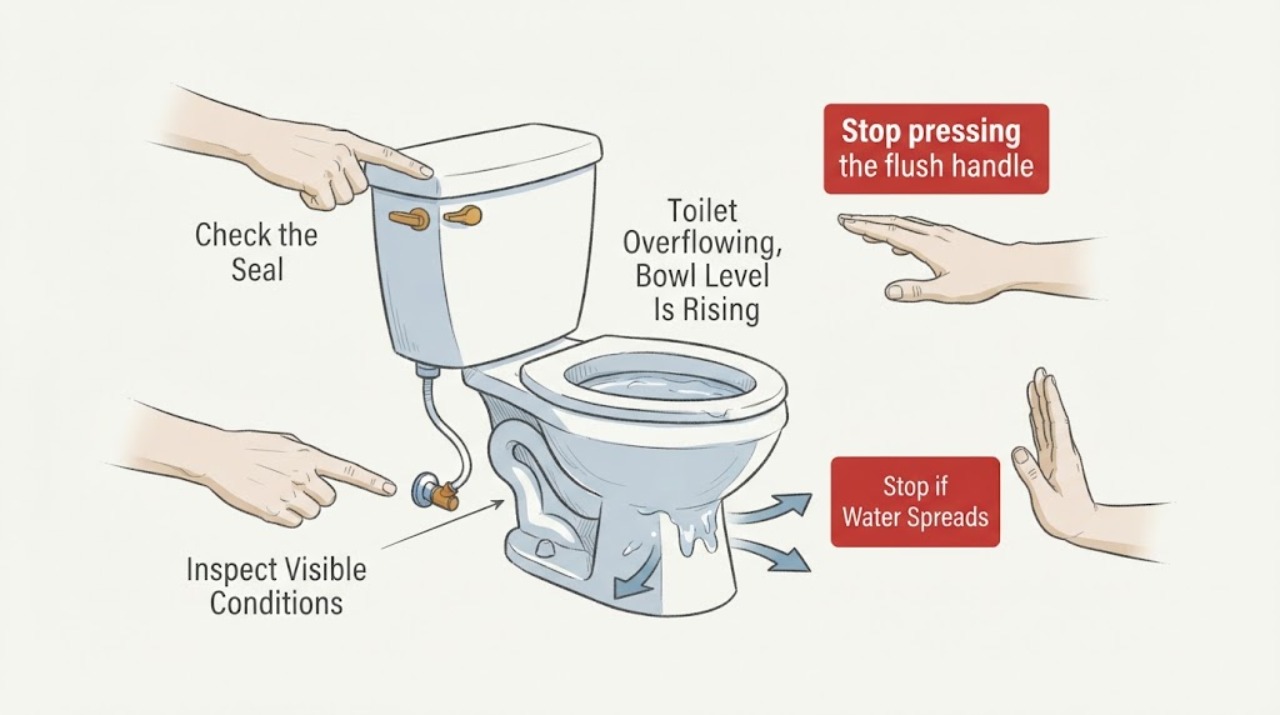
Stop pressing the flush handle and stop the water supply before the bowl reaches the rim. If the shutoff valve is accessible, close it; if water is still entering from the tank, lift the tank lid and hold the flapper closed or raise the float without forcing the mechanism. Once the level is safe, use a toilet plunger for a likely bowl or trap clog. If the bowl does not drain, rises again immediately, water is leaking at the base, or other fixtures gurgle or back up, stop flushing and call a licensed plumber.
Before you begin
Safety first
- Do not remove the toilet, work on a wet supply connection, handle contaminated water without suitable protection, or continue testing a cracked or unstable fixture.
Work through in order
Diagnostic checks
Use only checks that match the exact appliance or system and its official guide.
-
Check 1
Stop pressing the flush handle and turn off the toilet's local water-supply valve if it is readily accessible. If the valve does not stop the flow, remove the tank lid and hold the flapper closed or gently raise the float only if the mechanism moves freely.
Expected result: Water stops entering the bowl, or water continues entering despite the local shutoff and tank mechanism being left alone.
Next step: Keep the supply off and continue only when the bowl level is safely below the rim. If flow cannot be stopped without forcing a valve or reaching into a hazard, call a plumber.
Stop if: Do not force a stuck shutoff valve, reach into contaminated overflow water, or dismantle the tank while water is actively spilling.
Why this matters
Why: A stopped flow creates time to diagnose. Continued flow points to a shutoff or fill mechanism problem in addition to any drain blockage and should not be managed by repeated flushing.
-
Check 2
With the supply off, look in the tank and observe whether the flapper is seated, the float moves freely, and water is still traveling into the overflow tube. Do not flush during this check.
Expected result: The tank flow stops when the flapper or float is correctly positioned, or the tank continues to refill or send water through the overflow tube.
Next step: Leave the supply off, document the tank behavior, and correct only a simple, freely accessible adjustment described by the toilet instructions. If the valve or float remains faulty, arrange plumbing service.
Stop if: Do not remove the fill valve, disconnect the supply line, or use tools on a wet or corroded tank connection during an active overflow.
Why this matters
Why: A misaligned flapper, chain, float, or fill valve can create continuing tank-to-bowl flow even when the drain is clear; a stable tank with a high bowl makes a drain-side blockage more likely.
-
Check 3
After the incoming water has stopped and the bowl is not at the rim, use a toilet or flange plunger with a centered seal over the drain opening. Make several controlled strokes, then pause to see whether the water level drops; do not flush to create pressure.
Expected result: The bowl level drops and remains lower, or it stays high and returns to the same level after plunging.
Next step: If the level drops, wait and perform only one cautious test flush after restoring the supply and confirming the tank mechanism is no longer overfilling. If it does not drop, keep the supply off and move to professional help or a model-appropriate closet auger.
Stop if: Stop if plunging causes water to leak from the base, the bowl rises toward the rim, or the obstruction may be a sharp or nonflushable object.
Why this matters
Why: A drop suggests the obstruction is loosening in the toilet trap or nearby drain. No change suggests a deeper, hard, or shared-line obstruction that ordinary plunging may not clear.
-
Check 4
Check whether other nearby fixtures are slow, gurgling, or backing up, and look for water at the toilet base without moving the toilet. Keep all fixtures from adding more water while the bowl is unstable.
Expected result: Only this toilet is affected, or multiple fixtures show drainage symptoms; alternatively, water appears around the toilet base.
Next step: Do not keep flushing. Call a licensed plumber when multiple fixtures are involved or water appears at the base, and describe which fixtures changed and when.
Stop if: Stop immediately for sewage backup, contaminated water spreading, a cracked bowl, or a floor that is becoming saturated.
Why this matters
Why: One affected toilet is more consistent with a local trap obstruction, while multiple fixtures suggest a downstream drain or vent issue. Base water can indicate a seal or drain connection problem rather than a simple bowl clog.
-
Check 5
Once the bowl is stable, identify whether the problem began after a normal flush, after a nonflushable object may have entered, or while the toilet was not flushed and the tank kept running. Record the tank and bowl behavior before restoring normal use.
Expected result: The level rises only after flushing, rises while the tank is refilling, or the same problem returns after a temporary drop.
Next step: Give the sequence and photos to a plumber. Do not use chemical drain opener or repeatedly test-flush an unresolved obstruction.
Stop if: Stop user troubleshooting when an object may be lodged, the bowl or tank is cracked, the level rises again, or the cause cannot be isolated without removing the toilet.
Why this matters
Why: Flush-linked rising favors a drain restriction; refill-linked rising favors a flapper, float, or fill-valve issue; recurrence indicates that the first improvement did not remove the underlying fault.
Use your observations
Decision map
Find the observation that best matches what you see, then follow the next safe action.
-
PATH 01Next step
What you see
Do this next
Use a plunger if needed, then restore water and perform one supervised test only when the level is stable. Stop and call a plumber if the level rises again.
Why this path and its safety boundary
Why it matters: The fixture may have a partial drain restriction that is beginning to pass water; a confirmed clear path still requires a cautious test rather than repeated flushing.
-
PATH 02Next step
What you see
Do this next
Keep the local supply closed and arrange a plumber or a manufacturer-approved fill-mechanism repair. Do not force a corroded valve or disconnect the tank.
Why this path and its safety boundary
Why it matters: The fill mechanism or its adjustment is contributing to the overflow; clearing the bowl alone would not prevent another spill.
-
PATH 03Next step
What you see
Do this next
Keep the supply off and have a plumber clear the obstruction, or use only a closet auger that is appropriate for the toilet and within the manufacturer's guidance.
Why this path and its safety boundary
Why it matters: The obstruction may be deeper or lodged in the trap, and additional flushing can turn a restricted drain into an overflow.
-
PATH 04Next step
What you see
Do this next
Stop adding water to the affected fixtures and call a licensed plumber. Report the pattern of fixtures and whether wastewater is backing up.
Why this path and its safety boundary
Why it matters: A shared drain or vent problem is more likely than an isolated toilet trap clog, so fixture-level plunging may not solve the cause.
-
PATH 05Next step
What you see
Do this next
Keep the water supply off, keep people away from contaminated water or sharp porcelain, and obtain prompt plumbing service; follow local emergency guidance for significant flooding.
Why this path and its safety boundary
Why it matters: This is a leak or sanitation and property-damage condition beyond a routine bowl unclogging check.
Helpful context
Understand the symptom
First separate incoming water from trapped bowl water
A rising bowl can result from a blocked trap or drain, or from the tank continuing to send water after a flush. Stopping the supply prevents a controllable flow problem from becoming a floor spill. After the water stops, the next observation is whether the bowl level falls on its own or remains high.
Do not keep flushing to test it
A single flush can leave the bowl near the rim when a clog is present. Repeated flushes add water without improving drainage. Use the exact bowl and tank observations below, and escalate when the pattern suggests a shared drain, vent, toilet-base, or concealed plumbing problem.
Safety boundary
Stop conditions
- Stop flushing when the bowl level rises, the drain does not clear, or the water approaches the rim.
- Keep the local water supply off for continued tank flow, an uncontrolled overflow, base leakage, or a cracked fixture.
- Do not force a stuck shutoff, dismantle a wet tank connection, use chemical drain opener, or remove the toilet as an ordinary-user step.
- Call a licensed plumber for a recurring blockage, a suspected hard object, multiple affected fixtures, water at the base, sewage backup, or any leak that cannot be isolated safely.
Only after diagnosis
Potential parts
- toilet fill valve
Consider this only when the tank continues feeding the overflow or bowl after the float and flapper are correctly positioned and diagnosis confirms the fill valve is not shutting off.
Confirm the toilet manufacturer, model, tank arrangement, and installation instructions before selecting a replacement. - toilet flapper or flush valve seal
Consider this only when a tank-to-bowl leak or misaligned flapper is confirmed after the supply is safely shut off; it does not clear a bowl-side clog.
Flappers and seals are not universally interchangeable; confirm the exact toilet manufacturer and model. - toilet base seal or drain connection
Consider this only when a plumber confirms leakage at the toilet base or drain connection after separating it from water spilled during the overflow.
The repair method depends on the toilet, floor, flange, and local plumbing conditions; do not order a seal from the overflow symptom alone.
When checks do not resolve it
Need a professional?
Call a licensed plumber when the bowl stays high after controlled plunging, the level returns, the local valve or fill mechanism will not stop incoming water, multiple fixtures are affected, or water appears at the toilet base.
Safety scope: Do not remove the toilet, work on a wet supply connection, handle contaminated water without suitable protection, or continue testing a cracked or unstable fixture.
Have this ready
- Provide whether the level rose after flushing or during refill, whether the tank flow stopped, how plunging changed the level, which other fixtures were affected, and photos of any base or tank leak.
Common questions
FAQ
What should I do first when the toilet bowl is rising?
Stop flushing and stop the water supply at the local valve. If water is still entering from the tank, hold the flapper closed or raise the float gently if it moves freely, then wait until the bowl is safely below the rim.
Is a rising bowl always caused by a clog?
No. A blocked trap or drain is common after a flush, but a faulty flapper, float, or fill valve can keep adding water from the tank. Check whether water is still entering before choosing a drain-side remedy.
When is it safe to try a plunger?
Only after the incoming water is stopped and the bowl is not at the rim. Use a toilet plunger with a seal and controlled strokes; stop if the level rises, the base leaks, or a hard object may be lodged.
Why is water at the toilet base a reason to call a plumber?
Water at the base can be spilled overflow water, but it can also indicate a seal or drain connection problem. Do not keep flushing to find out; keep the supply off and have the source checked.
What if other sinks or toilets gurgle or back up too?
Multiple fixtures with slow drainage, gurgling, or backup point to a broader drain or vent issue rather than only the toilet trap. Stop adding water and call a licensed plumber.
Read the exact guide
Official sources
- Home MaintenanceU.S. Environmental Protection Agency · Government guidance for toilet tank leaks, overflow-tube flow, flappers, and when to contact a plumber.
- Check Your ToiletCity of Santa Barbara · Municipal water-conservation guidance for observing tank levels, overflow-tube flow, float behavior, and fill-valve problems.
- Toilet Leak DetectionNew York City Department of Environmental Protection · Government explanation of tank water behavior, flapper versus fill-valve symptoms, overflow-tube flow, and licensed plumber escalation.
- 3 Quick Fixes for Common Toilet ProblemsDelta Faucet Company · Official plumbing-fixture manufacturer guidance for an overflowing or clogged toilet.
Community feedback
Share a repair observation
Share a plain-text repair observation. Accepted observations are published automatically; this page may take a moment to update.