
On this page
Start here
Quick answer
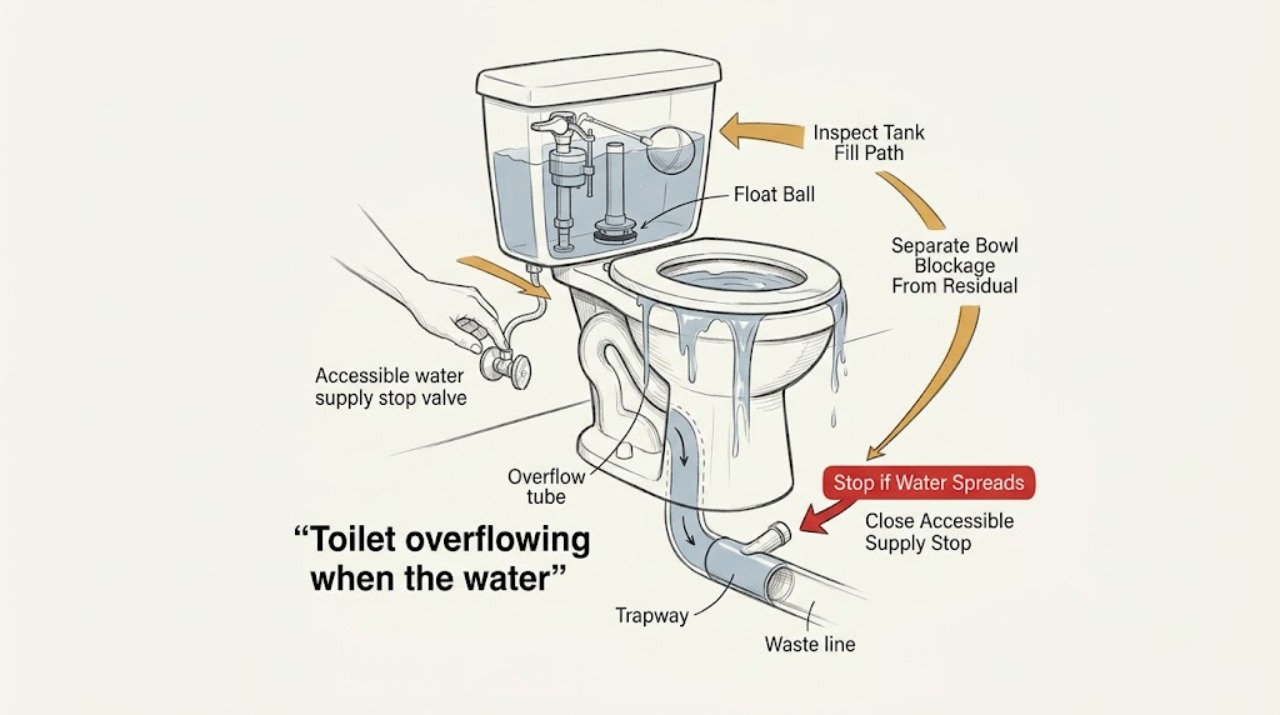
Stop the water before trying to clear an overflowing toilet. Since the supply stop is accessible, turn it clockwise until water stops, do not flush again, and keep people and pets away from contaminated water. If the bowl still rises after the supply is off, the flush likely has a trapway or waste-line blockage; use a toilet flange plunger only while the water level is safely below the rim. If the tank was overfilling, the float, fill valve, flush-valve seal, or tank water level may be the cause. Kohler troubleshooting guidance separates a blocked trapway or waste pipe from a valve that lets water run into the overflow. Arrange plumbing service when the supply stop will not shut off, the bowl remains blocked after careful plunging, sewage backs up elsewhere, the toilet leaks at its base, or overflow has reached flooring or a wall.
Work through in order
Diagnostic checks
Use only checks that match the exact appliance or system and its official guide.
-
Check 1
Do not flush again. Turn the accessible toilet supply stop clockwise by hand until it stops, without forcing it; for a lever-style stop, move the lever to the closed position. Keep towels or a shallow container nearby only if they can be placed without contacting contaminated water.
Expected result: Record that incoming water stopped, water still enters the tank, the stop drips or will not turn, or the bowl remains high but no fresh water is entering.
Next step: Leave the stop closed and continue only with the non-contact observations below. If the stop will not shut off, drips heavily, or the bowl threatens to reach the rim, obtain prompt plumbing service.
Stop if: Stop for sewage contact over a large area, water near electrical equipment, a broken supply stop, uncontrolled flow, or a toilet that is moving or leaking at its base.
Why this matters
Why: Water that stops at the supply stop points toward a fill-valve, float, flush-valve, or drain-path question. Water that continues despite a closed stop means the valve may be passing water or the supply path is not the expected one. A bowl that stays high after incoming water stops points toward trapped flush water or a blockage rather than continued filling.
-
Check 2
With the supply stop closed and no further flushing, watch the bowl for several minutes from a safe position. If the level is below the rim and stable enough to work, use a toilet flange plunger with slow initial strokes followed by firm strokes; do not use a chemical drain opener.
Expected result: Record water draining on its own, a level that stays high, a level that rises after plunging, a clear release followed by normal drainage, or water backing up in a tub, shower, sink, or nearby toilet.
Next step: Stop plunging if the level rises, another fixture backs up, or two careful attempts do not restore drainage; close the bathroom and arrange plumbing service. Do not use a powered auger or remove the toilet to reach a concealed line as a first home step.
Stop if: Do not plunge overflowing water at the rim, use chemical opener, place hands into the bowl, or continue if wastewater reaches flooring, walls, or electrical equipment.
Why this matters
Why: A bowl that drains after one blockage-clearing attempt makes a local trapway obstruction more likely. A high or rising level, repeated backup, or backup at other fixtures makes a deeper waste-line or shared sewer blockage more likely. A bowl that never received a new flush but rises can indicate a downstream backup.
-
Check 3
Only after the supply is closed and the bowl is stable, lift the tank lid without placing hands in the water. Observe the float, fill valve, flush-valve seal, chain or cable, refill tube, and waterline; do not bend a float arm or remove a valve cap unless the exact toilet instructions permit it.
Expected result: Record a float held down or rubbing, a flush valve held open, a chain or cable caught, water entering the overflow tube, a waterline above its mark, or no tank overflow while the bowl remains blocked.
Next step: Leave the supply closed. If a chain or float is visibly caught and can be freed without tools or contact with contaminated water, correct only that obvious obstruction; otherwise request plumbing service and provide the observation.
Stop if: Do not force a float, bend a metal arm, remove internal hardware from an unfamiliar tank, use in-tank chemicals, or open the tank when water may splash into an unsafe area.
Why this matters
Why: Water entering the overflow tube with a high level points toward fill-valve, float, refill-tube, or tank-level trouble. A flush-valve seal held open can let tank water run into the bowl. No tank overfill while the bowl remains high makes a trapway, waste line, or downstream backup more likely.
-
Check 4
With the supply stop still closed, inspect the accessible flexible supply line, stop, tank connection, bowl base, floor, and nearby wall for a kink, drip, crack, staining, or movement. Do not loosen a connector or use pliers on the stop.
Expected result: Record a dry stable connection, a kinked hose, a stop that drips or will not close, a tank or bowl crack, water at the base, a soft or swollen floor, or leakage into a wall or ceiling below.
Next step: Keep the supply closed and arrange plumbing service for any leak, crack, unstable toilet, damaged floor, or concealed water path. Do not reopen the stop just to test a leaking connection.
Stop if: Stop for a cracked bowl or tank, uncontrolled leak, unstable toilet, water entering a wall or ceiling, or water near electrical outlets or equipment.
Why this matters
Why: A kink can affect filling but does not explain a blocked bowl. A stop, tank, base, or concealed leak adds a water-damage path and requires more than plunging. A soft floor or water below the toilet makes the mounting seal or piping a professional repair boundary.
-
Check 5
Keep the toilet out of use, isolate contaminated towels or materials, and record whether the overflow was clean supply water or bowl or sewage water, how far it spread, what other fixtures do, the supply-stop result, and the tank and plunger observations.
Expected result: Record a contained event with normal drainage after one safe clearing attempt, a persistent local blockage, a shared-fixture backup, an active leak, or contaminated water in porous materials or near electrical equipment.
Next step: Arrange plumbing service for any unresolved overflow, and request qualified cleanup for sewage or hidden moisture. Keep the supply stop closed until the cause is corrected and the area is safe.
Stop if: Do not resume use after a failed clearing attempt, repeated overflow, shared backup, base leak, or contaminated spread until the cause and cleanup are addressed.
Why this matters
Why: A contained local event may need only a model-appropriate seal, fill-valve, or blockage repair. Persistent, shared, leaking, or contaminated conditions need a plumber and may also need professional water-damage cleanup. EPA warns that untreated sewage can threaten health and damage property.
Use your observations
Decision map
Find the observation that best matches what you see, then follow the next safe action.
-
PATH 01Next step
What you see
Closing the accessible supply stop stops the incoming water, and the tank had been filling into the overflow tube or the bowl was receiving a continuous stream without a new flush.
Do this next
Keep the supply closed and arrange repair based on the exact toilet model. A visibly caught float or chain may be freed only if it is safe and obvious; do not force internal parts.
Why this path and its safety boundary
Why it matters: A fill valve, float, refill tube, flush-valve seal, or tank-level problem is more likely than a trapway blockage.
-
PATH 02Next step
What you see
The bowl rose during or after a flush, the supply stop now remains closed, no other fixture backs up, and the bowl drains after careful use of a toilet flange plunger.
Do this next
Do not flush repeatedly to test it. If drainage is not reliably normal after the safe attempt, stop use and arrange plumbing service.
Why this path and its safety boundary
Why it matters: A local trapway obstruction is more likely and the immediate overflow has been contained.
-
PATH 03Next step
What you see
The bowl stays high after supply water is off, rises without a new flush, backs up at a tub, shower, sink, or another toilet, or two careful plunger attempts do not restore drainage.
Do this next
Stop using nearby fixtures, keep the toilet isolated, and arrange prompt plumbing service. Do not add chemical opener or remove the toilet as a first home step.
Why this path and its safety boundary
Why it matters: A deeper waste-line or shared sewer blockage is more likely than a tank fill-valve issue.
-
PATH 04Next step
What you see
The accessible supply stop will not close, drips heavily, the tank or bowl is cracked, the toilet moves, or water is escaping at the base, wall, ceiling, or electrical area.
Do this next
Keep clear of the water and arrange urgent plumbing service; isolate the affected electrical circuit only if this can be done without entering water or touching wet equipment.
Why this path and its safety boundary
Why it matters: The event includes a supply, fixture, mounting-seal, or concealed leak that cannot be safely solved by plunging or adjusting the tank.
-
PATH 05Next step
What you see
Bowl or sewage water reached flooring, wallboard, rugs, furnishings, or a large area, or the source is uncertain and may include wastewater.
Do this next
Keep people and pets away, avoid spreading the water, and obtain qualified plumbing and cleanup assessment. Do not return the toilet to service until the blockage and affected area are addressed.
Why this path and its safety boundary
Why it matters: The problem now includes contamination and property-damage risk. EPA notes that untreated sewage can carry pathogens and that porous materials may require replacement.
Helpful context
Understand the symptom
Stop supply water before diagnosing the overflow
An overflowing toilet can have two different water paths. Fresh supply water may still be entering through the fill valve, or flush water may be trapped above a blockage in the bowl, trapway, waste pipe, or vent. Closing the accessible supply stop limits fresh water, but it cannot remove water already in the bowl or clear a drain blockage. Do not flush again while the bowl is high.
A tank overflow and a bowl overflow point to different checks
If the tank is filling above its normal line and water enters the overflow tube, inspect only the visible float, fill valve behavior, flush-valve seal, and waterline after the supply is off. If the bowl rises during or after a flush and does not drain, treat the trapway or waste line as blocked. If the water level in the bowl rises even though the toilet was not flushed, stop using nearby fixtures because a shared waste-line backup may be involved.
Overflow water may be contaminated
Keep children and pets away, wear disposable gloves for limited contact, and avoid spreading water into other rooms. EPA describes untreated sewage as carrying bacteria, viruses, parasites, and fungi and notes that contaminated flooring, wallboard, rugs, and upholstered items may require thorough cleaning or replacement. Stop cleanup and obtain qualified help when the source is sewage, the area is large, or water has reached electrical equipment.
Only after diagnosis
Potential parts
- toilet flange plunger
Consider only when the bowl level is safely below the rim, the supply is stopped, no other fixture backs up, and the symptom points to a local trapway obstruction.
Use a toilet-specific flange shape; do not use a chemical opener or a tool that can damage the bowl. - toilet fill valve
Consider only after the tank continues filling into the overflow or the float and fill-valve path is diagnosed as the cause.
Confirm the exact toilet model, valve height, connection, and manufacturer's instructions before selection or installation. - flush valve seal
Consider only when the tank loses water through the flush valve or a worn or misaligned seal lets water run into the bowl.
Match the exact flush-valve design and model; do not use in-tank chlorine cleaners that can damage fittings.
When checks do not resolve it
Need a professional?
Arrange plumbing service when the accessible supply stop will not shut off, the bowl stays blocked after a careful flange-plunger attempt, another fixture backs up, the toilet leaks at its base or into a wall, the tank or bowl is cracked, or overflow reaches flooring or electrical equipment. Keep the stop closed and seek qualified cleanup for bowl or sewage water in porous materials or a large area. Do not flush repeatedly, use chemical opener, force the supply stop, or dismantle unfamiliar tank or waste-line parts.
Have this ready
- Give the plumber the toilet model if visible, whether water stopped at the supply stop, whether the tank or bowl overflowed, bowl and tank level behavior, plunger result, other fixture symptoms, supply-line and base observations, spread of water, and whether the water may be sewage.
Common questions
FAQ
What should I do first when a toilet is overflowing and the water shutoff is accessible?
Do not flush again. Turn the toilet supply stop clockwise until it stops, keep people and pets away, and watch whether the bowl continues to rise. If the stop does not control the flow, arrange prompt plumbing service.
Why does a toilet overflow after the supply water is turned off?
The bowl may still contain flush water above a trapway or waste-line blockage. If it rises without a new flush or other fixtures back up, a deeper shared drain blockage is more likely. Stop using nearby fixtures and call a plumber.
How can I tell whether the tank or the drain is causing the overflow?
If water was entering the tank's overflow tube, inspect the float, fill valve, flush-valve seal, refill tube, and tank waterline after closing the supply. If the bowl rose during a flush and does not drain, the trapway or waste line is more likely blocked.
Should I use chemical drain cleaner in an overflowing toilet?
No. Keep the supply closed and use only a toilet flange plunger when the bowl level is safely below the rim and no other fixture backs up. Chemical opener can create a splash and handling hazard and does not diagnose a shared waste-line blockage.
Is toilet overflow water hazardous?
Bowl or sewage water can carry pathogens and contaminate porous flooring, wallboard, rugs, or furnishings. Keep people and pets away, avoid spreading it, and obtain qualified plumbing and cleanup help when the spread is large, hidden, or near electrical equipment.
Read the exact guide
Official sources
- Sanitary Sewer Overflow (SSO) Frequent QuestionsU.S. Environmental Protection Agency · EPA SSO guidance used for contamination and cleanup boundaries when toilet overflow may include wastewater; it does not diagnose the toilet mechanism.
- Troubleshooting GuideKohler Co. · Kohler toilet troubleshooting guide used for tank-side reasoning, not as a universal model-specific repair procedure.
- One-Piece ToiletKohler Co. · Kohler one-piece toilet guide used for general diagnostic distinctions; exact components vary by toilet model.
Community feedback
Share a repair observation
Share a plain-text repair observation. Accepted observations are published automatically; this page may take a moment to update.