
On this page
Start here
Quick answer
A basement toilet leak may come from the toilet itself, its supply connection, the drain or sewer path, a pipe or wall above it, or groundwater and condensation that only appears near the fixture. First identify whether the water is clean supply water, toilet-bowl water, or seepage from the room, then watch where it first appears and whether it changes during refill or flushing. Close the toilet's accessible supply stop only if it turns normally and can be reached from a dry position; stop flushing, keep away from sewage and wet electrical equipment, and do not open walls, ceilings, floors, or a drain chase. A plumber should handle an uncontrolled leak, a base or concealed leak, sewage backup, soft or damaged structure, persistent mold, or any repair requiring disassembly of the toilet or pressurized piping.
Before you begin
Safety first
- Do not enter standing water, touch wet electrical equipment, force a shutoff, flush a backed-up toilet, open a wall/ceiling/floor, disturb mold, handle sewage, or remove the toilet.
Work through in order
Diagnostic checks
Use only checks that match the exact appliance or system and its official guide.
-
Check 1
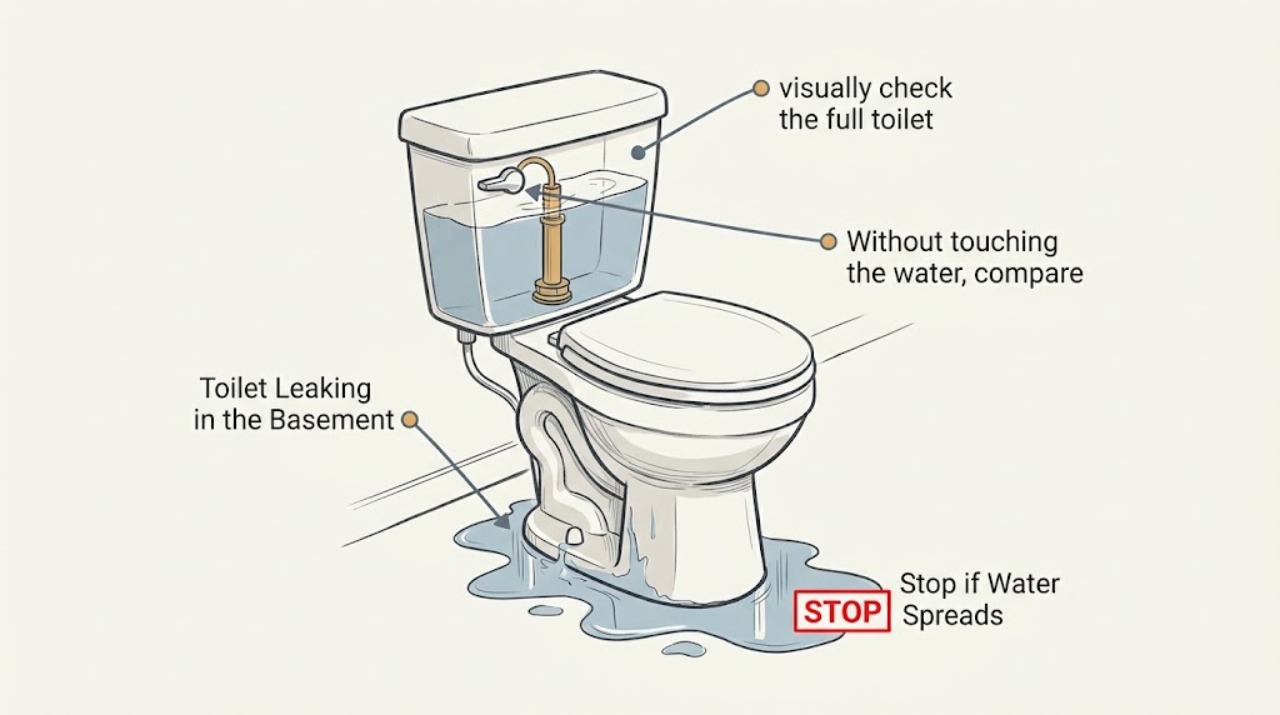
From the basement stairs or a dry standing position, visually check the full toilet footprint, supply line, tank underside, bowl base, nearby ceiling, walls, floor penetrations, and any exposed drain piping. Do not touch the water or enter a wet area to inspect it.
Expected result: The first wet point is at the toilet tank or supply, at the bowl base, from an overhead ceiling/wall, along exposed drain piping, from the floor/foundation, or cannot be identified.
Next step: Photograph and note the first wet point from a dry position. Close the toilet supply only if the stop is accessible and turns normally; otherwise keep away and call a plumber.
Stop if: Stop for standing water, sewage, rapid flow, an unstable floor, ceiling bulging, exposed wiring, or water near outlets, appliances, panels, or extension cords.
Why this matters
Why: A toilet-side wet point keeps the fixture and supply path in scope; a ceiling/wall or foundation wet point points away from the toilet; a drain-side wet point raises a wastewater or sewer-path concern. The lowest visible puddle may be downstream from the source.
-
Check 2
Without touching the water, compare its appearance and timing: clear water at a supply fitting, tank water at the fixture, cloudy or foul-smelling water near a drain, or dampness that appears after rain or when no toilet is used. Do not taste, mop through, or handle suspected wastewater.
Expected result: Water is clear and appears during refill, appears only after flushing, is cloudy/foul, or appears independently of toilet use or after wet weather.
Next step: Keep the toilet unused and report the water character and timing to a plumber. Use a water-damage or remediation professional when contaminated water or broad basement materials are involved.
Stop if: Stop for sewage odor or contact, large or fast flow, skin exposure, water near electricity, or any need to handle contaminated material.
Why this matters
Why: Clear refill-timed water supports a supply, tank, or fill-valve path; flush-timed cloudy/foul water supports a drain or sewer path; weather- or no-use-timed dampness makes an upstream pipe, foundation seepage, or condensation source more likely.
-
Check 3
If the basement is dry enough and no sewage or active overflow is present, observe the toilet during one ordinary refill or flush without moving the fixture. Watch the tank-to-bowl seam, fill-valve area, supply connection, bowl base, and exposed drain for the first new moisture; do not flush again to reproduce a leak.
Expected result: Moisture starts at the supply stop/hose, tank or fill-valve connection, tank-to-bowl seam, bowl base, exposed drain, or no toilet-side wetness appears.
Next step: Close the supply if safe and arrange plumbing service for the identified fixture path. If the toilet remains dry, ask the plumber or building professional to trace the upper or concealed source rather than replacing toilet parts.
Stop if: Stop for water under the fixture, bowl overflow/backflow, movement or cracks in porcelain, or water reaching an electrical area.
Why this matters
Why: Refill-timed wetness supports a clean-water supply or tank path; flush-timed wetness at the base or drain supports a bowl seal or wastewater path. No toilet-side wetness shifts attention to an overhead, wall, foundation, or condensation source.
-
Check 4
From a dry distance, inspect the basement ceiling and walls directly above or beside the toilet for stains, peeling paint, bulging drywall, wet insulation, pipe-chase moisture, or a drip that changes when an upper fixture is used. Do not open the ceiling or wall.
Expected result: The stain grows during an upstairs shower, toilet flush, or sink use; it follows a visible pipe; it grows after rain; or it remains unchanged while the basement toilet is unused.
Next step: Stop using the suspected upstairs fixture if doing so is practical and call a plumber or building-water professional. Keep the wall/ceiling closed until the source and any electrical/structural risk are assessed.
Stop if: Stop for ceiling bulging, falling material, sagging drywall, visible mold over a broad area, damp electrical wiring, or a need to cut into the structure.
Why this matters
Why: Use- or pipe-timed moisture can indicate an upper supply/drain or concealed pipe; rain-timed moisture can indicate foundation or exterior water entry. Hidden wet drywall, insulation, or ceiling materials can support mold and structural damage.
-
Check 5
Look for basement-wide moisture patterns without handling them: damp foundation walls/floor, condensation on cold pipes, a dehumidifier or sump area, musty odor, or a puddle that is not connected to the toilet. Note whether the pattern predates the toilet complaint or follows weather.
Expected result: Moisture is widespread or foundation-related, forms on cold surfaces, appears only in humid weather, or is localized to the toilet and its immediate plumbing.
Next step: Keep the toilet-side supply closed if it is implicated, and arrange the appropriate plumber, waterproofing/building, or water-damage professional. Do not run electrical equipment in standing water.
Stop if: Stop for standing water, wet cords or appliances, visible mold that would be disturbed, strong sewage odor, or an unsafe basement access path.
Why this matters
Why: Widespread or weather-timed dampness may be seepage or condensation rather than a toilet leak. A localized fixture pattern supports plumbing diagnosis, while musty odors or damaged porous materials raise a mold-remediation concern.
-
Check 6
Prepare a service handoff: basement location, first wet point, water appearance/odor, refill/flush/rain timing, toilet and upstairs fixtures involved, supply-stop response, photos from a dry distance, ceiling/wall/floor condition, and any electrical or mold concern.
Expected result: The record points to a toilet-side supply/tank/bowl path, an upstream or concealed pipe, a drain/sewer backup, groundwater/condensation, or mixed sources.
Next step: Leave the affected fixture unused and keep people away from contaminated or structurally damaged areas until the source is controlled and the basement is judged safe.
Stop if: Stop all homeowner investigation if the source is unclear, water returns, mold is hidden, or any repair would require opening walls/ceilings/floors, handling sewage, or entering standing water.
Why this matters
Why: A time-and-location record prevents the lowest puddle from being mistaken for the source and helps the plumber choose fixture isolation, drain investigation, or concealed leak tracing.
Use your observations
Decision map
Find the observation that best matches what you see, then follow the next safe action.
-
PATH 01Safety boundary
What you see
There is standing or rapidly spreading water, sewage/backflow, an overflowing toilet, water near electrical equipment, a soft floor, or a bulging ceiling.
Do this next
Keep people out, do not enter the water or touch electrical equipment, close the toilet supply only from a dry and safe position if the stop turns normally, and call a plumber or appropriate emergency service. Use professional contaminated-water cleanup when sewage is involved.
Why this path and its safety boundary
Safety stop: No flushing, plunging, electrical operation, wet-vacuum use, forced shutoff, or ceiling/wall opening.
-
PATH 02Safety boundary
What you see
The first wet point is the toilet supply, tank, bowl base, or exposed toilet drain.
Do this next
Leave the toilet unused, close its accessible supply stop if safe, and have a plumber identify the gasket, tank, bowl, supply, or drain repair. Do not assume the basement puddle alone identifies the failed part.
Why this path and its safety boundary
Safety stop: Do not disconnect pressurized lines, rock/lift the bowl, remove the tank, or work around sewage or cracked porcelain.
-
PATH 03Safety boundary
What you see
The basement ceiling/wall above or beside the toilet wets when an upstairs fixture or visible pipe is used.
Do this next
Stop using the suspected upper fixture where practical and call a plumber for supply/drain or concealed-pipe tracing. Keep the ceiling/wall closed and avoid disturbing wet materials.
Why this path and its safety boundary
Safety stop: Stop for sagging/bulging materials, wet wiring, mold, or any need to cut into the structure.
-
PATH 04Safety boundary
What you see
Moisture appears after rain, across the foundation/floor, or on cold pipes while the toilet remains dry.
Do this next
Treat it as seepage, condensation, or another building-moisture source rather than a toilet part failure. Arrange building-water or plumbing assessment and monitor/dry the area only when it is safe.
Why this path and its safety boundary
Safety stop: Stop for widespread dampness, hidden mold, structural damage, or wet electrical equipment.
-
PATH 05Safety boundary
What you see
Musty odor, visible mold, damaged drywall/carpet, or repeated basement dampness remains after the water is controlled.
Do this next
Fix the water source first and consult an experienced water-damage or mold professional when contamination is broad, hidden, sewage-related, or likely to be disturbed. Do not paint or seal over wet/moldy materials.
Why this path and its safety boundary
Safety stop: Stop cleanup for sewage, hidden mold, health concerns, or materials that require demolition or professional containment.
Helpful context
Understand the symptom
A basement is a useful observation point because water from an upper bathroom, wall cavity, drain line, foundation, or toilet can collect at the lowest level. A puddle beside the toilet does not prove that a toilet gasket or supply hose is the source. The most useful evidence is the first place that becomes wet and whether the water appears during refill, flushing, rainfall, or periods when no fixture is used.
Treat basement water as a combined plumbing and building-safety problem. Keep people and pets away from sewage, standing water, soft flooring, and wet electrical equipment. If the toilet supply stop is plainly accessible from a dry position and turns normally, closing it can limit a toilet-side leak; do not force a corroded stop or walk through water to reach it.
EPA guidance emphasizes fixing the water problem and drying wet materials promptly because damp areas can support mold, while hidden leaks in walls and pipe chases may require an experienced professional. This page uses only visual, low-risk checks; it does not authorize opening a ceiling, wall, floor, drain, or toilet assembly.
Safety boundary
Stop conditions
- Standing or rapidly spreading water, sewage/backflow, an overflowing bowl, soft flooring, bulging ceiling, or water near electrical equipment.
- Cracked or moving porcelain, a seized supply stop, uncontrolled flow, or a basement path that is wet or unsafe to enter.
- Musty odor, visible or hidden mold, wet drywall/insulation/carpet, or water entering walls, ceilings, or foundations.
- Any need to disconnect pressurized piping, remove the toilet, open walls/ceilings/floors, disturb mold, handle sewage, or operate electrical equipment in wet conditions.
When checks do not resolve it
Need a professional?
Call a plumber for any active toilet leak, supply-stop problem, bowl-base leak, drain/sewer backup, or source that is not clearly visible., Arrange prompt plumbing/building service when basement ceiling or wall moisture changes with an upstairs fixture, rain, foundation seepage, or an exposed pipe., Use a water-damage or mold professional for sewage-contaminated water, persistent musty moisture, broad or hidden mold, wet porous materials, or structural damage.
Safety scope: Do not enter standing water, touch wet electrical equipment, force a shutoff, flush a backed-up toilet, open a wall/ceiling/floor, disturb mold, handle sewage, or remove the toilet.
Common questions
FAQ
Why is a toilet leak showing up in the basement?
The basement may be receiving water from the toilet, an upstairs supply or drain, a concealed pipe, foundation seepage, or condensation. Trace the first wet point and timing; the lowest puddle is not necessarily the source.
How can I tell if basement water came from the toilet or an upstairs pipe?
From a dry position, compare the water timing with one normal toilet refill/flush and with upstairs fixture use, then watch the toilet base, ceiling, wall, and exposed pipes. Do not open the ceiling or wall or enter standing water.
Is basement toilet water automatically sewage?
No. Clean supply water may leak from a hose, valve, or tank, while cloudy or foul water near the bowl or drain may be wastewater. Do not touch or clean suspected sewage; keep people away and use a plumber or contaminated-water professional.
What should I do about mold after a basement toilet leak?
Control and repair the water source first, then dry affected materials promptly without disturbing hidden or broad mold. EPA recommends experienced professional help for sewage damage, hidden or extensive growth, health concerns, or porous materials that cannot be safely cleaned.
Read the exact guide
Official sources
- A Brief Guide to Mold, Moisture and Your HomeU.S. Environmental Protection Agency · General residential mold and moisture guidance.
- Home MaintenanceU.S. Environmental Protection Agency WaterSense · General residential toilet maintenance guidance; exact fixture instructions control.
- What are the basic mold cleanup steps?U.S. Environmental Protection Agency · General residential mold cleanup guidance.
- Fix a Leak WeekU.S. Environmental Protection Agency WaterSense · General household plumbing leak guidance.
- Ways to Protect Yourself and Others from Shock or ElectrocutionU.S. Consumer Product Safety Commission · General electrical safety around water; basement-specific equipment may vary.
- Interactive Mold House TourU.S. Environmental Protection Agency · General residential building moisture guidance.
Community feedback
Share a repair observation
Share a plain-text repair observation. Accepted observations are published automatically; this page may take a moment to update.