
On this page
Start here
Quick answer
A slow-draining toilet usually needs its bowl, trapway, or connected drain path distinguished before parts are replaced. Keep the bowl from overflowing, check whether the water level falls normally after a flush, and—only when the bowl is at a safe level—use a small controlled water-pour observation. A toilet plunger can address a local blockage; if the bowl still drains slowly, other fixtures are affected, or the problem returns, stop repeated flushing and have a plumber inspect the trapway, vent, or shared drain. Do not pour chemical drain opener into the toilet.
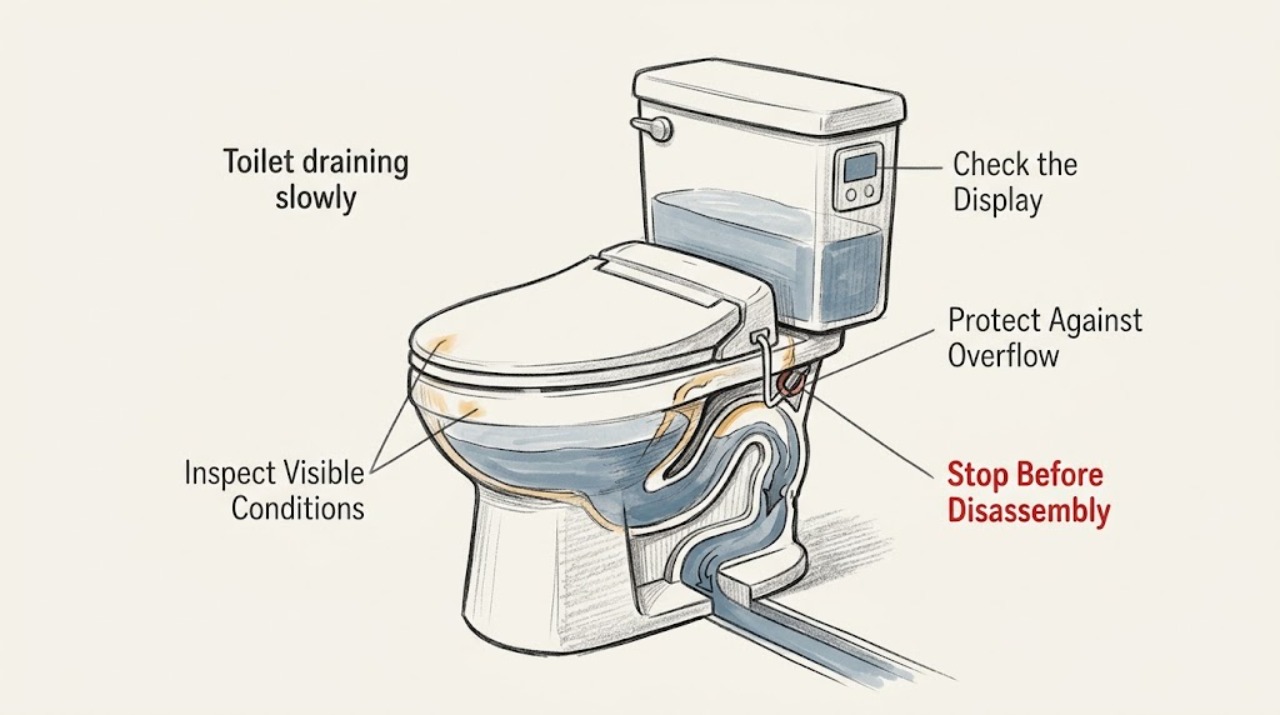
Work through in order
Diagnostic checks
Use only checks that match the exact appliance or system and its official guide.
-
Check 1
Stop flushing and observe the bowl from a safe level. If the water is close to the rim or continues rising, close the toilet’s accessible water-supply valve if you can do so without force, and wait for the level to settle before testing.
Expected result: The bowl is high or rising, or it is at its normal resting level and not threatening to overflow.
Next step: For a high bowl, stop and use a plumber if the level does not fall. For a safe level, continue to the flush and water-level observations without repeated full flushes.
Stop if: Stop if sewage backs up, the bowl overflows, wastewater appears at the floor, or the supply valve leaks or will not close.
Why this matters
Why: A high or rising bowl indicates that adding more flush water can cause an overflow; a normal resting level allows a controlled local check.
-
Check 2
With the bowl at a safe level, perform one normal flush and watch whether the water level falls below the trapway opening promptly or remains high and drains slowly. Do not flush repeatedly to see if it improves.
Expected result: The water drops below the trapway opening promptly, or it remains high and falls slowly with weak evacuation.
Next step: If the level remains high or slow, continue with the controlled water-pour test only if there is enough bowl capacity. If the level drops normally but the flush is weak, inspect the visible bowl and rim-jet path rather than assuming a drain-line clog.
Stop if: Stop if the bowl rises toward the rim, water leaks from the base, or another fixture begins backing up.
Why this matters
Why: Kohler’s troubleshooting flow uses the water-level drop after a flush to separate a normal evacuation from a possible blockage or other flush-path issue. Slow movement supports a partial restriction but does not identify its location.
-
Check 3
Only when the bowl is not high and there is room to stop safely, slowly pour a modest amount of clean water into the bowl while watching the level. Stop immediately if the bowl rises instead of accepting the water.
Expected result: The water drains away as it is poured, or the bowl level rises and remains elevated.
Next step: If water drains away but the flush remains weak, inspect the visible jet and tank-water conditions according to the model manual. If the bowl rises, treat it as a blockage and use a toilet plunger; do not keep adding water.
Stop if: Do not perform this test with a near-full bowl, after chemical drain product was added, or when wastewater is already backing up elsewhere.
Why this matters
Why: Kohler’s flowchart uses a controlled water-pour observation: water that drains away suggests the main evacuation path is accepting flow, while a rising bowl indicates a blockage requiring clearing.
-
Check 4
With the water level safe, look for an obvious object or mineral buildup at the bowl opening and visible rim or jet openings. Remove only a loose, reachable object without tools that could scratch the porcelain; do not dismantle the toilet.
Expected result: A visible obstruction is present and can be removed safely, or no visible obstruction is found.
Next step: After a safe loose obstruction is removed, perform one controlled test. If no obstruction is visible or the slow drain remains, use the toilet-plunger branch rather than poking deeper with improvised wire.
Stop if: Stop if the object is sharp, lodged, below the visible opening, or removal would require removing the bowl, tank, jets, or any plumbing connection.
Why this matters
Why: A visible obstruction can weaken the flush or slow evacuation, but a clear surface does not rule out a restriction inside the trapway or waste line.
-
Check 5
If the bowl is safe and no chemical drain opener is present, use a toilet-specific flange plunger that seals the outlet. Keep the cup covered with water, make controlled strokes, and stop if resistance is abnormal or the bowl begins to rise.
Expected result: The water begins to move freely and a subsequent single flush is normal, or the bowl remains slow, rises, or the plunger cannot make a seal.
Next step: If drainage improves, test once and monitor rather than repeatedly flushing. If it does not, stop and call a plumber to use the appropriate toilet auger or snake and assess the wider drain path.
Stop if: Do not plunge if chemical drain product may be in the bowl, if sewage is backing up from another fixture, or if porcelain is cracked or unstable.
Why this matters
Why: A successful change after plunging supports a local blockage. No improvement, a poor seal, or recurring slowness means the restriction may be deeper or the toilet’s trapway or vent may need professional assessment.
-
Check 6
Without adding more water, check whether the sink, tub, shower, or another toilet in the same area is also slow, gurgling, or backing up. Note whether this toilet became slow after a dropped object, renovation, landscaping work, or a prior drain-clearing attempt.
Expected result: Only this toilet is affected, or several fixtures show the same slow or backup pattern.
Next step: For a single toilet that remains slow after plunging, call a plumber for trapway or auger work. For multiple fixtures, stop using affected fixtures and request a shared drain and vent assessment.
Stop if: Stop flushing or using fixtures if wastewater backs up, sewage odor is strong, the floor becomes wet, or the problem returns immediately after clearing.
Why this matters
Why: One affected toilet is more consistent with a local trapway or fixture restriction; several fixtures together raise concern for a shared drain or vent restriction. This comparison narrows the handoff but is not proof of a particular pipe fault.
Use your observations
Decision map
Find the observation that best matches what you see, then follow the next safe action.
-
PATH 01Next step
What you see
The bowl is near the rim, rising, overflowing, or wastewater is backing up
Do this next
Stop using the fixture and call a plumber if the level does not settle or other fixtures are affected.
Why this path and its safety boundary
Why it matters: Do not add water or keep flushing; overflow control takes priority over diagnosis.
-
PATH 02Next step
What you see
The bowl accepts controlled water and a visible loose obstruction can be removed safely
Do this next
Remove only the reachable obstruction, test once, and escalate if the slow drain remains.
Why this path and its safety boundary
Why it matters: A local flush-path restriction is plausible.
-
PATH 03Next step
What you see
The controlled water-pour test makes the bowl rise
Do this next
Use a toilet-specific plunger if no chemical product is present; call a plumber if it does not clear.
Why this path and its safety boundary
Why it matters: The trapway or immediate drain path is blocked or restricted.
-
PATH 04Next step
What you see
Plunging restores normal drainage and the problem does not return
Do this next
Flush only human waste and toilet paper, monitor the next uses, and call service if slow drainage recurs.
Why this path and its safety boundary
Why it matters: A local blockage was likely displaced, but avoid treating repeated clogging as resolved permanently.
-
PATH 05Next step
What you see
The toilet remains slow after plunging or needs an auger, snake, bowl removal, or vent access
Do this next
Stop repeated attempts and have a plumber inspect and clear the appropriate path.
Why this path and its safety boundary
Why it matters: The obstruction may be deeper or the vent or shared drain may be involved.
-
PATH 06Next step
What you see
Several fixtures are slow, gurgle, or back up together
Do this next
Limit water use in the affected area and request professional drain and vent assessment.
Why this path and its safety boundary
Why it matters: A shared drain, vent, or septic-side restriction is more plausible than a simple bowl-only clog.
Helpful context
Understand the symptom
What a slow drain tells you
A toilet that empties slowly may have a partial obstruction in the bowl or trapway, a restricted vent, or a problem farther along the waste line. The same symptom can appear before a complete blockage, so avoid repeated full flushes while testing. A single toilet with a normal bathroom drain points to a local check; several fixtures slowing together changes the likely scope to shared plumbing.
Prevent an overflow while checking
Do not add water or flush again when the bowl is already high or rising. Keep the floor clear and use only a toilet-specific plunger if the bowl contains no chemical drain product. Never mix cleaners or reach into standing water without appropriate protection.
When a plumber should take over
If a plunger does not restore drainage, a plumber can use a toilet auger or snake and assess whether the vent or building drain is restricted. Removing a toilet, opening a drain line, or diagnosing a vent stack is not required for an ordinary first check and can create a leak if done incorrectly.
Safety boundary
Stop conditions
- Stop flushing or adding water when the bowl is near the rim, rising, overflowing, or wastewater backs up from another fixture.
- Do not use chemical drain opener in the toilet, especially when a plunger may be needed or a septic system is involved; chemical splash can make clearing unsafe.
- Do not remove the toilet, open a drain line, access a vent stack, use improvised wire that can damage porcelain, or continue repeated clearing attempts when drainage quickly returns.
Only after diagnosis
Potential parts
- toilet-specific flange plunger
Only relevant when the bowl is at a safe level, no chemical drain product is present, and the observation supports a local blockage.
Use a tool intended to seal a toilet outlet; a plunger cannot resolve a shared drain, vent, or structural problem. - toilet auger or closet snake
Only relevant when a toilet-specific plunger fails and a plumber determines the restriction is in the trapway or nearby branch.
Use an appropriate toilet tool and technique; deep, hard, or recurring obstructions should be handled by a plumber to avoid porcelain or seal damage.
When checks do not resolve it
Need a professional?
Use a plumber for a slow toilet that remains blocked after a safe plunger attempt, requires an auger or snake, affects multiple fixtures, backs up wastewater, or returns repeatedly.
Common questions
FAQ
Why is my toilet draining slowly but not completely clogged?
A partial restriction can be in the bowl, trapway, nearby branch, or vent. Use the safe water-level and controlled pour observations, then try a toilet-specific plunger; recurring or deeper symptoms need a plumber.
How can I tell if the toilet trapway is blocked?
With a safe bowl level, observe whether water drains away during a controlled pour or instead makes the bowl rise. A rising bowl supports a blockage, but it does not locate the obstruction precisely; a plumber can use an appropriate auger or snake if plunging fails.
Should I use chemical drain cleaner for a slow toilet?
Do not pour chemical drain opener into the toilet. EPA advises avoiding chemical drain openers for a clogged drain in septic contexts, and chemical residue can make later plunging or professional clearing hazardous; use a toilet plunger or call a plumber instead.
What if the toilet is slow and the sink or shower is slow too?
Several affected fixtures point away from a bowl-only check and toward a shared drain, vent, or septic-side restriction. Limit water use and request a plumber’s assessment rather than repeatedly flushing the toilet.
Can I use a regular sink plunger on a toilet?
A toilet-specific flange plunger is the better match because it is designed to seal the toilet outlet. Use it only when the bowl is safe and free of chemical drain product; stop if the bowl rises or the attempt does not improve drainage.
Read the exact guide
Official sources
- Toilet Water Not Leaving BowlKohler Assist · Toilet bowl water evacuation, trapway blockage, auger, and vent-path escalation
- How to Care for Your Septic SystemU.S. Environmental Protection Agency · Toilet-use limits, non-flushable waste, septic drain restrictions, and chemical drain-opener caution
- TroubleshootingKohler · Kohler toilet flush-path troubleshooting, controlled water test, plunger, and plumber escalation
Community feedback
Share a repair observation
Share a plain-text repair observation. Accepted observations are published automatically; this page may take a moment to update.