
On this page
Start here
Quick answer
A bang or thump immediately after a toilet refills is usually hydraulic shock: water stops or changes direction quickly, and the pressure surge makes a valve, hose, or pipe move. First confirm that the sound is tied to this toilet, look for an accessible loose line or leak without forcing the shutoff, and compare it with other fixtures. If several fixtures bang, the noise is in the home plumbing or pressure control; if it is isolated to this toilet, a plumber can assess the fill valve, supply line, supports, or a correctly sized water-hammer arrestor.
Work through in order
Diagnostic checks
Use only checks that match the exact appliance or system and its official guide.
-
Check 1
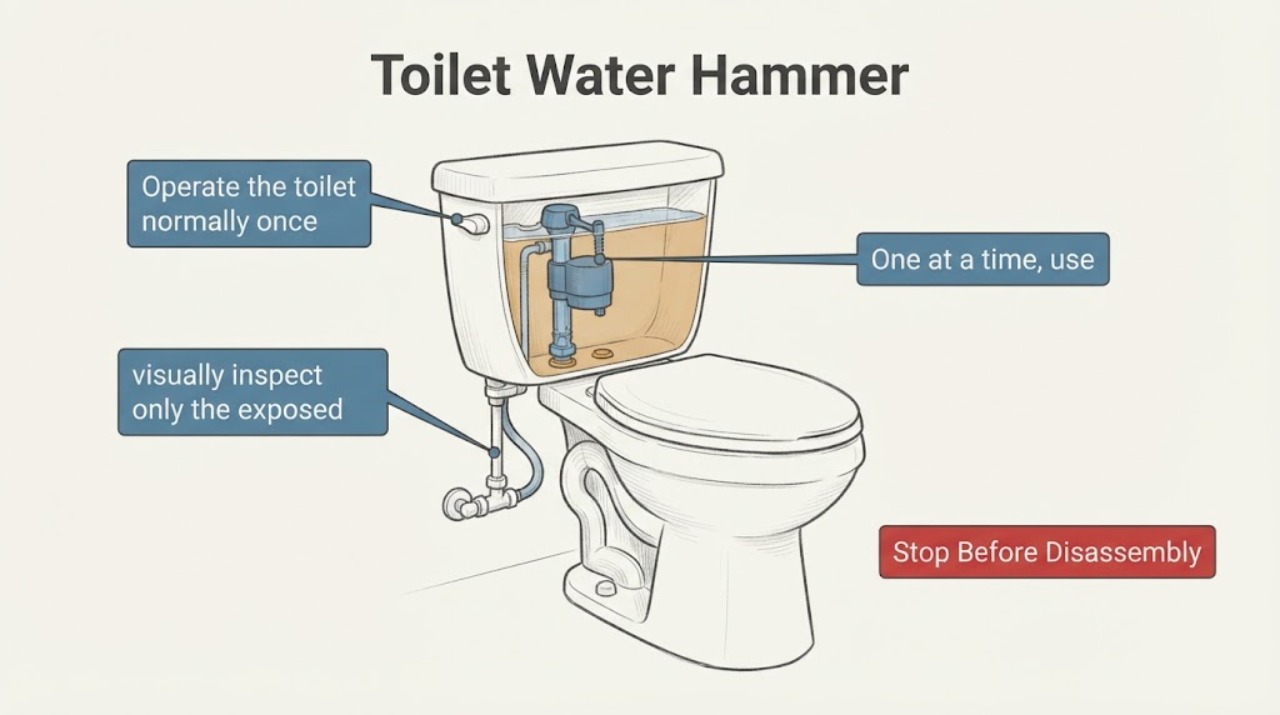
Operate the toilet normally once and listen from the bathroom and the nearest accessible pipe or valve area; note exactly when the sound occurs rather than repeatedly flushing to reproduce it.
Expected result: The bang occurs when the tank stops filling, when the flush valve closes, or only after another fixture or appliance shuts off water.
Next step: Use the trigger to choose the toilet-only or whole-plumbing branch below; stop repeating the test if the noise is accompanied by a leak or strong pipe movement.
Why this matters
Why: A bang at the end of refill implicates a quick-closing toilet-side valve or the line serving it. A sound triggered elsewhere suggests a shared supply or pressure problem, and a sound that cannot be localized may be a loose pipe within a wall.
-
Check 2
With the toilet idle, visually inspect only the exposed supply line, stop-valve area, and nearby pipe entry for moisture, a loose connection, or movement; do not remove fittings or force the valve.
Expected result: The exposed line moves or taps a surface when the toilet refills, a fitting is damp, or nothing visible moves or leaks.
Next step: If there is moisture or pronounced movement, stop using the toilet if necessary and arrange a plumber. If the area is dry and stable, continue by comparing other fixtures.
Why this matters
Why: A loose line or pipe support can turn a modest pressure event into a loud knock, while moisture indicates a leak that needs attention. No visible issue does not rule out a concealed pipe or valve problem.
-
Check 3
One at a time, use another nearby faucet and any water-using appliance that is safe to operate while listening for the same bang; avoid opening concealed access panels.
Expected result: Only this toilet causes the sound, or multiple fixtures cause banging or vibration when their flow stops.
Next step: Keep a toilet-only problem on the local branch. For repeated noise at several fixtures, arrange a plumbing assessment of system pressure and supports instead of replacing toilet parts at random.
Why this matters
Why: A toilet-only symptom makes the toilet fill valve, local supply line, and local support the useful focus. A symptom across fixtures points toward incoming pressure, a pressure regulator, or broader pipe support rather than one toilet part.
-
Check 4
Look at the toilet's accessible isolation valve and note whether it appears normally open; only try the handle if it moves easily and there is no corrosion, damage, or leak, and never force or dismantle it.
Expected result: The valve is visibly partly closed, or it is already open and normal-looking; the bang changes when the toilet refills only if the valve position was already safe to adjust.
Next step: If the valve is stiff, corroded, leaking, or its position is uncertain, leave it alone and call a plumber. If it is normal and the hammer remains, continue to professional diagnosis rather than repeatedly operating it.
Why this matters
Why: A restricted flow path can change the speed and noise of a closing valve, but a stuck or damaged valve is itself a service issue. A normal-looking valve does not prove the fill valve or pressure system is healthy.
-
Check 5
For recurring or loud hammer, have a qualified plumber evaluate the home's water pressure, pressure regulator, toilet fill valve, and pipe supports as one system; provide the trigger and fixture comparison from the earlier checks.
Expected result: The plumber finds a pressure inconsistency, a fast-closing or worn valve, an unsupported line, or no fault at the toilet itself.
Next step: Follow the plumber's diagnosis and the applicable manufacturer or local code instructions. Do not choose a pressure setting, cut piping, or install an arrestor based only on the sound location.
Why this matters
Why: Water hammer can have more than one contributor. A regulator or pipe-support issue will not be reliably solved by swapping a toilet component, and an arrestor needs correct sizing and placement near the quick-closing valve.
Use your observations
Decision map
Find the observation that best matches what you see, then follow the next safe action.
-
PATH 01Next step
What you see
The bang happens only when this toilet finishes filling and no leak or unsafe valve condition is visible.
Do this next
Ask a plumber to assess the fill valve, local pipe support, and supply line. If an arrestor is appropriate, it should be sized and placed near the quick-closing valve according to the manufacturer's instructions.
-
PATH 02Next step
What you see
Several faucets, appliances, or toilets cause the same bang when flow stops.
Do this next
Treat it as a system pressure or pipe-support problem and arrange a plumbing evaluation; do not keep replacing individual fixture parts without finding the shared cause.
-
PATH 03Next step
What you see
An exposed line moves, taps a surface, or the sound seems to come from behind a wall or ceiling.
Do this next
Stop chasing the sound by opening finished surfaces. Have a plumber locate and support the line and check for stress or a developing leak.
-
PATH 04Next step
What you see
The supply connection is wet, the stop valve is corroded or stuck, or operating the toilet produces a leak.
Do this next
Stop user-level adjustments, keep the area safe, and arrange prompt plumbing service. Do not force the valve or dismantle a pressurized connection.
Helpful context
Understand the symptom
Identify the valve event before changing parts
The timing matters. A single bang as the tank finishes filling points to a rapid valve closure or a moving supply line. A knock that occurs when another fixture operates, or several bangs through the house, points to a wider pressure or pipe-support issue rather than a toilet-only adjustment.
Keep plumbing checks accessible
Do not dismantle a pressurized connection, force a corroded stop valve, open a wall or ceiling to chase a sound, or make a pressure adjustment without the right equipment and plumbing knowledge. Stop for an active leak, a wet or damaged surface, or a valve that will not move normally.
Safety boundary
Stop conditions
- Stop immediately for an active leak, a wet or damaged fitting, a corroded or stuck shutoff valve, a pipe that moves violently, or water entering a wall or ceiling. Do not open finished surfaces, cut or reconnect piping, force a valve, or alter a pressure regulator without qualified plumbing help.
Only after diagnosis
Potential parts
- water-hammer arrestor
Consider this only after a plumber confirms a quick-closing toilet-side valve is producing the surge and selects an arrestor suited to the pipe layout and connection.
Size, location, connection type, and installation instructions are layout-specific; do not assume any arrestor fits an existing toilet supply. - toilet fill valve
Consider this only if inspection or professional diagnosis links the bang to a faulty or rapidly closing fill valve rather than a shared pressure or support issue.
Confirm the toilet model and the manufacturer's fit information before selecting a valve; a new valve will not correct a whole-house pressure problem. - pressure regulator
Consider this only when a qualified pressure assessment identifies regulator failure or an unsuitable incoming pressure condition affecting multiple fixtures.
Regulator selection and adjustment depend on the home's plumbing design and local requirements; use a qualified plumber for this work.
When checks do not resolve it
Need a professional?
Call a qualified plumber when hammering is loud or recurring, affects multiple fixtures, appears behind a wall, follows a plumbing change, or is accompanied by a leak or damaged valve. A plumber should also handle pressure-regulator diagnosis and any arrestor sizing or installation that requires changing the supply piping.
Common questions
FAQ
Why does my toilet bang after I flush?
The bang often occurs when the toilet's incoming water flow stops quickly, creating a pressure surge that can move the supply line or a pipe. If other fixtures cause the same noise, investigate the shared plumbing system rather than the toilet alone.
Can I install a water-hammer arrestor myself?
An arrestor may be suitable, but its size, connection, and location depend on the actual piping. Have a plumber confirm the diagnosis and follow the manufacturer's instructions, especially when a new tee, altered piping, or concealed work would be needed.
Does a water-pressure problem cause toilet water hammer?
It can contribute, particularly when several fixtures show the symptom. A qualified plumber can evaluate the pressure regulator and system pressure; do not adjust a regulator just by guessing from the sound.
When is toilet water hammer an emergency?
Stop using the affected fixture and seek prompt plumbing help for an active leak, wet wall or ceiling, a damaged or stuck valve, violent pipe movement, or a noise that began after plumbing work. These signs can indicate more than harmless vibration.
Read the exact guide
Official sources
- 604.9 Water hammer.New York City Plumbing Code · Example official plumbing-code requirement: control flow velocity and install compliant arrestors at quick-closing valves according to manufacturer instructions; local rules may differ.
- Banging Pipes: What the Pros Should KnowOatey · General residential plumbing explanation that explicitly includes toilets, washing machines, quick-closing valves, loose lines, and pressure contributors.
- Water Pressure RegulatorsCity of Santa Barbara · City guidance linking water hammer or pressure inconsistency to checking a pressure regulator and recommending qualified plumbing help when needed.
- How to Install Hammer Arrestors to Silence Banging PipesOatey · Manufacturer project guide covering bathroom piping, toilets, appliances, near-valve placement, leak checks, and professional help for unusual layouts.
Community feedback
Share a repair observation
Share a plain-text repair observation. Accepted observations are published automatically; this page may take a moment to update.