
On this page
Start here
Quick answer
A TOTO toilet that keeps running is usually either still refilling after a flush, sending water from the tank into the bowl through a flush-valve seal or overflow path, or operating a model-specific electronic water cycle. First close the visible toilet shutoff if water is continuous or the bowl is rising, then observe from a dry position whether water enters the tank, trickles into the bowl, or comes from a supply connection. Inspect only the visible handle, chain, tank water level, gasket, and model indicators; do not bend a float, disassemble a valve, or open a powered unit. If the water does not stop after the model's normal refill period, returns between flushes, leaks at the base or connection, or the toilet is a concealed or electronic design, leave it out of service and arrange qualified TOTO or plumbing service.
Before you begin
Safety first
- This article covers water isolation, visible pattern observation, and model-manual checks only. Do not dismantle the tank or flush valve, adjust hidden components, test wiring, bypass sensors, or open concealed plumbing.
Work through in order
Diagnostic checks
Use only checks that match the exact appliance or system and its official guide.
-
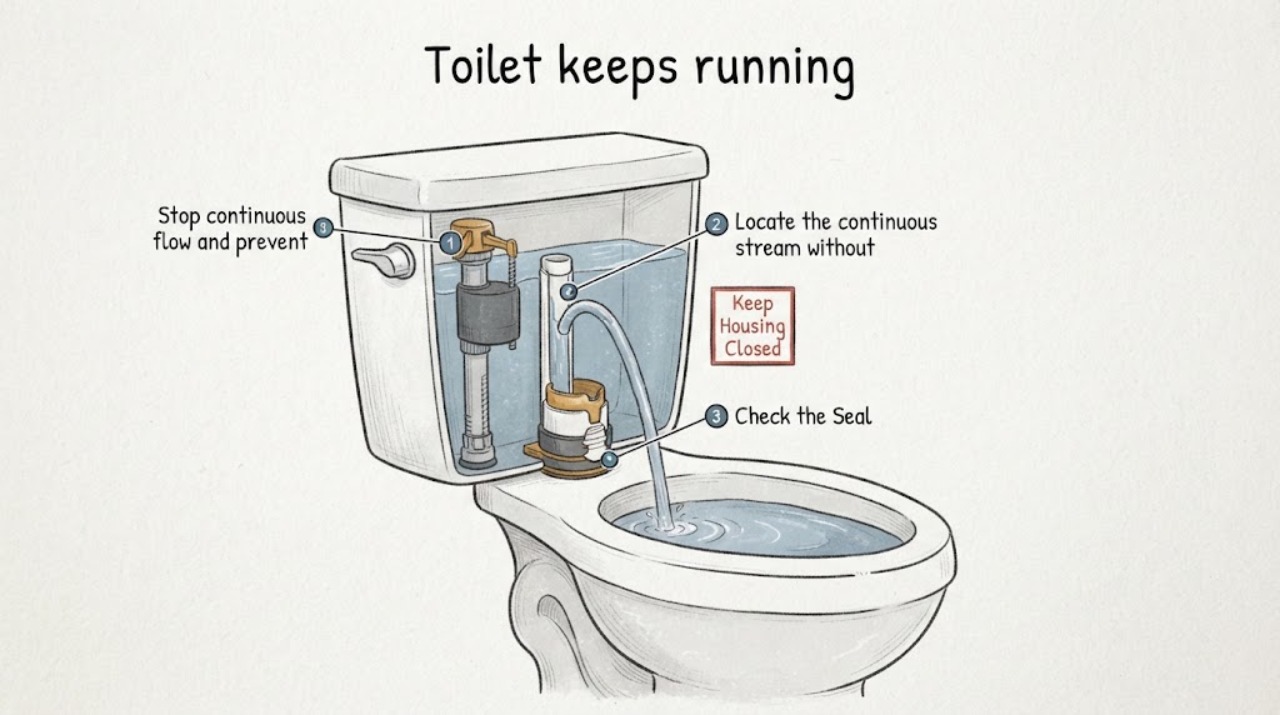
Stop continuous flow and prevent overflow
If water is continuously entering the tank or bowl, turn the plainly visible toilet shutoff valve to its closed position from a dry, stable position. Keep the flush handle or button untouched while the bowl level settles.
Expected result: The flow stops, slows but continues, the valve will not turn safely, or the bowl keeps rising despite the shutoff being closed.
Next step: Leave the toilet out of service and continue only with dry external observations if the flow stops. If the valve is seized, water keeps entering, or the bowl or floor is unsafe, arrange urgent plumbing service.
Stop if: Do not force a seized shutoff, touch wet electrical parts, keep flushing, or continue if water is near an outlet, damaged cord, floor penetration, or ceiling below.
Why this matters
Why: A shutoff that stops the flow isolates the immediate water-use risk; continued flow can indicate another supply path, a powered or concealed system, or a valve that is not closing. A rising bowl or floor leak is an urgent water-damage boundary.
-
Locate the continuous stream without dismantling the toilet
With the water isolated when needed, observe the bowl and, on a tank model, look through the lifted tank lid without touching the mechanism. Classify the water as entering through the fill valve, falling through the overflow path, trickling from the flush-valve opening into the bowl, or leaking at the supply or base.
Expected result: The bowl has a steady internal trickle, the tank water reaches the overflow path, the fill valve never stops, an electronic unit shows a water-cycle indicator, or water is outside the fixture.
Next step: Photograph or write down the pattern and model, then use the matching branch below. Keep the shutoff closed when the water is not needed or the source is uncertain.
Stop if: Do not reach into the tank, remove the lid from a powered unit, press hidden buttons, or touch a stream near electrical components.
Why this matters
Why: A bowl trickle can involve a flush seal or overflow level; a fill stream that never stops can involve the fill valve or water level; an electronic indicator requires the exact manual; external water is a connection, seal, or fixture problem rather than normal running.
-
Check the visible handle, button, chain, or flush seal position
On a conventional tank toilet only, inspect the external handle or button and the visible chain or lift connection from above without forcing it. Note whether the handle is held down, the chain is taut, the flush valve or flapper appears held open, or the visible controls return normally.
Expected result: The handle or button is stuck, the chain is taut or tangled, the flush seal is visibly held open, or all visible controls return but water still trickles.
Next step: If the external control is clearly obstructed by a loose item, remove only that item without reaching into the tank; otherwise keep the shutoff closed and arrange service for the internal flush path.
Stop if: Do not pull the chain, press the seal, bend the linkage, scrape the valve seat, or perform this check on a concealed, integrated, or powered TOTO unit.
Why this matters
Why: A held-open control can keep the flush seal from closing, while normal controls with continued trickle make a worn seal, mineral contamination, overflow level, fill valve, or concealed component more likely. The visible symptom does not identify which part should be replaced.
-
Compare the tank level with its overflow path
On a conventional tank model, observe the water level after the shutoff is briefly opened only if there is no leak or overflow risk. Compare the level with the manufacturer's marked normal level or the overflow path, without adjusting the float or fill-valve mechanism.
Expected result: The fill stream stops at the normal level, continues toward or into the overflow path, stops below normal, or the model has no user-visible tank.
Next step: Close the shutoff again if the level rises or water continues to flow, record the level pattern, and arrange qualified service for persistent overfill, low fill, or any concealed or powered design.
Stop if: Do not bend floats, adjust screws, remove a fill valve, drain a tank onto the floor, or allow water to enter the overflow path repeatedly.
Why this matters
Why: Water entering the overflow path can create a continuous bowl trickle and points toward fill-level or fill-valve diagnosis. A low level can produce a weak or incomplete flush but does not by itself prove a fill-valve failure. No visible tank requires the model manual or service path.
-
Use only the exact TOTO procedure for an electronic toilet
If the toilet is an integrated or electronic TOTO unit, read the visible indicator and model identification without removing covers. Follow only the manual's stated response for a continuing water cycle; if the manual is unavailable, keep the shutoff closed and do not experiment with power or manual cords.
Expected result: The manual identifies a normal post-flush water period, a water-supply or sensor condition, a persistent warning, or no clear model-specific explanation.
Next step: Record the model, indicator, timing, and shutoff result. Request TOTO or qualified plumbing service when the cycle exceeds the manual's normal behavior or the explanation is uncertain.
Stop if: Do not remove covers, unplug or reconnect wet equipment, pull a manual water cord unless the exact manual directs it, test wiring, or bypass a sensor or valve.
Why this matters
Why: Electronic and integrated toilets may intentionally supply water during a cycle, but a recurring or unexplained stream can indicate a sensor, valve, control, filter, or water-supply fault. A procedure from another TOTO model may be unsafe or ineffective.
-
Verify whether the running returns between flushes
After any normal manual-approved stop or refill, leave the toilet unused and listen from outside the closed fixture. Record whether the sound disappears, returns intermittently, starts after every flush, or is accompanied by a visible external leak or a falling bowl or tank level.
Expected result: The toilet becomes quiet and stays dry, the trickle returns without a flush, the running returns after every flush, or water appears at the base or supply.
Next step: Keep the shutoff closed when the toilet is not needed and provide the timing and location record to a plumber or TOTO technician. Do not replace parts based only on sound.
Stop if: Stop use for an external leak, rocking or cracked porcelain, overflow, sewage, water near electrical equipment, or any return that cannot be safely isolated.
Why this matters
Why: A recurring between-flush trickle supports a seal, fill, overflow, sensor, or control fault rather than a one-time refill. A post-flush-only stream can still be normal for some models, but repeated or prolonged running needs the manual and service boundary. External water indicates a separate leak risk.
Use your observations
Decision map
Find the observation that best matches what you see, then follow the next safe action.
-
PATH 01Safety boundary
What you see
Water runs only during the model's documented refill or post-flush period, then stops completely with no bowl rise, leak, or recurring sound.
Do this next
Keep the model manual with the toilet and monitor whether running begins between flushes or lasts beyond the documented behavior.
Why this path and its safety boundary
Why it matters: This can be normal operation for that TOTO design rather than a failed part; the exact owner's manual controls the expected timing and sequence.
Safety stop: Do not alter the fill valve, seal, sensor, or control merely to shorten a documented cycle.
-
PATH 02Safety boundary
What you see
Water continuously trickles into the bowl, the tank level reaches the overflow path, or the sound continues between flushes.
Do this next
Close the visible shutoff, record whether the tank was high or low, and arrange qualified TOTO or plumbing service for the internal valve path.
Why this path and its safety boundary
Why it matters: A flush-valve seal, fill-level or fill-valve condition, dirty sealing area, or concealed control may be allowing water through; the symptom does not identify a single replacement part.
Safety stop: Do not bend the float, press or scrape the seal, dismantle a valve, or repeatedly reopen the supply to test it.
-
PATH 03Safety boundary
What you see
The tank's fill stream never stops, the level is below normal while water continues, or the stream resumes after the visible control returns.
Do this next
Keep the supply isolated and arrange service to evaluate the fill and flush paths together; provide the level and leak observations.
Why this path and its safety boundary
Why it matters: A fill valve, water-level control, supply condition, or internal seal may be involved. A low tank level does not prove the supply is inadequate because water can be escaping through the flush path.
Safety stop: Do not adjust or replace the fill mechanism as a generic fix, leave the tank filling unattended, or operate with water entering the overflow path.
-
PATH 04Safety boundary
What you see
The toilet is an integrated, WASHLET, concealed, sensor, or other powered TOTO design and water continues beyond the manual-described cycle or a warning appears.
Do this next
Close the visible shutoff, record the model and indicator, and request TOTO or qualified plumbing service using the exact manual for that unit.
Why this path and its safety boundary
Why it matters: The running may involve a model-specific sensor, solenoid, filter, control, water-supply path, or emergency manual function that cannot be inferred from a conventional tank toilet.
Safety stop: Do not remove covers, pull unverified cords, test wiring, bypass sensors, or use another model's reset or adjustment procedure.
-
PATH 05Safety boundary
What you see
Water appears at the supply connection, under the tank or bowl, around the base, or on the floor rather than only inside the bowl.
Do this next
Close the local shutoff if safe, stop using the toilet, dry and isolate the area, and arrange prompt plumbing service.
Why this path and its safety boundary
Why it matters: This is a leak or fixture-seal condition, not merely normal refill noise. Continued operation can damage flooring or allow water near electrical equipment.
Safety stop: Do not tighten hidden connections, lift the toilet, continue flushing, or touch wet electrical components.
-
PATH 06Safety boundary
What you see
The shutoff is seized, the bowl or floor is overflowing, sewage is backing up, the porcelain is cracked or rocking, or water is near an outlet or damaged cord.
Do this next
Keep people away, isolate the area, follow local emergency or building guidance, and arrange urgent plumbing or electrical help from a dry, safe location.
Why this path and its safety boundary
Why it matters: The immediate risk is water damage, contamination, slip, fixture failure, or electrical injury; continued troubleshooting is not appropriate.
Safety stop: Do not operate wet switches or plugs, force valves, stand in contaminated water, or reopen the toilet to collect more observations.
Helpful context
Understand the symptom
First identify where the water is going
“Keeps running” can mean water is continuously entering the tank, water is quietly spilling from the tank into the bowl, a powered toilet is completing a model-specific cycle, or water is leaking at a connection. These patterns need different checks. If the bowl is rising or water is reaching the floor, close the local shutoff before looking for a cause. If the bowl is stable, observe the stream and its source without repeatedly flushing.
A TOTO model can change the safe procedure
TOTO's troubleshooting material covers multiple toilet types, including tank toilets and integrated or electronic units. A tank model may expose a fill valve, flush seal, overflow tube, and handle; a powered unit may use sensors, a control, a water filter, or a model-specific manual water control. Do not assume that a tank adjustment, manual cord, or reset applies to an unidentified TOTO toilet.
Temporary silence does not prove the repair
A float can stop moving water for a moment, and a flush seal can close after the handle is released, but recurring trickling wastes water and can signal a worn seal, fill problem, valve passage, sensor, or control. TOTO's own support guidance separates normal post-flush behavior from persistent water and says the response varies by toilet type. Record whether the sound occurs after every flush or between flushes before replacing a part.
Safety boundary
Stop conditions
- If the toilet is continuously supplying water, close the visible shutoff when safe and do not keep flushing or leave the flow unattended.
- Do not bend floats, force handles, press or scrape seals, dismantle valves, adjust hidden control stops, or replace parts based only on the sound.
- Do not remove covers or test wiring on an integrated, sensor, WASHLET, concealed, or powered TOTO unit, and do not use another model's reset or manual-cord procedure.
- Stop for a bowl or floor overflow, sewage backup, base or supply leak, cracked or rocking porcelain, water near electrical equipment, or a seized shutoff.
- Arrange qualified TOTO or plumbing service when running returns between flushes, lasts beyond the model manual's normal cycle, the cause is concealed, or safe checks do not stop it.
Only after diagnosis
Potential parts
- toilet flush-valve seal or flapper assembly
Consider this category only when diagnosis confirms water is bypassing the flush valve into the bowl after the control returns and the exact TOTO model uses that serviceable seal arrangement.
Confirm the exact TOTO model and seal design before ordering; do not press, scrape, or substitute a seal as a test. - toilet fill valve or water-level component
Consider this category only when service confirms the fill stream does not stop or the water level is incorrect after the flush path and supply are evaluated.
Confirm the exact TOTO model, tank arrangement, water-level specification, and manufacturer fit information; do not bend a float or adjust a concealed valve by guesswork. - TOTO sensor, solenoid, or water-control assembly
Consider this category only for an integrated, sensor, or powered TOTO unit after the manual and qualified testing identify a water-control fault.
Confirm the exact model, electrical and water-control architecture, and manufacturer procedure; do not open or bypass a powered assembly.
When checks do not resolve it
Need a professional?
Arrange qualified TOTO or plumbing service when the toilet keeps running between flushes, the fill stream does not stop at its normal level, water trickles into the bowl, the issue returns after every flush, an integrated or concealed unit shows a warning, or the exact model procedure is unavailable. Stop use and seek urgent help for an overflow, sewage backup, external leak, cracked or rocking porcelain, a seized shutoff, or water near electrical equipment.
Safety scope: This article covers water isolation, visible pattern observation, and model-manual checks only. Do not dismantle the tank or flush valve, adjust hidden components, test wiring, bypass sensors, or open concealed plumbing.
Common questions
FAQ
Why does my TOTO toilet keep running after a flush?
Some TOTO models supply water for a normal refill or post-flush cycle, but water that continues between flushes or never reaches a stable stopping point can involve a flush-valve seal, overflow level, fill valve, filter, sensor, or control. Close the visible shutoff when needed and use the exact model manual before arranging service.
What should I do if water keeps trickling into the TOTO bowl?
Close the local shutoff if the trickle is continuous, then observe whether the tank is high at the overflow path or whether water is bypassing the flush valve. Do not press or scrape the seal or bend the float. Record the pattern and request qualified TOTO or plumbing service if it returns.
Can I adjust the float to stop a TOTO toilet from running?
Do not adjust a float or fill mechanism by guesswork. TOTO toilet types and tank arrangements differ, and a high level, low level, or running fill stream can have different causes. Use only an exact model instruction that clearly identifies the part as user-adjustable; otherwise close the shutoff and arrange service.
Does a TOTO Washlet or integrated toilet need a different running-water check?
Yes. Integrated and powered TOTO units can use model-specific sensors, controls, filters, and water paths. Read the visible model and indicator without opening covers, follow only that manual's procedure, and keep the shutoff closed if water continues beyond the documented cycle or the cause is unclear.
When should I call a plumber for a TOTO toilet that keeps running?
Call when running returns between flushes, the fill stream does not stop, the bowl rises, water leaks at the base or supply, the toilet is concealed or powered, a warning appears, or safe model-manual checks do not resolve it. Seek urgent help for overflow, sewage backup, cracked porcelain, or water near electrical equipment.
Read the exact guide
Official sources
- EcoPower Flush Valve for ToiletTOTO U.S.A. · TOTO EcoPower flush-valve manual used only for the principle that continuous flow can involve piston or diaphragm sealing and that unspecified parts should not be dismantled; it does not define residential toilet fitment.
- トイレの水が止まらないTOTO LTD. · TOTO's official residential support page, in Japanese, used for the model-dependent distinction between normal post-flush replenishment and persistent water, and for closing the shutoff when leaking.
- TroubleshootingTOTO U.S.A. · TOTO owner manual used for model-specific examples of shutoff, water-supply, filter, tank, indicator, and persistent-water checks; exact procedures vary by toilet model.
Community feedback
Share a repair observation
Share a plain-text repair observation. Accepted observations are published automatically; this page may take a moment to update.