
On this page
Start here
Quick answer
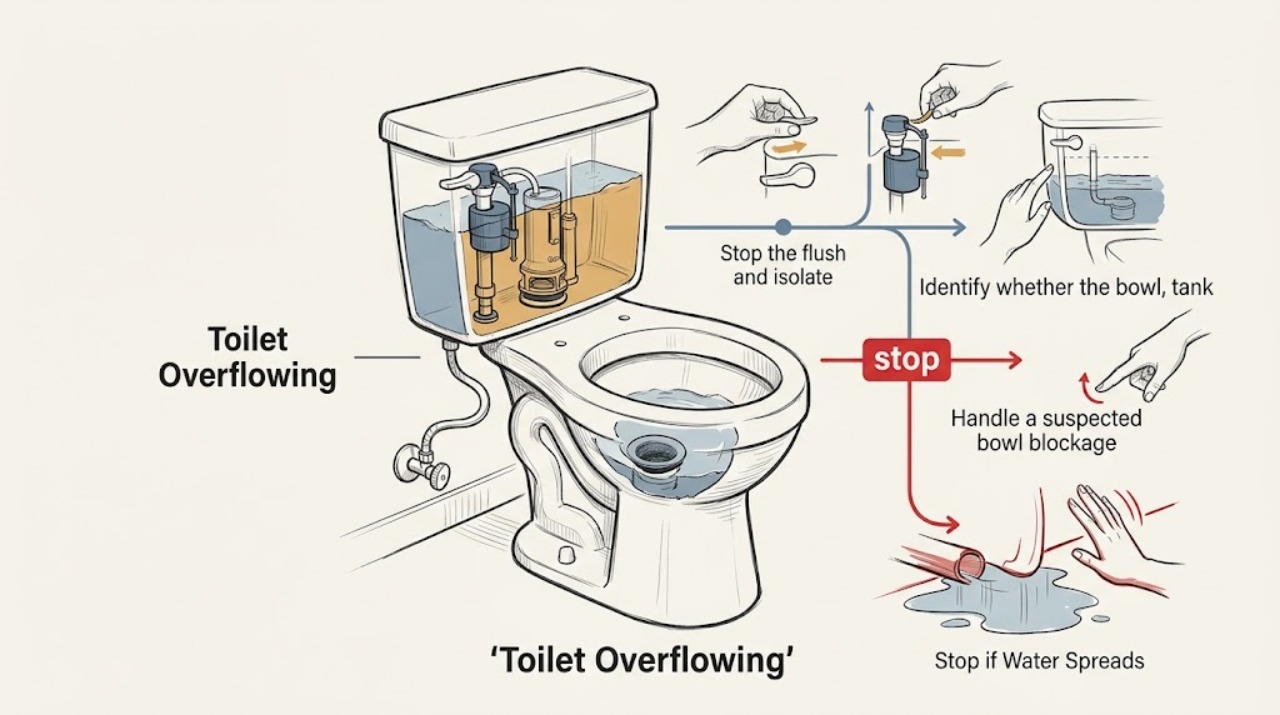
Stop pressing the flush handle, button, or sensor and close the toilet's nearby shutoff valve by hand if it is accessible and safe. Do not flush a TOTO bowl that is already clogged. Then identify whether water is rising in the bowl, continuing into the tank's overflow area, or leaking from the base or supply connection. A bowl that rises only during a flush points toward a drain blockage; a tank that keeps filling without a flush points toward the fill valve or flush control; water at the base or hose needs prompt plumbing service. If the toilet is a WASHLET or another electronic model, keep water away from electrical connections and use the exact model manual rather than transferring tank-toilet instructions.
Before you begin
Safety first
- This article supports stopping the flush, closing an accessible shutoff, observing the bowl and tank from a dry position, cleaning a visible lint-free area, and using a toilet plunger only when the bowl is stable and safely below the rim. A qualified professional should handle base seals, ceramic, internal valves requiring disassembly, electrical controls, hidden drains, and any work around wet power connections.
Work through in order
Diagnostic checks
Use only checks that match the exact appliance or system and its official guide.
-
Stop the flush and isolate the water
Stop pressing the handle, flush button, remote, or automatic-flush trigger. Close the nearby toilet shutoff valve by hand if it is accessible, turns normally, and can be reached without stepping through unsafe water. If an electronic TOTO unit has water near its power connection, keep hands dry and do not touch the connection through the spill.
Expected result: The incoming water stops after the shutoff is closed; water continues to rise or spread; the valve is stuck, damaged, or inaccessible; or the unit is an electronic model with water near electrical connections.
Next step: If the water does not stop, the valve cannot be operated safely, or water is near electrical equipment, keep the toilet out of use and call a qualified plumber or authorized TOTO service. If the inflow stops, continue by identifying the water's source without flushing again.
Stop if: Do not force the shutoff, repeatedly cycle the flush, reach into contaminated water near power connections, or remove a supply-filter or pipe fitting while the valve is open.
Why this matters
Why: A stopped supply separates active tank filling from water already trapped in the bowl, while a stuck valve, continued rise, or wet electrical area is outside an ordinary adjustment. TOTO identifies a clogged bowl and leaks as malfunctions that require stopping use and closing the shutoff.
-
Identify whether the bowl, tank, or floor is overflowing
With the water isolated, look from a dry, safe position at the bowl rim, tank or flush-tower area, base, supply hose, and shutoff connection. Do not remove a sealed electronic top unit or loosen a connection just to find the source.
Expected result: The bowl rose during a flush while the tank was otherwise normal; the tank kept filling toward or above its marked waterline; water is escaping from the base or floor; water is at the supply hose or shutoff; or the source cannot be seen.
Next step: Use the matching branch below: contain and cautiously address a bowl blockage only if the level is stable, keep a tank-control fault isolated for model-specific guidance, and stop using the toilet for any base or supply leak.
Stop if: Do not assume a tank waterline or flush-valve layout from another TOTO model, and do not use a wet floor as a work area.
Why this matters
Why: Bowl-only rise makes a drain blockage more likely. A tank level that continues rising without a flush makes the fill valve, flush control, or water-level setting more likely. Base or supply water is a leak that should not be treated as a clog, and an unseen source needs professional inspection.
-
Handle a suspected bowl blockage without another flush
Only when the inflow is stopped and the bowl level is well below the rim, use a toilet plunger or another tool specifically intended for unclogging a toilet, following its instructions. Keep the shutoff closed while checking whether the level begins to fall, and do not push a visible object deeper into the trap.
Expected result: The level falls and stays down after gentle plunging; the level stays high; the bowl refills without a flush; a foreign object is visible; or other fixtures also drain slowly or back up.
Next step: If the blockage does not clear promptly or the symptom returns, leave the shutoff closed and call a plumber. If another fixture backs up or sewage is present, stop using connected fixtures and request urgent plumbing service.
Stop if: Do not flush to test a clogged bowl, pour hot water or harsh cleaner into it, use a powered drain tool, or keep plunging when water could spill over the rim.
Why this matters
Why: A level that falls and remains stable makes a localized bowl blockage more likely. Persistent high water, automatic refilling, a foreign object, or symptoms at other fixtures suggests a deeper obstruction, control fault, or shared drain problem that a plunger cannot safely distinguish.
-
Compare tank behavior with the model waterline
If the tank is accessible and there is no active spill, use the exact TOTO manual to locate its marked waterline and identify the fill valve and flush valve or flush tower. Observe only whether water stops at the marked line, continues toward the overflow path without a flush, or leaks through the bowl after the flush control has returned to its resting position.
Expected result: The level stops at the marked line; it rises above the line or continues into the overflow path; water continues trickling into the bowl; the flush button or handle does not return; or the toilet has no conventional tank that matches this procedure.
Next step: Keep the shutoff closed for a persistent tank fault and arrange model-specific service, or follow only the exact user maintenance procedure in the matching TOTO manual. Do not order a fill valve, seal, or flush-control part until the model and fault are confirmed.
Stop if: Do not adjust above the marked line, defeat a float or sensor, remove an electronic top unit, or work on a valve or seal with the supply open unless the exact manual explicitly defines a safe user procedure.
Why this matters
Why: Normal stopping at the marked line makes a continuing fill fault less likely. Continued filling points toward the fill valve or water-level control; water passing into the bowl after the command ends points toward the flush valve, seal, or actuator. A different or electronic design requires its own manual.
-
Check for a base or supply leak and decide on service
After the water is isolated, blot the floor and inspect from outside the bowl for fresh water at the base, supply hose, shutoff, or visible tank connection. Do not rock the toilet, remove the base, or loosen plumbing connections. If the bowl and tank are stable and no leak remains, document the exact model and the event before any single cautious verification allowed by the model manual.
Expected result: Fresh water returns at the base or floor; a hose or shutoff connection leaks; the toilet rocks or the ceramic is cracked; the bowl or tank remains stable with no visible leak; or the overflow returns on the next allowed use.
Next step: Keep the toilet isolated and call a qualified plumber for base, ceramic, supply, or recurring leaks. Give the technician the full TOTO model number, overflow location, whether the bowl or tank rose first, shutoff behavior, other-fixture symptoms, and any WASHLET or automatic-flush status.
Stop if: Do not reuse the toilet with a base leak, cracked ceramic, unstable bowl, uncontrolled refill, sewage spill, or recurring overflow; do not dismantle the toilet as a first-line check.
Why this matters
Why: A base leak, unstable bowl, cracked ceramic, or supply leak can cause water damage independent of a clog and needs plumbing or authorized service. A stable result after containment does not prove that the original cause is repaired, especially when an actuator or tank valve may have stuck.
Use your observations
Decision map
Find the observation that best matches what you see, then follow the next safe action.
-
PATH 01Safety boundary
What you see
The bowl rises during a flush, the tank was not continuing to fill, and closing the shutoff stops any fresh inflow.
Do this next
Keep the shutoff closed, do not flush again, and use a toilet plunger only if the water level is stable and safely below the rim. Call a plumber if the level remains high, a foreign object is involved, another fixture backs up, or the overflow returns.
Why this path and its safety boundary
Why it matters: A localized bowl or drain-path blockage is more likely than a fill-valve fault.
Safety stop: Do not add hot water or harsh cleaner, push an object deeper, or continue if the bowl may spill.
-
PATH 02Safety boundary
What you see
The tank or flush tower continues receiving water without a flush command, approaches its marked waterline or overflow path, and the bowl is not the first place water rises.
Do this next
Leave the shutoff closed and use the exact TOTO manual or qualified service for the identified model. A technician may need to distinguish the fill valve from the flush valve seal or actuator before selecting a part.
Why this path and its safety boundary
Why it matters: A fill-valve, water-level, flush-control, or model-specific actuator problem is more likely than a simple bowl clog.
Safety stop: Do not set the level above the marked line, defeat a float or sensor, or keep reopening the shutoff to watch an uncontrolled refill.
-
PATH 03Safety boundary
What you see
Water returns at the base, floor, supply hose, shutoff, or a visible connection even though the bowl and tank level are not rising in the expected way.
Do this next
Keep the shutoff closed, dry and restrict access to the area, and arrange qualified plumbing service. Do not rock the toilet or remove the base to investigate.
Why this path and its safety boundary
Why it matters: A seal, connection, cracked ceramic, or installation issue is more likely than a drain blockage, and continued use can spread water damage.
Safety stop: Stop immediately for a cracked bowl or tank, an unstable toilet, contaminated water, or a leak that cannot be contained.
-
PATH 04Safety boundary
What you see
The bowl overflows again after it seemed to clear, plunging does not restore a stable level, or a nearby sink, tub, or toilet also drains slowly or backs up.
Do this next
Stop using connected fixtures, keep the TOTO shutoff closed, and request prompt plumbing service with the locations and timing of every affected fixture.
Why this path and its safety boundary
Why it matters: A deeper branch-line or main-drain obstruction, vent issue, or unresolved control fault is more likely than a one-time surface blockage.
Safety stop: Do not continue flushing other fixtures to find out whether the line is clear.
-
PATH 05Safety boundary
What you see
The toilet is a WASHLET or other electronic TOTO model, an automatic flush repeats, the bowl is clogged, or water is near the power connection.
Do this next
Keep the unit out of use, stop automatic flushing using the exact model instructions only if it can be done safely, keep clear of wet electrical connections, and contact authorized TOTO service or a qualified plumber as appropriate.
Why this path and its safety boundary
Why it matters: Automatic operation and electrical exposure add risks that are not covered by a conventional tank-toilet adjustment.
Safety stop: Do not touch wet plugs or connections, remove the electronic top unit, bypass a sensor, or continue using the product during the malfunction.
Helpful context
Understand the symptom
First contain the overflow
Treat an overflowing toilet as an active water-damage problem, not as a normal flush that needs another test. Keep people away from contaminated or slippery water, stop the flush command, and close the nearby shutoff valve if it turns normally and can be reached without contacting wet electrical equipment. TOTO's electronic-toilet guidance specifically warns against continued use during a malfunction and says to close the water shutoff valve; a WASHLET may also need its exact power-off procedure followed by an authorized service representative.
Read the overflow location before choosing a fix
The location and timing of the water change the diagnosis. Water that rises in the bowl during or immediately after a flush is usually a drain-path decision; water that keeps entering the tank without a flush is a tank-control decision; water appearing around the base, supply hose, or shutoff connection is a leak and seal decision. Do not assume all TOTO toilets have the same tank, flush tower, sensor, or remote-control arrangement. Use the full model number and its TOTO manual for any model-specific part or adjustment.
Keep cleaners and improvised tools out of the decision
Do not pour hot water into the bowl, add an aggressive cleaner, force a stuck control, or push an unknown object farther into the trap. TOTO warns that hot water and unsuitable cleaners can damage the toilet or its water-supply parts. A plunger made for a toilet is a reasonable user-level option only after the inflow is stopped and the bowl level has enough clearance from the rim; a foreign object, repeated overflow, or failed plunging belongs with a plumber.
Know when the shutoff is not the whole problem
Closing the shutoff prevents fresh supply from entering, but it does not remove a bowl blockage or repair a failed base seal. Once the water is contained, record whether the bowl level falls, whether the tank was above its marked waterline, and whether water remains at the floor or supply connection. Those observations give a plumber a better starting point than repeatedly flushing or ordering a part from the brand name alone.
Safety boundary
Stop conditions
- Stop flushing immediately when the bowl is high, clogged, or already spilling; keep the shutoff closed until the cause is controlled.
- Stop and seek prompt plumbing service for a base leak, supply leak, cracked ceramic, unstable toilet, recurring overflow, sewage backup, or symptoms at multiple fixtures.
- For a WASHLET or other electronic TOTO toilet, keep water away from power connections and do not disassemble the top unit or bypass automatic controls.
- Do not pour hot water or aggressive cleaner into the bowl, use improvised powered tools, force a shutoff, or order a replacement part from the symptom alone.
- Use qualified or authorized service for work involving the base seal, ceramic, internal valves, wiring, electronic controls, hidden drain lines, or connections requiring disassembly.
Only after diagnosis
Potential parts
- TOTO fill valve or water-level control
Consider this category only if the tank continues filling without a flush and a qualified diagnosis confirms a fill or water-level fault.
Confirm the complete TOTO model and the exact manual or technician diagnosis; do not assume a universal fill valve fits every TOTO design. - TOTO flush valve, flush tower seal, or actuator
Consider this category only if water continues passing into the bowl after the flush command ends and the model-specific diagnosis points to the flush assembly or seal.
Confirm the exact model and whether it uses a flapper, flush tower, button linkage, or electronic actuator before ordering anything. - toilet base seal or supply connection component
Consider this category only when fresh water is confirmed at the base or a supply connection and a qualified plumber identifies the leaking component.
Base and plumbing connection work requires site and model confirmation; a visible floor leak does not identify a compatible part by itself.
When checks do not resolve it
Need a professional?
Call a qualified plumber or authorized TOTO service when the shutoff cannot stop the inflow, the bowl blockage does not clear safely, water leaks from the base or supply connection, the tank continues filling, the overflow recurs, multiple fixtures are affected, or the toilet is an electronic model with a malfunction or water near its power connection. Treat active sewage, a cracked or unstable toilet, and uncontrolled water as urgent service situations.
Safety scope: This article supports stopping the flush, closing an accessible shutoff, observing the bowl and tank from a dry position, cleaning a visible lint-free area, and using a toilet plunger only when the bowl is stable and safely below the rim. A qualified professional should handle base seals, ceramic, internal valves requiring disassembly, electrical controls, hidden drains, and any work around wet power connections.
Common questions
FAQ
What should I do first when my TOTO toilet is overflowing?
Stop the flush command and close the nearby shutoff valve if it is safe and accessible. Do not flush a bowl that is already clogged or high. Then note whether the bowl, tank, base, or supply connection is the source so the next step matches the symptom.
Why does my TOTO toilet overflow only when I flush?
If the bowl rises during the flush while the tank is not continuing to fill, a drain-path blockage is more likely. Keep the shutoff closed, do not flush again, and use a toilet plunger only with a stable level safely below the rim. A persistent or recurring blockage needs a plumber.
What if the TOTO tank keeps filling and reaches the overflow area?
Keep the shutoff closed and use the exact model manual to identify the marked waterline, fill valve, and flush assembly. Continued filling without a flush can involve the fill valve or water-level control; water passing into the bowl after the command ends can involve the flush valve, seal, or actuator. Do not adjust above the marked line or guess at a replacement part.
What if water is leaking from the base of my TOTO toilet?
Close the shutoff, stop using the toilet, and arrange qualified plumbing service. A base leak, cracked ceramic, or unstable bowl is not a bowl-clog diagnosis, and rocking or removing the toilet can worsen the damage.
Can I use hot water or drain cleaner to clear an overflowing TOTO toilet?
No. TOTO warns against pouring hot water into the toilet and against unsuitable cleaners that can damage the toilet or water-supply parts. If the inflow is stopped and the level is safely below the rim, use a toilet plunger intended for the bowl; call a plumber for a stubborn, recurring, or object-related blockage.
When should I call for TOTO toilet service?
Call promptly when the shutoff cannot stop the water, the bowl will not clear safely, water is at the base or supply connection, the overflow recurs, more than one fixture backs up, the ceramic is cracked or unstable, or an electronic TOTO toilet has water near its power connection or repeats automatic flushing.
Read the exact guide
Official sources
- NEOREST RS2 Instruction ManualTOTO USA · Official TOTO USA manual for the documented NEOREST RS2/MS8341CUMFG family; exact model instructions control for other TOTO electronic toilets.
- 便器のつまりの対処方法 便器のつまりを取りますTOTO Japan · Official TOTO Japan support guidance; the physical clogging precautions are relevant to TOTO toilet bowls, while exact controls and local service options vary by model and region.
- Installation and Owner’s Manual Manual de instrucciones y del propietario Manuel d’installation et d’utilisationTOTO USA · Official TOTO USA manual for CST646F and its documented tank-toilet mechanism; use the exact manual for other TOTO models.
- Installation and Owner’s ManualTOTO USA · Official TOTO USA manual for the documented CST436/CST448 family; exact model instructions control where construction differs.
Community feedback
Share a repair observation
Share a plain-text repair observation. Accepted observations are published automatically; this page may take a moment to update.