
On this page
Start here
Quick answer
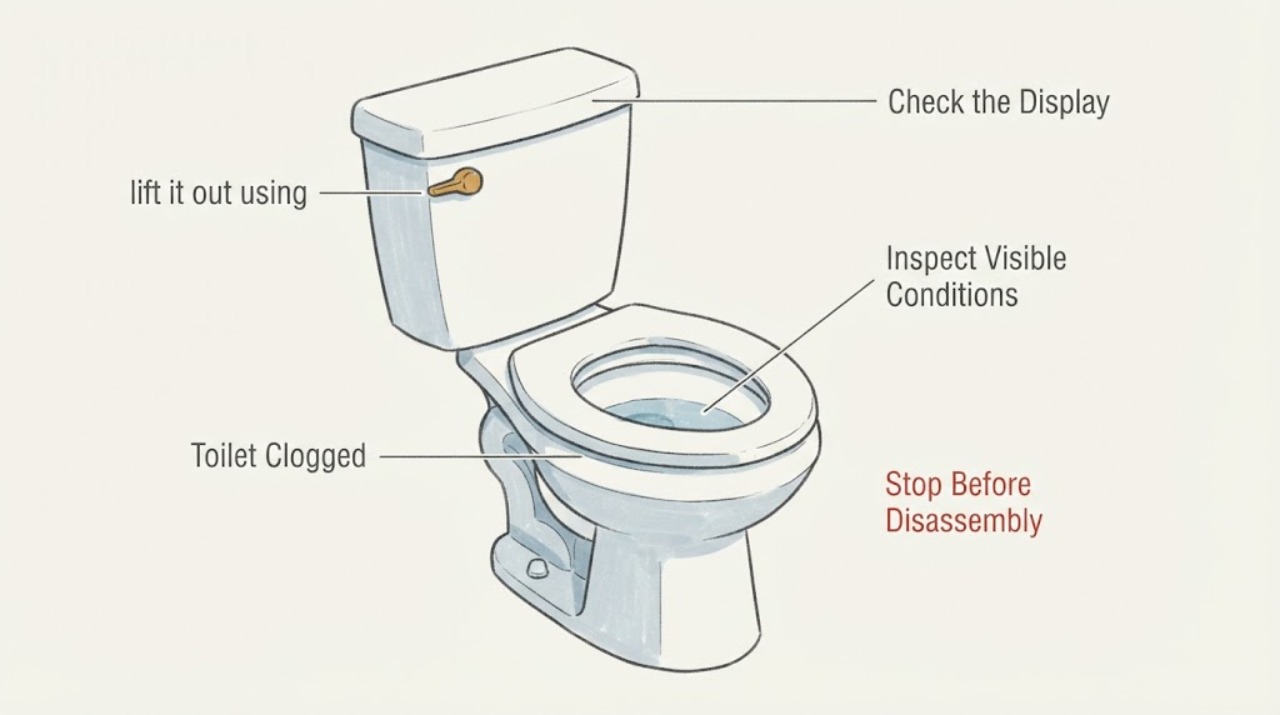
Do not flush again if the TOTO toilet bowl is rising. Stop an automatic flush, close the toilet's shutoff valve, and, for an electronic TOTO/WASHLET model, disconnect power only from a dry, accessible connection. Keep the water level below the rim and identify whether this is a single-bowl blockage or a deeper drain problem affecting other fixtures. Remove only a loose object that is safely reachable without putting bare hands into wastewater; do not force it farther down. For an ordinary, non-chemical clog, use a toilet flange plunger with enough water to cover the cup and controlled strokes, then add only a small amount of clean water to confirm that the level falls before attempting a normal flush. TOTO manuals direct owners to use a plunger and warn about wastewater overflow; do not pour hot water, drain opener, bleach, acid, or mixed cleaners into the bowl. If the clog returns, the bowl will not clear, other fixtures gurgle or back up, an object is lodged, or chemical cleaner is already present, stop and arrange a qualified plumber; keep people away from contaminated water and follow an official poison-safety resource for chemical exposure.
Work through in order
Diagnostic checks
Use only checks that match the exact appliance or system and its official guide.
-
Check 1
If the TOTO bowl is rising, stop pressing the flush control and stop any automatic-flush sequence. Close the toilet shutoff valve by hand, and if the toilet has an electronic seat or automatic flushing unit, disconnect its power only from a dry, accessible plug or isolator. Do not reach into wastewater or touch a wet electrical connection.
Expected result: The water level stops rising, water continues entering with the valve closed, the bowl is near the rim, or water is near an electrical connection.
Next step: Keep the valve closed and prevent anyone from flushing. If the level is near the rim, water continues entering, or an electrical area is wet, stop and arrange qualified plumbing or electrical service from a dry safe position.
Why this matters
Why: A stable level creates room for controlled clearing. Continued filling suggests a supply or flush-valve issue in addition to the blockage; water near an electronic connection is an electrical hazard.
-
Check 2
Observe the bowl level without adding water, then check nearby fixtures without running them. Note whether only the TOTO bowl is slow or full, whether another toilet, sink, or tub gurgles or backs up, and whether the bowl has a visible hard object. Wear waterproof gloves and keep children and pets away from any wastewater; do not put bare hands into the bowl.
Expected result: Only this bowl is affected, several fixtures show slow drainage or backup, the bowl gurgles, or a solid object is visible.
Next step: Use the local plunger branch only when the water is stable and no chemical is present. For multiple-fixture symptoms, a lodged object, or wastewater spreading beyond the bowl, stop and arrange a qualified plumber.
Why this matters
Why: A single-bowl symptom is more consistent with a local trap or bowl blockage. Multiple fixtures or gurgling make a shared branch or main-line restriction more likely; a visible object may not respond to plunging.
-
Check 3
If a loose object is visible above the water and can be removed without pushing it into the trap, lift it out using a disposable tool or gloved hand while the shutoff valve is closed. Do not try to retrieve an object that is below the water, sharp, heavy, electrically connected to a bidet seat, or firmly lodged.
Expected result: The object comes out intact, the object moves deeper, the bowl level rises, or nothing visible can be reached safely.
Next step: If the object does not lift freely, stop and arrange plumbing service. If it is removed, keep the valve closed and continue only with a non-chemical, stable-water plunger check; do not flush to test yet.
Why this matters
Why: A removable object can be the entire blockage. Pushing or forcing a lodged object deeper can convert a visible local obstruction into a harder-to-access trap or line problem and can spread contaminated water.
-
Check 4
For an ordinary clog with stable water and no drain cleaner in the bowl, place a toilet flange plunger over the outlet so the cup is covered by water. If the bowl is too full, wait for it to fall or remove only enough water with a dedicated container to leave safe clearance; TOTO guidance for the manual reviewed specifies at least 4 inches (10 cm) between the bowl top and the water surface to reduce overflow risk.
Expected result: The plunger seals, the water level is controlled, the cup will not seal, or the level rises toward the rim.
Next step: Use steady, moderate push-pull strokes without violent force, then pause to observe. Stop immediately if the level rises, the bowl rocks, porcelain cracks, or the tool cannot be controlled; do not use a chemical opener as an alternative.
Why this matters
Why: A controlled seal lets pressure work at the bowl outlet. A poor seal may be caused by the tool shape or water level; rising water means the attempt must stop before overflow.
-
Check 5
After a short controlled plunger attempt, stop and watch the bowl rather than flushing repeatedly. When the level has fallen and remains stable, add only a small amount of clean water slowly to see whether it drains freely; do not pour hot water into the bowl and do not use a full flush as the first test.
Expected result: The water drops and stays down, drains slowly but does not rise, or rises again and threatens overflow.
Next step: If the bowl stays clear, reopen the valve and perform one normal flush only while watching from a safe position. If it rises, reclogs, or drains slowly, close the valve again and arrange plumbing service.
Why this matters
Why: A stable drop suggests the local obstruction may have moved. Slow or returning rise means the passage remains restricted or the clog is farther down, so more water can create overflow and contamination.
-
Check 6
Ask whether any drain opener, toilet cleaner, bleach, acid, or homemade mixture has been added to the bowl. If any chemical is present or the product is unknown, do not plunge, add water, mix products, or put your face near the bowl; keep the area ventilated and follow the product label and an official poison-safety resource.
Expected result: No chemical was added, a single known cleaner was added, multiple cleaners were mixed, or there is a splash, fume, skin, eye, or breathing exposure.
Next step: For any exposure, move away from fumes, rinse affected skin or eyes with water as directed by the product or poison-safety authority, and seek urgent professional guidance. For a chemical-filled bowl without exposure, keep people away and arrange a plumber who is told exactly what product was used.
Why this matters
Why: A chemical-filled bowl can splash during plunging, and incompatible cleaners can produce hazardous fumes. Exposure is a safety and medical issue, not a clog-clearing branch.
-
Check 7
If the plunger does not clear the TOTO toilet, use the exact model instructions to decide whether an owner-level toilet-unclogging tool is appropriate. Record the bowl level, whether water backs up at another fixture, what was flushed recently, and any object or chemical involved. Do not remove the toilet, open a wall or floor drain, use a powered drain machine, or disassemble a TOTO electronic unit as a first response.
Expected result: The clog returns, the bowl remains full, multiple fixtures back up, a hard object is suspected, or the toilet clears only temporarily.
Next step: Keep the shutoff valve closed and arrange a qualified plumber. Provide the TOTO model, the symptom sequence, water level, other-fixture behavior, and any chemical or object history; do not keep escalating force yourself.
Why this matters
Why: These patterns are consistent with a deeper trap, branch, or main-line restriction, or an obstruction that a plunger cannot safely move. Repeated flushing can turn a partial clog into an overflow.
Use your observations
Decision map
Find the observation that best matches what you see, then follow the next safe action.
-
PATH 01Next step
What you see
The bowl is rising toward the rim or an automatic flush could start again.
Do this next
The immediate risk is wastewater overflow, not identifying the clog mechanism.
-
PATH 02Next step
What you see
Only the TOTO bowl is affected, the water is stable, no chemical is present, and no hard object is lodged.
Do this next
A local bowl or trap blockage is more likely than a shared drain restriction.
-
PATH 03Next step
What you see
Another toilet, sink, or tub gurgles, drains slowly, or backs up when this TOTO toilet is used.
Do this next
A shared branch or main drain restriction is more likely than a blockage limited to the TOTO bowl.
-
PATH 04Next step
What you see
A hard object is visible but does not lift freely, or the object moves deeper when touched.
Do this next
Forceful retrieval could damage the trap or push the obstruction into a deeper line.
-
PATH 05Next step
What you see
Drain opener, bleach, acid, toilet cleaner, or an unknown chemical has already been added to the bowl.
Do this next
Plunging or mixing can create corrosive splashes or fumes, so ordinary clog clearing is no longer safe.
-
PATH 06Next step
What you see
The bowl drops after plunging but drains slowly, reclogs soon, or rises during a cautious water test.
Do this next
The restriction may be deeper in the trap or branch line, or an object may still be lodged; a temporary drop is not proof the system is clear.
Helpful context
Understand the symptom
Prevent the TOTO bowl from overflowing first
A clogged bowl can still receive water from a tank, supply valve, or automatic flush feature. Treat the water level as the first decision: stop the flush, close the shutoff valve, and keep the level below the rim. Electronic TOTO units may require power to be disconnected before clearing the bowl, but only from a dry, accessible plug or isolator. The exact TOTO model manual controls the procedure for the seat or automatic flush system.
Use a plunger only for an ordinary, non-chemical clog
TOTO manuals reviewed recommend a commonly available toilet plunger for a clogged bowl and warn that wastewater can overflow. A flange-style toilet plunger is the useful shape for a bowl drain. Keep the motion controlled and stop if the water rises, the seal cannot be made, or a hard object is lodged. A plunger is not a safe next step after drain cleaner has been added because splashing can expose skin and eyes to corrosive liquid.
Know when the restriction is beyond the toilet
If one TOTO bowl slowly clears but repeatedly clogs, or if a sink, tub, or another toilet gurgles or backs up at the same time, the restriction may be in a shared branch or building drain rather than in the bowl trap alone. Do not keep adding water or repeatedly flushing to force the line open. A plumber can determine the safe access point and protect against contaminated wastewater.
Safety boundary
Stop conditions
- Stop immediately when the bowl is near the rim, water continues entering after the shutoff is closed, wastewater reaches the floor or electrical connection, or the toilet or supply connection is cracked or damaged.
- Do not pour hot water, drain opener, bleach, acid, or mixed cleaners into the bowl. Do not plunge a bowl containing an unknown chemical, and do not mix products; use an official poison-safety resource for exposure.
- Stop after a controlled plunger attempt fails, the clog returns, another fixture backs up or gurgles, a hard object is lodged, or the TOTO model requires internal/electronic disassembly; arrange qualified plumbing service.
Only after diagnosis
Potential parts
- toilet flange plunger
Relevant only for a stable, ordinary, non-chemical bowl clog where controlled plunging is appropriate and no hard object is lodged.
Use a toilet-specific flange tool and follow the TOTO model instructions; the tool is not a remedy for chemical contamination or a shared-line restriction. - toilet unclogging auger
Consider only when a plunger does not clear a single-bowl clog, no chemical is present, and the exact TOTO model and user instructions allow an owner-level tool; otherwise use a plumber.
Confirm the tool is intended for toilets and will not damage the bowl or electronic top unit; do not use a powered drain machine or force a suspected object. - flush valve or fill valve component
Relevant only if water continues entering after the shutoff control is operated or the toilet has a separate flush-valve symptom in addition to the clog.
Verify the complete TOTO model and manual before considering a valve; a clog alone does not identify a valve failure.
When checks do not resolve it
Need a professional?
Arrange a qualified plumber when the TOTO toilet remains clogged after a controlled non-chemical plunger attempt, the clog returns, a hard object is lodged, or another fixture gurgles or backs up. Keep the shutoff valve closed for a rising bowl or recurring overflow. Do not use the toilet after drain cleaner or another unknown chemical has been added; disclose the product to the plumber and seek official poison-safety guidance for any exposure. Use an electrician for a wet or damaged electronic seat connection, repeated breaker trip, smoke, or burning odor.
Common questions
FAQ
What should I do first if my TOTO toilet is clogged and the bowl is rising?
Stop flushing or automatic flushing and close the toilet shutoff valve. For an electronic TOTO unit, disconnect power only from a dry, accessible connection. Keep the level below the rim; do not add water or plunge if overflow is imminent.
Can I use a plunger on a TOTO toilet?
TOTO manuals reviewed recommend a commonly available toilet plunger for a clogged bowl. Use controlled strokes only when the water is stable and no chemical is present, keep safe clearance from the rim, and stop if the bowl rises or the clog returns.
Should I pour drain cleaner or hot water into a clogged TOTO toilet?
No. The TOTO manuals reviewed warn against hot water and non-approved cleaners, and EPA septic guidance advises avoiding chemical drain openers for a clogged drain. Do not mix bleach, acid, toilet cleaner, or drain opener. If chemical is already present, do not plunge and tell the plumber what was used.
How can I tell whether the TOTO clog is in the toilet or deeper in the drain?
A stable, single-bowl clog that clears and stays clear after controlled plunging is more consistent with a local blockage. Gurgling, slow drainage, or backups at another toilet, sink, or tub point toward a shared branch or main-line restriction and need a plumber.
When should I call a plumber for a clogged TOTO toilet?
Call when the bowl will not clear, the clog returns, a hard object is lodged, another fixture backs up or gurgles, the bowl overflows, or a chemical has been added. Keep the shutoff valve closed and do not keep flushing or escalating force.
Read the exact guide
Official sources
- How to Care for Your Septic SystemU.S. Environmental Protection Agency · Chemical and waste disposal cautions for homes connected to septic systems; not a substitute for a local plumbing diagnosis
- NEOREST RS2 Instruction ManualTOTO USA · TOTO electronic toilet clog and overflow precautions, safe maintenance, and model-specific controls
- What's in drain cleaner and what happens if you drink it?Poison Control · Chemical-splash, inhalation, ingestion, storage, and protective-equipment cautions; use poison-safety guidance for actual exposure
- Instruction ManualTOTO USA · TOTO electronic bowl units with automatic flushing; clog, power isolation, plunger, overflow, and cleaning-product safety instructions
Community feedback
Share a repair observation
Share a plain-text repair observation. Accepted observations are published automatically; this page may take a moment to update.