
On this page
Start here
Quick answer
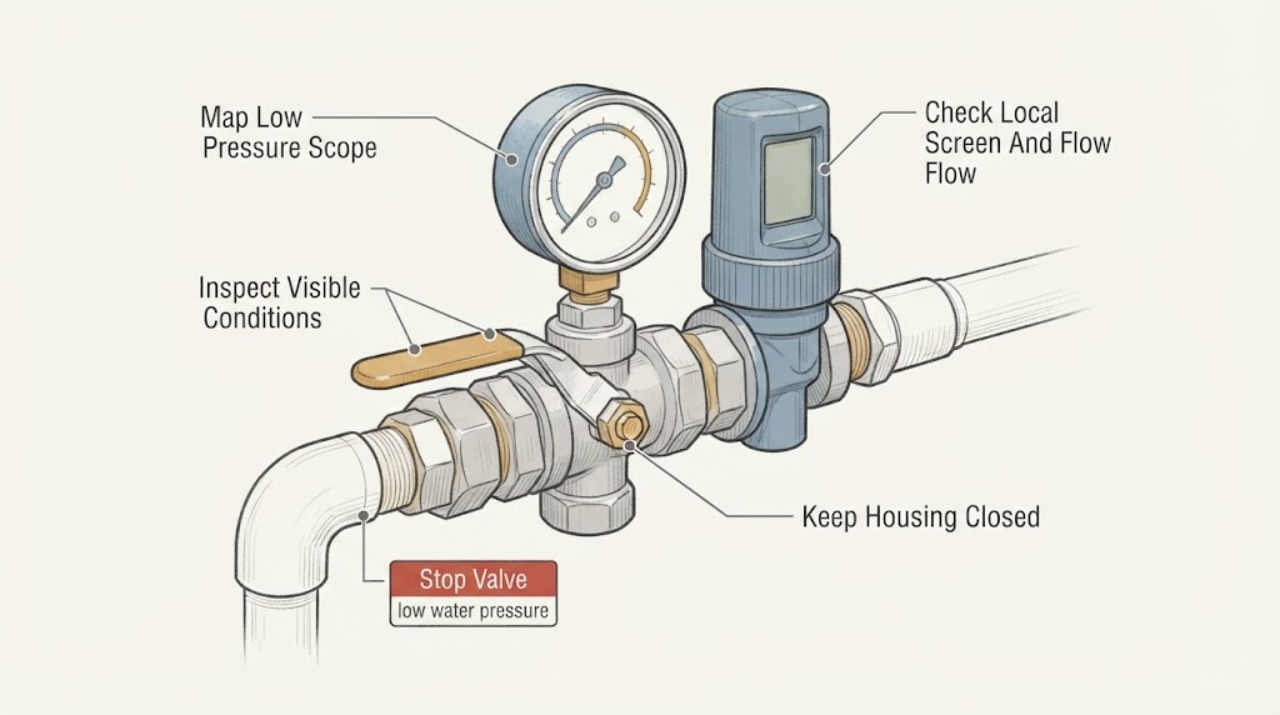
Low pressure at a plumbing valve is not proof that the valve itself has failed. First compare the affected outlet with other cold and hot outlets, then check whether the accessible shutoff is fully open without forcing it. A problem at one fixture points toward that fixture’s valve, screen, or pipe; low flow everywhere points toward the main shutoff, pressure-reducing valve, leak, frozen or corroded pipe, or the incoming supply. Clean an accessible faucet screen only when appropriate, but do not remove a valve, adjust a pressure regulator, or open a pipe. Persistent, sudden, whole-house, leaking, or fluctuating low pressure needs a plumber or water utility to measure the system safely.
Work through in order
Diagnostic checks
Use only checks that match the exact appliance or system and its official guide.
-
Check 1
Test the affected outlet briefly, then compare a nearby cold outlet, a nearby hot outlet, an outside hose spigot if available, and another area of the property. Do not open multiple fixtures at once during the comparison.
Expected result: Only one outlet or section is weak, only hot water is weak, all outlets are weak, or neighbors and common areas have the same problem.
Next step: Follow the matching branch and record when the change began, whether it is constant or demand-related, and whether other fixtures are affected.
Stop if: Stop using water and seek prompt help for flooding, a burst or spraying pipe, sewage contamination, or a rapidly worsening pressure loss.
Why this matters
Why: A single outlet or section supports a private local restriction; hot-only weakness points toward the hot-water path; whole-property weakness can involve the main valve, pressure-control equipment, leak, pipes, or incoming supply; neighbors affected suggests a utility or building event.
-
Check 2
Locate the accessible local or main shutoff and observe whether the handle or lever is in the manufacturer’s fully open position. Move it only gently if it is designed for routine hand operation and there is no leakage; do not force a stiff valve or use a wrench.
Expected result: The valve appears partly closed, appears fully open, cannot be identified, or leaks when touched.
Next step: If it moves easily to the clearly open position, retest one outlet. If it is stuck, leaking, damaged, or its position is uncertain, leave it alone and call a plumber; for whole-property issues with valves open, contact the water utility as appropriate.
Stop if: Stop immediately for spraying, dripping at the stem or joint, corrosion that flakes, a valve that will not turn, or any need to disconnect the valve.
Why this matters
Why: Official water guidance identifies a partially closed internal stop tap or main shutoff as a possible source of low pressure or flow. A fully open-looking valve does not rule out a failed valve, restriction, or upstream problem.
-
Check 3
If only one faucet or fixture is affected, turn that outlet off and inspect its removable screen, aerator, or inlet filter for sediment. Rinse the screen and reinstall it without overtightening; do not remove the supply valve or disturb a compression connection.
Expected result: Sediment or debris is visible on the removable screen, the screen is clear, or the restriction remains after the screen is rinsed.
Next step: Retest the single outlet. If flow is still weak, have a plumber inspect the local valve and branch pipe; do not enlarge the screen openings or substitute an unverified component.
Stop if: Stop if the screen cannot be removed without stressing the faucet, the connection starts leaking, water is discolored with particles after plumbing work, or the issue is not limited to that outlet.
Why this matters
Why: Toronto and Portland both identify clogged faucet screens or aerators as a local low-flow cause. If the screen is clear and the valve remains weak, the restriction may be inside the valve or pipe rather than the screen.
-
Check 4
At the same fixture, compare cold and hot flow separately, then stop the comparison. Note whether low flow occurs only after the water heater, only through one valve, or on both hot and cold sides.
Expected result: Only hot flow is low, only cold flow is low, or both sides are low at the same fixture.
Next step: For hot-only weakness, check only visible water-heater leakage and accessible valve position, then call a plumber or property manager if unresolved. For both sides at one fixture, request local valve/branch inspection; for both sides everywhere, follow the whole-house branch.
Stop if: Stop for water-heater leakage, scalding water, a damaged valve, or any need to open the water-heater or pipe connections.
Why this matters
Why: Portland’s guidance uses hot-versus-cold comparison to narrow the path: hot-only problems can involve the water heater or hot-side screens, while one side or one fixture can indicate a local valve or pipe restriction.
-
Check 5
For a whole-house or sudden pressure change, look at visible indoor and outdoor pipes, the meter area if safely accessible, and the street or building for a water-main notice or active work. Listen for continuous water movement only from a safe, dry location; do not dig or remove the meter.
Expected result: A visible leak, unexplained meter movement, frozen or exposed pipe, nearby water-main work, or no visible cause is found.
Next step: If a leak is visible, limit water use and call a plumber or emergency utility service; if neighbors are affected or a utility event is reported, contact the water utility. If no cause is visible and all valves are open, request professional pressure and flow measurements.
Stop if: Stop for flooding, a wet electrical area, a burst pipe, a sinkhole or ground movement, contaminated water, or any need to enter a meter pit or excavation.
Why this matters
Why: Portland notes that leaks and water-service events can reduce pressure, while Toronto distinguishes utility-owned and private portions of the service pipe. No visible leak does not rule out an underground or internal restriction.
-
Check 6
If low flow remains at multiple outlets after the accessible valve and screen checks, record whether pressure is constant, fluctuates with peak demand, or changed after plumbing work. If you already have a pressure gauge installed at a suitable hose connection, record the reading without adjusting anything; do not install a gauge or alter a regulator as a repair.
Expected result: Low flow occurs only at peak demand, is constant throughout the property, fluctuates unexpectedly, or began after work on the main valve, filter, or pressure-control equipment.
Next step: Provide the scope, timing, valve position, leak observations, and any existing gauge readings to a plumber or water utility. Have them measure at the appropriate points before replacing a valve, regulator, or booster equipment.
Stop if: Do not adjust a pressure-reducing valve, bypass a filter, remove a meter, open a wall, or continue if pressure spikes, pipe hammer, leaks, or flooding occur.
Why this matters
Why: Daily demand and elevation can change supply pressure, while a failed or obstructed pressure-reducing valve, whole-house filter, service pipe, or leak can create a private whole-house problem. A reading is evidence for diagnosis, not a reason to turn an adjustment screw.
Use your observations
Decision map
Find the observation that best matches what you see, then follow the next safe action.
-
PATH 01Next step
What you see
Only one faucet, valve, or short section has low flow
Do this next
Rinse the accessible screen or aerator and verify the local valve is open; call a plumber if flow remains low.
Why this path and its safety boundary
Why it matters: A local screen, valve, or branch-pipe restriction is more likely than a water-main pressure problem.
-
PATH 02Next step
What you see
Only hot water is weak
Do this next
Check only visible conditions and accessible valve position; have a plumber or property manager inspect unresolved hot-side restrictions.
Why this path and its safety boundary
Why it matters: The hot-side path or water-heater area needs attention rather than an immediate main-valve replacement.
-
PATH 03Next step
What you see
All fixtures are weak but nearby properties are normal
Do this next
Verify the main valve is visibly open without forcing it, look for safe visible leaks, and request plumber pressure/flow measurements.
Why this path and its safety boundary
Why it matters: A private main shutoff, pressure-control device, leak, filter, frozen pipe, or service pipe restriction is plausible.
-
PATH 04Next step
What you see
Neighbors or common areas are also affected, or utility work is visible
Do this next
Report the change to the property manager or water utility and avoid changing private valves beyond a safe visual check.
Why this path and its safety boundary
Why it matters: A building or public water-supply event may be responsible.
-
PATH 05Next step
What you see
The valve is stuck, leaking, damaged, or cannot be identified safely
Do this next
Leave it in place and have a plumber identify, isolate, and replace it if measurement confirms that need.
Why this path and its safety boundary
Why it matters: Forcing or disassembling it can turn a low-flow problem into a leak or flooding event.
-
PATH 06Next step
What you see
Pressure fluctuates, a leak is visible, or low flow persists after accessible checks
Do this next
Limit water use where appropriate and arrange plumber or utility assessment; do not adjust regulator equipment yourself.
Why this path and its safety boundary
Why it matters: A pressure-reducing valve, service pipe, leak, filter, or upstream condition needs professional measurement.
Helpful context
Understand the symptom
Pressure and flow are not the same symptom
A partly closed valve can restrict flow, but a clogged screen or corroded pipe can do the same even when supply pressure is normal. Portland’s water guidance recommends comparing fixtures and hot versus cold water to separate a local low-flow problem from a broader pressure problem. The useful first result is therefore the scope of the symptom, not a guessed replacement valve.
Use gentle, visible checks only
A homeowner can compare outlets, look for visible leaks, inspect an accessible valve’s position, and rinse a removable faucet screen. Do not force a stuck valve, loosen threaded connections, adjust a pressure-reducing valve, remove a meter, cut pipe, or open a wall. A sudden drop, burst pipe, flooding, or contaminated water changes the task to urgent service.
What a professional will determine
A plumber or water utility can measure pressure and flow at appropriate points and determine whether the restriction is at the fixture valve, main shutoff, pressure-control equipment, private service pipe, or public supply. That measurement is needed before replacing a valve or installing a booster.
Safety boundary
Stop conditions
- Stop and seek prompt help for a burst or spraying pipe, flooding, water near electrical equipment, contaminated water, ground movement, or a rapidly worsening pressure loss.
- Do not force a stuck valve, loosen compression or threaded connections, adjust a pressure-reducing valve, remove a water meter, cut pipe, dig for a service line, or open a wall as an ordinary-user check.
- Stop repeated valve adjustments when the cause is not established, pressure fluctuates sharply, leaks appear, or the problem affects the whole property.
Only after diagnosis
Potential parts
- local shutoff or angle-stop valve
Only consider this category if a plumber confirms that a local valve is stuck, internally restricted, or leaking after the fixture screen and branch are assessed.
Confirm pipe connection, fixture, material, and local code requirements before selecting a replacement; low flow alone does not identify the valve. - pressure-reducing valve
Only consider this category when professional pressure measurements show that a pressure-control valve is malfunctioning or restricted.
Do not adjust or replace a pressure-control valve from a symptom alone; confirm system requirements and have the work performed safely. - fixture screen or aerator
Only relevant when the low flow is isolated to one outlet and the removable screen is damaged or remains restricted after cleaning.
Match the fixture and thread pattern; a screen replacement will not correct a valve, pipe, leak, or whole-house supply problem.
When checks do not resolve it
Need a professional?
Use a plumber for persistent local low flow, a stuck or leaking valve, whole-house pressure loss, suspected pressure-control or service-pipe trouble, or any repair requiring a connection to be opened. Use the water utility or property manager when the broader supply appears affected.
Common questions
FAQ
Can a partly closed valve cause low water pressure?
Yes. Official water guidance identifies a partially closed internal or main shutoff as a possible cause of low pressure or flow. Check its visible position gently, but do not force a stuck valve or assume a fully open-looking valve is healthy.
How can I tell whether the valve or the water supply is the problem?
Compare the affected outlet with other hot and cold fixtures and, if available, an outside spigot. One weak outlet suggests a local screen, valve, or branch issue; weak flow everywhere or affected neighbors points toward private main plumbing or the wider supply.
Could a clogged screen feel like low water pressure?
Yes. Portland and Toronto both note that clogged faucet screens or aerators can reduce local flow even when broader pressure is normal. Rinse an accessible screen, then call a plumber if that outlet remains weak.
Should I adjust the pressure-reducing valve myself?
No. A whole-house symptom should be measured before a pressure-control valve is adjusted or replaced. A plumber can distinguish the regulator from a leak, filter, service pipe, or incoming-supply problem.
When is low water pressure an urgent plumbing problem?
Seek prompt help for a burst or spraying pipe, flooding, water near electrical equipment, contaminated water, a rapidly worsening drop, a leaking valve, or pressure that fluctuates sharply. Otherwise, persistent local or whole-house low flow still warrants professional diagnosis.
Read the exact guide
Official sources
- Troubleshooting water pressure and flowCity of Portland Water Bureau · Home water-pressure and flow comparison, local versus whole-house causes, valves, leaks, filters, and pressure-control context
- No Water or Low Water PressureCity of Toronto · Low-pressure scope comparison, main shutoff, tap screens, private versus utility supply, and service assessment
Community feedback
Share a repair observation
Share a plain-text repair observation. Accepted observations are published automatically; this page may take a moment to update.