
On this page
Start here
Quick answer
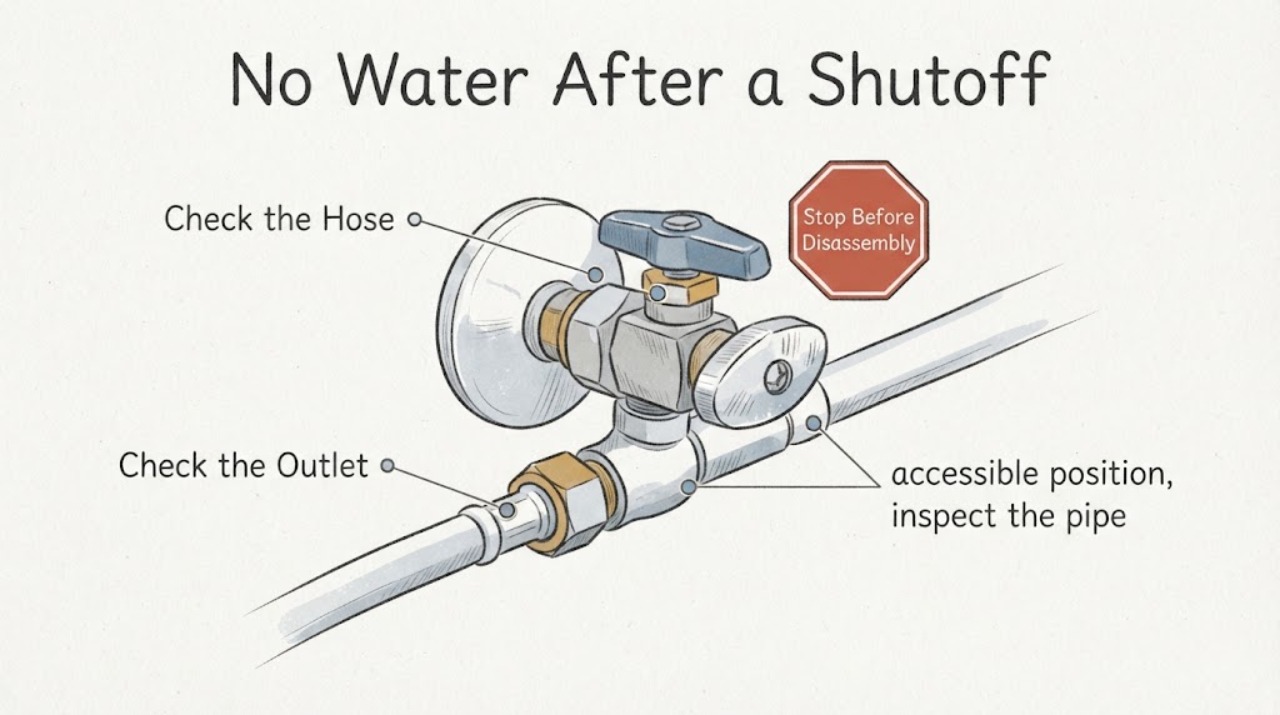
When no water comes through a valve, first compare the affected outlet with other fixtures to determine whether the problem is local or affects the whole property. Then identify the correct upstream shutoff and check its visible position and condition without forcing the handle. Look for frost, a leak, a kink, a recently closed valve, or a utility interruption. If the valve is open and intact but water still stops downstream, or if the valve is stuck, damaged, buried, or leaking, stop and have a qualified plumber diagnose it.
Work through in order
Diagnostic checks
Use only checks that match the exact appliance or system and its official guide.
-
Check 1
Open the affected downstream faucet or fixture briefly, then compare another nearby outlet and, if available, an outdoor hose connection; compare hot and cold water without leaving fixtures unattended.
Expected result: Only the outlet after this valve is dry, several outlets in one area are dry, only hot water is absent, or the entire property has no water.
Next step: Use the result to choose the local-valve, whole-home, hot-water, or utility branch; do not replace the valve before establishing this scope.
Why this matters
Why: A single dry outlet points to a local valve, screen, fixture, or branch restriction. A whole-home loss points upstream to the main valve, service line, utility, or a significant leak. Hot-only loss points to the hot-water side rather than a cold supply valve.
-
Check 2
Trace the pipe to identify the correct valve serving the dry outlet and visually check whether its handle appears open; operate it only if it is clearly intended for normal hand use and turns easily, without forcing it or using a tool.
Expected result: The valve was partly closed, the handle moves normally and the outlet remains dry, or the handle is stuck, damaged, spinning without effect, or leaking.
Next step: If the valve is stuck, damaged, or leaking, leave it alone and call a plumber. If it is safely open, continue with the visible pipe and upstream supply checks.
Why this matters
Why: A partly closed supply valve can stop or restrict flow to a fixture. A normal-looking handle with no downstream flow suggests a failed valve, blockage, frozen section, or upstream supply problem. A damaged or stuck valve cannot be treated as a routine adjustment.
-
Check 3
From a safe, accessible position, inspect the pipe on both sides of the valve for frost, kinks, crushed sections, dampness, staining, or water entering a wall, cabinet, floor, or ceiling; do not remove fittings or insulation aggressively.
Expected result: Frost or a cold exposed section is present, a line is kinked or crushed, moisture or a crack is visible, or the accessible line looks dry and intact.
Next step: For water, a crack, or a concealed wet area, stop using the line and call a plumber. If the line is visibly intact, continue without opening walls or disconnecting the valve.
Why this matters
Why: Frost, physical restriction, and leaks can stop water downstream or conceal freeze damage. A dry visible line does not rule out an internal, buried, or concealed blockage.
-
Check 4
If more than one outlet is dry, locate the home's main control valve near the meter or service entry and check its visible position; also look for a utility shutoff notice or nearby water work, without entering an unsafe meter area.
Expected result: The main valve appears closed or partly closed, the main valve is open, or a utility/building interruption is reported.
Next step: If the main valve is safe to operate and its position was the only issue, restore it gradually and recheck fixtures. If it is stuck, damaged, inaccessible, or the interruption is shared, contact a plumber, property manager, or water utility instead of forcing it.
Why this matters
Why: A main valve left closed after work can remove water from the whole home. An open main with a shared interruption points to the utility or building supply rather than the local valve.
-
Check 5
With all intended water use off, inspect accessible plumbing and observe the water meter's leak indicator or movement during a no-use interval; handle the meter lid carefully and do not dismantle the meter or its fittings.
Expected result: The indicator moves or the reading changes, visible water is present, or the meter remains still and accessible plumbing is dry.
Next step: For confirmed water loss, use a known safe shutoff only if it operates normally and arrange prompt plumbing service. If no leak is indicated, continue to the local blockage or valve-service branch.
Why this matters
Why: Meter movement without intended use supports a leak that can reduce supply and damage the property. A still meter does not exclude a concealed or intermittent restriction, but it makes a confirmed leak less likely.
-
Check 6
When the valve is open and other fixtures have water, inspect the affected faucet or fixture's accessible screen, aerator, or inlet for sediment without loosening a pressurized supply connection.
Expected result: Sediment or a blocked screen is visible, or the outlet remains dry with no visible local blockage.
Next step: Clean or service only the accessible outlet component according to its instructions. If it remains dry, stop disassembly and have a plumber test the valve and branch line.
Why this matters
Why: A local screen or fixture restriction can mimic a valve failure. If the outlet is clear but still receives no water, the valve, branch pipe, or hidden restriction needs diagnosis.
Use your observations
Decision map
Find the observation that best matches what you see, then follow the next safe action.
-
PATH 01Next step
What you see
Other fixtures work, but the outlet after this valve is dry.
Do this next
Check the valve position and accessible outlet screen. If the valve is open and the screen is clear, arrange plumbing service for a failed valve or branch restriction.
-
PATH 02Next step
What you see
Several fixtures, including a lower-level or outside outlet, have no water.
Do this next
Check the visible main-valve position, utility notices, and safe leak indicators. If the main valve is open or unsafe to operate, contact the water utility, property manager, or plumber.
-
PATH 03Next step
What you see
Cold water works but hot water is absent at multiple outlets.
Do this next
Treat this as a hot-water-side issue and arrange a plumber or property-manager assessment rather than changing the cold-water valve.
-
PATH 04Next step
What you see
Water, a crack, a wet wall or ceiling, meter movement without intended use, or a damaged valve is present.
Do this next
Stop using the affected plumbing, close a normally operating safe shutoff if it can be reached without entering a hazard, and call a plumber. Do not open walls or disconnect fittings.
-
PATH 05Next step
What you see
Neighbors or other units are also without water, or utility work is visible or announced.
Do this next
Report or confirm the service interruption with the water utility or property manager and avoid changing private valves until the shared supply is restored.
Helpful context
Understand the symptom
Find out whether the valve or the supply is the problem
“No water after this valve” is not yet a diagnosis. If another fixture supplied from the same area works, the restriction may be at the local valve, outlet, or branch. If every cold outlet is dry, the main valve, meter-side supply, a service interruption, or a larger leak becomes more likely.
Do not turn a small restriction into a flood
Do not force a corroded handle, use pliers on a stuck valve, open a wall or meter fitting, or disconnect a pressurized connection. If water is escaping, water is near electrical equipment, or a valve will not operate normally, stop and get professional help.
Safety boundary
Stop conditions
- Stop immediately for an active leak, water entering a wall or ceiling, water near electrical equipment, a stuck, corroded, damaged, or leaking valve, a buried or inaccessible section, or a need to open the meter, wall, or pressurized piping. Do not force a handle, use tools to break a valve free, or dismantle a supply connection.
Only after diagnosis
Potential parts
- fixture or branch shutoff valve
Consider this only after a plumber confirms that the local valve fails to pass water or cannot provide a reliable shutoff.
Connection type, size, access, and local requirements are system-specific; do not disconnect a pressurized valve yourself. - faucet aerator or inlet screen
Consider this only when one outlet is dry or weak and sediment is confirmed at its accessible screen or aerator.
Confirm the fixture model and thread or inlet fit before selection; a screen cannot correct a closed valve or whole-home supply loss. - main water shutoff valve
Consider this only when the main valve is confirmed failed, damaged, or unable to stop or restore the home's supply.
Main-valve replacement affects the service line and may require utility coordination, permits, and a licensed plumber.
When checks do not resolve it
Need a professional?
Call a qualified plumber when the valve is stuck, damaged, leaking, or open without restoring flow; when a line may be frozen, blocked, buried, or broken; when a leak indicator moves with no intended use; or when all safe checks fail. Contact the water utility or property manager when several homes or units share the loss or a service interruption is reported.
Common questions
FAQ
Why is there no water after one valve but other faucets work?
The local valve may be partly closed or failed, or the outlet screen or branch may be restricted. Check only the accessible valve position and fixture screen; if the valve is open and the outlet stays dry, have a plumber test the branch.
What if no faucet in the house has water?
Check the visible main-valve position, utility notices, nearby work, and whether other homes or units are affected. A stuck main valve, service-line fault, leak, or utility interruption needs professional or utility help.
How can I tell whether a leak is causing the loss of water?
Turn off all intended water use and observe the meter's leak indicator or movement. Movement without use supports a leak; visible water or a wet wall or ceiling is a reason to stop and call a plumber.
Should I force a stuck water valve?
No. Forcing a corroded or stuck valve can break it and create a leak. Leave it alone and call a qualified plumber, especially if there is no other reliable way to shut off the supply.
Read the exact guide
Official sources
- How to Turn Off Your WaterWestern Municipal Water District · Official guidance distinguishing master and fixture supply shutoffs and emphasizing slow operation when restoring water.
- Locating a Water Meter & Emergency Service ValveCity of Columbus, Ohio · Official water-utility guidance on main-valve location, checking valve operation, plumber escalation, and safe response when pipes freeze or break.
- How to check for leaksCity of Portland Water Bureau · Official guide on stopping water use, observing a meter leak indicator, testing a house shutoff, and escalating confirmed or concealed leaks.
- Property Owners and ContractorsCity of Fresno Water Division · Official city guidance on partly closed main valves, local restrictions, service-line responsibility, and the risk of forcing old valves with tools.
- Troubleshooting water pressure and flowCity of Portland · Official water-utility guidance on checking all fixtures, hot and cold water, indoor and outdoor outlets, valves, leaks, utility events, and property-manager escalation.
Community feedback
Share a repair observation
Share a plain-text repair observation. Accepted observations are published automatically; this page may take a moment to update.