
On this page
Start here
Quick answer
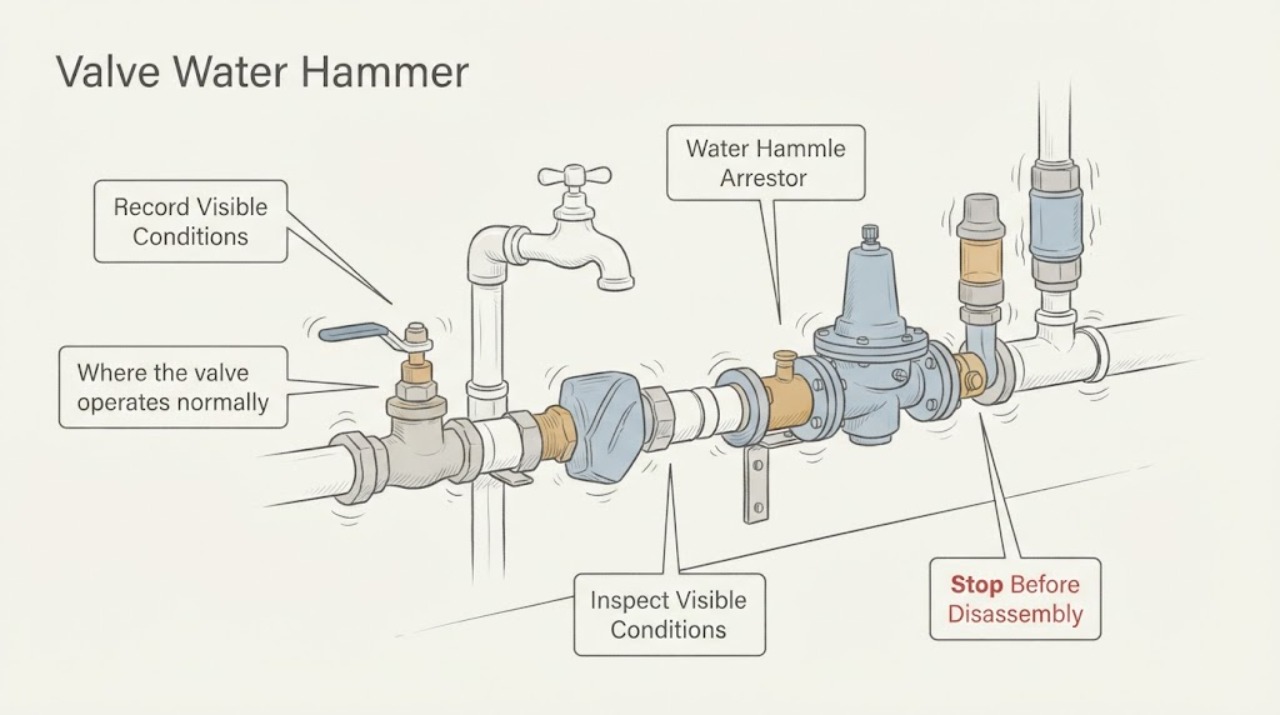
Water hammer is a pressure shock caused when moving water is stopped or redirected suddenly, often as a tap, appliance valve, or shutoff closes. Note exactly which valve or fixture triggers the bang, close taps more gently, and inspect only visible pipework for movement or loose supports. If the noise continues, is severe, follows plumbing work, or is accompanied by leaks, high pressure, or a valve that will not close, have a qualified plumber inspect the valve, pressure regulation, pipe supports, and any correctly sized water-hammer arrestor.
Work through in order
Diagnostic checks
Use only checks that match the exact appliance or system and its official guide.
-
Check 1
Record what was operating when the bang occurred: a faucet being closed, a toilet refilling, a washing machine or dishwasher stopping its fill, an outdoor tap, or a pump/check-valve event. Note whether it happens on opening, closing, or both.
Expected result: One fixture or valve consistently triggers the bang, several fixtures do, or the event cannot be tied to a user action.
Next step: Use the triggering fixture branch. If the event is severe, new after plumbing work, or unexplained, stop experimenting and ask a plumber to trace the pressure event.
Why this matters
Why: A repeatable single trigger points toward that fast-closing valve or appliance connection; housewide or unexplained events make pressure, check valves, supports, or a wider plumbing condition more likely.
-
Check 2
Where the valve operates normally and there is no leak, close the triggering tap or shutoff slowly once and compare the result. Do not force a stiff handle or repeatedly cycle an appliance valve.
Expected result: The bang is reduced when the flow stops more slowly, or it remains equally severe.
Next step: Adopt gentle manual closure temporarily and arrange a plumbing assessment if the noise persists. Do not use slow operation to mask a leaking or defective valve.
Why this matters
Why: A reduction with slower closure supports rapid flow stoppage as the trigger. No change suggests pressure, pipe support, check-valve behavior, or another system issue also needs attention.
-
Check 3
From accessible areas such as under sinks, in a cabinet, or along an exposed wall, observe whether pipes move, touch each other, or lack visible support when the triggering valve operates. Do not remove finishes or reach into energized equipment spaces.
Expected result: A visible pipe shakes, contacts another surface, has a missing/loose support, or no movement is visible.
Next step: Do not wedge, strap, or drill around concealed services based on guesswork. Photograph the observation and have a plumber secure or access the pipework safely if needed.
Why this matters
Why: Loose pipework can amplify a pressure shock into a loud bang; no visible movement does not rule out a concealed pipe or pressure problem.
-
Check 4
Identify whether the trigger is a manual tap, appliance solenoid, toilet fill valve, pressure-balance valve, or check valve, and whether the plumbing was recently installed or serviced. Do not remove a valve, cartridge, or check-valve retaining part to identify it.
Expected result: The trigger is a quick-closing appliance/fixture valve, a shower pressure-balance valve, a check valve, or an unknown concealed valve.
Next step: Provide the valve/fixture model and trigger sequence to a plumber. If the valve is concealed or the system has multiple outlets, use professional diagnosis before selecting an arrestor, cartridge, or replacement valve.
Why this matters
Why: Different valve types produce different flow changes and require different remedies. A transfer valve, mixing valve, check valve, and shutoff valve are not interchangeable diagnoses.
-
Check 5
If several fixtures cause hammering or flow is unusually strong/unstable, have a plumber check the home's pressure regulator and system pressure at an appropriate hose bib. Do not adjust the regulator screw or change pressure limits just to silence the noise.
Expected result: Hammering is housewide, pressure changes are noticeable, or the regulator is old/unknown; or the issue is isolated to one fixture with normal overall pressure.
Next step: Have a qualified plumber test and, if necessary, service or replace the regulator and verify the system afterward. Do not infer a regulator replacement from noise alone.
Why this matters
Why: A regulator can clog or fail and high or inconsistent pressure can amplify water hammer. An isolated fixture event is more likely to need local valve, support, or arrestor analysis.
-
Check 6
If the home has a known main shutoff and the utility or plumber's instructions support it, consider the documented whole-house drain-and-refill procedure to restore an air cushion. Do not attempt this if the main valve is uncertain, the building is shared, there is an active leak, or the procedure could affect a boiler, water heater, or other equipment.
Expected result: The noise eases after a properly performed system drain/refill, or it persists unchanged.
Next step: If unsure, skip the procedure and call a plumber. If it does not help or the system has no suitable air chamber, have a professional evaluate an air chamber or water-hammer arrestor for the exact installation.
Why this matters
Why: Brantford explains that air chambers can absorb the shock and may lose their air cushion when filled with water. Persistent noise indicates that the trigger, supports, pressure, or arrestor may still need correction.
-
Check 7
Stop user troubleshooting when hammering is severe, pipes move violently, a fitting or valve leaks, water damage is visible, a pressure regulator behaves abnormally, the valve cannot be closed, or the noise began immediately after plumbing work.
Expected result: A leak, uncontrolled flow, high-pressure symptom, damaged connection, concealed valve, or persistent hammer remains.
Next step: Isolate the affected water supply if safe and contact a licensed plumber promptly. Ask for the trigger, pressure, pipe-support, check-valve, and arrestor diagnosis rather than buying a generic part first.
Why this matters
Why: Water hammer can stress pipe connections and joints. Repair may require isolation, pressure testing, access behind finishes, regulator work, or correctly sized arrestor installation.
Use your observations
Decision map
Find the observation that best matches what you see, then follow the next safe action.
-
PATH 01Next step
What you see
One faucet or appliance valve reliably causes a single bang when it closes
Do this next
Close it gently temporarily, inspect accessible pipe movement, and have the local valve/connection and any required arrestor assessed.
-
PATH 02Next step
What you see
Several fixtures or the whole house cause hammering
Do this next
Prioritize system pressure, regulator, supports, and check-valve assessment by a plumber rather than replacing the local valve first.
-
PATH 03Next step
What you see
A visible pipe shakes, rattles against a surface, or lacks support
Do this next
Do not open walls or improvise a restraint; document it and have a plumber secure the pipework safely.
-
PATH 04Next step
What you see
The event began after installation, repair, or a change in valve/appliance
Do this next
Have the installer verify valve type, flow direction, check valves, supports, pressure, and any required arrestor for the actual system.
-
PATH 05Next step
What you see
A known-safe whole-house drain/refill is supported by the local instructions
Do this next
Use the documented procedure only if it will not affect shared or specialized equipment; persistent hammering still needs plumbing diagnosis.
-
PATH 06Next step
What you see
There is a leak, uncontrolled valve, wet fitting, severe vibration, or water damage
Do this next
Isolate water if safe and call a licensed plumber promptly; do not keep cycling the valve or attempt concealed repairs.
Helpful context
Understand the symptom
What the bang means
A bang immediately after a tap, shutoff, appliance fill valve, or other valve closes is usually a hydraulic pressure event, not a loose decorative trim piece. The sudden stop can make pipes vibrate and, when severe, stress connections and joints. The useful diagnosis is the event sequence: which valve moved, how quickly it closed, where the noise is loudest, and whether there is any water damage.
A valve can be the trigger without being the only fault
The triggering valve may be a fast-closing tap, a washing-machine or dishwasher inlet, a toilet fill valve, or a check valve. The underlying amplifier may be high pressure, unsupported pipework, a missing or waterlogged air chamber, or a failed pressure regulator. Do not choose an arrestor or pressure setting from the noise alone.
Protect the system while you investigate
Do not strike the pipe, force a stiff valve, open a wall, or adjust a pressure regulator without knowing the system and its safe limits. If a joint is wet, a pipe moves violently, or water is actively escaping, isolate water if that can be done safely and call a plumber.
Only after diagnosis
Potential parts
- water-hammer arrestor
Consider only after the trigger and installation location are confirmed and a plumber determines that an arrestor is appropriate.
Select by approved application, pipe connection, flow conditions, and local code; a generic arrestor is not guaranteed to fit or solve a whole-house pressure problem. - pressure regulator
Consider only when pressure testing confirms the regulator is clogged, unstable, or failed.
Regulator size, connection, pressure range, and installation requirements are system-specific and require qualified plumbing work. - mixing or pressure-balance valve cartridge
Consider only when a temperature-specific flow or valve symptom confirms a cartridge/balancing fault rather than a pipe-pressure event.
Cartridges are exact-valve-specific; identify the model and isolate water safely before any replacement. - check valve or shutoff valve assembly
Consider only if a plumber confirms a check valve slam, seized shutoff, or damaged local valve as the trigger.
Valve orientation, connection, flow rating, and code requirements must be verified for the actual system.
When checks do not resolve it
Need a professional?
Call a licensed plumber when water hammer is severe or persistent, affects multiple fixtures, follows plumbing work, involves a concealed or seized valve, or is accompanied by leaks, moving pipes, unstable pressure, or water damage. Request pressure, valve, pipe-support, check-valve, and arrestor assessment rather than assuming a cartridge or generic arrestor is the answer.
Common questions
FAQ
What causes water hammer at a valve?
A rapid stop or change in water flow creates a pressure shock that can make pipes bang or vibrate. The trigger may be a tap, appliance valve, toilet fill valve, or check valve, while high pressure or loose supports can make it worse.
Will closing a valve slowly stop water hammer?
It can reduce hammer caused by rapid manual closure, and it is a useful observation. If the noise persists, the system may also have pressure, support, check-valve, or arrestor issues that need a plumber.
Do I need a water-hammer arrestor?
Possibly, but location and sizing depend on the actual trigger, pipework, and flow conditions. Watts describes arrestors as absorbing the pressure change from quick shutoff and recommends installation close to the shock source; have a plumber confirm the application.
Can water hammer damage plumbing?
Yes. Utility guidance says severe hammer can vibrate pipes and damage connections or joints, potentially leading to leaks. Persistent banging, moving pipes, or any wet fitting should be assessed promptly.
Read the exact guide
Official sources
- How to Operate PosiTemp Stop Check ValvesMoen Solutions · Official Moen guidance for PosiTemp valves with optional stop checks; not a generic procedure for every valve.
- Water Pressure RegulatorsCity of Santa Barbara · Official municipal guidance; regulator installation and pressure requirements vary by property and jurisdiction.
- Water Hammer Arrestor for Residential ApplicationsWatts · Official Watts installation instructions for the cited arrestor series; do not generalize fit to other products or systems.
- Leaks in the HomeCity of Brantford · Official municipal plumbing guidance; building systems and local procedures vary.
- Shower Faucet: Low Flow- Independent Transfer ValvesMoen Solutions · Official Moen guidance for multi-device shower systems; model-specific valve and device instructions apply.
Community feedback
Share a repair observation
Share a plain-text repair observation. Accepted observations are published automatically; this page may take a moment to update.