
On this page
Start here
Quick answer
Water dripping from a water heater's temperature-and-pressure relief valve discharge pipe usually means the valve is responding to pressure or temperature, not that the pipe itself needs to be capped. Thermal expansion in a closed plumbing system, excessive supply pressure, a failed expansion tank, debris at the valve seat, or an overheating condition can be involved. From a safe position, distinguish a small intermittent drip from a large or very hot discharge, check that the outlet is visibly unobstructed, and look for water coming from nearby threaded connections instead. Never cap, plug, valve off, kink, or restrict the discharge pipe, and do not remove or replace the relief valve by guesswork. A large flow, steam, rapidly worsening leak, tank leak, or temperature or pressure concern requires prompt qualified plumbing service; leave the area and seek emergency help for a scalding or other immediate hazard.
Before you begin
Safety first
- This article supports safe observation of flow severity, visible discharge routing, accessible exterior moisture, and timing. Do not operate the relief lever, open the tank, alter pressure or temperature controls, restrict the discharge, or replace gas, electrical, or relief components.
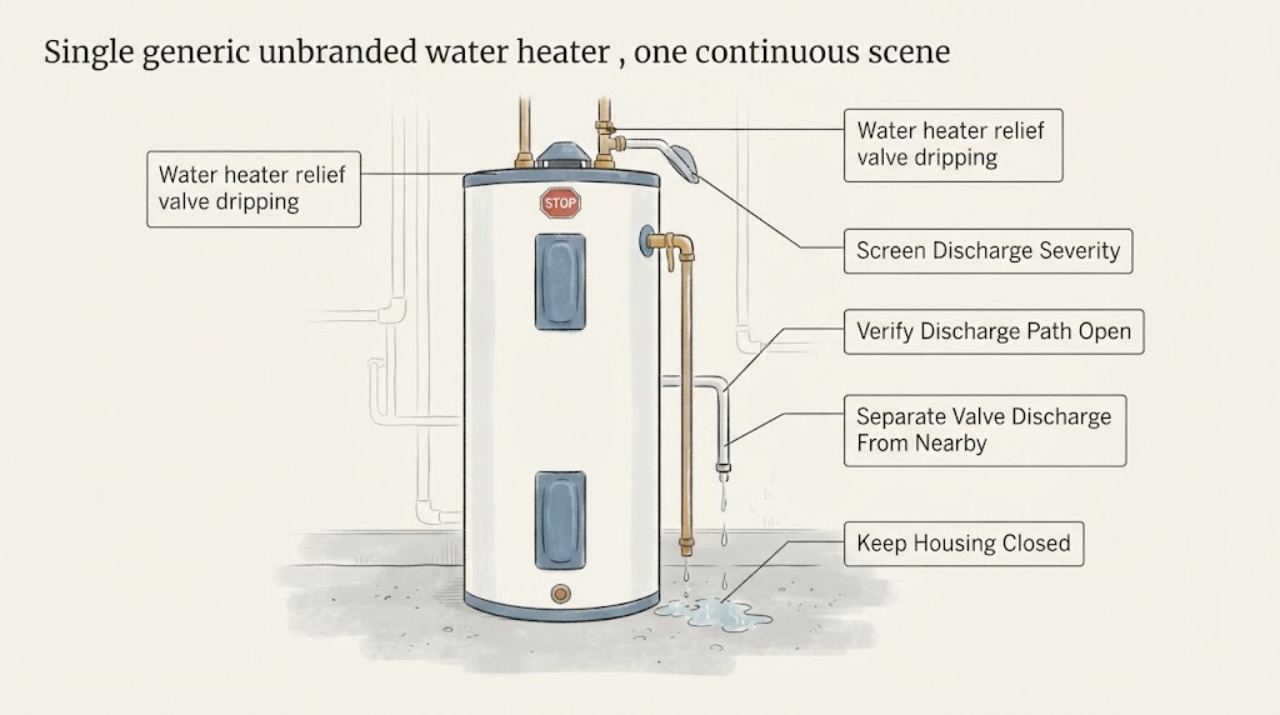
Work through in order
Diagnostic checks
Use only checks that match the exact appliance or system and its official guide.
-
Check 1
From a safe position, observe the discharge outlet without touching the pipe or relief lever. Note whether water is a few drops, a steady trickle, a large flow, or visibly very hot or steaming; keep people and pets away from the outlet.
Expected result: The drip is small and intermittent, or the discharge is steady, large, very hot, steaming, spraying, or increasing.
Next step: For a large, very hot, steaming, spraying, or worsening discharge, stop using the heater and obtain prompt qualified plumbing help; follow the model's emergency shutdown guidance only if it can be done without approaching the hot outlet. For a small drip, continue with safe visual checks without obstructing the outlet.
Stop if: Do not stand in front of the outlet, touch discharged water, lift the relief lever, or cap the pipe to stop the flow.
Why this matters
Why: A small intermittent drip, especially during a heating cycle, is consistent with thermal expansion or pressure. A large or very hot discharge can indicate excessive temperature or pressure and is not a routine drip to monitor casually.
-
Check 2
Visually trace the discharge pipe from the relief valve to its termination without disassembling it. Check for a cap, plug, shutoff valve, reducer, kink, crushed section, ice, stored item, or other visible restriction; do not insert anything into the opening.
Expected result: The pipe is open and drains freely, or it is capped, blocked, damaged, frozen, kinked, or terminated where water could damage the building.
Next step: Keep the area clear and arrange qualified service to correct any restriction, damaged piping, freezing, or termination problem. Do not remove a cap or valve from a hot or pressurized discharge line yourself.
Stop if: Never cap, plug, valve off, kink, pinch, reduce, or otherwise restrict the line, and do not operate the heater with a blocked discharge path.
Why this matters
Why: An open, unobstructed discharge path preserves the relief valve's safety function. A restriction can prevent safe discharge and must not be treated as a fix for dripping; an incorrect termination can turn a small release into hidden water damage.
-
Check 3
Only when surfaces are safe to approach, dry the accessible exterior around the relief-valve connection, drain valve, cold inlet, hot outlet, and nearby pipe joints with separate paper towels. Do not touch the relief lever, hot pipe, burner, electrical cover, or tank body to test temperature.
Expected result: New moisture first appears at the discharge opening, at a threaded connection, on the tank jacket or base, or cannot be localized safely.
Next step: Photograph the first wet point and arrange qualified service if the source is the valve, tank, or an inaccessible connection. If a cool accessible connection is clearly leaking, do not overtighten it; isolate the heater only under the model's instructions or have a plumber do so.
Stop if: Stop for scalding water, a leak at the tank body or base, water near electrical parts, or any need to remove fittings, drain the tank, or open the appliance.
Why this matters
Why: Moisture beginning at the discharge opening supports a relief-valve event. A connection leak or condensation can mimic discharge and needs a different repair; water at the tank body or base can indicate tank deterioration and is not a valve adjustment problem.
-
Check 4
Without changing the heater setting or operating the relief lever, note whether the drip appears only while the heater heats, after hot-water use, at night, or continuously. From safe exterior access, record whether the cold-water supply has a pressure-reducing or backflow device and whether a thermal expansion tank is visibly installed.
Expected result: The drip coincides with heating, the plumbing has backflow prevention or pressure reduction, an expansion tank is absent or visibly damaged, or the drip continues regardless of heating.
Next step: Give the timing, visible plumbing devices, heater model, and photos to a qualified plumber. Ask them to assess system pressure, pressure-reducing or backflow equipment, expansion-tank condition, heater temperature, and relief-valve operation.
Stop if: Do not adjust a pressure-reducing valve, charge or replace an expansion tank, change the thermostat, or remove the relief valve without qualified plumbing service.
Why this matters
Why: A drip tied to heating in a closed system makes thermal expansion, high pressure, or an expansion-tank problem more likely. A continuous drip can also involve debris or a relief valve that is not sealing, but the valve should not be replaced until pressure and expansion causes are assessed.
-
Check 5
Record the water-heater brand, model and serial information, fuel type, relief-valve label if legible from a safe position, discharge-pipe termination, drip frequency, and any recent plumbing, pressure, expansion-tank, or temperature-control work. Do not remove the label or disturb fittings.
Expected result: The model and installation details are available, or the valve rating, piping arrangement, or cause cannot be identified without disassembly.
Next step: Provide the record and photos to a qualified plumber or the manufacturer for model-specific diagnosis. Keep the discharge path open and the heater out of service when the drip is large, hot, persistent, or accompanied by a leak or overheating sign.
Stop if: Do not substitute a relief valve, change discharge-pipe sizing or termination, or make a pressure or temperature adjustment based only on appearance.
Why this matters
Why: Relief-valve ratings, discharge materials, expansion requirements, and service procedures are model and installation dependent. Missing information is a reason for a technician to inspect, not a reason to install a generic valve or restrict the discharge.
Use your observations
Decision map
Find the observation that best matches what you see, then follow the next safe action.
-
PATH 01Safety boundary
What you see
The discharge is a large, very hot, steaming, spraying, or rapidly increasing flow, or the tank appears to be overheating.
Do this next
Stay clear of the outlet, stop using the heater, and obtain prompt qualified plumbing or appliance service. Use only the model's emergency shutdown steps if they can be completed without approaching hot water or energized parts.
Why this path and its safety boundary
Why it matters: The relief valve may be responding to excessive temperature or pressure. This is a safety event, not a nuisance drip, and blocking the line could remove the only relief path.
Safety stop: Do not touch the discharge, lift the lever, cap the line, or continue operating the heater to see whether it stops.
-
PATH 02Safety boundary
What you see
A small drip appears mainly while the heater is heating, and there is a closed plumbing system, backflow device, or pressure-reducing valve.
Do this next
Arrange qualified plumbing assessment of pressure, backflow or pressure-reducing equipment, and the size and condition of the thermal expansion tank before replacing the relief valve.
Why this path and its safety boundary
Why it matters: Thermal expansion and high system pressure are more likely than a failed relief valve alone. The relief valve is relieving pressure that should be managed by the system's expansion control.
Safety stop: Do not plug the pipe, change pressure settings, or replace the valve without addressing the pressure and expansion diagnosis.
-
PATH 03Safety boundary
What you see
The discharge is a small but continuous drip regardless of a heating cycle, while pressure and temperature causes have not been assessed.
Do this next
Keep the discharge path open and schedule qualified plumbing service to check pressure, expansion control, temperature, valve condition, and the surrounding connections.
Why this path and its safety boundary
Why it matters: High pressure, thermal expansion, debris at the valve seat, or a relief valve that no longer seals are all possible. The observation does not justify a valve replacement by itself.
Safety stop: Do not repeatedly operate the relief lever, insert tools into the valve, or leave a bucket covering or obstructing the pipe.
-
PATH 04Safety boundary
What you see
Drying shows water begins at a threaded connection, drain valve, tank jacket, or tank base rather than at the discharge opening.
Do this next
Photograph the source and arrange qualified plumbing service; isolate water or energy only using the model's safe procedure and only when this can be done without contact with hot water or electrical parts.
Why this path and its safety boundary
Why it matters: The apparent relief-valve drip is likely a separate connection, condensation, or tank leak. A tank-body or base leak can worsen and is not fixed by changing the relief valve.
Safety stop: Do not overtighten hot fittings, remove the relief valve, open the tank, or continue using a tank that is leaking from its body or base.
-
PATH 05Safety boundary
What you see
The discharge pipe is capped, plugged, kinked, frozen, reduced, valved, or terminated where discharge cannot drain safely.
Do this next
Keep people away from the heater and request qualified plumbing correction of the discharge assembly; do not remove the obstruction or operate the heater as a test.
Why this path and its safety boundary
Why it matters: The relief path is not compliant with the safety design and may be unable to discharge as intended. This is an installation hazard even if the current drip is small.
Safety stop: Never cap, plug, valve, kink, reduce, or obstruct the discharge line, and do not place a container or covering over its outlet.
Helpful context
Understand the symptom
The discharge pipe is a safety outlet, not a normal drain
The temperature-and-pressure relief valve is designed to discharge water if excessive tank temperature or pressure develops. A small drip that occurs during heating often fits thermal expansion, especially when a backflow device or pressure-reducing valve makes the plumbing system closed. A large, very hot, continuous, or rapidly increasing discharge is a different decision because it can signal overheating or dangerous pressure. The discharge pipe must remain open and able to drain; stopping the water can remove the safety function.
Do not confuse a valve discharge with a nearby connection leak
Water can run along the pipe or tank jacket and make a threaded connection, drain valve, inlet, outlet, or condensation look like a T&P discharge. Use a dry towel only on cool, accessible exterior surfaces and observe where new moisture first appears. Do not touch the relief lever, hot discharge, vent, burner, electrical cover, or tank fittings while the heater is operating. The source and the discharge pattern determine whether the next step is pressure and expansion diagnosis, a connection repair, or an urgent safety call.
Safety boundary
Stop conditions
- Do not cap, plug, valve off, kink, reduce, cover, or obstruct the temperature-and-pressure relief valve discharge pipe.
- Do not touch the relief lever or discharged water when it may be hot, and do not stand in front of the outlet.
- Do not remove or replace the relief valve, install an expansion tank, adjust pressure, change temperature controls, or drain a pressurized tank as a casual homeowner fix.
- Stop for a large, very hot, steaming, spraying, or worsening discharge; a tank-body or base leak; water near electrical parts; smoke; gas odor; or suspected overheating, and seek prompt qualified or emergency help from a safe location.
- Do not keep operating a heater with a blocked discharge path or persistent unexplained relief discharge while waiting to see if it stops.
Only after diagnosis
Potential parts
- thermal expansion tank
Consider this category only when qualified pressure and plumbing-system assessment confirms thermal expansion in a closed system and determines that an expansion tank is required or the existing tank has failed or is undersized.
Confirm water-heater capacity, system pressure, connection location, potable-water approval, sizing, and local plumbing requirements with a qualified plumber. - pressure-reducing valve
Consider this category only when qualified measurement identifies excessive building water pressure and the supply arrangement requires pressure reduction.
Confirm the building supply, backflow arrangement, pressure limits, potable-water rating, and local requirements before selecting or adjusting a valve. - temperature-and-pressure relief valve
Consider this category only after qualified service assesses temperature, pressure, expansion control, discharge routing, debris, and the existing valve and confirms that the valve itself no longer seals or is incorrect for the model.
Match the exact heater rating, approved relief-valve standard, connection, and discharge requirements; never substitute a generic valve or install one with a higher rating. - relief-valve discharge pipe
Consider this category only when qualified inspection finds a damaged, frozen, blocked, undersized, incorrectly terminated, or otherwise noncompliant discharge assembly.
Confirm the exact heater instructions, approved pipe material, routing, termination, drainage, and local plumbing requirements before replacement.
When checks do not resolve it
Need a professional?
Arrange qualified plumbing service for any persistent drip, a discharge tied to heating, suspected high pressure or thermal expansion, an expansion tank or pressure-reducing device, debris or valve-sealing concern, an incorrect discharge pipe, or a leak that cannot be localized safely. Request prompt service for a large or very hot discharge, tank-body or base leak, water near electrical parts, or suspected overheating. For gas odor, smoke, fire, or another immediate hazard, leave the area when appropriate and contact the gas utility or emergency service from a safe location.
Safety scope: This article supports safe observation of flow severity, visible discharge routing, accessible exterior moisture, and timing. Do not operate the relief lever, open the tank, alter pressure or temperature controls, restrict the discharge, or replace gas, electrical, or relief components.
Common questions
FAQ
Should I cap the water heater relief-valve discharge pipe to stop the dripping?
No. The discharge pipe is the safety outlet for excessive temperature or pressure and must remain open, unobstructed, and able to drain. Capping, plugging, valving, kinking, or reducing it can make the heater unsafe.
Does a dripping T&P relief valve always need to be replaced?
No. A small drip during heating can result from thermal expansion or high system pressure, especially in a closed plumbing system, and an expansion tank or pressure-control issue may be the cause. Have pressure, expansion, temperature, debris, and valve condition assessed before selecting a replacement.
What does a large amount of hot water from the discharge pipe mean?
A large, very hot, steaming, spraying, or increasing discharge can indicate excessive temperature or pressure and needs prompt qualified service. Stay clear of the outlet, do not touch the water or relief lever, and do not block the pipe.
How can I tell whether the leak is really from the relief valve?
From safe access, dry only cool exterior areas and observe where new moisture first appears. Water may come from a threaded connection, drain valve, inlet, outlet, condensation, or the tank body and run along the heater. Do not overtighten fittings or open the tank to investigate.
When is a relief-valve drip an emergency?
Treat a large or very hot discharge, steam, rapid worsening, a tank-body or base leak, water near electrical parts, smoke, gas odor, or suspected overheating as a stop-use condition. Leave the area when appropriate and contact qualified plumbing, gas, electrical, or emergency help from a safe location.
Read the exact guide
Official sources
- What to Do If Your Water Heater LeaksA. O. Smith Water Heaters at Lowes · Manufacturer support page used for distinguishing T&P discharge drips, high pressure and expansion, nearby connection leaks, and qualified service escalation.
- Thermal Expansion TanksA. O. Smith Water Heaters at Lowes · Manufacturer support page used for the heating-cycle relationship, closed-system pressure, expansion-tank diagnosis, and pressure assessment boundary.
- Discharging Temperature and Pressure Relief ValvesBradford White For The Pro · Manufacturer professional bulletin used for the relationship between closed-system pressure, heating cycles, relief discharge, and expansion control.
- 5 Signs Your Water Heater Is Going Bad (And What to Do About It)Rheem Manufacturing Company · Manufacturer article used for the distinction between connection or T&P leaks and pooling at the tank body, which can signal internal corrosion.
- A. O. Smith Water Heaters at LowesA. O. Smith Water Heaters at Lowes · Manufacturer installation guidance used for an open, unrestricted discharge path, drainage, termination, and scald protection.
- Technical Operations and Maintenance Guidelines on Common Water EquipmentU.S. Department of Energy · Department of Energy guidance used as a government reference for pressure management and preventing relief-valve discharge.
Community feedback
Share a repair observation
Share a plain-text repair observation. Accepted observations are published automatically; this page may take a moment to update.