
On this page
Start here
Quick answer
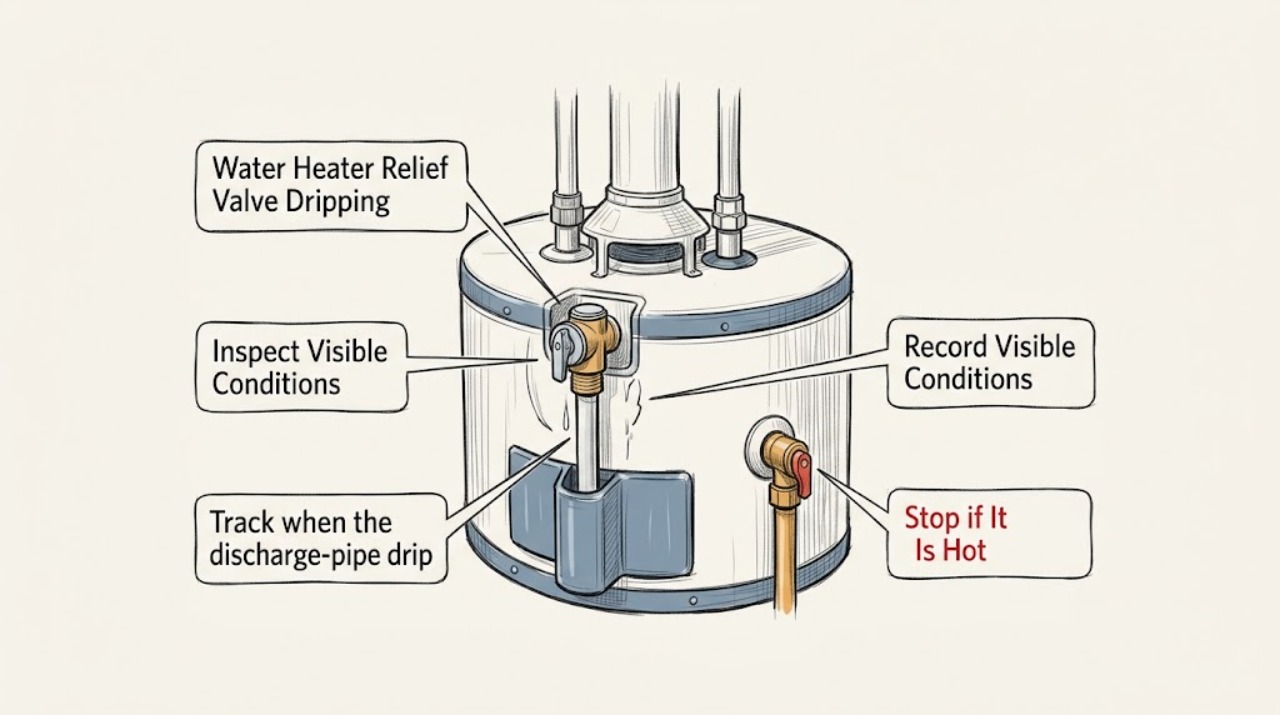
A water heater temperature-and-pressure relief valve that drips may be responding to thermal expansion or elevated supply pressure, especially when the dripping happens during a heating cycle after hot water use. Continuous dripping can also mean the valve is not seating, its connection is leaking, or the tank or controls have a separate fault. From a safe position, note where the water appears, whether it is a few drops or a large hot discharge, and when it happens. Do not cap, plug, tie open, remove, or repeatedly operate the relief valve. A qualified plumber should measure system pressure, evaluate any pressure-reducing or check-valve arrangement and expansion tank, and verify the valve and heater controls; a large hot discharge, rapidly worsening leak, excessive water temperature, gas odor, or water near electrical parts needs immediate escalation.
Before you begin
Safety first
- Pressure measurement, thermal-expansion diagnosis, pressure-reducing or expansion-tank work, relief-valve replacement, tank or fitting repair, and thermostat, gas, electrical, or safety-control diagnosis should be performed by a qualified plumbing or water-heater professional.
Work through in order
Diagnostic checks
Use only checks that match the exact appliance or system and its official guide.
-
Check 1
From a cool, dry position, identify the exact leak path without touching the valve, lever, discharge water, or nearby hot piping. Look for water at the end of the discharge pipe, around the valve threads or tank connection, at the tank shell, or on the floor, and note whether it is a few drops, a steady stream, or a large hot discharge.
Expected result: Water exits the discharge pipe, appears at a connection or tank surface, or is being discharged in a large or rapidly increasing volume.
Next step: Record the location, approximate pattern, heater type, and whether anyone recently used hot water. Keep clear and arrange qualified service; treat a large hot discharge, tank leak, or rapidly worsening flow as urgent.
Stop if: Stop immediately for scalding water, a burst or rapidly worsening leak, water contacting electrical equipment, gas odor, smoke, or a carbon monoxide alarm.
Why this matters
Why: Discharge-pipe water can indicate pressure or temperature actuation; a connection or tank-surface leak is a separate mechanical or tank problem. A large hot discharge raises concern for overheating or an active safety event rather than a minor pressure symptom.
-
Check 2
Track when the discharge-pipe drip occurs over one or two normal heating periods without changing the heater settings or operating the relief-valve lever. Note whether it follows hot-water use and appears while the heater is recovering, or whether it continues when no hot or cold fixture is being used and the heater is idle.
Expected result: The drip is limited to recovery periods, occurs after the system has been closed and unused, or continues at all times.
Next step: Give the timing pattern to a qualified plumber. Ask for system-pressure and expansion-control evaluation instead of treating the relief valve as a routine pressure regulator or replacing it based on timing alone.
Stop if: Do not hold the lever open, cap the discharge, block the outlet, or keep operating the heater to reproduce a leak.
Why this matters
Why: A recovery-linked pattern makes thermal expansion or supply-pressure changes more plausible, particularly in a closed system. Dripping at all times makes a valve-seat, valve-connection, or another leak more likely and does not prove that pressure is elevated.
-
Check 3
Inspect only visible plumbing around the heater for a pressure-reducing valve, check or backflow device, and thermal expansion tank, without loosening fittings or adjusting settings. If an existing pressure gauge is already installed and readable from a safe position, record its trend during ordinary use rather than installing a gauge or opening a drain valve.
Expected result: A closed-system device is present, the expansion tank is visibly damaged or waterlogged, the gauge rises noticeably during recovery, or no such clue is visible.
Next step: Have a qualified plumber measure static and heated pressure and verify the expansion-control arrangement, valve condition, and local requirements. Do not change a regulator setting or attempt to recharge or replace an expansion tank from this observation alone.
Stop if: Stop if a fitting is wet, corroded, hot, unstable, or under visible stress; do not loosen, drain, puncture, or pressurize any component.
Why this matters
Why: Check valves and pressure-reducing devices can prevent expanded water from moving back toward the supply, allowing pressure to rise; a damaged or incorrectly serviced expansion tank can fail to absorb that change. The absence of a visible device does not establish the plumbing design or the fault.
-
Check 4
Without removing covers or changing controls, observe the heater's normal display or external indicator if it has one, and note any unusually hot water reported at a faucet, overheating indication, or large discharge from the relief outlet. Do not test suspected overheating with bare skin or by repeatedly running the heater.
Expected result: Water is much hotter than usual, the heater shows an overheating or control alert, or a large amount of hot water is discharged; alternatively, temperature and indicators appear normal while only a small drip occurs.
Next step: Keep people away from the discharge and obtain qualified service promptly for overheating, an alert, or a large hot release. For a small drip with normal external indications, continue documenting the pattern and have pressure and valve operation evaluated.
Stop if: Do not open the heater cabinet, adjust gas or electrical controls, bypass a limit, or attempt to cool or drain a pressurized hot heater.
Why this matters
Why: Large hot discharge or excessive temperature makes a thermostat or other control fault more plausible than ordinary thermal expansion. Normal visible indicators do not rule out pressure, valve, or tank problems.
-
Check 5
Check the visible relief discharge line only for an open, downward-directed outlet and obvious damage, disconnection, cap, plug, or obstruction. Do not insert anything into it or re-route it; compare only with the heater manufacturer's installation instructions if the exact model information is safely available.
Expected result: The line is open and intact, or it is capped, blocked, disconnected, damaged, or routed so discharge could be trapped or directed at a person or electrical equipment.
Next step: Keep the heater out of normal operation when the safety discharge path is obstructed or unsafe and arrange qualified plumbing service. Provide photographs from a safe distance and the exact heater model if known.
Stop if: Never cap, plug, thread, clamp, tie open, remove, or disconnect the relief valve or its discharge line.
Why this matters
Why: A sound discharge path lets the safety valve relieve safely; an altered or obstructed path can hide or worsen a pressure event and is not a homeowner repair to improvise. An intact path does not explain why the valve is opening.
Use your observations
Decision map
Find the observation that best matches what you see, then follow the next safe action.
-
PATH 01Next step
What you see
Do this next
Have a qualified plumber measure pressure while the system is cold and recovering, then verify expansion-tank sizing and condition and the pressure-control arrangement. Do not use the relief valve as the expansion control.
Why this path and its safety boundary
Why it matters: Thermal expansion in a closed system or a pressure-control problem is more likely than a random discharge-pipe leak, although the relief valve may also have been weakened by repeated operation.
-
PATH 02Next step
What you see
Do this next
Keep the discharge path unobstructed and have a qualified plumber diagnose and replace the valve with the model- and system-appropriate part if needed after pressure and temperature causes are addressed.
Why this path and its safety boundary
Why it matters: A relief valve that is not seating, debris at the seat, or a worn valve is more likely; continuous dripping alone does not prove that the valve is the original pressure cause.
-
PATH 03Next step
What you see
Do this next
Keep clear, stop routine use of the heater, and obtain urgent qualified service. Do not reset, bypass, or open the heater to investigate the control.
Why this path and its safety boundary
Why it matters: An active temperature-control or heater safety problem is more likely than routine thermal expansion, with a scalding and equipment hazard.
-
PATH 04Next step
What you see
Do this next
Keep away from hot water and arrange qualified plumbing service. Do not tighten, remove, or reseal a hot or pressurized relief-valve connection yourself.
Why this path and its safety boundary
Why it matters: A connection seal, valve-to-tank joint, tank fitting, or tank failure is more likely than pressure relief through the outlet; a tank-shell leak can worsen quickly.
-
PATH 05Next step
What you see
Do this next
Do not operate or modify the valve or line. Keep the area clear and have qualified service restore a compliant, unobstructed discharge arrangement.
Why this path and its safety boundary
Why it matters: The safety discharge path is unsafe or altered, so the heater cannot be treated as a routine dripping-valve check even if the current flow is small.
Helpful context
Understand the symptom
The timing and location of the drip matter
A few drops from the discharge pipe during recovery can be a pressure symptom in a closed plumbing system, while a drip that continues after the heater is idle points more toward a valve that is not seating or a connection problem. Water around the threaded connection, tank fitting, or tank shell is a different leak path from water leaving the discharge pipe. Do not diagnose by touching the valve or the water; hot discharge can scald.
The relief valve is an emergency safety device
The relief valve is designed to release water when a temperature or pressure limit is reached, not to regulate routine thermal expansion. A dripping valve can be an early sign of pressure stress, and a discharge pipe must remain directed and unobstructed. The safe homeowner contribution is to document the pattern and visible conditions; pressure testing, expansion control, valve replacement, and heater-control diagnosis belong to qualified plumbing service.
Safety boundary
Stop conditions
- Stop and obtain urgent help for a large or rapidly increasing hot discharge, an overheating indication, a burst tank or pipe, flooding, or water contacting electrical equipment.
- Leave the area and follow emergency guidance for gas odor, smoke, fire, or a carbon monoxide alarm; do not operate switches near a gas or water hazard.
- Never cap, plug, clamp, tie open, remove, or disconnect the temperature-and-pressure relief valve or its discharge pipe.
- Do not open the heater cabinet, adjust gas, electrical, thermostat, pressure-reducing, or safety controls, loosen hot fittings, or drain a pressurized hot tank.
- Arrange qualified plumbing service for any persistent drip, abnormal pressure trend, damaged expansion-control device, connection or tank leak, altered discharge path, or uncertainty about the heater's safety operation.
Only after diagnosis
Potential parts
- temperature-and-pressure relief valve
Consider this only when a qualified professional confirms the valve is leaking or not seating after pressure, temperature, and connection causes have been evaluated.
The valve's temperature, pressure, connection, and certification must match the exact water heater and system; do not choose it from the drip symptom alone. - thermal expansion tank
Consider this only when pressure measurements and system design show thermal expansion in a closed system and a professional determines that expansion control is required or the existing tank has failed.
Sizing, precharge, location, and installation depend on the heater and supply system; confirm the design and local requirements before ordering. - water pressure-reducing valve
Consider this only if measured incoming or static pressure is above the safe range for the plumbing system and a qualified professional identifies pressure reduction as appropriate.
Pressure setting, flow capacity, connection, and code requirements are system-specific; a relief-valve drip does not establish that this part is needed.
When checks do not resolve it
Need a professional?
Contact a qualified plumber for any relief-valve drip that persists, returns during heating, appears at a connection or tank, accompanies abnormal pressure or temperature, or cannot be safely identified. Escalate urgently for a large hot discharge, rapid leak, flooding, or an unsafe discharge path.
Safety scope: Pressure measurement, thermal-expansion diagnosis, pressure-reducing or expansion-tank work, relief-valve replacement, tank or fitting repair, and thermostat, gas, electrical, or safety-control diagnosis should be performed by a qualified plumbing or water-heater professional.
Have this ready
- Provide the heater make and model if safely visible, the leak location, whether it exits the discharge pipe, the drip volume and timing, recent hot-water use, any existing pressure gauge reading or trend, expansion-tank or pressure-control observations, and photos taken from a safe distance.
Common questions
FAQ
Why is my water heater relief valve dripping only when the heater runs?
A drip limited to recovery after hot-water use can fit thermal expansion, particularly when a check or pressure-reducing device makes the plumbing a closed system. A plumber should confirm pressure and expansion control; the relief valve should not be used as routine pressure regulation.
Does a dripping relief valve always mean the valve is bad?
No. Pressure or thermal expansion, an overheating control, a leaking threaded connection, tank damage, or a valve that no longer seats can produce similar water. The drip's location, timing, volume, temperature, and measured pressure separate these possibilities.
Can I cap or plug the water heater relief-valve discharge pipe?
No. The discharge path is part of the heater's safety system and must remain unobstructed. Do not cap, plug, tie open, remove, or disconnect the valve or its pipe; have an unsafe installation corrected by a qualified professional.
Should I replace the relief valve first?
Not based on dripping alone. If pressure or thermal expansion is causing the valve to open, a new valve may continue to drip; if the valve is continuously leaking, a professional can verify pressure and temperature first and then select the correct replacement.
When is a dripping water-heater relief valve an emergency?
Treat a large hot discharge, sudden excessive temperature, rapidly worsening leak, flooding, water near electrical equipment, gas odor, smoke, or a carbon monoxide alarm as urgent. Keep clear, follow emergency guidance, and do not reset or open the heater to investigate.
Read the exact guide
Official sources
- LEAKING TEMPERATURE AND PRESSURE RELIEF VALVEA. O. Smith · Manufacturer technical bulletin describing relief-valve connection leaks, intermittent dribbling, large hot discharge, pressure actuation, and thermostat-related temperature discharge.
- THERMAL EXPANSIONA. O. Smith · Manufacturer technical bulletin used for recovery-linked dripping, check-valve or pressure-reducing-valve effects, pressure testing, expansion tanks, and the emergency-only role of the relief valve.
- Water Heater InformationCity of Phoenix · Municipal water-heater information used for the visible discharge-line safety checks; the heater manufacturer's instructions and applicable local code control a specific installation.
- Causes of High Water PressureCity of Troutdale, Oregon · Municipal public-works guidance explaining how heating in a closed system can raise pressure and how persistent discharge may indicate valve replacement needs.
Community feedback
Share a repair observation
Share a plain-text repair observation. Accepted observations are published automatically; this page may take a moment to update.