
On this page
Start here
Quick answer
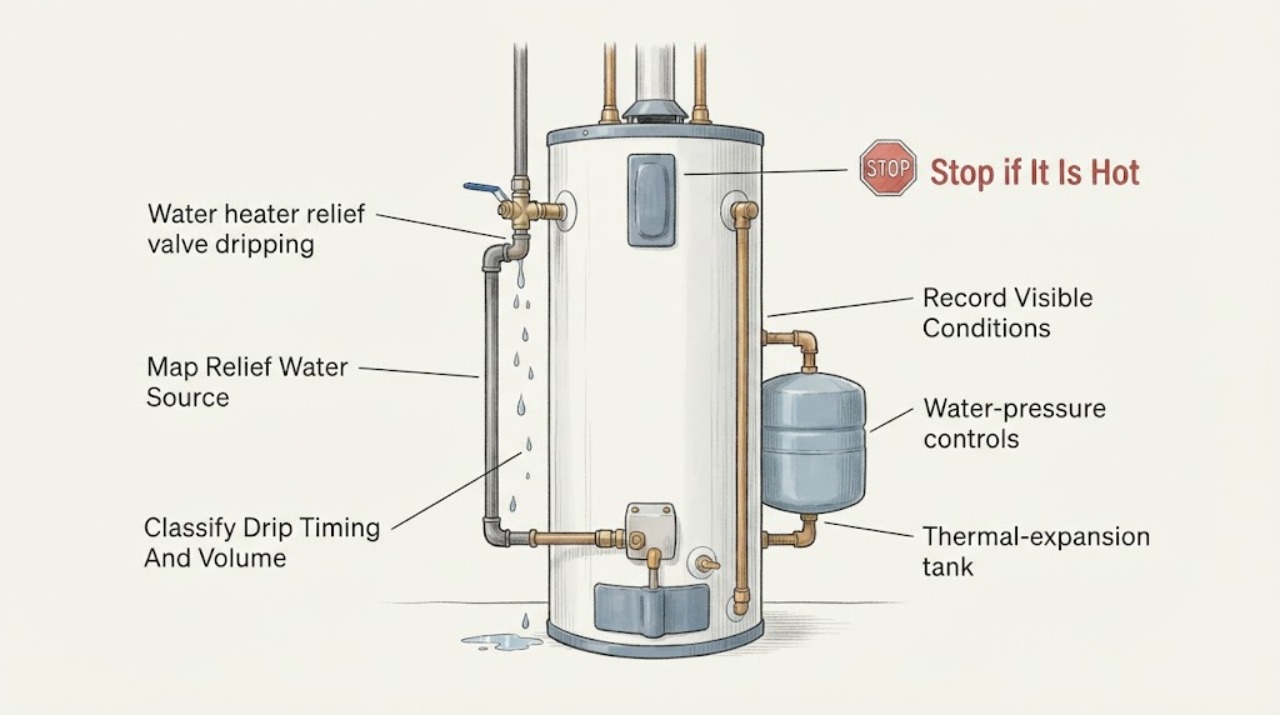
A temperature-and-pressure (T&P) relief valve that drips while a storage water heater recovers is commonly reacting to thermal expansion in a closed plumbing system, excessive supply pressure, debris at the valve seat, or a valve that no longer seals. A small drip still needs diagnosis; a large flow of very hot water, a rapid pressure rise, overheating, a leak from the tank, gas odor, smoke, or a carbon-monoxide warning is an urgent safety event. From a safe position, identify whether water is coming from the relief discharge pipe or the valve/tank connection, note whether it appears only during heating, and record any existing pressure indication without installing a gauge or adjusting anything. Never cap, plug, remove, or bypass the relief valve or its discharge pipe.
Before you begin
Safety first
- This article supports visual source mapping, recording drip timing and volume from a safe distance, reading visible status, and documenting existing pressure-control equipment. A qualified professional should measure pressure, inspect or replace the T&P valve, verify discharge piping, test expansion control, diagnose overheating, and work on hot, pressurized, gas, or electrical components.
Work through in order
Diagnostic checks
Use only checks that match the exact appliance or system and its official guide.
-
Check 1
From a safe, dry position, use a flashlight to trace where water first appears: at the end of the T&P discharge pipe, around the valve body or threads, at another fitting, or at the tank bottom; do not touch the water or relief lever.
Expected result: Water may be visible only at the discharge outlet, may track from the valve connection, may originate at a nearby inlet or outlet fitting, or may collect beneath the tank.
Next step: Photograph the source and keep the relief discharge unobstructed; arrange qualified plumbing service for any persistent drip, valve leak, tank-bottom water, or uncertain source.
Stop if: Stop immediately for hot spray, a large flow, steam, a wet electrical control, a gas odor, smoke, or a carbon-monoxide alarm.
Why this matters
Why: Water from the discharge path suggests the valve has opened or is not seating. A fitting or valve-body source points toward a connection or valve leak. Water from the tank bottom raises concern for tank failure; condensation or another appliance can mimic a heater leak and must be distinguished visually.
-
Check 2
Without operating the valve, record whether the drip begins only while the tank is recovering, continues when no hot or cold water is being used, stops after heating, or has become a steady or forceful discharge; keep people away from the outlet.
Expected result: The drip may correlate with each heating cycle, occur continuously, appear after a hot-water draw, or change from a few drops to a stream of hot water.
Next step: Write down the start and stop times and describe the volume to the plumber; do not test the valve by opening it or wait through a large discharge to collect more evidence.
Stop if: Treat a stream of very hot water, steam, rapid discharge, or a temperature-control fault as an urgent stop; do not approach the outlet or continue normal heater operation.
Why this matters
Why: A recovery-cycle pattern makes thermal expansion or excessive supply pressure more likely. A continuous drip after the cycle keeps a contaminated or worn valve, pressure condition, or expansion-control fault in the differential. A large hot discharge can indicate overheating and requires urgent professional attention.
-
Check 3
Look for an existing, clearly labeled pressure gauge on the home's water system and for an expansion tank or pressure-reducing/check device on the cold-water supply; record what is visible without installing, tapping, inflating, draining, or adjusting any component.
Expected result: There may be a visible pressure indication, an expansion tank, a backflow or check device, a pressure-reducing valve, or no identifiable expansion-control equipment.
Next step: Photograph labels and component placement and give them to a plumber; have the professional measure pressure under the exact operating conditions instead of applying a generic target.
Stop if: Do not loosen fittings, remove a valve, adjust a pressure-reducing valve, change an expansion-tank air charge, or connect a test gauge to a hot or pressurized port.
Why this matters
Why: A closed-system device or a pressure indication that changes sharply during recovery supports a thermal-expansion or supply-pressure investigation. A missing, leaking, damaged, or incorrectly configured expansion-control component also needs professional assessment. A visual presence does not prove that a tank is correctly sized or charged.
-
Check 4
Read the heater's external display, status light, or temperature indication and note any over-temperature, high-limit, fault, or lockout message; do not remove panels or raise the setpoint to see whether the dripping changes.
Expected result: The heater may show normal recovery, an overheating or high-limit condition, a fault, or no readable status; the water at the outlet may be merely warm or dangerously hot, but do not touch it to test.
Next step: Photograph the display or indicator and follow only the exact model's emergency shutdown instructions; arrange qualified service before using the heater when a fault, overheating, or abnormal discharge is present.
Stop if: Do not bypass a high-limit control, reset a recurring fault, operate the unit without a functioning relief valve, or change gas or electrical settings.
Why this matters
Why: A normal heating cycle with a small recovery-only drip keeps expansion or supply pressure likely. An over-temperature message or very hot discharge makes a temperature-control or safety fault possible and raises urgency. No status with a leak requires model-specific service rather than repeated resets.
-
Check 5
Record the heater brand, model, serial information, fuel type, age if known, recent plumbing work, water-softener or backflow equipment, expansion-tank history, valve replacement history, and whether the drip started after a heating or plumbing change.
Expected result: The history may show a new check valve or pressure reducer, a recently replaced relief valve, a long-standing expansion tank, recent water work, or a drip that began without any installation change.
Next step: Give the complete history, photos, timing, and status message to a licensed plumber; keep the discharge path open and avoid ordering a valve or expansion tank from appearance alone.
Stop if: Do not remove the relief valve, cap the discharge, substitute a valve with a different rating, or open the tank or gas/electrical service area.
Why this matters
Why: Changes to a closed supply system can expose a thermal-expansion problem, while a valve that drips after service may need inspection for debris, rating, installation, or damage. The model and system history are needed to select a safe, compatible valve or pressure-control repair.
Use your observations
Decision map
Find the observation that best matches what you see, then follow the next safe action.
-
PATH 01Safety boundary
What you see
A small drip comes from the discharge pipe only while the tank is heating, and the home has a check, backflow, softener, or pressure-reducing device that can close the water system.
Do this next
Arrange a plumber to measure supply and recovery pressure and verify the expansion-control arrangement; leave the relief path unobstructed.
Why this path and its safety boundary
Why it matters: Thermal expansion with inadequate or misconfigured expansion control or high supply pressure is more likely than a random pipe leak, but the T&P valve is still being activated and should not be treated as the fix.
Safety stop: Do not depend on the T&P valve for routine expansion, remove a check device, or adjust pressure controls without qualified diagnosis.
-
PATH 02Safety boundary
What you see
The discharge continues after the heating cycle or drips whenever the tank is idle, even when no hot or cold water is being used.
Do this next
Schedule qualified inspection of supply pressure, expansion control, valve condition, and discharge piping; do not repeatedly operate the lever in an attempt to flush it.
Why this path and its safety boundary
Why it matters: A persistent pressure condition, expansion-tank problem, debris at the valve seat, or a worn or damaged T&P valve is more likely than a one-time normal recovery event.
Safety stop: Stop for increasing flow, hot discharge, a damaged valve body, or any need to touch the valve or pressurized piping.
-
PATH 03Safety boundary
What you see
The T&P pipe releases a strong flow of very hot water, the heater indicates overheating, or the discharge is accompanied by steam or an unusual temperature condition.
Do this next
Stay clear of the outlet and use the clearly identified fuel or electrical shutoff only if it can be reached safely; obtain urgent qualified service and do not use the heater until cleared.
Why this path and its safety boundary
Why it matters: Overheating or a serious pressure event is possible. The relief valve is responding to a safety limit, and continued operation or obstruction could create an explosion or scald hazard.
Safety stop: Do not touch the discharge, cap or plug the pipe, reset the heater, remove the relief valve, or continue normal operation.
-
PATH 04Safety boundary
What you see
Water appears around the valve connection, another tank fitting, or the bottom of the tank rather than only at the open discharge outlet.
Do this next
Photograph the source, isolate water only when the shutoff is clearly identified and safe, protect nearby property, and arrange qualified plumbing inspection.
Why this path and its safety boundary
Why it matters: A threaded or piping leak, failed gasket, corrosion, or a leaking tank is more likely than thermal expansion alone. A confirmed tank leak can require replacement rather than a relief-valve adjustment.
Safety stop: Do not tighten or remove the relief valve, drain a hot tank, or energize a wet electrical heater.
-
PATH 05Safety boundary
What you see
The drip began after installation of a check valve, backflow preventer, softener, pressure reducer, expansion tank, or other plumbing change, or the visible pressure varies with heating.
Do this next
Have a plumber verify the system design, pressure during recovery, and expansion-tank condition and select any pressure-control repair; do not alter the recent installation yourself.
Why this path and its safety boundary
Why it matters: The system may now behave as a closed system or have pressure-control equipment that is incorrectly sized, charged, adjusted, or failing. The timing supports a system-pressure investigation but does not identify a part.
Safety stop: Do not remove backflow protection, change a pressure-reducing setting, or inflate or replace an expansion tank without system-specific instructions.
-
PATH 06Safety boundary
What you see
A gas odor, gas-leak sound, soot, smoke, exhaust odor, fire, or carbon-monoxide alarm occurs near a fuel-burning water heater while the valve drips.
Do this next
Leave immediately for suspected gas or carbon monoxide, get fresh air, and contact emergency or gas authorities from outside without operating electronics inside; arrange qualified inspection before re-entry or use.
Why this path and its safety boundary
Why it matters: This is a fuel or combustion emergency in addition to the water-pressure symptom. The appliance may expose occupants to fire or carbon monoxide.
Safety stop: Do not relight, reset, inspect the vent, operate the heater, or re-enter after a CO alarm until emergency responders or a qualified professional says it is safe.
Helpful context
Understand the symptom
A drip during heating is a clue, not a normal repair state
Water expands as it is heated. If a check valve, backflow preventer, softener, or pressure-reducing device makes the home's supply a closed system, that expansion can raise pressure and lift the T&P valve during recovery. The valve protects the tank; it is not a pressure-control device to be used routinely. The timing of the drip and the exact leak location help a plumber distinguish expansion from a valve, tank, or piping fault.
Find the source without touching hot discharge
Use a flashlight and a dry position to follow the discharge pipe visually. Water at the pipe outlet is different evidence from water at the valve threads, a nearby fitting, the drain valve, or the tank bottom. Do not put a hand under the outlet, lift the relief lever, loosen the valve, or block the pipe; the water may be hot and the opening must remain available for emergency relief.
The expansion tank is a diagnostic question, not a DIY pressure target
Note whether an expansion tank is installed on the cold-water supply and whether it is visibly damaged, leaking, or unsupported. Do not adjust its air charge or infer a correct setting from a generic number: the plumbing pressure, tank size, heater requirements, and local installation determine the proper service procedure. A plumber can measure pressure during recovery and verify the expansion-control arrangement.
Large hot discharge changes the urgency
A small intermittent drip and a strong flow of very hot water do not carry the same risk. A large discharge can indicate overheating or a serious pressure condition. Turn off the heater's fuel or electrical supply only if the control is clearly identified and safe to reach, stay clear of the discharge, and obtain qualified service. Never trade a leak for an obstructed relief path.
Safety boundary
Stop conditions
- Never cap, plug, remove, bypass, or obstruct the T&P relief valve or discharge pipe. A functioning, unobstructed relief path is a safety requirement, not a nuisance leak to hide.
- Stop immediately for a large flow of very hot water, steam, overheating, rapid pressure change, a tank-bottom leak, or water near electrical equipment. Stay clear and obtain urgent qualified help.
- Do not lift the relief lever, drain the tank, adjust the expansion-tank air charge, change a pressure-reducing setting, or install a pressure gauge as a generic homeowner test. Hot water and pressure can cause burns and property damage.
- For gas odor, a gas-leak sound, smoke, exhaust odor, fire, or carbon-monoxide alarm, leave as appropriate, contact emergency or gas authorities from outside, and do not operate the heater or nearby electronics.
- Arrange qualified plumbing service for any persistent drip, a valve or tank leak, a recovery-cycle discharge, a recurring relief event, a missing or damaged expansion-control component, or an uncertain source.
Only after diagnosis
Potential parts
- temperature-and-pressure relief valve
Consider this only when a qualified inspection confirms that the valve is contaminated, damaged, improperly rated, or no longer seals after pressure and temperature causes are addressed.
Match the heater's exact requirements, valve rating, connection, orientation, and discharge piping; never substitute, remove, or cap a relief device based on appearance. - thermal-expansion tank
Consider this only when the plumbing system is closed and a qualified professional confirms that an expansion tank is required, incorrectly sized, uncharged, or failed.
Sizing, system pressure, mounting, pre-charge, and installation location are system-specific; the tank must be serviced without disabling the relief path. - pressure-reducing or backflow/check device
Consider this only when measured supply pressure or a failed pressure-control device contributes to the relief event.
The plumber must verify local code, flow, pressure range, and interaction with the expansion tank; do not remove required backflow protection or change a setting as a test. - thermostat, high-limit, or temperature-control component
Consider this only when a qualified technician confirms overheating or a failed temperature-control or high-limit component.
Exact model, fuel type, electrical or gas control, and safety procedure matter; a hot discharge must not be managed by increasing or bypassing a control.
When checks do not resolve it
Need a professional?
Arrange a qualified plumbing or water-heater assessment for any T&P relief valve drip, especially when it repeats during heating, continues after recovery, or accompanies visible pressure changes. Treat a large discharge of very hot water, overheating, tank-bottom water, gas odor, smoke, exhaust concern, fire, or a carbon-monoxide alarm as urgent: stay clear, leave or isolate only if safe, and obtain emergency or qualified help before using the heater again.
Safety scope: This article supports visual source mapping, recording drip timing and volume from a safe distance, reading visible status, and documenting existing pressure-control equipment. A qualified professional should measure pressure, inspect or replace the T&P valve, verify discharge piping, test expansion control, diagnose overheating, and work on hot, pressurized, gas, or electrical components.
Common questions
FAQ
Is a dripping water-heater relief valve normal while the tank heats?
It can be a sign that thermal expansion or high supply pressure is opening the valve during recovery, but repeated dripping is not a condition to ignore. Have a plumber check the pressure-control and expansion arrangement and the valve itself; never block the discharge.
Can I cap the relief-valve discharge pipe to stop the drip?
No. Manufacturer safety guidance says not to cap or plug the relief valve or discharge pipe. The open path is needed if pressure or temperature becomes unsafe; arrange qualified service to find the cause.
Should I test the relief valve by lifting its lever?
Do not do this as a generic troubleshooting step. The discharge may be extremely hot, the valve may fail to reseat, and the exact manual must govern any maintenance test. Photograph and describe the drip and have a qualified professional inspect it.
What does a relief valve drip only during heating suggest?
That timing makes thermal expansion or excessive supply pressure more likely, particularly if a check valve, backflow preventer, softener, or pressure reducer creates a closed system. It does not prove that the expansion tank or relief valve is the failed part; a professional should measure pressure during recovery.
Read the exact guide
Official sources
- Carbon Monoxide Fact SheetU.S. Consumer Product Safety Commission · Government safety guidance applies to fuel-burning water heaters and is used only for the gas or CO emergency boundary.
- Technical Bulletin 51: Puddle on the FloorA. O. Smith / hotwater.com · Opened A. O. Smith bulletin used for distinguishing relief discharge from fittings, condensation, drain, element, and tank leaks; the exact heater manual controls service procedure.
- Safety Features in Tank Water HeatersAmerican Water Heaters · Opened manufacturer safety page used for the general role of the T&P valve and overheating boundary; it does not establish a setting or replacement for another heater.
- Technical Bulletin 45: Thermal ExpansionA. O. Smith / hotwater.com · Opened A. O. Smith technical bulletin used for the general mechanism and symptom timing; it does not set a generic pressure target or identify the user's heater system.
- Residential Gas Water Heater Use and Care Guide — TroubleshootingA. O. Smith / hotwater.com · Opened A. O. Smith gas water-heater guide used for documented relief-valve and discharge-pipe warnings; it does not identify the user's fuel type or model.
Community feedback
Share a repair observation
Share a plain-text repair observation. Accepted observations are published automatically; this page may take a moment to update.