
On this page
Start here
Quick answer
If hot water used to recover normally but now takes longer even though household demand has not changed, first determine whether the shortage is at every fixture or only one outlet, then identify the heater type and record what changed. A slower recovery can come from a failed heating element or thermostat, a burner or fuel or airflow problem, sediment or scale, colder incoming water, a leak, a mixing or fixture valve, a changed operating mode, or a tank that no longer matches the required recovery rate. Check only safe, visible items such as the model label, display or indicator, normal temperature or mode setting, obvious leaks, and fixture behavior. Do not open gas or electrical compartments, test live voltage, raise temperature to compensate, drain or flush a tank, or reset a safety as a guess. If the same demand now takes longer across the home, or the unit is leaking, tripping, locking out, making popping or hissing sounds, or showing an error, have a qualified water-heater professional test the heating source, controls, tank, and delivery path.
Before you begin
Safety first
- Owner checks are limited to safe observation, reading the label and user-facing controls, comparing more than one fixture, checking visible connections for leaks, and recording symptoms. A professional must handle gas or electrical diagnosis, live tests, tank draining or flushing, burner or element work, thermostat and sensor tests, relief and high-limit devices, mixing valves, and replacement decisions.
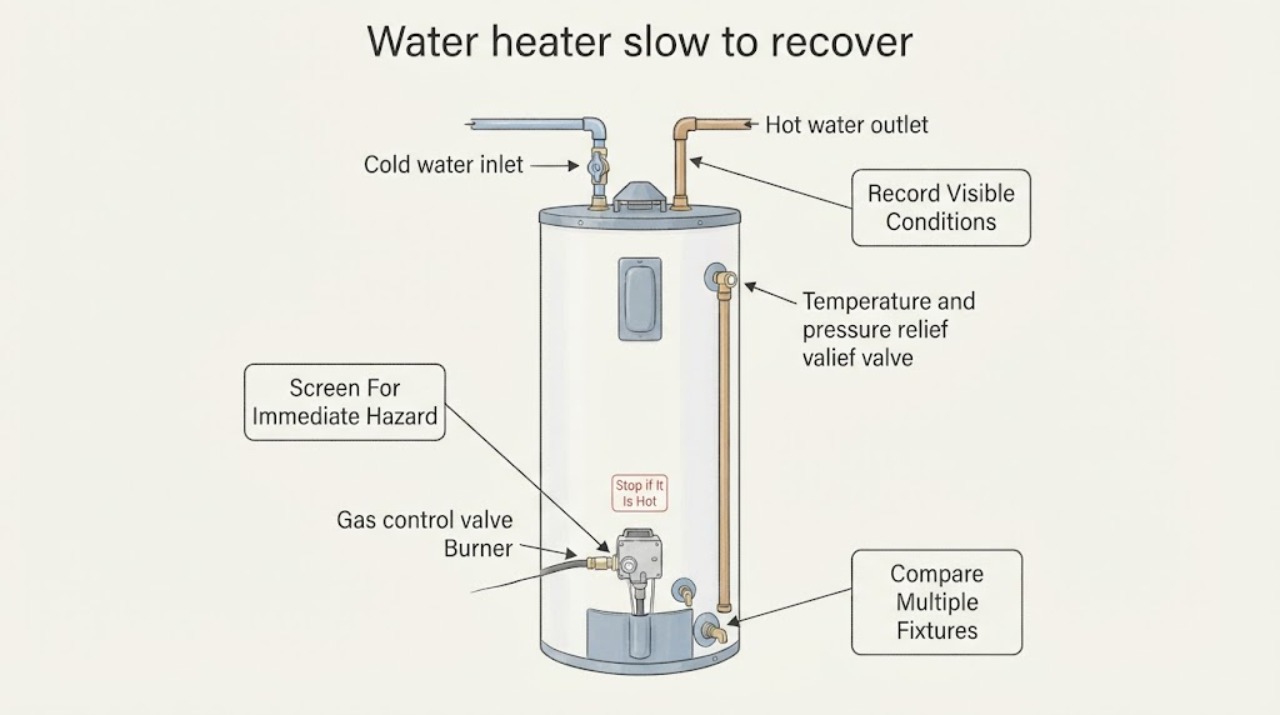
Work through in order
Diagnostic checks
Use only checks that match the exact appliance or system and its official guide.
-
Check 1
From a dry, stable position, check for gas odor, a carbon-monoxide alarm, smoke, flame or venting concern, hot spray or steam, fast flooding, or water touching electrical equipment. Do not touch the tank, burner, element covers, relief outlet, or hot piping.
Expected result: Record no immediate hazard, or record gas odor, an alarm, smoke, combustion concern, hot discharge, active flooding, exposed wiring, or water near electrical equipment.
Next step: For gas odor or a carbon-monoxide alarm, leave as appropriate and contact emergency services or the gas utility from a safe location. For smoke, hot discharge, electrical contact, or flooding, keep clear and arrange urgent qualified service. Do not restart the heater to test recovery.
Stop if: Stop immediately for gas odor, an alarm, smoke, hot spray or steam, uncontrolled water, or water reaching electrical parts.
Why this matters
Why: These conditions can involve fire, carbon-monoxide, scald, shock, or property-damage risk and are not routine recovery troubleshooting.
-
Check 2
Read the rating label and user-facing display from a safe, dry position and record gas, standard electric, heat-pump, or tankless type; tank size or capacity if shown; model and serial information; current mode and setpoint; and when the recovery slowdown began. Do not remove a panel to find the label or change a setting just to test it.
Expected result: The heater type and label are clear, the mode is vacation or energy-saving, a display shows an alert, the setpoint differs from the usual setting, or the type and controls cannot be identified safely.
Next step: Compare the normal user controls with the exact manual and return only an obviously changed user setting if the manual permits. If an alert appears or the type is unclear, document it and request qualified service.
Stop if: Stop if identification requires opening the heater, touching hot parts, entering a combustion compartment, or exposing wiring.
Why this matters
Why: Recovery depends on equipment type, capacity, heat source, and input, so the same symptom has different causes on gas, electric, heat-pump, and tankless units. A changed mode or setpoint may explain the symptom; an alert or unknown type needs model-specific guidance.
-
Check 3
Check hot-water behavior at two or more fixtures, such as a shower and a nearby sink, without running them long enough to create a new demand. Note whether the water is cooler than usual everywhere, whether only one outlet is affected, and whether temperature changes when another fixture runs.
Expected result: All tested fixtures have less hot water, only one fixture is affected, hot and cold mix changes when another fixture runs, or the water is normal at every fixture.
Next step: For a single-fixture symptom, arrange plumbing diagnosis at that fixture. For a whole-home slowdown, continue only with safe external checks and prepare for water-heater service; do not replace the heater based on one faucet.
Stop if: Stop for scalding, a leaking fixture or pipe, unstable temperature, or any need to open a faucet cartridge or mixing valve.
Why this matters
Why: A whole-home change keeps heater capacity, energy input, sediment, leak, and storage problems in consideration. A single-fixture problem points more toward a cartridge, mixing valve, local restriction, or long run; pressure interaction can mimic heater failure.
-
Check 4
Use only the normal user interface and visible indicators to check whether the heater has power, a normal operating display, a vacation or reduced-output mode, an error or lockout, or an obvious tripped household breaker. For gas equipment, do not relight, adjust, or inspect the burner unless the exact manual and a qualified professional direct it.
Expected result: The display is blank, a breaker is tripped, a mode is changed, an error or lockout is present, the normal indicator is active, or no user-facing clue appears.
Next step: Follow the exact manual for a user-visible mode or error, and reset a breaker only once when the area is dry and no fault sign is present. If the breaker trips again, a lockout returns, or the panel remains blank, stop and call qualified service.
Stop if: Stop for repeated breaker trips, burning odor, gas or venting concerns, a wet control, or any need to open a cover or measure live voltage.
Why this matters
Why: A blank display or breaker event can prevent heating; a changed mode can intentionally reduce recovery; an error or lockout can reflect a safety, sensor, burner, element, or control problem. A normal indicator does not prove that heating output is complete.
-
Check 5
From safe, accessible locations, look for hot-water leakage at visible heater connections, nearby piping, faucets, toilets, utility equipment, recirculation lines, and the floor around the tank. Listen for water flow when all fixtures are off, but do not remove insulation or open walls to chase a leak.
Expected result: There is no visible leak, a faucet or toilet runs, a pipe or connection is wet, the relief outlet is wet, the floor is damp, or water flow continues with all fixtures off.
Next step: Stop using a leaking fixture if its local shutoff is clear and safe. For heater, relief, concealed, or continuing leaks, close the heater water supply only if the correct valve is clearly identified and turns freely, then arrange qualified service; do not cap the relief path or tighten hot fittings.
Stop if: Stop for active flooding, hot or forceful discharge, water near electrical components, a concealed leak, or a valve that is seized or unclear.
Why this matters
Why: A hidden hot-water draw or leak can consume the heater's output even when household demand has not changed. Water at a relief outlet can involve temperature, pressure, expansion, or valve issues; a tank-body leak needs prompt professional evaluation.
-
Check 6
Note whether recovery worsened gradually, the heater makes new popping, rumbling, hissing, or sizzling sounds, water is cloudy or rusty, and maintenance or descaling has been deferred. Observe only; do not drain, flush, descale, remove elements, or open the burner compartment as a first response.
Expected result: The decline is gradual with scale signs, the tank or elements make new noises, water is discolored, maintenance is overdue, or no scale or maintenance clue is present.
Next step: Give the symptom and maintenance history to a qualified technician for a model-appropriate flush, descaling, element, burner, thermostat, sensor, or tank assessment. Do not use stop-leak chemicals or a guessed cleaning procedure.
Stop if: Stop for rumbling with overheating signs, a leak, hot discharge, gas or electrical access, or any task that requires draining or opening the heater.
Why this matters
Why: Sediment and scale can insulate the heat source, lengthen heating, reduce effective recovery, and damage elements or the tank. A lack of visible scale does not rule out a failed element, burner, thermostat, sensor, or mixing valve.
-
Check 7
Compare the unchanged household demand with the nameplate capacity and model documentation, and record the time from a normal draw until water is usable again without deliberately emptying the tank or raising the temperature. Include incoming-season temperature changes and whether the heater is tank, tankless, or heat-pump.
Expected result: The demand is within the historical pattern but recovery is slower, the unit is near its rated capacity, incoming water is colder, recovery is normal after a long wait, or the model data is unavailable.
Next step: If the pattern is new, whole-home, or persistent, stop owner troubleshooting and schedule qualified water-heater service. Provide the model, fuel or operating type, settings, fixture results, leak and noise observations, error history, and safe photos.
Stop if: Stop when the next step requires opening, draining, rewiring, gas testing, burner work, element testing, or changing a safety or pressure component.
Why this matters
Why: A capacity limit or colder incoming water can make recovery longer, but a new decline under unchanged demand points toward reduced heat input, scale, leakage, controls, or delivery mixing. Recovery is model-specific and should not be judged by an internet-wide time estimate.
Use your observations
Decision map
Find the observation that best matches what you see, then follow the next safe action.
-
PATH 01Next step
What you see
Multiple fixtures now run short of hot water, demand and user settings are unchanged, and the heater has no obvious active leak or immediate hazard.
Do this next
Book qualified water-heater diagnosis and provide the model, type, recovery timing, fixture results, noise history, and visible-indicator observations.
-
PATH 02Next step
What you see
The heater recovers normally at other fixtures, but one shower or faucet remains cooler or changes temperature when another fixture operates.
Do this next
Arrange plumbing diagnosis at the affected fixture before replacing the water heater. Do not disassemble a cartridge or mixing valve while hot or pressurized.
-
PATH 03Next step
What you see
Water is visible around the heater or piping, the relief outlet is wet, a fixture or toilet runs, or flow continues with all fixtures off.
Do this next
Keep clear of hot or forceful water, isolate only an unmistakable safe local supply valve if it turns freely, and call qualified service. Do not cap relief discharge or keep refilling to maintain hot water.
-
PATH 04Next step
What you see
Recovery declined gradually and the unit has popping, rumbling, hissing, sizzling, discolored water, hard-water history, or overdue maintenance.
Do this next
Have a qualified professional choose the correct flush, descaling, element, burner, or tank assessment for the model. Do not drain or open the unit as a guess.
-
PATH 05Next step
What you see
A breaker is tripped, the display is blank, a vacation or reduced-output mode is selected, or an error or lockout appears.
Do this next
Follow only the model's user-facing instructions. Reset a breaker once only when safe; a repeat trip, blank panel, or returning error requires qualified service.
-
PATH 06Next step
What you see
The heater performs consistently, no fixture or leak issue is found, and the unchanged demand approaches the documented capacity or occurs with colder incoming water.
Do this next
Compare with the model's recovery documentation and monitor. If this is a new change for the same demand, have the heating input and tank condition verified before considering a capacity change.
Helpful context
Understand the symptom
Recovery is a capacity and heat-input problem
Recovery is how quickly the heater can restore usable hot water after a draw. Bradford White describes it as a result of energy input and temperature rise that varies with tank capacity, heat source, and burner or element size. A household can keep the same habits while a weak element, burner, thermostat, sediment layer, colder incoming water, or leaking hot-water line reduces effective recovery. A larger heater is not the first conclusion when a previously adequate system changes behavior.
Separate a heater-wide shortage from a fixture problem
If every shower and faucet runs out sooner, investigate the heater, its energy input, storage, or a hidden hot-water draw. If only one shower or faucet is affected, a worn cartridge, thermostatic mixing valve, local restriction, or long pipe run can mimic slow recovery. A hot-water check at more than one fixture, performed without touching hot surfaces or opening the heater, can prevent an unnecessary part diagnosis.
A normal-looking control does not clear the heating system
A display or thermostat can look normal while one heating element, burner, sensor, or control has lost output. Conversely, a vacation or energy-saving mode, low setpoint, flow restriction, or mixing problem can reduce delivered temperature without a failed heater. Check the normal user settings and indicators against the model manual, then stop before removing covers or changing gas, electrical, or safety components.
Scale and leaks can make a gradual change look mysterious
Rheem explains that hard-water minerals form sediment or scale that acts as a barrier to heat transfer, making the unit run longer and recover more slowly. State also lists hot-water leakage and sediment or pipe scale among causes of insufficient hot water. A new popping or hissing sound, visible moisture, rusty or cloudy water, or a recovery decline that continues with unchanged demand is a reason for professional maintenance rather than repeated resets.
Safety boundary
Stop conditions
- Stop immediately for gas odor, a carbon-monoxide alarm, smoke, sparks, hot spray or steam, active flooding, exposed wiring, or water reaching electrical equipment; leave as appropriate and obtain urgent help from a safe location.
- Do not open gas or electrical compartments, test live voltage, remove a burner or element, drain or flush a tank, descale a heat exchanger, or reset a high-limit or safety device as a guess.
- Do not raise the temperature to compensate, cap or operate a relief valve, loosen hot or pressurized fittings, use stop-leak chemicals, or keep refilling a leaking heater without diagnosis.
- Stop part selection when the heater type, model, capacity, input, connection, or failure evidence is unknown; a changed recovery time alone does not establish a failed element, thermostat, burner, mixing valve, or tank.
Only after diagnosis
Potential parts
- electric heating element
Consider only for an electric heater when professional testing confirms reduced heating output or an open or grounded element and other causes are excluded.
Confirm exact model, element voltage, wattage, style, gasket, and safe power-isolation and draining requirements; do not infer fit from appearance. - thermostat or temperature sensor
Relevant only when measured temperature behavior or a model-specific fault indicates a thermostat or sensor is not controlling heating correctly.
Match exact model, fuel type, sensor location, control revision, temperature limits, and safety procedure; a setpoint that looks normal does not clear the component. - gas control valve, burner, or combustion-air service
Relevant only when a qualified technician confirms inadequate gas or burner input, combustion-air or venting trouble, or a failed gas control after safety checks.
Confirm exact model, fuel, input rating, approved conversion orifices, venting requirements, and local code; gas and combustion work is not an owner adjustment. - tankless heat exchanger or descaling service
Relevant only for a tankless unit when flow, temperature, and maintenance evidence support scale or heat-exchanger restriction and a professional confirms it.
Confirm exact model, flow requirements, water chemistry, approved descaling method, and isolation procedure; do not introduce chemicals without the model procedure. - thermostatic mixing valve or faucet cartridge
Relevant only when the heater recovers at other outlets and the symptom is isolated to one fixture or a mixing path is proven to reduce delivered temperature.
Identify the affected fixture or valve, exact model and connection, temperature limits, and cross-connection evidence before ordering; do not use a fixture part to mask a whole-home heater fault.
When checks do not resolve it
Need a professional?
Call a qualified water-heater professional when recovery is newly slow across the home despite unchanged demand, the heater leaks, the relief outlet is wet, a breaker trips or display is blank, an error or lockout returns, the unit makes new popping or hissing sounds, water is discolored, or diagnosis requires opening, draining, gas work, electrical testing, descaling, or safety-component work.
Safety scope: Owner checks are limited to safe observation, reading the label and user-facing controls, comparing more than one fixture, checking visible connections for leaks, and recording symptoms. A professional must handle gas or electrical diagnosis, live tests, tank draining or flushing, burner or element work, thermostat and sensor tests, relief and high-limit devices, mixing valves, and replacement decisions.
Have this ready
- Provide model and serial or nameplate information, fuel and heater type, capacity, mode and setpoint, recovery timing before and after the change, fixture comparison, incoming-season temperature context, visible leaks, noises, water appearance, display or breaker behavior, maintenance history, and safe photos.
Common questions
FAQ
Why is my water heater slow to recover if demand has not changed?
A heating element, thermostat, burner, sensor, scale, sediment, leak, mixing valve, operating mode, colder incoming water, or tank condition can reduce recovery without a demand change. Compare more than one fixture and record the pattern before selecting a part.
What does recovery mean on a water heater?
Recovery is how much hot water the unit can heat over time. Bradford White says it depends on energy input and temperature rise and varies with tank capacity, heat source, and burner or element size. Use the model documentation rather than a universal time estimate.
Can sediment make a water heater recover slowly?
Yes. Sediment or scale can insulate the heat source and lengthen heating. Popping, rumbling, hissing, or sizzling can support that possibility, but a professional should choose the model-appropriate cleaning and check for damaged elements, burners, or the tank.
Could a leak cause slow hot-water recovery?
Yes. A visible or concealed hot-water leak can continually consume heated water. Check only accessible, cool exterior areas for moisture and listen for flow with fixtures off. A heater, relief, concealed, or continuing leak needs qualified service.
Why is only one shower or faucet slow to get hot?
If other outlets recover normally, a local cartridge, thermostatic mixing valve, restriction, cross-connection, or long pipe run may be involved. Diagnose that fixture before replacing the water heater, and do not disassemble hot or pressurized plumbing as a first check.
Can colder incoming water slow recovery?
Yes. State notes that colder incoming water lengthens heating time, and seasonal changes can make an otherwise unchanged demand feel different. If the slowdown is much larger than the seasonal change or continues, check for heating, scale, leak, and control problems.
Should I turn up the water-heater temperature?
Do not raise the setting to compensate without the model instructions and scald-risk review. A higher setting can hide a failed heating component and increase burn risk. Have the system diagnosed if recovery changed under the same demand.
How do I know whether an electric element is bad?
A slow recovery or some hot water does not identify an element. A qualified technician should isolate power and test the element, thermostats, wiring, tank condition, and controls. Do not remove an access panel or use a meter on energized parts.
How do I know whether a gas burner is causing slow recovery?
A burner, gas supply, combustion air, venting, or gas-control issue can reduce heat input, but it requires qualified combustion diagnosis. Do not adjust gas pressure, relight repeatedly, remove the burner, or alter venting to test recovery.
What should I give the water-heater technician?
Provide the model and nameplate details, fuel and type, capacity, current mode and setting, old and new recovery timing, fixture comparison, leak and noise observations, water appearance, display or breaker behavior, and maintenance history. Safe photos are useful; do not open the unit to obtain them.
Read the exact guide
Official sources
- What Is Hard Water?Rheem Manufacturing Company · Manufacturer explanation of scale reducing heat transfer, lengthening recovery, causing noise, and degrading heating components
- What does "recovery" mean for my water heater?Bradford White Water Heaters · Manufacturer FAQ explaining recovery as heated volume over time and its dependence on capacity, heat source, and burner or element input
- TROUBLESHOOTING CHECKLISTState Water Heaters · Manufacturer checklist covering recovery period, colder incoming water, leaks, sediment or scale, power, relief leakage, and qualified service when a malfunction cannot be corrected
- Why Hot Water Feels Inconsistent Throughout the DayRheem Manufacturing Company · Manufacturer explanation of unchanged-demand temperature issues, recovery, colder inlet water, worn heating components, scale, and fixture mixing
- When to Repair or Replace Your Water HeaterState Water Heaters · Manufacturer information distinguishing undersizing, thermostat, element, leak, noise, recovery-rate, and fixture considerations
Community feedback
Share a repair observation
Share a plain-text repair observation. Accepted observations are published automatically; this page may take a moment to update.