
On this page
Start here
Quick answer
A water heater that eventually makes hot water may be working normally for a demand that exceeds its stored capacity, or it may be recovering slowly because of cold incoming water, a low setting or restricted operating mode, sediment, a leak or mixing-valve problem, a weak heating element or thermostat, or reduced gas, airflow, or electrical output. First determine whether the delay occurs only after heavy use, at every fixture, or even with little use. Check the model manual, visible leaks, operating mode, breaker or status display, and safe external airflow or filter items. Do not open gas controls, energized covers, burner compartments, or hot drain paths; persistent slow recovery, repeated safety trips, leaks, unusual combustion, or water that never reaches normal temperature needs qualified service.
Before you begin
Safety first
- A professional should diagnose and repair heating elements, thermostats, thermistors, burner and gas controls, electrical wiring, energy cutoffs, internal leaks, relief devices, sediment-heavy tanks, heat-pump refrigerant components, and sizing or capacity concerns. Keep homeowner work to fixture comparisons, external status checks, accessible filter care when documented, and visible leak observations.
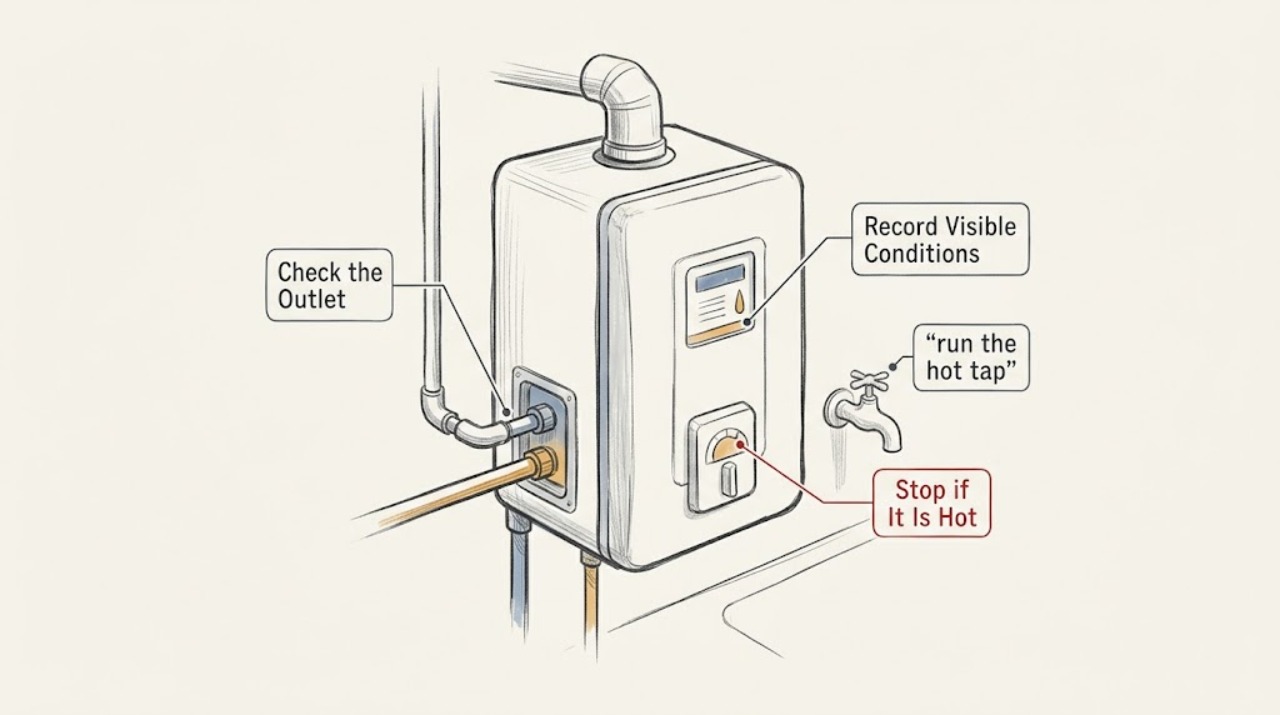
Work through in order
Diagnostic checks
Use only checks that match the exact appliance or system and its official guide.
-
Check 1
Stop the test if water is scalding, leaking near electricity, the unit smells of gas or burnt wiring, smoke or combustion fumes are present, a relief outlet is discharging, or a safety reset keeps tripping; isolate the appliance only as its manual permits.
Expected result: There is an immediate heat, water, gas, electrical, combustion, or repeated safety-trip hazard, or the appliance is safe to observe from outside.
Next step: Leave the unit out of service as appropriate and use emergency or qualified help for gas odor, smoke, combustion fumes, active flooding, or scalding discharge. Otherwise let hot components settle and continue with external observations only.
Why this matters
Why: A slow recovery complaint becomes a safety or damage problem when hot water is uncontrolled, fuel or electrical parts are abnormal, or a protective control will not stay reset.
-
Check 2
Record the water-heater type, model, operating mode, temperature setting as shown in the manual or control, time of the last heavy hot-water use, and how long it takes for several fixtures to return to normal temperature.
Expected result: The delay occurs only after unusually heavy or back-to-back use, occurs after ordinary use, or occurs even when there has been little recent demand.
Next step: Compare the pattern with the exact model's documentation and keep a simple demand-and-recovery log. Do not raise the temperature beyond the manual or use a larger setting as a substitute for diagnosis.
Why this matters
Why: A delay limited to a large demand makes stored capacity, first-hour capability, usage pattern, or cold inlet water more likely. A delay after ordinary or light use makes an output, control, leak, mixing, or heat-transfer fault more likely.
-
Check 3
After the unit has had time to recover, run the hot tap at more than one fixture and compare temperature and flow, without changing a cartridge, mixing valve, or supply connection during the test.
Expected result: All fixtures are similarly lukewarm, only one fixture is affected, hot flow is weak but cold flow is normal, or the tank or unit is hot while a fixture remains lukewarm.
Next step: If only one fixture fails, arrange fixture-side plumbing diagnosis before replacing heater parts. If all fixtures fail, continue with the heater status, leak, and heating-output checks.
Why this matters
Why: A whole-home temperature issue keeps the heater, hot-water leak, control, or supply side in focus. A single fixture or weak hot-only flow points more toward a mixing valve, cartridge, cross-connection, restriction, or hot-side plumbing issue.
-
Check 4
Inspect accessible hot-water pipes, faucets, toilets with hot-water connections where applicable, tank or unit fittings, the floor below the heater, and any condensate or drain area for dripping, dampness, staining, corrosion, or unexplained water use.
Expected result: A hot-side faucet or pipe drips, water is present around the tank or fittings, a relief or drain path shows discharge, or all accessible areas are dry.
Next step: Stop relying on the heater if water is actively escaping, protect the area without blocking a relief discharge, and arrange qualified plumbing service. If no leak is visible, continue with model-specific performance checks.
Why this matters
Why: A leak can continuously consume newly heated water and make recovery appear slow. A relief or tank leak can also create damage risk. Dry surfaces reduce but do not eliminate the possibility of a concealed or internal leak.
-
Check 5
Check the display, indicator lights, operating mode, and electrical panel from the outside; for a heat-pump model, clean only the accessible air filter and confirm the surrounding airflow space matches the manual, without opening electrical covers.
Expected result: The unit is in vacation or reduced-output mode, the display is blank, a breaker or energy-cutoff indication is present, a heat-pump filter is visibly dirty, an error returns, or controls and airflow appear normal.
Next step: Restore only a clearly documented user mode or accessible filter condition, then perform one attended recovery check. Do not repeatedly reset a breaker or safety cutoff; persistent errors, trips, a blank display, or abnormal heat-pump operation need service.
Why this matters
Why: A mode, power, safety cutoff, dirty filter, or airflow restriction can reduce or stop heating even though the unit eventually produces some hot water. A normal external status does not rule out a failed element, thermostat, sensor, compressor, burner, or control.
-
Check 6
Listen and look during a normal heating cycle from outside the appliance for popping or rumbling, unusually long or repeated cycles, no burner or element activity when the manual indicates a call for heat, or unusual fan and compressor behavior on a heat-pump model.
Expected result: Popping or rumbling accompanies the delay, the unit cycles normally but recovers slowly, the heat source does not appear to engage, or a harsh, repeated, or abnormal sound occurs.
Next step: Do not remove panels, test live voltage, adjust gas parts, or dismantle the burner or heat source. Arrange qualified water-heater service when the sound or heating activity is abnormal or the delay persists after safe external checks.
Why this matters
Why: Popping or rumbling supports sediment or scale around the heat source. A normal-looking but weak cycle can reflect a worn element, thermostat, sensor, burner, input, or capacity issue. No heat-source activity or abnormal mechanical sound shifts the problem toward a control, fuel, electrical, compressor, fan, or safety fault.
-
Check 7
After one controlled period of normal household use, compare the recovery log with the previous result and check whether the water eventually becomes fully hot, remains lukewarm, or becomes hot only after the demand stops.
Expected result: Recovery is normal with spaced demand, remains slow but eventually reaches the prior temperature, gets progressively slower, or never reaches the normal temperature.
Next step: Use the model manual and log to decide between demand management and service. Schedule qualified diagnosis for progressive decline, persistent lukewarm water, unusual noise, leaks, or any fuel, electrical, or safety indication.
Why this matters
Why: Normal recovery with spaced demand supports a capacity or usage mismatch. A stable but slow pattern can reflect cold inlet water, sediment, reduced input, or aging components. Progressive decline or failure to reach normal temperature supports a worsening fault rather than a one-off demand peak.
Use your observations
Decision map
Find the observation that best matches what you see, then follow the next safe action.
-
PATH 01Next step
What you see
The heater reaches normal temperature after one large or closely spaced demand, but recovers acceptably when use is spread out and all fixtures behave alike.
Do this next
Compare household demand with the model's capacity and recovery documentation, stagger high-use fixtures, and have a professional evaluate sizing if the pattern no longer fits the household.
Why this path and its safety boundary
Why it matters: The heater may be operating as designed while the demand exceeds its stored capacity or recovery capability; a failed part is less likely from this pattern alone.
-
PATH 02Next step
What you see
Recovery is slow after ordinary use, has worsened over time, and the tank makes popping or rumbling sounds or hot water is cloudy or rusty.
Do this next
Follow the exact Rheem maintenance procedure only if the drain path and shutoff process are clearly safe; otherwise arrange a professional flush, inspection, or descaling.
Why this path and its safety boundary
Why it matters: Sediment, scale, or corrosion is more likely to be reducing heat transfer or damaging the tank and heating components.
-
PATH 03Next step
What you see
All fixtures stay lukewarm, the display is blank or reports a fault, a breaker or energy cutoff trips, or the heat source does not engage normally.
Do this next
Keep the unit off if a safety device trips or any electrical, fuel, or combustion concern is present, and arrange qualified water-heater service. Do not open covers or keep resetting it.
Why this path and its safety boundary
Why it matters: An electrical element, thermostat, sensor, control, fuel, burner, airflow, or safety fault is more likely than a simple capacity limit.
-
PATH 04Next step
What you see
Only one shower or faucet remains lukewarm or has weak hot flow while other fixtures are hot after the heater has recovered.
Do this next
Have the affected fixture or branch checked by a plumber before replacing heater components.
Why this path and its safety boundary
Why it matters: A mixing valve, cartridge, cross-connection, local restriction, or hot-side fixture problem is more likely than slow heater recovery.
-
PATH 05Next step
What you see
The heater never reaches normal temperature, recovery becomes progressively slower, water leaks from the tank or fittings, or a relief or drain path discharges.
Do this next
Leave the unit out of service as appropriate, control only the clearly identified external shutoffs if safe, and arrange qualified service.
Why this path and its safety boundary
Why it matters: A failed heating component, thermostat, severe scale, tank or plumbing leak, relief issue, or another condition requiring inspection is more likely than a temporary demand peak.
Helpful context
Understand the symptom
Recovery is not the same as hot water arriving late
Recovery describes how quickly the heater restores usable hot water after demand. A long wait at one distant faucet can instead be a plumbing-run or fixture issue, while a tank that becomes hot again only after a large shower load is a capacity or recovery question. Test more than one fixture and note whether the tank or unit itself is actually reheating.
Start with demand, heater type, and the manual
Tank, tankless, electric, gas, and heat-pump models do not recover in the same way. Compare the complaint with the rating and operating guidance for the exact model, including its mode, capacity, and expected demand. A larger-than-usual household load, consecutive showers, laundry, or cold seasonal inlet water can expose a capacity limit without proving a failed part.
Sediment and restricted heat transfer can make the delay worsen gradually
Mineral buildup can insulate the tank bottom or coat heating elements, forcing longer cycles. Popping or rumbling, cloudy or rusty hot water, rising energy use, and progressively longer recovery support a sediment or scale path. Flushing, descaling, or opening a drain can release scalding water or expose a fragile valve, so follow the exact manual and use a professional when the procedure or condition is uncertain.
A fixture can imitate a slow water heater
A thermostatic mixing valve, shower cartridge, cross-connection, leaking hot faucet, reversed connection, or a restricted hot outlet can make one tap feel lukewarm even when the heater has recovered. Compare several hot taps after the same waiting period. A whole-home problem points back toward the heater, supply, or a plumbing leak; a single-fixture problem usually needs a fixture-side diagnosis.
Keep fuel, electrical, and sealed components professional
External observations can include a blank display, a tripped breaker, an error message, a dirty accessible heat-pump filter, blocked airflow around a heat-pump unit, unusual noise, or visible water. Do not remove electrical access panels, adjust gas pressure or burner parts, open a combustion compartment, defeat an energy-cutoff device, or replace an element or thermostat based only on the symptom.
Safety boundary
Stop conditions
- Stop and arrange qualified service if water leaks from the tank or fittings, a relief or drain path discharges, the water is unexpectedly scalding, or flooding is possible.
- Do not remove electrical access covers, test live voltage, open a gas control or burner compartment, adjust gas pressure, bypass an energy cutoff, or replace an element, thermostat, sensor, or mixing valve based only on slow recovery.
- Stop repeated resets if a breaker, energy cutoff, error, or safety control trips again. Gas odor, smoke, combustion fumes, or a carbon-monoxide alarm requires leaving the area as appropriate and using emergency or qualified help.
- Do not drain or flush a hot tank, operate a relief valve, or loosen a drain fitting unless the exact model procedure, temperature, discharge route, and shutoff conditions are understood and safe; use a professional when any part is uncertain.
Only after diagnosis
Potential parts
- electric heating element
Consider this only after a qualified diagnosis confirms reduced electric heating output; slow recovery can instead be demand, sediment, thermostat, power, or plumbing related.
Match the exact model, element type, voltage and wattage, gasket, access procedure, and manufacturer service instructions. - water-heater thermostat or temperature sensor
Consider this only when temperature control, a diagnostic code, or a qualified test points to a thermostat or sensor fault.
Match the exact model, sensor location, control platform, wiring, and safety-reset requirements; do not bypass a cutoff. - thermostatic mixing valve
Consider this when only one outlet is lukewarm or the tank is hot but delivered temperature is low, after ruling out a local cartridge or cross-connection.
Confirm the installed valve, connection size, temperature range, flow direction, and local plumbing configuration before replacement. - water-heater burner or gas control assembly
Consider this only after qualified testing finds inadequate combustion or heat input; gas, venting, and burner work is not a homeowner adjustment.
Use only the exact approved model-specific part and installation procedure through a qualified professional. - water-heater anode rod
Consider this during professional maintenance when corrosion, water-quality symptoms, or the model schedule support inspection; it is not a direct cure for every slow-recovery complaint.
Match tank model, length, diameter, thread, clearance, and manufacturer guidance.
When checks do not resolve it
Need a professional?
Safety scope: A professional should diagnose and repair heating elements, thermostats, thermistors, burner and gas controls, electrical wiring, energy cutoffs, internal leaks, relief devices, sediment-heavy tanks, heat-pump refrigerant components, and sizing or capacity concerns. Keep homeowner work to fixture comparisons, external status checks, accessible filter care when documented, and visible leak observations.
Common questions
FAQ
Why does my water heater eventually recover but take too long?
A heavy demand may exceed the unit's stored capacity, but slow recovery after ordinary use can point to cold inlet water, sediment, a leak, low output, a weak element or thermostat, a reduced mode, or fuel, airflow, or control trouble. Compare several fixtures and the model guidance before choosing a repair.
How can I tell whether the problem is capacity or a failing water heater?
If the heater recovers normally when large demands are spaced out and all fixtures behave alike, capacity or usage is more likely. If recovery is slow after ordinary use, worsening, accompanied by noise, leaks, errors, or a safety trip, arrange professional diagnosis.
Can sediment make a Rheem water heater recover slowly?
Yes. Rheem explains that mineral sediment or scale can insulate the heat source, extend heating cycles, and cause longer recovery, often with popping or rumbling or water-quality changes. Follow the exact tank or tankless maintenance procedure and use a professional if the drain, valve, temperature, or condition is uncertain.
Why is one faucet lukewarm when the water heater has recovered?
A shower cartridge, thermostatic mixing valve, cross-connection, local restriction, reversed connection, or hot-side leak can affect one fixture while the heater is hot. Compare more than one fixture and have the affected branch checked before replacing heater parts.
When should I stop troubleshooting slow recovery?
Stop for leaks, relief discharge, scalding water, gas or combustion warnings, a blank display, repeated breaker or safety trips, persistent errors, unusual burner or electrical behavior, or water that never reaches normal temperature. Keep the unit safe and arrange qualified service rather than opening covers or bypassing protection.
Read the exact guide
Official sources
- Residential Electric Water Heater Use and Care GuideA. O. Smith · A. O. Smith residential electric and heat-pump water-heater guide used as general manufacturer troubleshooting context; do not infer the exact Rheem procedure or part
- What does recovery mean for my water heater?Bradford White Water Heaters · General manufacturer definition; exact recovery depends on the installed model and household demand
- How Long Does It Take a Water Heater to Heat Up?A. O. Smith · General A. O. Smith residential water-heater guidance; exact Rheem performance depends on type, model, installation, and demand
- Is Your Hot Water Not Getting Hot? Common Causes & What To Do About ThemA. O. Smith · General manufacturer guidance for A. O. Smith electric and gas water heaters; use only as diagnostic context for a Rheem unit
- Heat Pump Water Heater Maintenance: Complete Rheem Care Guide & TroubleshootingRheem · Rheem heat-pump water heaters; use the exact manual for other Rheem types and models
- How Often To Flush Your Water Heater (And How To Do It)Rheem · Rheem tank water-heater maintenance guidance; tankless units use different descaling procedures and all models require their manual
- What Is Hard Water?Rheem · Rheem water-heater guidance for mineral-heavy water; exact maintenance and descaling requirements depend on heater type and model
Community feedback
Share a repair observation
Share a plain-text repair observation. Accepted observations are published automatically; this page may take a moment to update.