
On this page
Start here
Quick answer
Hot water that runs out quickly and takes too long to return can be caused by unusually high demand, an undersized or incorrectly configured heater, sediment that insulates the heat source, a failed heating element or thermostat, a burner or gas-supply problem, a damaged dip tube, or a mixing valve or plumbing leak that makes usable hot water disappear. First compare the temperature at more than one fixture and record when the water turns lukewarm, then check only safe exterior controls, the normal electric breaker or gas status, visible leaks, and obvious changes in demand. Do not open electrical covers, test live circuits, open gas controls, raise the temperature beyond the model instructions, or flush or descale a tank without a safe model-specific procedure. If recovery remains slow at normal demand, a component fault, sediment, sizing issue, or plumbing problem needs qualified diagnosis; smoke, gas odor, a tank leak, unstable temperature, or water near electrical parts is a stop-use condition.
Before you begin
Safety first
- This article supports ordinary-access observation of demand, fixtures, exterior controls, visible leaks, and visible maintenance signs. Do not open electrical or gas compartments, perform live measurements, drain or descale a tank, alter safety controls, or dismantle plumbing or venting.
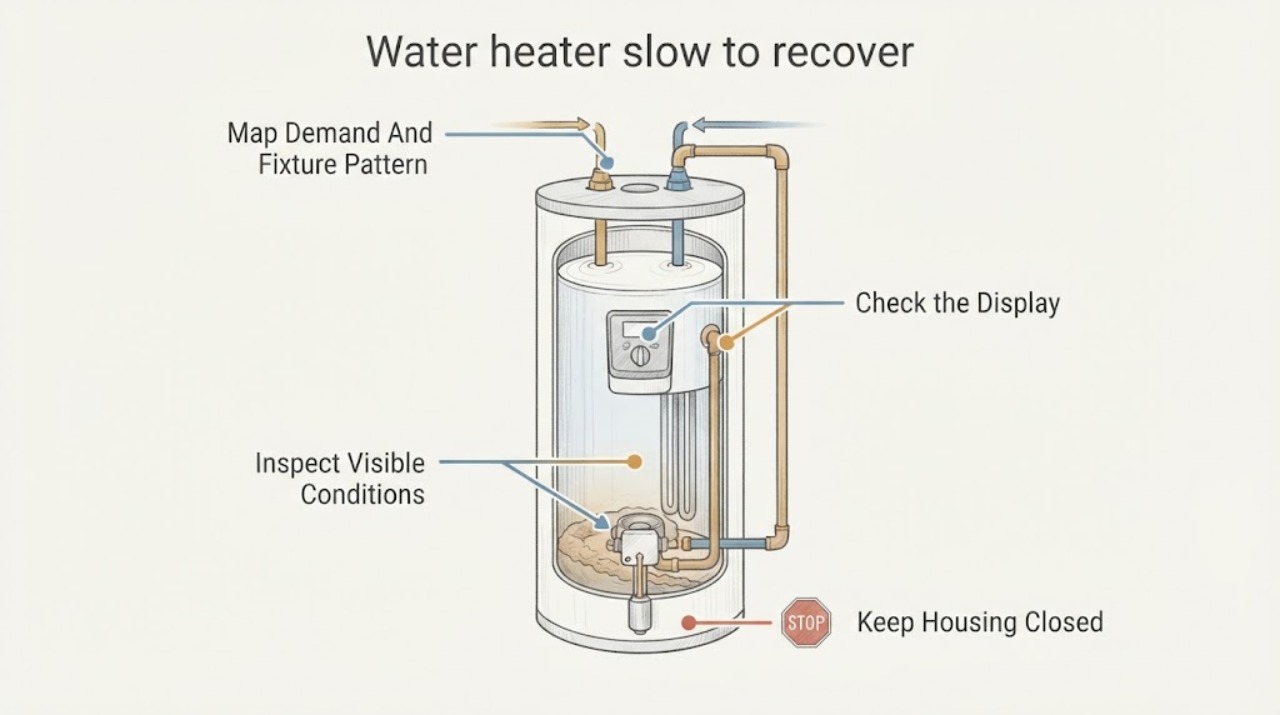
Work through in order
Diagnostic checks
Use only checks that match the exact appliance or system and its official guide.
-
Check 1
For one normal use period, note how many people or fixtures use hot water, whether showers, laundry, or dishwashing overlap, and compare a cautious hot-water check at two or more fixtures. Record when the water changes from hot to lukewarm and whether every fixture is affected.
Expected result: Hot water returns after a long demand pause, runs out only during overlapping use, is lukewarm at every fixture, or is cold at only one fixture.
Next step: Record the demand, fixture pattern, and recovery behavior before changing any setting. If normal demand now produces a faster or more severe shortage than before, use the heater-specific checks and arrange service if it persists.
Stop if: Stop for scalding or unstable temperature, a leak, water near electrical parts, smoke, gas odor, or a need to open a wall or appliance.
Why this matters
Why: A demand-linked shortage can be normal recovery or a capacity mismatch. A problem at every fixture points toward the heater or common piping; one cold fixture points toward its faucet, mixing valve, crossover, or branch plumbing.
-
Check 2
Identify whether the heater is electric, gas-fired, tankless, or a heat-pump model. From the exterior, check the normal breaker or disconnect position for an electric unit, or the normal control display, pilot, and burner viewing area for a gas unit; verify the unit is not in a vacation, disabled, or low-demand mode. Do not remove covers or alter gas controls.
Expected result: The breaker is tripped, the display is dark or faulted, the gas pilot or burner is absent or unstable, a non-heating mode is selected, or the exterior status appears normal.
Next step: Use only a single user-level mode or breaker reset that the exact manual permits, without opening the unit. If the breaker trips again, a gas flame will not remain stable, a fault returns, or the heater remains slow, leave it for qualified service.
Stop if: Do not repeatedly reset a breaker or safety device, open electrical or burner covers, measure live circuits or gas pressure, or bypass a flame or thermal safety.
Why this matters
Why: A supply interruption, non-heating mode, or burner or pilot fault can explain slow recovery. Normal exterior status does not rule out a failed element, thermostat, sensor, gas-control, or other internal fault.
-
Check 3
From safe exterior access, note rumbling or popping during heating, rusty or cloudy water, visible mineral scale at fixtures, a longer heating cycle, rising energy use, or whether the tank or tankless unit has missed its model-specific maintenance. Do not drain, open, or descale the heater solely from these observations.
Expected result: Noise and scale signs accompany slow recovery, maintenance is overdue or unknown, or recovery slowed without noise or visible scale.
Next step: Give the signs and maintenance history to a qualified technician. Request the model-appropriate flush or descaling decision, especially when the drain valve, burner, element, gas line, or heat exchanger would need to be handled.
Stop if: Do not open the relief valve or drain valve, remove elements, clean a burner, or descale a tankless heat exchanger without the exact safe procedure and ability to restore the appliance correctly.
Why this matters
Why: Sediment or mineral scale can insulate a tank bottom or element and reduce heat transfer, making recovery longer and stressing heating parts. Without those signs, a control, element, burner, sensor, capacity, or plumbing cause remains possible.
-
Check 4
Look for a faucet, shower, appliance, or hot-water recirculation path that is continuously drawing or leaking, and inspect the floor, drain pan, tank base, hot outlet, and accessible pipe joints for moisture. Compare hot and cold flow at a sink without touching hot fittings or a relief discharge.
Expected result: A hot fixture runs continuously, water is pooling or dripping, hot water is available at the tank or another fixture but not one outlet, or no visible delivery issue is found.
Next step: Close only an accessible fixture that is safe to operate and photograph any leak from a dry position. Arrange plumbing service for a persistent leak, one-fixture temperature problem, or any unexplained hot-side loss.
Stop if: Do not cap a relief discharge, force a shutoff, remove a mixing valve, open a wall, or continue operating a tank that leaks from its body or base.
Why this matters
Why: An open fixture or hot-side leak can consume stored hot water. Hot water at the tank but not at one outlet points toward a mixing valve, faucet, crossover, reversed connection, or branch restriction. A tank-base leak is a separate urgent condition, not a recovery adjustment.
-
Check 5
Compare today's shortage with the same household demand before the problem began and record the heater's size, age, fuel type, recovery setting or mode, recent installation or plumbing changes, incoming-water season, and whether the unit ever fully recovers between uses.
Expected result: The shortage is new at unchanged demand, has always occurred with simultaneous use, began after installation or piping work, or the unit never recovers normally.
Next step: Provide this timeline and the earlier checks to a qualified plumber, electrician, or gas-appliance technician. Ask for a capacity and recovery assessment before buying a larger heater or ordering a part.
Stop if: Do not raise the temperature beyond the manual, substitute a larger component, energize an unfilled tank, or open gas, electrical, or sealed plumbing systems.
Why this matters
Why: A long-standing demand-linked shortage can indicate sizing or usage mismatch. A new decline at unchanged demand makes sediment, a failed element or thermostat, burner or gas-supply trouble, dip tube, sensor, or control fault more likely. A post-installation decline raises reversed connections or configuration concerns.
Use your observations
Decision map
Find the observation that best matches what you see, then follow the next safe action.
-
PATH 01Safety boundary
What you see
The heater recovers after a long pause, but hot water runs out only during back-to-back showers or simultaneous laundry, dishwashing, or other high demand.
Do this next
Reduce overlapping demand while arranging a capacity and recovery assessment if the household's normal use has changed. Do not raise the setting beyond the manual or assume a larger heater is the only answer.
Why this path and its safety boundary
Why it matters: Demand or the heater's usable capacity is likely the primary limiter, although a new worsening pattern can still reveal sediment, a failed heating method, or a dip-tube problem.
Safety stop: Stop for unstable or scalding temperature, leaks, smoke, gas odor, or a shortage that no longer matches the prior demand pattern.
-
PATH 02Safety boundary
What you see
Recovery has gradually slowed and is accompanied by rumbling or popping, mineral scale, cloudy or rusty water, longer heating cycles, or hard-water history.
Do this next
Request model-appropriate flushing or descaling service and inspection of the element, burner, heat exchanger, and tank condition. Follow a manufacturer procedure only if it is specifically safe for the installed model.
Why this path and its safety boundary
Why it matters: Sediment or scale can insulate the tank or heating element and reduce heat transfer, making hot water run out faster and stressing the heater.
Safety stop: Do not drain a hot or pressurized tank, remove an element, open a gas burner, or descale a tankless unit without qualified capability and the exact procedure.
-
PATH 03Safety boundary
What you see
The shortage is new at unchanged demand, the unit has a fault or non-heating status, a breaker trips, a gas burner or pilot is unstable, or the heater never recovers normally.
Do this next
Leave the affected heater in its safe state and arrange qualified electrical, gas-appliance, or plumbing diagnosis based on the fuel type. Provide the status, timing, and any single reset result.
Why this path and its safety boundary
Why it matters: A failed element, thermostat, sensor, ECO or other control, burner or gas-supply issue, ignition fault, or tankless flow or heat-exchanger problem is more likely than capacity alone.
Safety stop: Do not open covers, test live electrical parts, adjust gas pressure, bypass safety controls, or repeatedly cycle a faulted unit.
-
PATH 04Safety boundary
What you see
Hot water is present at another fixture or the tank, but one outlet remains lukewarm, a faucet or appliance is drawing continuously, or a hot-side leak is visible.
Do this next
Stop the safe-to-close fixture and arrange qualified plumbing diagnosis; provide the fixture comparison and leak location. Do not replace a heater before the delivery path is checked.
Why this path and its safety boundary
Why it matters: The heater may be producing heat while a mixing valve, faucet, crossover, reversed connection, dip tube, restriction, or plumbing leak limits usable hot water.
Safety stop: Do not remove a mixing valve, open a wall, force connections, cap a relief pipe, or keep using a leaking tank.
-
PATH 05Safety boundary
What you see
The slow recovery or quick run-out began immediately after a new installation, piping change, or service visit.
Do this next
Keep the heater off if an electric tank may not be full, and ask the installer or qualified technician to verify connections, fill state, fuel and electrical configuration, settings, and model-specific components.
Why this path and its safety boundary
Why it matters: Reversed hot and cold connections, a damaged dip tube or J-tube, an incorrect element or control, an unfilled electric tank, or a changed operating mode can mimic a failed heater.
Safety stop: Do not energize an unfilled tank, open panels, reconnect wiring, alter gas piping, or continue operating after an installation error is suspected.
Helpful context
Understand the symptom
Recovery speed is a pattern, not a single part diagnosis
A storage heater supplies a finite amount of stored hot water and then must heat incoming cold water. Back-to-back showers, laundry, dishwashing, or colder inlet water can temporarily exceed its recovery rate. If the same usage worked before, sediment or scale can insulate an element or burner, while a failed element, thermostat, burner, gas supply, sensor, or dip tube can reduce heat production or usable tank volume. A mixing valve, open hot tap, or hot-side plumbing leak can make a healthy tank appear slow. The fixture pattern and the timing of recovery help separate these paths.
Do not trade recovery time for a scald or equipment hazard
A higher temperature setting is not a universal fix: it can increase scald risk and may hide a failed control or mixing valve. Electric elements and thermostats sit behind covers, and gas burners, gas pressure, and venting need qualified assessment. Tank flushing, element removal, burner service, and descaling also require the correct model procedure and safe isolation. Use ordinary-access observations to prepare a technician rather than opening the heater to guess at the cause.
Safety boundary
Stop conditions
- Stop for gas odor, smoke, soot, flame rollout, a carbon-monoxide alarm, unstable combustion, a tank-body leak, major water damage, or water near electrical parts; leave the area when appropriate and get qualified or emergency help from a safe location.
- Do not open electrical covers, move insulation, test live circuits, replace elements or thermostats, or reset a breaker that trips again.
- Do not open gas connections, adjust gas pressure, clean a burner or heat exchanger, bypass a flame or thermal safety, or dismantle venting.
- Do not drain, flush, or descale a hot or pressurized tank without the exact model procedure and safe isolation; do not energize an electric heater that may not be full of water.
- Do not raise the temperature beyond the manual, cap a relief discharge, force a shutoff, or replace the heater or a part before separating demand, delivery, capacity, and heating faults.
Only after diagnosis
Potential parts
- electric heating element
Consider this category only when qualified diagnosis confirms an element is failed or derated after safe power and control checks.
Confirm the exact model, element style, electrical rating, tank fill state, and manufacturer-approved part; do not energize an unfilled tank. - thermostat or temperature sensor
Consider this category only when the model's controls or qualified testing identify a thermostat or sensor fault rather than demand, scale, element, burner, or plumbing loss.
Control design and fit are model-specific and may involve electrical or scald hazards; have a qualified technician select the approved component. - gas burner or ignition assembly
Consider this category only when qualified gas-appliance diagnosis identifies burner, ignition, flame-sensing, or gas-control trouble after supply, combustion air, and venting are assessed.
Match the exact model and fuel configuration with the manufacturer or qualified technician; do not alter combustion settings or substitute an orifice. - dip tube or inlet tube
Consider this category only when the shortage began after installation or piping work, hot and cold connections are suspected to be reversed, or qualified diagnosis finds a damaged tube that mixes incoming cold water into the hot outlet.
Confirm the tank model, connection arrangement, tube material, and manufacturer's approved part; installation requires safe water isolation and correct reassembly. - thermostatic mixing valve
Consider this category only when hot water is available at the tank or another fixture but a particular outlet is lukewarm and qualified plumbing diagnosis identifies mixing or crossover.
Confirm valve type, connections, temperature-control requirements, and applicable plumbing guidance before ordering or replacing.
When checks do not resolve it
Need a professional?
Arrange qualified service when hot water runs out faster than before at unchanged demand, recovery remains slow after ordinary demand, the heater has a fault or non-heating status, a breaker trips, a gas burner or pilot is unstable, sediment or scale needs flushing or descaling, or an element, thermostat, sensor, burner, gas supply, dip tube, mixing valve, or plumbing leak needs diagnosis. Ask a plumber to assess capacity before replacement. For gas odor, smoke, flame rollout, a carbon-monoxide alarm, major water damage, or water near electrical parts, stop using the heater and seek appropriate emergency or qualified help from a safe location.
Safety scope: This article supports ordinary-access observation of demand, fixtures, exterior controls, visible leaks, and visible maintenance signs. Do not open electrical or gas compartments, perform live measurements, drain or descale a tank, alter safety controls, or dismantle plumbing or venting.
Common questions
FAQ
Why does my water heater run out of hot water faster than it used to?
A new decline at the same household demand can indicate sediment or scale, a failed element, thermostat, sensor, burner, gas-supply problem, damaged dip tube, or a leak or mixing valve. Compare several fixtures and record the recovery pattern before assuming the tank is simply too small.
Can heavy hot-water use cause slow recovery without a broken heater?
Yes. Back-to-back showers or simultaneous laundry and dishwashing can use stored hot water faster than the unit can recover, and colder incoming water can lengthen recovery. If the same normal demand now produces a shortage, request a component and capacity assessment.
Can sediment make a water heater recover slowly?
Yes. Mineral sediment can insulate the tank bottom or heating element and reduce heat transfer, often alongside rumbling, popping, longer cycles, or visible scale. Ask for the model-specific flush or descaling procedure rather than opening the heater casually.
Why is one shower lukewarm when another faucet has hot water?
The heater may be working while a shower cartridge, thermostatic mixing valve, crossover, reversed connection, branch restriction, or local leak limits that fixture. Check the pattern at other faucets and arrange plumbing diagnosis before replacing the heater.
When should I stop troubleshooting slow hot-water recovery?
Stop for gas odor, smoke, soot, a carbon-monoxide alarm, unstable flame, a recurring breaker trip, a tank leak, water near electrical parts, or scalding or unstable temperatures. Do not open gas or electrical compartments, drain or descale a tank, bypass a safety device, or keep cycling a faulted heater; arrange qualified service.
Read the exact guide
Official sources
- Water Heater Boosters: An Efficient Solution for Increasing Hot Water CapacityRheem Manufacturing Company · Manufacturer article used for the relationship between simultaneous hot-water demand, tank depletion, and usable capacity.
- How Often To Flush Your Water Heater (And How To Do It)Rheem Manufacturing Company · Manufacturer article used for linking sediment to longer recovery and for the boundary that draining, flushing, and descaling may need professional help.
- Installation Instructions and Use & Care GuideA. O. Smith Water Heaters at Lowes · Manufacturer guide used for usage, mixing-valve, reversed-connection, leak, element, power, mode, ECO, sensor, and air-filter causes, plus electrical and fill safety.
- 5 Signs Your Water Heater Is Going Bad (And What to Do About It)Rheem Manufacturing Company · Manufacturer article used for distinguishing connection, relief-valve, condensation, and tank-body leaks that can accompany performance decline.
- What Is Hard Water?Rheem Manufacturing Company · Manufacturer article used for the relationship between mineral buildup, reduced heat transfer, longer heating, and slower recovery.
- Why Hot Water Feels Inconsistent Throughout the DayRheem Manufacturing Company · Manufacturer article used for distinguishing peak demand, recovery delay, sediment, worn components, and fixture pressure or mixing causes.
- Commercial Electric Energy Saver Medium Duty E32 Series Models Service ManualBradford White · Manufacturer service manual used for element, thermostat, ECO, sediment, wiring, demand, capacity, and qualified-service boundaries.
- Residential Super High Efficiency Water Heater Use & Care ManualRheem Manufacturing Company · Manufacturer manual used for gas-side recovery causes, burner stability, low gas pressure, controls, venting, and qualified repair boundaries.
- A. O. Smith Water Heaters at LowesA. O. Smith Water Heaters at Lowes · Manufacturer installation support used for post-installation connection checks, full-tank-before-power guidance, and safe temperature-control boundaries.
Community feedback
Share a repair observation
Share a plain-text repair observation. Accepted observations are published automatically; this page may take a moment to update.