
On this page
Start here
Quick answer
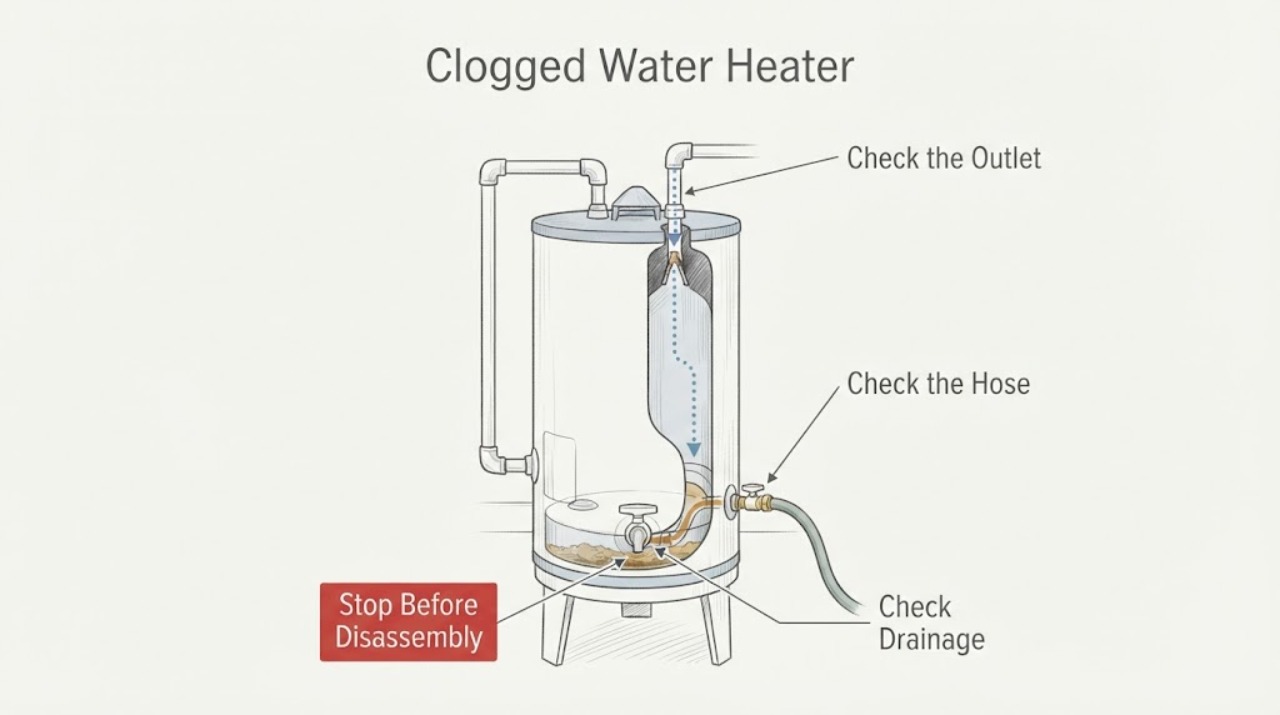
A water heater that seems clogged may have sediment blocking a storage-tank drain valve, a restricted hot-water outlet or shutoff valve, or debris in a tankless inlet filter. First compare hot and cold flow at more than one fixture and look for leaks, hot discharge, or gas or electrical warning signs without opening the heater. If the unit is a storage tank, use only the cooling, isolation, and flushing procedure in its own manual; never force a blocked drain valve. If it is tankless, clean an inlet filter only when the manual identifies it as homeowner-serviceable. No flow from the drain, persistent low hot-water flow, internal scale, or any leak, relief-valve discharge, gas symptom, or electrical symptom calls for qualified plumbing or appliance service.
Work through in order
Diagnostic checks
Use only checks that match the exact appliance or system and its official guide.
-
Check 1
At a sink, briefly compare the hot and cold streams, then check a second hot-water fixture. Note whether the restriction is present only at one outlet or throughout the hot-water side.
Expected result: One faucet or shower is weak while cold flow and another hot fixture are normal, or all hot fixtures are weak while cold flow is normal.
Next step: If isolated, clean or service only that fixture according to its instructions. If all hot fixtures are affected, continue with the heater-type and safety checks below.
Why this matters
Why: A single-fixture result points first to an aerator, shower control, or local mixing valve; a whole-house hot-side restriction makes a heater outlet, shutoff valve, sediment, or plumbing restriction more plausible.
-
Check 2
Without touching hot parts or opening a cover, read the unit label and identify whether the heater stores water in a tank or is tankless. Look only for an obvious kinked drain hose, closed external water valve, moisture, or sediment around accessible connections.
Expected result: The unit is a tank, a tankless model, or the type cannot be identified; an external valve appears closed or the area is wet.
Next step: Follow the model manual for an identified unit. If the type or valve status is unclear, or any connection is wet, stop at external observation and arrange qualified service.
Why this matters
Why: Tank and tankless units use different maintenance paths. A closed supply valve can mimic a clog, while moisture means the priority is leak assessment rather than flushing.
-
Check 3
For a storage tank only, review the owner manual before flushing. If it permits homeowner flushing and the heater can be safely cooled and isolated, use the specified hose and drain path; never force the drain valve or work on a hot tank.
Expected result: Water drains and carries visible sediment before becoming clearer, or little to no water exits after the valve is opened according to the manual.
Next step: If the valve will not drain, stop and have a plumber or service technician clear or replace the valve. If flushing is completed safely, refill and restart only as the model manual directs, then recheck flow for improvement.
Why this matters
Why: Sediment in the discharge supports buildup as a contributor to the restriction. A drain that will not flow can itself be blocked by sediment, and forcing it can create a leak or uncontrolled hot-water release.
-
Check 4
For a tankless model, use the manual to locate any external inlet filter and confirm whether it is listed as homeowner-serviceable. If so, isolate water exactly as instructed before removing it; do not open gas or electrical compartments.
Expected result: The filter contains grit or mineral debris, or the filter is clean but hot-water flow and temperature remain restricted.
Next step: Rinse and reinstall only as the manual directs, then test flow. If restriction remains, or the model has no user-serviceable filter, stop and arrange qualified tankless service or descaling.
Why this matters
Why: Debris at the inlet can reduce flow and performance. A clean filter with ongoing restriction points toward internal scale, a flow sensor, heat exchanger, or another model-specific fault rather than a simple external clog.
-
Check 5
During and after one model-approved maintenance attempt, observe hot-water flow, temperature stability, unusual popping or rumbling, and the floor and fittings for new moisture. Do not test a pressure-relief valve or burner as a casual clog check.
Expected result: Flow improves and remains stable without leakage or unusual operating sounds, or the restriction returns, temperature fluctuates, or new noise or moisture appears.
Next step: Use the heater normally only when it is dry and stable. For recurring restriction, poor heating, noise, or any leak, stop DIY troubleshooting and provide the recorded observations to a qualified technician.
Why this matters
Why: A durable improvement supports accessible sediment or filter debris as the cause. A quick return or added symptoms suggest internal scale, a damaged dip tube, valve restriction, heating fault, or tank deterioration.
-
Check 6
Record the heater type, model identification, affected fixtures, hot-versus-cold flow comparison, visible sediment, whether a drain or inlet filter flowed, and any leak, odor, noise, or temperature change.
Expected result: The pattern is repeatable and either isolated to an accessible fixture, resolved after approved maintenance, or still present with the heater implicated.
Next step: Keep the unit closed and schedule plumbing or appliance service when the heater remains implicated; share the record instead of guessing at a replacement part.
Why this matters
Why: A repeatable record helps service distinguish a local fixture restriction from a clogged drain valve, tankless filter or heat exchanger, hot-water shutoff, or internal tank part.
Use your observations
Decision map
Find the observation that best matches what you see, then follow the next safe action.
-
PATH 01Safety boundary
What you see
Is the low flow limited to one hot-water faucet or shower?
Do this next
Treat the outlet as the first suspect and follow its cleaning or mixing-control instructions; do not flush the heater based on one fixture alone.
Why this path and its safety boundary
Safety stop: If multiple hot fixtures are weak while cold flow is normal, continue with heater type, external valve, and sediment or filter checks.
-
PATH 02Safety boundary
What you see
Is the unit a storage tank rather than tankless?
Do this next
Use the storage-tank manual's cooling, isolation, and flushing procedure; a drain that will not flow is a service trigger.
Why this path and its safety boundary
Safety stop: For tankless equipment, use only the manual's inlet-filter procedure and leave internal descaling or repairs to qualified service.
-
PATH 03Safety boundary
What you see
Does water flow from the storage-tank drain when the exact manual procedure is followed on a cooled unit?
Do this next
Sediment in the discharge supports a flush or sediment-removal path; stop if the water cannot be safely contained or the valve begins leaking.
Why this path and its safety boundary
Safety stop: Do not force the valve or insert tools. Sediment may be blocking the drain, so arrange a plumber or service technician.
-
PATH 04Safety boundary
What you see
Are there warning signs such as an active leak, large hot discharge, gas odor, smoke, sparking, water near electrical equipment, or repeated circuit interruption?
Do this next
Stop using the heater, keep clear of hot or energized components, and contact the appropriate emergency, utility, plumbing, or appliance professional.
Why this path and its safety boundary
Safety stop: Continue only with external observation and the model-approved maintenance branch that matches tank or tankless construction.
Helpful context
Understand the symptom
What clogged can mean
The word clogged does not identify one part. A storage tank can collect mineral sediment at the bottom and restrict its drain valve or water lines. A tankless unit can lose flow when its inlet filter or heat exchanger has debris or scale. A single slow faucet can instead have a local aerator or mixing-control problem, so separate the fixture from the heater before attempting maintenance.
Keep the diagnosis external
Do not remove access panels, burner covers, heating elements, service caps, or plumbing connections just to look for a clog. Hot water can scald, and gas, electrical, pressure-relief, and combustion components need model-specific procedures. Stop immediately for a gas odor, smoke, sparking, a large hot discharge, water near electrical equipment, or an active leak.
Only after diagnosis
Potential parts
- water heater drain valve
Consider this only if a qualified diagnosis confirms the valve is blocked, leaking, or failed after the sediment problem is assessed.
Confirm the exact heater model, valve connection, material, and service requirements before selecting any replacement. - tankless inlet filter
Consider this only when the model manual identifies an inlet filter and inspection shows it is damaged or cannot be cleaned to restore flow.
Match the exact model and manufacturer instructions; do not assume filters are interchangeable.
Common questions
FAQ
Can sediment really clog a water heater drain valve?
Yes. Manufacturer maintenance guidance notes that sediment inside a storage tank can block the drain valve. Do not force the valve; if the tank will not drain under the exact model procedure, use a plumber or service technician.
How do I tell whether the clog is in the water heater or one faucet?
Compare hot and cold flow at one sink, then check another hot fixture. A problem limited to one outlet points toward that faucet, shower control, or mixing valve; weak flow at multiple hot fixtures warrants heater and hot-side plumbing checks.
Does a tankless water heater need a tank flush?
No tank is drained on a tankless unit. Depending on the model, an inlet filter may be cleanable and the heat exchanger may require model-directed descaling. Use the manual or qualified service for that procedure.
When should I stop trying to clear a clogged water heater?
Stop for a blocked drain valve, active leak, relief-valve discharge, gas odor, smoke, sparking, water near electrical parts, repeated circuit interruption, or a restriction that remains after one correct model-approved maintenance attempt. Keep covers and internal parts closed and arrange qualified service.
Read the exact guide
Official sources
- Water Heater Maintenance GuideA. O. Smith · Storage-tank flushing, sediment, blocked drain valves, and tankless versus tank maintenance distinctions.
- Water Heater Maintenance ChecklistA. O. Smith · Leaks, hot discharge, unusual sounds, sediment flushing, tankless descaling, and professional service boundaries.
- How to Flush a Water HeaterA. O. Smith · Tank draining and flushing, the risk of a sediment-blocked drain valve, and the different procedure for tankless descaling.
- How to Keep Your Tank and Tankless Water Heaters Running at Peak PerformanceRheem Manufacturing Company · Tankless inlet-filter debris, heat-exchanger scale, reduced output, fluctuating temperature, noises, and leaks.
- Water Heater Repair: Things to ConsiderA. O. Smith · Separating a single-fixture problem from whole-house hot-side restriction and identifying blocked valves, dip tubes, leaks, and sediment as possible causes.
Community feedback
Share a repair observation
Share a plain-text repair observation. Accepted observations are published automatically; this page may take a moment to update.