
On this page
Start here
Quick answer
First compare one hot fixture with another hot fixture and with cold water. Low flow at only one faucet or shower points to a scaled aerator or showerhead; low flow at every hot outlet but normal cold flow points toward the heater's cold-water inlet path, a restriction, or a mixing/tempering component; low pressure on both hot and cold sides points upstream to a leak, pressure-regulating valve, well or pump, or a utility-side problem. The U.S. EPA says fixtures work best with incoming service pressure of 45–60 psi and that a hose-bibb gauge can check it; a reading much below 45 psi warrants leak investigation and a high reading warrants professional pressure-regulator attention. Check only visible valves, connections, and fixtures. Do not drain or open the heater, disturb the temperature-and-pressure relief valve, test live electrical or gas parts, or continue if there is a leak, steam, scalding discharge, flooding, gas odour, or electrical hazard.
Before you begin
Safety first
- Do not drain the tank, open heater covers, test live electrical or gas components, remove or cap the temperature-and-pressure relief valve, bypass a shutoff, open a pressurized connection, enter a wet mechanical area, or adjust a pressure regulator or well pressure control. Stop immediately for active leakage, steam, scalding discharge, flooding, gas odour, smoke, a damaged tank, or electrical danger.
Work through in order
Diagnostic checks
Use only checks that match the exact appliance or system and its official guide.
-
Check 1
Compare flow at one hot faucet or shower with a second hot outlet and with cold water at the same or nearby fixtures. Record whether the weak flow is limited to one outlet, affects all hot outlets, or affects both hot and cold water throughout the home.
Expected result: Only one outlet is weak; every hot outlet is weak but cold flow is normal; or both hot and cold flow are weak.
Next step: Use the matching local-outlet, hot-only, or whole-home branch below before replacing any heater part.
Stop if: Stop if water is escaping rapidly, the heater is flooding, the T&P discharge is steaming or scalding, a pipe is damaged, or gas/electrical danger is present.
Why this matters
Why: One weak outlet makes a local aerator, showerhead, or faucet restriction more likely. Hot-only weakness keeps the heater inlet/outlet path or a mixing component in scope. Weak hot and cold water points upstream to service pressure, a regulator, leak, well or pump, or a utility-side event rather than proving a tank fault.
-
Check 2
For a one-outlet problem, let the fixture cool enough to handle safely and inspect the visible aerator or showerhead for scale, debris, drips, or a blocked spray pattern. Clean or replace only the accessible outlet component according to its own instructions; do not open the water heater.
Expected result: The weak outlet has visible scale or debris and improves when the outlet restriction is cleared, or it remains weak while other outlets are normal.
Next step: If other hot outlets are normal, keep the heater diagnosis closed and repair or replace the affected fixture component only after confirming its fit. If multiple outlets are weak, continue with the hot-only or whole-home checks.
Stop if: Do not force a stuck fitting, work on a hot pressurized connection, or continue if the fixture or supply connection starts leaking.
Why this matters
Why: EPA identifies scaling or calcium buildup at faucets and showerheads as a restriction that can reduce flow. Improvement after a local clean points away from the heater; no improvement, or a faucet that leaks under the handle or connections, needs fixture-level plumbing service.
-
Check 3
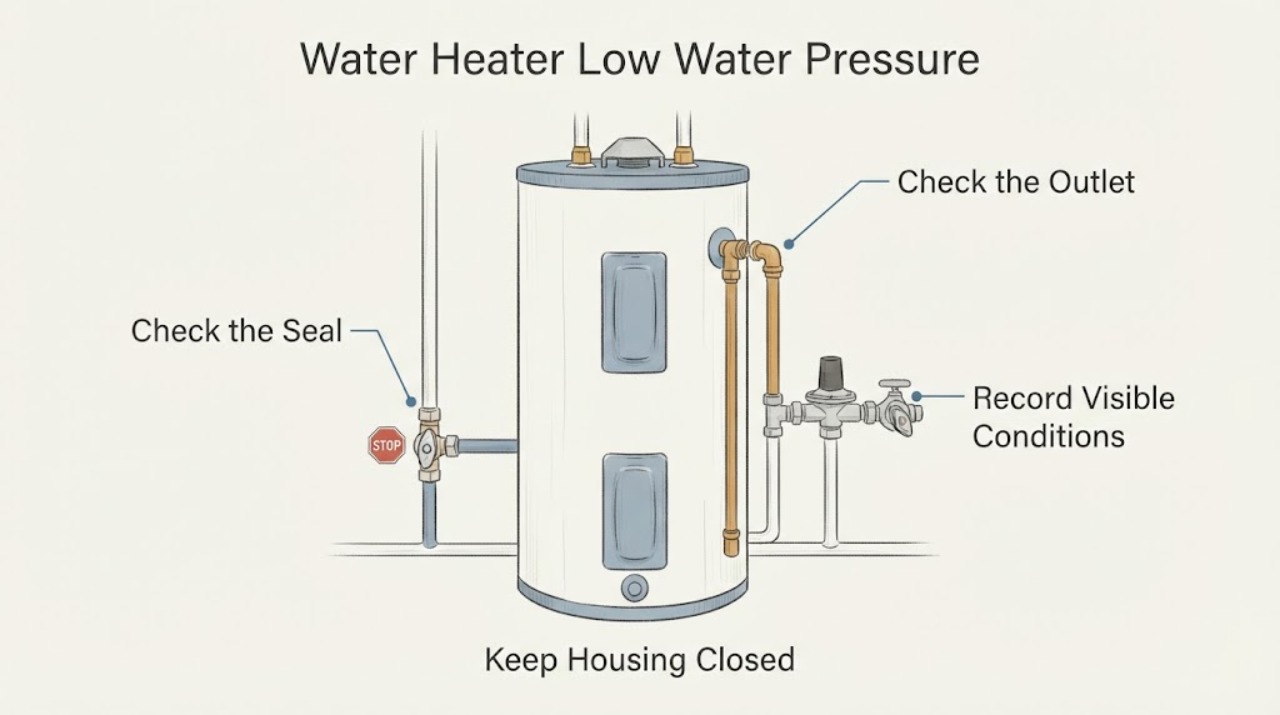
With the heater idle and the area dry, visually trace the cold-water pipe into the heater. Check whether the visible cold-water shutoff is open, whether a flexible connector is sharply kinked, and whether the inlet, outlet, tank base, or nearby connections show moisture, corrosion, or a strained joint. Do not force a stiff valve or remove a fitting.
Expected result: The inlet valve is visibly closed or partly closed, the connector is kinked, or there is a leak/corrosion; alternatively, the accessible inlet path appears open and dry.
Next step: If a valve position is clearly marked and safe to observe, do not force it; have a plumber correct a restriction or leak. If the path is open and dry, record the heater model and symptoms for service instead of opening the unit.
Stop if: Stop immediately for active leakage, a bulging or badly corroded tank, steam, a hot discharge, a wet electrical area, gas odour, or a valve/connection that moves or separates when touched.
Why this matters
Why: A closed or restricted inlet can limit hot-water flow because water cannot pass through the heater at the expected rate. A leak or corrosion is a repair issue, not a reason to keep cycling the heater. If the visible inlet path is open and dry while all hot outlets remain weak, an internal restriction, heat-trap/check component, or mixing/tempering valve requires professional diagnosis.
-
Check 4
If both hot and cold water seem weak, turn off water-using fixtures and, only from a dry safe position, attach a household pressure test gauge to an accessible hose bibb as EPA describes. Open the bibb fully for the reading, then close it and remove the gauge without disturbing plumbing. Do not adjust a pressure regulator based on this test.
Expected result: The static reading is much below 45 psi, within roughly 45–60 psi, or much above 60 psi; the reading also changes unexpectedly while no fixture is using water.
Next step: For low or unstable pressure, check for a visible leak only and arrange a plumber or water utility investigation. For high pressure, arrange professional PRV assessment. If pressure is normal, return to the hot-only branch and have flow under demand tested by a plumber.
Stop if: Do not test a damaged hose bibb, remove a regulator cover, alter its adjustment screw, or continue if the connection leaks or the gauge cannot be attached without force.
Why this matters
Why: EPA says much below 45 psi may require leak investigation and much above the recommended service range may require professional PRV assessment. A changing reading with no use can support a leak or pressure-control problem. A normal static reading with poor flow may indicate a restriction that only appears under demand, so it does not clear the heater or piping.
-
Check 5
For a sudden whole-home loss, note whether neighbors or other fixtures are affected and check the local water utility's outage or boil-water information. If the home is on a well or booster system, record whether its pump or power has recently stopped, but do not open electrical controls or pressure tanks.
Expected result: The problem began after a main break, outage, plumbing work, or pump event; a utility notice is active; or only this home's hot water is affected while the wider supply is normal.
Next step: Follow any current utility advisory and ask the utility when normal pressure and water-use instructions are restored. For an isolated home or persistent hot-only fault, arrange plumbing service and provide the pressure pattern, gauge reading, heater model, and visible findings.
Stop if: Do not drink water contrary to an active utility advisory, enter a wet mechanical area to reset a pump, or work on energized well/booster equipment.
Why this matters
Why: EPA says public distribution systems can lose pressure after main breaks, equipment failures, or power loss, and that a distribution pressure loss can create a contamination concern. A utility-side event should be handled under the utility's notice; an isolated hot-only problem returns the diagnosis to the heater's plumbing path or a mixing component.
Use your observations
Decision map
Find the observation that best matches what you see, then follow the next safe action.
-
PATH 01Next step
What you see
Cold flow and other hot outlets are normal, but one faucet or shower is weak.
Do this next
Inspect the accessible aerator or showerhead for scale or debris and service the fixture if needed. Do not replace the water heater based on a single-outlet symptom.
-
PATH 02Next step
What you see
Multiple hot outlets have low flow while cold flow is normal.
Do this next
Check the visible heater inlet valve, connector, leaks, and corrosion without forcing or dismantling anything. If those checks are normal, arrange a plumber to evaluate an inlet restriction, internal check/heat-trap component, or mixing/tempering valve.
-
PATH 03Next step
What you see
Several fixtures on both sides of the system have low flow.
Do this next
Measure incoming pressure safely at a hose bibb and investigate a leak, PRV, well/booster, or utility-side event. EPA's 45–60 psi range is service-pressure guidance; do not adjust a regulator yourself.
-
PATH 04Next step
What you see
The whole home lost pressure after a main break, equipment/power event, or a utility notice is active.
Do this next
Follow the utility's current water-use or advisory instructions and wait for official restoration guidance. Do not assume flushing or heater replacement fixes a public distribution problem.
-
PATH 05Next step
What you see
There is active water around the tank, a T&P valve discharge, steam/scalding water, a damaged tank, gas odour, smoke, or an electrical hazard.
Do this next
Stop using the heater and keep people away. Shut off water or energy only if the installation provides a clearly accessible control and doing so is safe; otherwise call qualified plumbing and/or electrical help. Never plug or cap the T&P discharge.
Helpful context
Understand the symptom
Low pressure is a pattern, not a heater diagnosis
A water heater normally receives household water pressure; it does not by itself prove that the incoming supply is low. Begin at the outlets. If just one hot tap is weak, the restriction may be at that faucet or showerhead. If every hot outlet is weak while cold water is normal, inspect the heater's visible inlet path and arrange a plumbing diagnosis if the restriction is not obvious. If both hot and cold are weak throughout the home, move upstream to service pressure, a pressure-regulating valve, a leak, a well or booster system, or a public-system event. This pattern prevents a faucet restriction from being mistaken for a tank failure.
Use a pressure reading to separate flow restriction from supply pressure
EPA WaterSense says fixtures operate best with incoming service pressure between 45 and 60 psi and describes checking pressure with a gauge on a hose bibb after turning off water-using fixtures. Treat that range as household guidance, not a license to adjust a regulator or infer a heater-specific setpoint. A low reading with all fixtures off supports an upstream leak or supply investigation; a normal reading with weak hot flow keeps the focus on the hot-water path or outlet restriction. A high reading is a reason for professional pressure-regulator assessment.
Hot water and pressure equipment have a firm stop boundary
A heater contains hot water and may include electrical, gas, and pressure-relief hazards depending on the installation. Bradford White's manual requires the temperature-and-pressure relief arrangement and says not to plug its discharge; it also warns not to operate the heater until it is completely filled. For a low-pressure complaint, stay with cool, visible, user-accessible observations. Do not drain the tank, open covers, remove a relief valve, bypass a shutoff, or change an internal mixing valve unless the exact manual and a qualified professional make that work appropriate.
Only after diagnosis
Potential parts
- faucet aerator or showerhead
Consider this category only when one outlet is weak, scale or debris is visible, and other hot and cold outlets have normal flow.
Confirm the outlet type, thread, size, and fixture instructions before selecting a replacement; a local restriction does not establish a water-heater part fault. - water-heater cold-water shutoff or inlet connector
Consider this category only when a plumber confirms a restricted, damaged, leaking, or kinked accessible inlet component is the cause of hot-only low flow.
Confirm the heater model, pipe material, connection size, local code, and pressure/temperature ratings; do not force or replace a valve on a pressurized hot-water system without qualified guidance. - water-heater mixing or tempering valve
Consider this category only after normal incoming pressure and an open, leak-free inlet are established and a qualified diagnosis identifies a mixing or tempering valve restriction.
Confirm the exact heater and valve arrangement, flow direction, temperature and pressure ratings, and applicable code; low pressure alone does not prove this component failed.
When checks do not resolve it
Need a professional?
Call a plumber when low hot-water flow affects multiple outlets, the visible inlet path is open but the problem persists, pressure is much below or above the household guidance range, or a regulator, well/booster, mixing valve, or internal restriction may be involved. Contact the water utility for sudden whole-home pressure loss or an advisory. Stop immediately for a tank or pipe leak, T&P discharge, steam or scalding water, flooding, gas odour, smoke, or electrical hazard; do not open or drain the heater.
Safety scope: Do not drain the tank, open heater covers, test live electrical or gas components, remove or cap the temperature-and-pressure relief valve, bypass a shutoff, open a pressurized connection, enter a wet mechanical area, or adjust a pressure regulator or well pressure control. Stop immediately for active leakage, steam, scalding discharge, flooding, gas odour, smoke, a damaged tank, or electrical danger.
Common questions
FAQ
Can a water heater itself cause low water pressure?
It can contribute to low hot-water flow when the heater's visible inlet path is restricted or when an internal valve, heat-trap/check component, or mixing valve is obstructed, but a heater symptom does not prove that the home's incoming pressure is low. Compare hot and cold outlets and measure service pressure before choosing a heater part.
Why is cold water pressure normal but hot water pressure low?
That pattern keeps the hot-water path in scope: a partly closed or restricted cold inlet, kinked connector, heater-side restriction, or mixing/tempering component. Check only visible, dry conditions and have a plumber diagnose anything inside the heater or valve assembly.
What water pressure should a home have?
EPA WaterSense says fixtures operate best with incoming service pressure between 45 and 60 psi and describes checking it at a hose bibb with a pressure gauge. A reading much below 45 psi calls for leak or supply investigation; a high reading calls for professional pressure-regulator assessment. Local codes and the home's equipment still control the final decision.
Should I drain the water heater to fix low pressure?
Not as a first troubleshooting step. Draining involves hot water, shutoff and relief considerations, and model-specific procedures; Bradford White warns that the heater must be completely filled before operation and that the T&P discharge must not be plugged. Leave draining and internal service to the exact manual and a qualified professional unless the task is clearly within a safe, model-approved maintenance procedure.
What if the whole house suddenly loses water pressure?
Check for a visible leak only if safe, compare the timing with power, pump, plumbing, or utility work, and review the water utility's notices. EPA explains that public distribution pressure can be lost after main breaks, equipment failures, or power loss and that a pressure loss can create a contamination concern; follow any active advisory rather than treating the water heater as the sole cause.
Read the exact guide
Official sources
- Loss of Pressure in Drinking Water Systems in Wyoming and on Tribal Lands in EPA Region 8U.S. Environmental Protection Agency · Official public-water-system context for a sudden whole-home pressure loss; operator procedures are not presented as homeowner repairs.
- Home MaintenanceU.S. Environmental Protection Agency WaterSense · Official household guidance for distinguishing service-pressure and leak issues from fixture restrictions and for safe water-heater maintenance boundaries.
- ELECTRIC WATER HEATERBradford White · Manufacturer manual used for model-family water-heater safety boundaries: cold-water inlet/shutoff, fill-before-operation, T&P relief protection, hot discharge, and qualified service.
Community feedback
Share a repair observation
Share a plain-text repair observation. Accepted observations are published automatically; this page may take a moment to update.