
On this page
Start here
Quick answer
If a water heater seems to have no water, first distinguish no hot water from no water flow: compare hot and cold flow at more than one faucet. Normal cold flow with no hot water points toward the heater, a hot-side restriction, a mixing valve, or a plumbing leak; low flow from both hot and cold faucets points toward the home's supply or a wider plumbing issue. Check only visible valves, the heater's external status indicator or display, and signs of leaking without opening panels or gas controls. Leave immediately for a gas odor, keep clear of hot discharge or flooding, and arrange qualified plumbing or appliance service when the symptom persists or any hazard is present.
Before you begin
Safety first
- Observation only. No gas-component adjustment, pilot relighting, electrical-panel or access-panel work, live testing, relief-valve operation, tank draining, plumbing disconnection, or diagnosis from a part list.
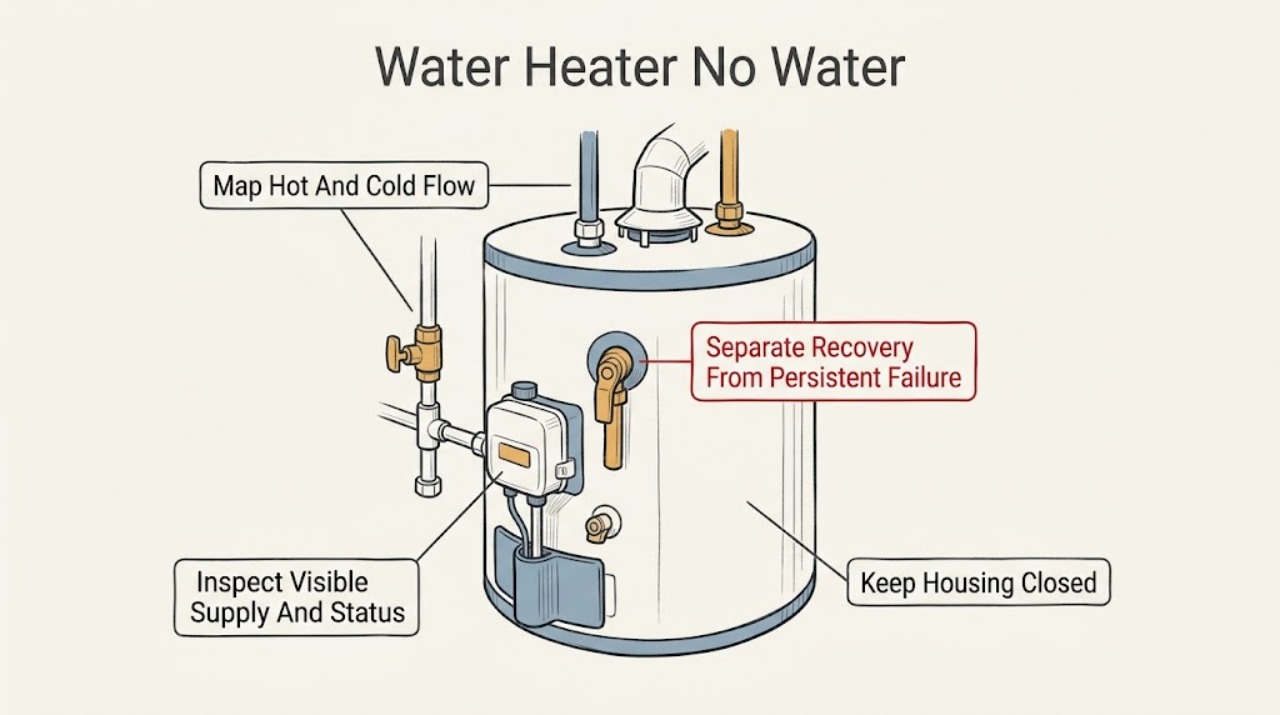
Work through in order
Diagnostic checks
Use only checks that match the exact appliance or system and its official guide.
-
Check 1
At two or more safe-to-reach fixtures, briefly compare the hot and cold taps and note whether water flows normally, weakly, or not at all. Do not run your hand under unexpectedly hot water; use the control and a container only if the fixture is stable and the water can be observed safely.
Expected result: Cold flow is normal but hot flow is absent or weak everywhere; only one fixture has the hot-water symptom; both hot and cold flow are weak; or neither side flows.
Next step: Record which fixtures were tested and follow the matching branch. If all cold fixtures are also dry, check for a building or utility interruption and contact the property manager or water utility as appropriate; do not alter the heater.
Stop if: Stop if water is scalding, discolored with a burning odor, spraying, or entering an electrical area.
Why this matters
Why: Normal cold flow with a whole-home hot-water problem points toward the water heater or hot-side plumbing. A single affected fixture makes its aerator, cartridge, or mixing valve more likely than a failed heater. Low or absent flow on both sides suggests a supply, shutoff, leak, or utility/building issue rather than a heating diagnosis.
-
Check 2
From outside the heater cabinet, look for a clearly labeled cold-water inlet shutoff that is visibly in its normal open position and note any external status light, display, or warning indication. Do not force a handle, remove a cover, reset an unfamiliar control, or touch gas, wiring, or hot venting.
Expected result: The inlet valve appears closed or obstructed; the status indicator is normal; the indicator is absent or showing an unfamiliar pattern; or the heater has no visible status information.
Next step: Photograph the exterior label and status indication, note the heater type if obvious, and use the exact owner manual or arrange qualified service. Do not infer a failed thermostat, element, gas control, or sensor from an indicator alone.
Stop if: Stop for gas odor, a hot surface or vent, damaged wiring, water on controls, smoke, or any need to open the cabinet.
Why this matters
Why: A visibly closed inlet can prevent hot-water delivery, but a stuck or unclear valve should be handled by a professional. On covered gas models, the manufacturer uses the status indication to distinguish normal no-call-for-heat behavior from a missing or different pattern; an unfamiliar pattern is not a basis for a generic reset or repair.
-
Check 3
Ask whether the hot water was recently used up, the home recently lost water, or the heater was recently installed or serviced. Without changing settings, observe whether hot water returns after the recovery interval specified by the exact model manual.
Expected result: Hot water returns after ordinary recovery; it remains absent after the model's stated interval; it returns only briefly; or the symptom began immediately after installation or service.
Next step: Record the use pattern, timing, model identifier, and whether the water was ever warm. If the symptom persists, recurs, or follows service, request a model-specific assessment; do not increase the temperature or open the heater to speed recovery.
Stop if: Stop if the unit overheats, produces smoke or unusual combustion sounds, leaks, or shows any gas or electrical hazard.
Why this matters
Why: A temporary loss after heavy use can be a recovery or capacity situation rather than an immediate part failure. Persistent or brief-return symptoms need diagnosis of the heating system, hot-side plumbing, or demand. A symptom that follows installation raises the importance of checking connections and installation by a qualified person rather than guessing at parts.
-
Check 4
From a dry, stable floor, look around the heater, nearby hot-water piping, drain pan, and the visible end of any discharge pipe for puddles, active dripping, a large flow, or water damage. Keep clear of hot water and do not touch, cap, plug, or operate the temperature-and-pressure relief assembly.
Expected result: The area is dry; there is a small intermittent drip; there is an active or large discharge; or water has reached controls, wiring, flooring, or other property.
Next step: For a dry area, continue documenting the other observations. For any active leak, large discharge, water near controls, or property damage, keep people away and obtain prompt qualified plumbing or appliance service; use a shutoff only if it is clearly labeled, accessible, and safe to operate without approaching hot water or exposed utilities.
Stop if: Stop immediately for spraying water, steam, a rapidly filling pan, water near electrical parts, a hot vent, or unstable flooring.
Why this matters
Why: A hot-side plumbing leak can consume heated water and make the heater seem unable to produce it. A discharge or water around controls can indicate a pressure, temperature, leak, or electrical hazard and cannot be safely classified by appearance alone.
-
Check 5
If you notice a rotten-egg-like gas odor or hear escaping gas near the heater, leave the building or odor area immediately and keep others away. Do not light anything, operate switches or appliance controls, use electrical equipment near the odor, or try to find the leak.
Expected result: There is no gas odor or escaping-gas sound; the odor is present but weak or uncertain; or the odor is strong or the sound of escaping gas is clear.
Next step: From a safe location away from the odor, contact the gas supplier or emergency services and follow their instructions. Do not return or turn gas back on until the responsible utility or responder says it is safe. If there is no odor, continue only with the external, non-invasive checks.
Stop if: Any gas odor, hissing, smoke, flame, or carbon-monoxide alarm ends troubleshooting immediately.
Why this matters
Why: An uncertain or strong gas indication is an emergency-safety condition, not a water-heater troubleshooting branch. The gas supplier or emergency responders must determine when the area is safe; a missing odor does not prove that gas equipment is safe.
-
Check 6
If the heater is electric or its external display is blank, record the symptom and check only that the surrounding area is dry and that no obvious household outage is affecting other fixtures. Do not open panels, remove insulation, perform any energized electrical check, handle breakers as a repair, or reset an unknown high-limit device.
Expected result: Other household power is normal but the heater remains blank; multiple fixtures are without power; water is present near the heater; or there is heat, burning odor, buzzing, or visible damage.
Next step: Leave the heater undisturbed and provide the model, display behavior, outage pattern, photos, and timeline to a qualified plumber or appliance/electrical professional. Do not assume the heating element, thermostat, breaker, or wiring is the failed part.
Stop if: Stop for any exposed conductor, shock or tingle, sparking, smoke, burning odor, repeated tripping, or water near electrical equipment.
Why this matters
Why: A blank heater with normal household power may require model-specific electrical diagnosis, while a wider outage may be upstream. Water, heat, odor, buzzing, or damage raises the urgency and makes energized inspection unsafe.
Use your observations
Decision map
Find the observation that best matches what you see, then follow the next safe action.
-
PATH 01Next step
What you see
Cold water has normal flow at several fixtures, but hot water is absent or weak throughout the home.
Do this next
Use the visible status, recovery, and leak observations, then arrange qualified plumbing or appliance service if hot water does not return or the cause remains unclear.
Why this path and its safety boundary
Why it matters: The water supply is present, so the decision shifts to the water heater, hot-side piping, a mixing valve, a leak, or a model-specific heating fault.
-
PATH 02Next step
What you see
Other fixtures have hot water, but one faucet or shower does not.
Do this next
Leave the heater alone, document the affected fixture and hot/cold comparison, and have a qualified plumber assess that outlet if a simple, model-appropriate external cleaning is not clearly covered by its instructions.
Why this path and its safety boundary
Why it matters: The symptom is localized and a fixture aerator, cartridge, or thermostatic mixing valve is more relevant than replacing the water heater.
-
PATH 03Next step
What you see
Hot and cold flow are both weak or absent at multiple fixtures.
Do this next
Check for a known utility or building interruption without opening plumbing, notify the property manager where applicable, and contact the water utility or plumber when the cause is not clear.
Why this path and its safety boundary
Why it matters: This pattern is more consistent with a supply interruption, building shutoff, leak, or broader plumbing restriction than a water-heating failure.
-
PATH 04Next step
What you see
There is gas odor, escaping gas, smoke, a carbon-monoxide alarm, hot discharge, flooding, water at electrical parts, or an unstable service area.
Do this next
Leave or keep clear as appropriate, avoid switches, flames, controls, and damaged equipment, and contact the relevant emergency utility or qualified professional from a safe location.
Why this path and its safety boundary
Why it matters: The immediate risk is greater than the no-water symptom and cannot be resolved by ordinary homeowner troubleshooting.
-
PATH 05Next step
What you see
Cold flow is normal, no visible hazard is present, and hot water remains absent after the exact model's normal recovery interval or the symptom keeps returning.
Do this next
Schedule qualified plumbing or appliance service and provide the model, heater type, fixture comparison, status indication, recovery history, leak observations, and photos.
Why this path and its safety boundary
Why it matters: A heating, control, hot-side plumbing, or installation fault needs model-specific diagnosis; the symptom does not identify a safe replacement part.
Helpful context
Understand the symptom
“No water” can mean that no water comes from a hot tap, that hot water is not heating, or that flow is weak or absent at every fixture. The first useful observation is the pattern: hot versus cold, one fixture versus the whole home, and a stable symptom versus an active leak or safety event. A faucet or shower mixing valve can limit hot water at one outlet even when the tank contains hot water, so do not diagnose the heater from one tap alone.
These checks are limited to dry, visible observation. Do not remove access covers, test live electrical parts, relight a pilot, adjust gas components, open a relief valve, drain the tank, or disconnect plumbing as part of this guide. Water can scald, a tank can hold pressure, and both gas and electric heaters require model-specific service procedures.
Safety boundary
Stop conditions
- Leave immediately and contact the gas supplier or emergency services from a safe location for a gas odor, hissing, smoke, flame, or carbon-monoxide alarm; do not operate switches or gas controls and do not return until cleared.
- Stop for hot spraying water, a large relief discharge, flooding, water at controls or electrical equipment, burning odor, sparking, shock, exposed wiring, or repeated electrical trips.
- Do not open access panels, test live circuits, relight a pilot, adjust gas components, remove a relief valve, drain the tank, or disconnect plumbing as a homeowner troubleshooting step.
- Do not cap or plug a temperature-and-pressure relief valve or its discharge pipe.
Only after diagnosis
Potential parts
- thermostatic mixing valve or faucet cartridge
Consider this category only when other fixtures have normal hot water and the symptom is isolated to one faucet or shower after a qualified diagnosis.
Confirm the exact fixture or valve model and fit information before ordering; do not infer compatibility from appearance. - water-heater inlet valve or dip tube
Consider this category only when a qualified assessment supports a hot-side delivery or inlet-path fault, especially after installation or connection history is reviewed.
Match the exact water-heater model and connection requirements; internal replacement is professional work. - water-heater heating control or heating element
Consider this category only after qualified testing identifies a heating or control fault; no-hot-water symptoms alone do not identify the failed component.
Confirm model-specific fit, voltage or fuel type, and installation requirements with a qualified professional before ordering.
When checks do not resolve it
Need a professional?
Arrange qualified plumbing or appliance service when the no-hot-water symptom persists or recurs, the fixture comparison points to the heater or hot-side plumbing, a valve or status indication is unclear, or any leak, discharge, combustion, gas, or electrical concern is present.
Safety scope: Observation only. No gas-component adjustment, pilot relighting, electrical-panel or access-panel work, live testing, relief-valve operation, tank draining, plumbing disconnection, or diagnosis from a part list.
Common questions
FAQ
Why should I compare hot and cold water at more than one faucet?
It separates a whole-home hot-water problem from a single-fixture restriction and from a broader supply interruption. Normal cold flow with no hot water points toward the heater or hot-side plumbing; low flow on both sides points elsewhere.
Can I relight the water heater or reset its internal safety control?
Not as a generic troubleshooting step. Fuel type, model, status indications, and safety controls differ, and a gas or electrical fault can create fire, shock, combustion, or scalding hazards. Use the exact manual or arrange qualified service.
What if hot water is missing at only one shower or faucet?
If other fixtures have normal hot water, the local cartridge, aerator, or mixing valve is more relevant than the heater. Document the comparison and have the fixture assessed rather than replacing the heater from one outlet's symptom.
What should I do if I smell gas while checking the heater?
Leave the odor area immediately, keep others away, avoid flames, switches, appliance controls, and electrical equipment near the odor, and contact the gas supplier or emergency services from a safe location. Do not return or restore gas until responders say it is safe.
Read the exact guide
Official sources
- Residential Gas Water Heater Use and Care GuideA. O. Smith · The assigned topic does not specify fuel type; this source is used for the gas-heater branch and for manufacturer-described hot-water delivery symptoms, not as a universal electric-heater procedure.
- Troubleshooting water pressure and flowCity of Portland Water Bureau · Supports distinguishing whole-home no-water or low-flow conditions from normal cold flow with no hot water; it is not a heater repair manual.
- What To Do If You Smell Propane Gas?Connecticut Public Utilities Regulatory Authority · Supports the emergency stop boundary for a gas-fueled water heater when an odor or escaping-gas sound is noticed.
Community feedback
Share a repair observation
Share a plain-text repair observation. Accepted observations are published automatically; this page may take a moment to update.