
On this page
Start here
Quick answer
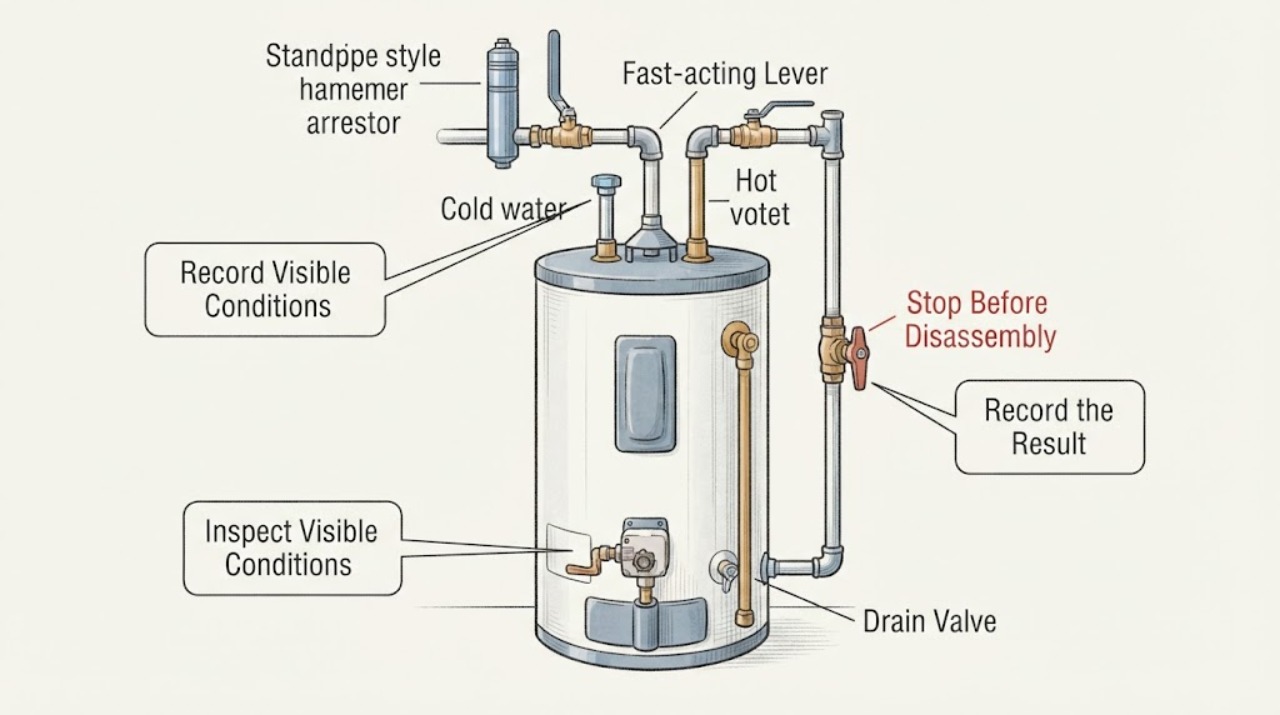
Water hammer is a pressure shock that happens when flowing water stops abruptly; the water heater may be where the bang is heard even when a fast-closing faucet, dishwasher, washing-machine valve, or other fixture is the source. Note exactly when the bang occurs, inspect the heater and nearby piping externally for leaks or movement, and stop if there is damage. A plumber can confirm the source and install a correctly selected water-hammer arrestor as close to that source as local plumbing rules allow; do not open or attempt to recharge an existing arrestor.
Work through in order
Diagnostic checks
Use only checks that match the exact appliance or system and its official guide.
-
Check 1
Record what was operating immediately before the bang: a hot-water tap, single-lever faucet, dishwasher, washing machine, toilet, or another fixture; note whether the sound occurs when the valve opens, closes, or the cycle changes.
Expected result: The bang consistently follows one fast valve closure, or it occurs at several unrelated fixtures and cannot yet be tied to one source.
Next step: Keep a short event log and continue with the safe external inspection; do not deliberately create repeated shocks to test the system.
Stop if: Stop the test if the bang is violent, the piping moves sharply, or a leak appears.
Why this matters
Why: A repeatable link to a quick-closing valve points toward a water-hammer source; an unrepeatable sound needs broader plumbing diagnosis and should not be assigned to the water heater by location alone.
-
Check 2
With the heater untouched and the area dry, look at exposed hot- and cold-water connections and nearby pipework for fresh leaks, unusual movement, or visible deformation; do not remove covers or insulation.
Expected result: The connections and tank appear dry and stable, or there is active leakage, movement, or visible damage.
Next step: If any damage is present, stop using the affected installation as safely as possible and arrange a qualified plumber; otherwise continue to identify the valve source.
Stop if: Stop immediately for a burst connection, uncontrolled water, smoke, scorching, or any suspected gas or electrical hazard.
Why this matters
Why: A stable exterior supports continued source mapping, while leakage or deformation means the surge may already be damaging equipment and needs prompt professional assessment.
-
Check 3
Observe normal use of likely sources one at a time, such as a faucet or appliance cycle, and note whether a slower manual closure changes the sound; do not alter appliance valves or plumbing fittings.
Expected result: The sound follows a particular quick-closing valve, or it remains after that fixture is ruled out.
Next step: Give the plumber the triggering fixture, timing, and whether the sound travels toward the heater; use this evidence to choose arrestor placement.
Stop if: Stop if operation causes leaking, unsafe appliance behavior, strong vibration, or a sudden change in water flow.
Why this matters
Why: The valve that reproduces the event is the likely shock source; if the event remains elsewhere, the source may be another valve or a piping condition requiring a professional survey.
-
Check 4
If an arrestor is visibly installed near the suspected source, photograph its location and model markings without loosening, opening, recharging, or moving it.
Expected result: An arrestor is present close to the source, present far from it, or not visible at all.
Next step: Give the installation details to a plumber for code-compliant assessment; do not treat the arrestor as a user-serviceable tank or valve.
Stop if: Stop if reaching the arrestor requires entering a wet, hot, cramped, or electrically hazardous area.
Why this matters
Why: Presence alone does not prove correct selection, placement, or condition; manufacturer guidance says arrestors work by absorbing the shock and should be close to its source, while some units are factory charged and not repairable.
-
Check 5
Arrange qualified plumbing service when hammer persists, the source is unclear, a connection leaks, or an arrestor or pressure-control change may be needed; provide the event log, photos, fixture source, and heater details.
Expected result: The plumber can reproduce the bang or has enough timing and location evidence to inspect the relevant branch and heater connections.
Next step: Follow the site-specific diagnosis and local code requirements; approve parts only after the plumber confirms the source and the applicable installation method.
Stop if: Stop using the installation if there is uncontrolled leakage, tank deformation, severe vibration, or a suspected gas, electrical, or hot-water hazard.
Why this matters
Why: Source evidence lets the plumber evaluate valve closure, arrestor placement, pressure control, and code requirements without guessing that the water heater itself needs replacement.
Use your observations
Decision map
Find the observation that best matches what you see, then follow the next safe action.
-
PATH 01Next step
What you see
The bang reliably follows a single-lever faucet or an appliance solenoid valve closing.
Do this next
Arrange qualified service and follow the exact model guidance.
Why this path and its safety boundary
Why it matters: Treat that valve or appliance branch as the likely shock source and have a plumber evaluate source-side control and arrestor placement.
-
PATH 02Next step
What you see
The sound is loudest at the water heater but no heater connection damage is visible.
Do this next
Arrange qualified service and follow the exact model guidance.
Why this path and its safety boundary
Why it matters: Do not assume the heater created the hammer; trace the event through connected piping and the fixture that just changed state.
-
PATH 03Next step
What you see
There is active leakage, visible deformation, or abrupt pipe movement during the bang.
Do this next
Arrange qualified service and follow the exact model guidance.
Why this path and its safety boundary
Why it matters: Stop testing and obtain prompt qualified plumbing service; keep clear of hot, electrical, or fuel hazards.
-
PATH 04Next step
What you see
An arrestor is installed but the hammer continues.
Do this next
Arrange qualified service and follow the exact model guidance.
Why this path and its safety boundary
Why it matters: Do not open or recharge it; have a plumber verify that it is appropriate and located close to the actual shock source under local code.
-
PATH 05Next step
What you see
No arrestor is visible and a fast-closing source is confirmed.
Do this next
Arrange qualified service and follow the exact model guidance.
Why this path and its safety boundary
Why it matters: Have a plumber select and install an appropriate arrestor near the source; do not choose a fitting solely by pipe appearance.
-
PATH 06Next step
What you see
The noise cannot be tied to a valve or appliance, or occurs without a clear flow change.
Do this next
Arrange qualified service and follow the exact model guidance.
Why this path and its safety boundary
Why it matters: Stop repeated experiments and arrange plumbing diagnosis because the sound may not be water hammer and the heater should not be condemned by sound alone.
Helpful context
Understand the symptom
Why the water heater may sound guilty
The bang can travel through connected piping, so hearing it at the water heater does not prove the tank itself created the shock. A. O. Smith describes water hammer as a pressure wave created when water is stopped abruptly and identifies quick-closing faucets and appliance solenoid valves as common sources. Track the event to the fixture or appliance that was just turned off before deciding what needs repair.
Use an arrestor only after locating the source
A water-hammer arrestor uses an air chamber to absorb the shock. Manufacturer guidance places it close to the shock source and calls for local plumbing-code review. That makes placement and selection a plumbing diagnosis, not a reason to replace a water-heater part by guesswork. If a persistent bang is accompanied by a leak, movement, or visible tank damage, stop and obtain professional help.
Safety boundary
Stop conditions
- A water connection is leaking, a tank or fitting is visibly deformed, or piping moves violently.
- There is smoke, scorching, a wet electrical area, or a suspected gas or hot-water hazard.
- The source cannot be safely observed without removing covers, entering a hazardous area, or altering plumbing.
- The sound is severe, persistent, or associated with loss of water service or equipment damage.
- A repair would require opening, recharging, or relocating an arrestor or changing pressure-control equipment without a qualified assessment.
Only after diagnosis
Potential parts
Only after a qualified assessment confirms a fast-closing source and selects a code-compliant arrestor and location close to that source.
Only if a plumber measures the installation and determines that pressure control is required for the system and the proposed arrestor under local plumbing rules.
Only when the exact faucet or appliance valve is confirmed as the source and a qualified diagnosis finds the valve itself needs correction or replacement.
When checks do not resolve it
Need a professional?
The bang persists after the likely fast-closing source is identified., The bang is accompanied by leakage, visible deformation, strong vibration, or a damaged connection., The water heater is where the noise is heard but the actual shock source is unclear., An arrestor is present but ineffective, damaged, or not obviously near the shock source., Selecting an arrestor, pressure-control device, or plumbing repair would require local code review or work on hot, fuel, or electrical equipment.
Common questions
FAQ
Why does my water heater bang when water stops?
The water heater may be where the pressure wave is transmitted or heard, while a fast-closing faucet or appliance valve is the actual source. Track which valve changed immediately before the bang.
Will an arrestor fix water heater water hammer?
It can control a confirmed water-hammer source when correctly selected and installed close to that source, but it should not be placed or sized by guesswork. Local plumbing rules apply.
Can I recharge or repair a water-hammer arrestor?
Do not open or recharge one as a homeowner. The Watts installation guidance identifies its listed units as factory charged and not rechargeable or repairable; have a plumber assess a persistent problem.
Should I replace the water heater because of the bang?
Not from the sound alone. First document the trigger and inspect externally for leakage or damage; a plumber should determine whether the issue is a valve, arrestor, pressure condition, piping, or the heater itself.
Read the exact guide
Official sources
- Series 05 and LF05 Water Hammer Arrestors — Installation GuidelinesWatts · Supports source-side placement, local plumbing-code review, and the listed arrestor's factory-charged non-repairable boundary; it is not a universal sizing or installation instruction for every plumbing system.
- Technical Bulletins - Bulletin #11 Water Hammer | A. O. SmithA. O. Smith · Supports the cause-and-control explanation for water hammer in water-heater plumbing; it does not diagnose a particular installation or determine a part fit.
Community feedback
Share a repair observation
Share a plain-text repair observation. Accepted observations are published automatically; this page may take a moment to update.